
Is the Knoxville Metro a Good Place to Live?
You're probably comparing the Knoxville Metro against Greater Nashville or the Chattanooga Area — and the honest answer is that this region sits below both of them on price while offering something neither does quite as well: a manageable, human-scale version of city life with the Smoky Mountains on one edge and a string of TVA lakes on the other. The real tension here isn't between urban and rural. It's between the cities that feel genuinely connected — to downtown Knoxville, to the University of Tennessee, to the federal research presence at Oak Ridge National Laboratory — and the small towns on the outer ring that trade commute time for quieter roads and lower price points. Knowing which side of that divide fits your life is the question this guide is built to answer.
The economic backbone of the Knoxville Metro is unlike almost any other mid-size region in the South. Anderson County's federal research and national security corridor — anchored by Oak Ridge National Laboratory and the Y-12 National Security Complex — draws engineers, physicists and policy professionals from across the country, and those employers shape the character of every community within commuting distance. At the same time, Covenant Health, the University of Tennessee, and a cluster of major manufacturers including Arconic, DENSO Manufacturing Tennessee, and Clayton Homes give the region genuine economic diversity. Knox County Schools and Blount County's districts are the main draws for families settling near the city, while smaller districts in Union, Monroe and Roane Counties suit buyers who are trading proximity for space.
The region sits below Greater Nashville and the Southern Suburbs on price, meaning buyers priced out of those markets often find the Knoxville Metro is where the spreadsheet finally works out. The tradeoff is real, though: the outer towns — Rockwood, Sweetwater, Maynardville — are genuinely affordable precisely because daily errands and most professional services require a drive into a larger center. Closer in, Farragut and Lenoir City carry the region's higher price points in exchange for polished infrastructure and easy interstate access. Knoxville itself lands near the middle of the regional range, and that mid-range positioning makes it the most logical first stop for most buyers who haven't yet pinned down which part of the metro fits them.
Whether you're weighing Farragut's planned neighborhoods against a bungalow in North Knoxville, considering a lakefront lot in Loudon, or trying to figure out whether Clinton or Powell makes more sense for your commute to Oak Ridge, the city blurbs below cover every community in the Knoxville Metro — what kind of place it is, who it typically suits, and what you'd be giving up to live there.
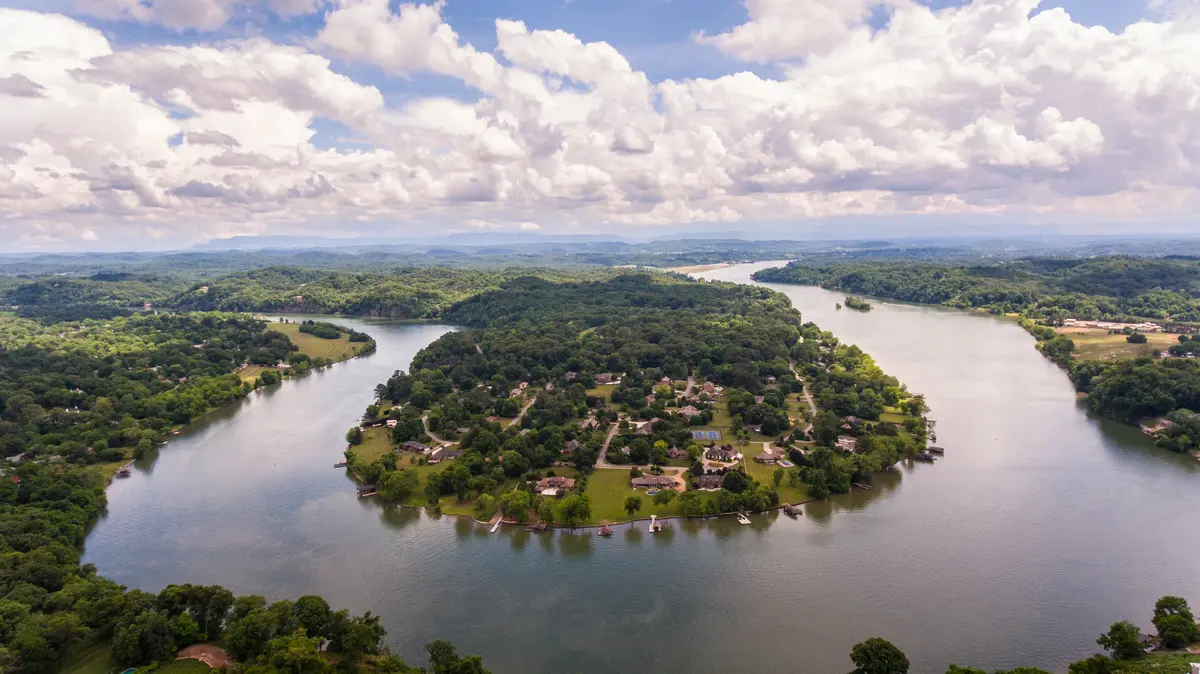
Explore All 14 Cities in the Knoxville Metro
Click into any city for the complete guide — neighborhoods, home prices, cost of living, pros & cons, schools, top employers, and mortgage help.
Knoxville
Knoxville is the region's cultural and commercial center, home to the University of Tennessee campus, Market Square's independent restaurant and bar scene, and major employers like Covenant Health and Tennessee Valley Authority. West Knoxville and Bearden draw families seeking newer construction and strong schools, while Fort Sanders and North Knoxville attract buyers who want walkable streets and older character. Price-wise it lands near the middle of the region — not the entry point, but not the ceiling either, which gives buyers real variety depending on which neighborhood they're targeting.
Full Knoxville Guide →
Oak Ridge
Oak Ridge is unlike anywhere else in Tennessee — a planned federal city that still bears the marks of the Manhattan Project and now operates one of the country's premier scientific research facilities. The American Museum of Science and Energy and the Secret City Commemorative Walk draw visitors, but the day-to-day draw for buyers is a mid-range price point paired with employers of genuine national significance. People move here for careers at Oak Ridge National Laboratory, the Y-12 National Security Complex, or Oak Ridge Associated Universities, and then stay because the city turns out to be more livable and community-minded than its industrial-science identity might suggest.
Full Oak Ridge Guide →
Maryville
Maryville sits at the foot of the Blount County foothills with Maryville College anchoring its historic core and Clayton Homes, DENSO and Arconic providing a manufacturing job base that doesn't require a commute to Knox County. The Greenbelt Park and Greenway give residents a genuine outdoor amenity within city limits, and US-129 connects the city quickly toward the Smokies in one direction and Knoxville in the other. It prices near the middle of the region and tends to draw families who want a smaller-city feel without sacrificing services.
Full Maryville Guide →
Farragut
Farragut is the region's most polished planned community — a Knox County town built largely around Turkey Creek, Farragut High School and a network of neighborhood associations that take subdivision covenants seriously. It sits toward the pricier end of the Knoxville Metro, and buyers choosing it are generally trading price for highly-rated schools, low crime and quick interstate access via I-40 and I-75. If you're relocating from a well-resourced suburb in another state, Farragut is the city in this region that will feel most immediately familiar.
Full Farragut Guide →
Alcoa
Alcoa is a small city in Blount County whose identity has long been shaped by the aluminum manufacturing that gave it its name — Arconic Corporation's operations remain a defining presence — but McGhee Tyson Airport and an Amazon fulfillment center have broadened the employment base considerably. The Bicentennial Greenway and the Alcoa Duck Pond give the city more recreational texture than its industrial reputation implies. Prices land near the middle of the region, and the city's location immediately off Pellissippi Parkway makes it a practical base for buyers who need quick access to both Knoxville and Maryville.
Full Alcoa Guide →
Powell
Powell is a Knox County community that offers a quieter, more spread-out version of suburban Knoxville life — the kind of place where neighbors know each other and the Airplane Filling Station, a vintage roadside icon, still stands as a beloved local landmark. Most residents commute into Knoxville, Oak Ridge or points south, and I-75 and US-25W carry the bulk of that traffic. Prices run near the middle of the region, and Powell tends to attract buyers who want Knox County schools and a modest lifestyle without paying Farragut prices.
Full Powell Guide →
Lenoir City
Lenoir City is a Loudon County town that pairs a walkable historic downtown and a marina district on Fort Loudoun Lake with serious industrial employers like Kimberly-Clark and Hubbell — a combination that makes it feel more economically self-contained than many small cities its size. It prices toward the pricier end of the Knoxville Metro, which reflects both the lakefront access and the I-40 and I-75 interchange that makes the commute to Knoxville straightforward. Buyers here often come specifically for the water — the Fort Loudoun Lake waterfront is a genuine quality-of-life draw, not just a marketing line.
Full Lenoir City Guide →
Clinton
Clinton is the Anderson County seat, a small city with a historically significant downtown — the Green McAdoo Cultural Center and the Ritz Theatre anchor a civic core that punches above the city's modest size — and an automotive manufacturing base anchored by established industrial employers in the region. Prices run near the middle of the regional range, and Clinton suits buyers who want to be within reach of Oak Ridge's research employers without paying Oak Ridge prices. The Clinch River runs through the city and gives it a natural character the surrounding industrial landscape doesn't quite prepare you for.
Full Clinton Guide →
Loudon
Loudon is a small Loudon County town where the Tennessee National and Tellico Village communities have made it one of the region's best-known retirement destinations, and the Fort Loudoun Lake waterfront shapes both the scenery and the lifestyle. It prices toward the pricier end of the region — largely because the lakefront and the planned communities there carry real premiums — and the day-to-day footprint is genuinely small, so buyers who need regular access to professional services or varied retail should factor in the drive. That said, the Loudon Riverwalk and the historic downtown district give it a genuine civic center that purely residential lake towns typically lack.
Full Loudon Guide →
Sweetwater
Sweetwater is among the more affordable communities in the Knoxville Metro, a Monroe County small town with a historic downtown, a dairy farm that draws visitors from across the region, and one of East Tennessee's most unusual attractions — the Lost Sea inside Craighead Caverns, one of the largest underground lakes in the country. The employment picture is thin locally, with most working residents commuting toward Knoxville or Athens, so it suits buyers who work remotely or whose job is already anchored in Monroe County. For buyers whose first priority is price, Sweetwater offers some of the most accessible entry points in the entire region.
Full Sweetwater Guide →
Kingston
Kingston is the Roane County seat, a small town on Watts Bar Lake where the TVA Kingston Fossil Plant has long been the dominant employer and Roane State Community College gives the town a modest educational anchor. Fort Southwest Point, the reconstructed frontier fort at the confluence of the Clinch and Tennessee Rivers, is the kind of local landmark that makes the city more interesting historically than its size might suggest. It prices near the middle of the region, and buyers are usually drawn by the lake access and a quieter pace that Knoxville's inner suburbs can no longer offer at comparable price points.
Full Kingston Guide →
Rockwood
Rockwood is one of the most affordable small towns in the Knoxville Metro, a Roane County community on Watts Bar Lake that has built a small but real manufacturing base around companies like Teijin Carbon America and Protomet — specialized industrial operations that give the local economy more depth than many towns of comparable size. The Rockwood Forest Trails and lake access give outdoor-oriented buyers genuine recreational options close to home, but the honest trade is that daily conveniences require a drive, and the city's amenity set is limited by design and by geography. Buyers who choose Rockwood are almost always prioritizing price and space above everything else.
Full Rockwood Guide →
Madisonville
Madisonville is the Monroe County seat, a small town with a handsome courthouse square and a more diverse local identity than many communities its size — Hiwassee College, Benton's Smoky Mountain Country Hams, and Tsali Notch Vineyard all operate within or very near the city, giving it a combination of agricultural heritage and craft-food culture that draws weekend visitors and new residents alike. The employment base centers on Monroe County government and schools, with many residents commuting toward Knoxville or Athens. Prices sit near the middle of the regional range, which reflects a community that offers genuine character without a premium for proximity to the interstate.
Full Madisonville Guide →
Maynardville
Maynardville is the Union County seat, a small town whose main selling point is honest and geographic: Norris Lake and Big Ridge State Park are right there, and for buyers whose idea of a weekend is a boat on a clear-water reservoir surrounded by ridgeline, this is the most direct address in the Knoxville Metro. The trade is equally honest — Union County has a thin local job market beyond the school district and county government, so most working residents drive toward Knoxville or Oak Ridge, and the town itself offers limited services. Prices run near the middle of the regional range, though lakefront lots and marina-adjacent properties carry real premiums that can push well above it.
Full Maynardville Guide →Compare Every City in Knoxville Metro
Full ranked breakdowns across every city in the region — scored and compared side by side.
Local Expert Takeaway: The Knoxville Metro rewards buyers who research the specific city rather than the region — because the difference between Farragut and Rockwood, or between Oak Ridge and Maynardville, is not a matter of degree but of fundamentally different ways of living.
Frequently Asked Questions
Which city in the Knoxville Metro is best for families with school-age children?
Is the Knoxville Metro affordable compared to other parts of Tennessee?
What's the job market like in the Knoxville Metro — do I need to work in Knoxville itself?
Which cities are best for people who want lake access or outdoor recreation close to home?
What surprises people most about the Knoxville Metro after they've actually moved here?
Helpful Tennessee Resources
Explore Other Tennessee Regions
the Knoxville Metro is one of 10 distinct regions that make up Tennessee. Each has its own climate, character, and housing market — explore them all.

The state capital and the ring of towns north and west of it, from riverfront suburbs to farm country an hour out. 16 cities including Nashville, Clarksville, Hendersonville.
Explore all 16 Greater Nashville cities →
Nashville’s southern growth corridor — historic town squares, newer subdivisions, and some of the priciest addresses in the state. 11 cities including Murfreesboro, Franklin, Smyrna.
Explore all 11 Southern Suburbs cities →
The Mississippi River city and its eastern suburbs, where the metro thins into Fayette and Tipton county farmland. 11 cities including Memphis, Bartlett, Collierville.
Explore all 11 Greater Memphis cities →
A riverfront downtown ringed by ridges and mountain towns, at the point where Tennessee meets Georgia and Alabama. 12 cities including Chattanooga, Cleveland, East Ridge.
Explore all 12 Chattanooga Area cities →
Three cities that function as one metro in the far northeast corner, surrounded by the oldest towns in the state and the high Appalachians. 8 cities including Johnson City, Kingsport, Bristol.
Explore all 8 Tri-Cities cities →
West Tennessee away from Memphis — a regional hub city, college towns, and river and lake country up against the Mississippi. 9 cities including Jackson, Dyersburg, Martin.
Explore all 9 Jackson & Northwest Tennessee cities →
County-seat towns between Nashville and the Alabama line, with walking-horse farms, lakes and a long manufacturing tradition. 7 cities including Shelbyville, Tullahoma, Manchester.
Explore all 7 Southern Middle Tennessee cities →
The plateau and highland rim between Nashville and Knoxville — waterfalls, lakes and a university town, at the lowest prices in Middle Tennessee. 6 cities including Cookeville, McMinnville, Crossville.
Explore all 6 Upper Cumberland cities →
The gateway towns to Great Smoky Mountains National Park, and the lake country just north of them. 6 cities including Morristown, Sevierville, Seymour.
Explore all 6 Smokies & Lakeway cities →Moving to Tennessee?
Tell us what you need help with and we'll connect you with local resources.
