
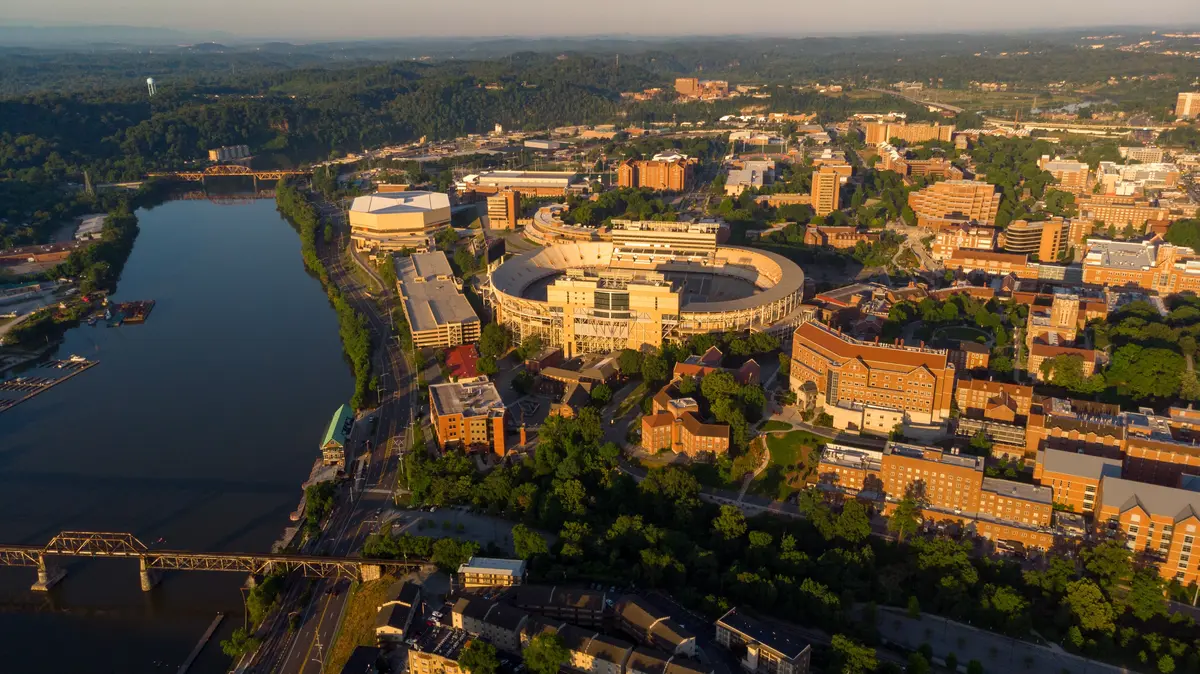
You've done the math on California, and the math stopped working. Maybe it was a routine renewal that jumped your rent past anything you could justify, or a property tax bill on a house you bought a decade ago that still felt like a gut punch. Most Californians who move to Knoxville don't arrive on a whim — they arrive after a spreadsheet made the case so clearly there wasn't much left to argue. What the spreadsheet doesn't tell you is what the city actually feels like: a genuine college town anchored by the University of Tennessee, ringed by the Appalachian foothills, with Neyland Stadium casting a long orange shadow over the entire fall calendar. Knoxville sits at the crossroads of I-40 and I-75 in east Tennessee, giving it unusual regional reach for a city of 202,021 — Nashville, Charlotte, and Atlanta are all driveable in an afternoon.
The economic backbone here is more diverse than most outsiders expect. Covenant Health anchors the healthcare employment picture, the University of Tennessee Knoxville drives research, arts, and a constant population of students and faculty, and Oak Ridge National Laboratory — about 25 miles west — pulls a significant share of the science and engineering workforce. The Tennessee Valley Authority, one of the country's largest public power companies, is headquartered here as well. Knox County Schools, with 58,329 students enrolled in 2024-25, is the region's largest single employer in public education. The result is a job base that skews toward research, energy, and education rather than the tech-and-finance concentration you'd find in coastal California — a real distinction for anyone weighing a career move alongside a lifestyle one.
The cost gap between California and Knoxville is substantial and immediate. The typical home price here stands at $370,699 (August 2026 Zillow Home Value Index) — see the full breakdown on the cost of living page — and the overall cost of living runs roughly 14% below the national average, with housing costs nearly 23% below it. The city has 204 sunny days a year, a lively stretch of independent coffee shops and restaurants around Market Square, and genuine outdoor access through the Urban Wilderness trail system and Ijams Nature Center. The tradeoff against California isn't weather uniformity — summers here are hot and humid in a way coastal Californians genuinely underestimate — it's that you get a city that costs a fraction as much while still having real cultural infrastructure.
Whether you're already committed or still running scenarios, the sections below break down the tax picture, the home price comparison, what the climate adjustment actually looks like, how the job market lines up, and what daily life in Knoxville is really like for someone arriving from California.

The Tax Advantage Is Real — and More Complicated Than It Looks
The headline is accurate: Tennessee levies zero state income tax on wages, salaries, or investment income. The Hall Tax on dividends and interest was fully phased out by 2021, leaving nothing. For high earners who were paying into California's upper brackets, the savings are immediate and substantial. For middle-income households, the income-tax savings are real but partially offset by higher sales taxes on purchases — the net benefit is genuine but smaller than the top-line comparison suggests.
That recurring income-tax savings still matters meaningfully for most households. For a two-income household earning well into the six figures, the income tax delta alone can cover a car note or a year of college tuition. Tennessee also levies no state estate or inheritance tax, and Social Security, pension, and IRA or 401(k) withdrawals face no Tennessee tax at all — which matters significantly for Californians moving in retirement or approaching it.
The honest counterpoint is sales tax. Knoxville's combined rate is 9.25% — a 7% Tennessee state base plus a 2.25% Knox County add-on — which is higher than California's statewide base sales tax rate of 7.25% (California Dept. of Tax and Fee Administration). When you account for local additions that stack on top of California's base, the two states' final rates are often closer than the income tax gap suggests. Tennessee does apply a reduced 4% rate on groceries, which meaningfully softens everyday household costs.
Property tax is where Californians feel the sharpest relief. Knoxville's effective property tax rate sits at 0.39%, compared to California's effective property tax rate of 0.71% (Tax Foundation). On a home near Knoxville's typical price point, that gap translates into a noticeably lower annual bill — and unlike California's Proposition 13 system, you won't find a structure here that makes moving itself a tax penalty.
| Tax Type | Knoxville / Tennessee | California |
|---|---|---|
| State income tax | 0% | Graduated brackets up to 13.3%; income-tax savings favor higher earners most |
| Effective property tax rate | 0.39% | 0.71% (Tax Foundation) |
| Combined sales tax (city level) | 9.25% (4% on groceries) | 7.25% state base plus local additions |
| Estate / inheritance tax | None | None at state level |
| Tax on retirement income | None (SS, pension, IRA/401k) | Taxed as ordinary income |
| Income tax on dividends/interest | None (Hall Tax eliminated 2021) | Taxed as ordinary income |
The picture favors Tennessee clearly for income, retirement income, and property tax. The catch is that higher sales tax takes a larger share of every purchase — and Tennessee's sales tax structure means you feel it on appliances, furniture, and vehicles in a way that Californians don't always anticipate when they run the initial comparison.
Home Prices: What Your California Equity Actually Buys Here
The most common thing Californians say after closing in Knoxville is that they felt like they were getting away with something. Knoxville's typical home price is $370,699 as of August 2026 (Zillow Home Value Index). California's statewide typical home value of $764,158 (Zillow Home Value Index) is more than double that figure — and that's the statewide average, not a coastal premium market.
What that gap means in practice: equity from a California sale frequently arrives in Knoxville as a cash offer or a very large down payment. Buyers who spent years in the Bay Area or Southern California sometimes find themselves owning outright or carrying a mortgage that feels almost theoretical compared to what they left. That dynamic has made California equity buyers a visible presence in the Knoxville market, particularly in neighborhoods like Fort Sanders and the areas around Downtown Knoxville, where prices run above the city median.
The geographic spread matters. North Knoxville and South Knoxville both sit below the city-wide typical price — they're where entry-level buyers and investors tend to concentrate, with older housing stock and real upside as both neighborhoods continue to attract younger buyers and renovation activity. The areas around Bearden and West Knoxville attract families with school-age children and offer larger lots and newer construction, though buyers should get a local agent's read on current comparable sales before anchoring to any specific number.
For renters making the transition, the city-wide typical rent is $1,712 per month as of August 2026 (Zillow). Knoxville rent runs well below Los Angeles levels overall — a compression that makes renting here while you search for a home a genuinely reasonable strategy, rather than the expensive holding pattern it becomes in most California markets.
One honest note on affordability: Knoxville's median household income of $50,994 sits below what's needed to carry the typical home price here without strain. That gap is smaller than in California, where it's a chasm, but it exists — and it shapes the buyer pool. California equity buyers, remote workers with California-scale salaries, and dual-income households with professional earnings will find this market comfortable. Local wage earners are often priced toward the city's lower-tier neighborhoods or rentals. For more detail on neighborhoods and what distinguishes them, see the best neighborhoods page.
Climate: The Adjustment Californians Underestimate Most
Nobody warns you about August in Knoxville. Summers here are legitimately hot and humid — highs reach roughly 88–89°F in July and August, with relative humidity peaking near 76%. If you're arriving from coastal California, where summer often means mild, dry afternoons, this feels like a different planet. Californians from the Central Valley or Inland Empire adapt faster; Californians from San Francisco or Santa Barbara frequently do not.
The bigger structural shift is rain. Knoxville receives roughly 52 inches of rainfall annually, spread across all four seasons. California's Mediterranean pattern — essentially no rain from May through September — means most Californians have spent years without owning a good rain jacket or thinking much about drainage. In Knoxville, you will need both. The upside is that the hills stay genuinely green, the Tennessee River runs full, and the landscape around the Urban Wilderness trail system is lush in a way that desert-adjusted Californians find striking.
Winters are real but manageable. January lows run around 29–31°F, and Knoxville sees occasional light snowfall — typically a few inches in any given winter — that shuts things down briefly and then melts. This is not a Minnesota winter, but it is not coastal California either. The city sees 204 sunny days a year, which is noticeably fewer than most of California's sun totals, but more than most people picture when they hear "Tennessee."
The seasonal rhythm is one of the things Californians come to appreciate most after the first year. Fall in East Tennessee is visually dramatic in a way the state markets heavily and still undersells — the Appalachian ridgelines surrounding Knoxville turn color in a genuine spectacle that draws people to places like House Mountain State Natural Area. Spring comes early by mid-Atlantic standards. The four-season calendar feels like something you've been missing without knowing it, until you're in it.
What Longtime Californians Say After Six Months
The humidity is the recurring surprise. Not the concept of it, but the texture of it — stepping outside at 7 a.m. in July and feeling like you walked into a warm wet towel. Most people adapt within a summer or two. The other consistent observation is the darkness: fewer sunny days and more overcast stretches in December and January than the move felt like it promised. Both are real, and both are worth naming before you arrive.
Looking to buy in Knoxville? Estimate your payment.
Enter your numbers to see an estimated monthly mortgage payment.
Estimate only. Excludes HOA fees and mortgage insurance. The interest rate above is a starting point, not a quoted rate — replace it with your own to see real numbers. Insurance is a flat placeholder, not a Knoxville quote.
Beyond the Monthly Mortgage Payment — What to Factor In
- The property tax rate above — The 0.39% used in the estimate is the median effective rate — tax actually paid as a share of market value — published by Ownwell, 2026. Half of local homes pay more and half pay less: your own bill depends on that property's assessed value and any exemptions it qualifies for, which can differ a lot from its market price. Confirm with the Knox County assessor before you budget.
- Total cost of ownership — Your monthly mortgage payment is just the baseline. Depending on the specific city, county, and service district, homeownership costs also include local utility fees, municipal surcharges, and special assessments (such as water, sewer, storm drainage, or local energy taxes) that vary by location.
- Independent due diligence — Because these recurring local costs and municipal fees change depending on the exact property address, buyers must research them independently during their transaction process.
Tax laws, local municipal fees, and utility costs change frequently and individual situations vary. This page is general information, not tax or legal advice — always consult a qualified tax professional, CPA, or local municipal offices for personalized guidance.
Jobs, Economy, and Working in Knoxville
Knoxville's economy is anchored by institutions rather than by the startup-and-venture ecosystem many Californians are accustomed to. Covenant Health, the University of Tennessee Knoxville, Oak Ridge National Laboratory, and the Tennessee Valley Authority form the core — collectively drawing scientists, researchers, educators, and administrators at a scale that gives the metro real employment density in professional services. The Knoxville MSA recorded total employment of 456,158 as of Q2 2025, with the professional, scientific, and technical services sector representing a higher share of the regional workforce than either state or national averages.
Knox County's unemployment rate stood at 2.7% in December 2025, below both the metro rate and Tennessee's statewide figure. That is a tight labor market by any measure, and it reflects a region that has absorbed significant in-migration without a corresponding spike in joblessness. The regional economy has grown steadily rather than dramatically — a pattern that tends to produce stability rather than boom-and-bust cycles.
For Californians relocating with remote work intact, Knoxville is straightforwardly excellent: your California salary against Tennessee's cost structure is an immediate and dramatic lifestyle upgrade. The internet infrastructure in most established neighborhoods is solid, and the time zone shift to Eastern puts you squarely aligned with major financial and media markets. The challenge comes if you need to find comparable work locally. Technology sector jobs exist — particularly in the orbit of Oak Ridge's research programs and UT's engineering programs — but the sheer density of high-paying tech roles that California coastal markets generate is not replicated here. Salaries in most local professional roles run noticeably below California equivalents. If the plan is to convert to a local salary upon arrival, build that expectation into your budget before you move. For a fuller picture of the employment landscape, see the Knoxville overview page.
One sector worth flagging for California transplants: the Knoxville area's energy economy runs deeper than most newcomers realize. TVA's presence here is not just a headquarters — it shapes contracting, engineering, and environmental consulting work throughout the region in a way that creates real professional opportunities for people with energy or utilities backgrounds.
Daily Life, Culture, and What Knoxville Actually Feels Like
Knoxville is a college town in the most literal sense — the University of Tennessee's 47,000-student campus blends directly into the city, and the line between student life and civic life is genuinely porous. Market Square sits at the city's social center, anchored by the Market Square Farmers Market in season and ringed by the kind of independent dining and music scene that most cities this size don't sustain. The Tennessee Theatre anchors the arts calendar. The Knoxville Museum of Art and the World's Fair Park are genuine civic assets, not afterthoughts.
Californians consistently notice the pace. Knoxville is not slow, exactly, but it is unhurried — traffic during a Tennessee football weekend is its own category of gridlock, but ordinary weekday life in most of the city moves at a tempo that feels generous compared to the I-405 or Highway 101. The social culture is more openly neighborly than what most Californians are used to; people wave, people talk, and the assumption of goodwill in everyday transactions is noticeably present.
Weekends and Local Favorites
The outdoor access is real and immediate. Ijams Nature Center and the Urban Wilderness trail system give you legitimate hiking and mountain biking inside the city limits — not a two-hour drive to get into nature, but a short one. House Mountain State Natural Area is a short drive for longer ridge walks. Melton Hill Lake draws people for fishing and time on the water. For families with school-age children, this concentration of accessible outdoor space is one of Knoxville's strongest cards.
When it comes to food and coffee, the local independent scene holds its own. Wild Love Bakehouse, Remedy Coffee, Coffee and Chocolate - Downtown, Old City Java, and Awaken Coffee each have their own character and their own regulars — the kind of places where the barista knows your order by your third visit. For dining, Calhoun's On The River has been a Knoxville institution for decades, Stock & Barrel draws the downtown crowd for burgers and whiskey, Tupelo Honey Southern Kitchen & Bar brings a polished take on Southern cooking, Connors Steak & Seafood handles the upscale end of the dinner calendar, and Lakeside Tavern offers a more casual, waterside experience. The Dixie Lee Farmers Market rounds out the local food picture for anyone who wants to cook at home with regional produce.
The honest friction point for many California arrivals is cultural rather than logistical. Knoxville is a Southern city with strong religious and conservative traditions that sit differently than anything most Californians have lived inside. This is not a dealbreaker for most people who move here — and many actively welcome the shift — but it is a genuine adjustment, not a detail to skip over. The city is more politically diverse than its state reputation suggests, particularly in Fort Sanders and around the university, but the broader regional culture is meaningfully different from the California context most transplants are leaving. Most people who stay past the first year say the community warmth outweighs any friction. People who leave usually cite the cultural distance more than anything else.
For school families, Knox County Schools holds a B+ rating, according to Niche, and on 2025-26 state assessments, 42.6% of students reached math proficiency and 46.4% reached reading proficiency. The district is large — 58,329 students enrolled in 2024-25 — with considerable variation by school. The schools page has the full breakdown, including which neighborhoods feed into which campuses.
Healthcare costs run noticeably below what you were paying in California, though you may drive farther for specialist care depending on your specific needs — routine care is well distributed across the metro, and advanced treatment options exist in the region. See the retiring page for a fuller look at healthcare options.

Local Expert Takeaway: California equity buyers often arrive in Knoxville expecting a compromise and leave the closing table surprised. A typical home at $370,699 (August 2026), zero state income tax, and a thriving outdoor and food scene centered on Market Square and the Urban Wilderness trail system add up to something that doesn't feel like settling. The real adjustments are climate — August humidity is not optional — and a Southern cultural cadence that takes most transplants a full year to fully inhabit. Give it that year before you decide how you feel.
Quick Takeaways & FAQs
✅ Tennessee levies zero state income tax, putting Knoxville's total tax burden well below what most California households were carrying.
⚠️ Summers are genuinely hot and humid — July highs near 89°F with 76% humidity — a climate adjustment that catches many California transplants off guard.
📍 The Market Square Farmers Market, Ijams Nature Center, and the Urban Wilderness trail system give Knoxville an outdoor and community culture that punches above its size.
How much cheaper is it to buy a home in Knoxville compared to California?
Does Tennessee really have no state income tax?
What is the biggest lifestyle adjustment for Californians moving to Knoxville?
Is remote work from Knoxville practical if I'm keeping a California job?
How are the schools in Knoxville for families moving from California?
Moving to Tennessee?
Tell us what you need help with and we'll connect you with local resources.
