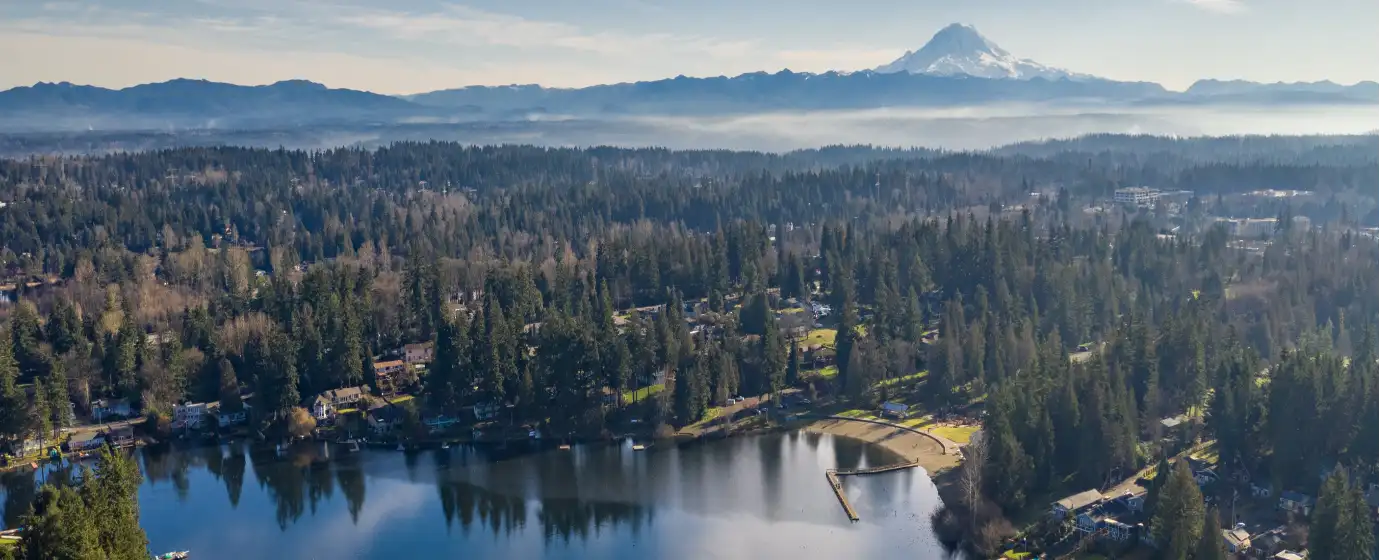
What Is Living in Federal Way, Washington Like?
Maybe you've been priced out of Seattle and someone mentioned Federal Way. Maybe your employer is on I-5 somewhere between downtown and Tacoma and you're trying to find the geographic middle. Either way, you've landed on a city that most outsiders underestimate. Federal Way sits at Interstate 5 exit 320, roughly 26 miles south of Seattle and just 9 miles north of Seattle-Tacoma International Airport — a position that sounds like a commuter compromise but has become something more interesting since December 2025, when Sound Transit's 1 Line light rail opened at Federal Way Downtown station. For the first time, you can leave your car in one of 1,524 park-and-ride spaces and reach SeaTac in approximately 18 minutes or downtown Seattle in approximately 46 minutes.
The economic backbone here is more varied than the suburban strip-mall exterior suggests. Weyerhaeuser, one of the world's largest forest products companies, has its global headquarters in Federal Way. World Vision U.S., a major international humanitarian nonprofit, operates its American headquarters here as well. Federal Way Public Schools employs thousands, Amazon runs logistics operations in the area, and Totem Ocean Trailer Express anchors the shipping and freight sector locally. That mix — corporate HQ, nonprofit sector, education, logistics — draws a genuinely wide range of households. Federal Way is also one of Washington's most ethnically diverse cities, with established Korean-American, East African, and Pacific Islander communities that have shaped everything from the restaurant scene along Pacific Highway South to the makeup of the school district.
On cost, Federal Way's typical home value sits at $564,681 (Zillow Home Value Index, June 2026) — meaningfully below what you'd pay in Seattle proper, and noticeably below Bellevue or Kirkland, while still inside the King County metro that employers and amenities share. Day-to-day life runs along a few main corridors, with Dash Point State Park offering saltwater access to the sound, the Rhododendron Species Botanical Garden and Pacific Bonsai Museum providing genuinely world-class horticultural stops, and PowellsWood Garden rounding out a green-space portfolio that surprises newcomers. The Federal Way Performing Arts & Event Center, opened in 2017, anchors a City Center that the city is actively redeveloping around the new light rail station.
Whether you're seriously considering a move or still in the research phase, the sections below break down Federal Way's job market and commute reality, what daily life actually feels like, the current housing market, and the local spots and weekend draws that make the city more than a waypoint on I-5.
Federal Way at a Glance
Looking to buy in Federal Way? Estimate your payment.
Enter your numbers to see an estimated monthly mortgage payment.
Estimate only. Excludes HOA fees and mortgage insurance. The interest rate above is a starting point, not a quoted rate — replace it with your own to see real numbers. Insurance is a flat placeholder, not a Federal Way quote.
Why Are People Moving to Federal Way?
The Price-and-Access Equation
The simplest version of the Federal Way pitch: King County address, King County school district, light rail to Seattle — at a home price well below what most of the county charges. That combination didn't exist until December 2025, when the 1 Line extension opened. Now the calculus has shifted enough that people who dismissed Federal Way three years ago are looking again.
The households moving in tend to fall into recognizable patterns. Families with school-age children who work in Seattle or at SeaTac find the commute math workable. Workers at Weyerhaeuser's campus or World Vision's headquarters want to live close to where they work rather than commuting in from Renton or Auburn. Logistics and freight professionals tied to the south sound shipping corridor find Federal Way's I-5 position genuinely central. And buyers who've watched Seattle-adjacent prices climb for a decade are arriving here as a deliberate choice, not a fallback.
Diversity as a Lived Fact, Not a Talking Point
Federal Way's Korean-American, East African, and Pacific Islander communities aren't a demographic footnote — they've shaped the actual texture of the city. Pacific Highway South hosts a stretch of Korean-owned businesses and restaurants that locals treat as a reliable weeknight destination. East African community organizations are active and visible. That diversity runs through the school district's enrollment, the city's faith communities, and the small-business ecosystem that added a notable wave of new restaurant openings in 2025 — part of why Federal Way held more than 5,000 active business licenses as of early 2026.
A City Mid-Transformation
Federal Way is genuinely in motion right now, and that carries both opportunity and uncertainty. The city formed a Tax Increment Area (TIA) in 2024 to fund downtown infrastructure tied to the light rail station. Sound Transit is partnering with the city on roughly six acres of transit-oriented development adjacent to Federal Way Downtown station, including approximately 230 affordable housing units across two buildings announced in late 2025. Trent Development has plans for up to 1,600 new apartments north of the station parking garage, with construction phased between 2027 and 2042.
The redevelopment vision centers on Town Square Park, the Town Center Steps, and the Federal Way Performing Arts & Event Center as civic anchors. That's the aspiration. The honest version is that City Center still feels more like a work-in-progress than a destination — but the infrastructure investment is real, and buyers who get in now are making a bet on what it becomes rather than what it is today.
| Who It Suits | Why Federal Way Works | The Catch |
|---|---|---|
| Commuter Seattle workers | Light rail to downtown Seattle in ~46 min, large park-and-ride | Train adds time vs. off-peak drive on a good day |
| Families with school-age kids | King County schools, lower home prices than north-of-SeaTac cities; Federal Way Public Schools holds a B- rating, according to Niche | Some boundary quirks worth researching before choosing a neighborhood |
| Tech / corporate HQ workers | Weyerhaeuser and World Vision headquarters are in-city | Not a tech-campus cluster — most tech jobs still require a commute |
| Nature seekers | Dash Point State Park, West Hylebos Wetlands, sound access | Best nature spots require a short drive from City Center |
| First-time buyers | Entry point well below Seattle and most of the Eastside | Property crime rate is higher than nearby suburban alternatives |
| Transit riders | 16 bus routes connect to Federal Way Downtown station | Car-free living is possible but still requires planning |
What Daily Life Feels Like in Federal Way
The Geographic Reality
Federal Way doesn't have one center of gravity — it has several. Pacific Highway South (also called Pacific Hwy S or Highway 99) is the commercial spine: strip malls, international restaurants, auto shops, and the kind of sprawling retail corridor that functions well if you drive everywhere and rewards patience if you don't. Interstate 5 runs parallel a mile or two east, and the area between the two highways is where most of the residential density sits.
West of Pacific Hwy S, the character shifts. Neighborhoods like Twin Lakes and Dash Point push toward the water, with tree cover, quieter streets, and views that remind you you're on the Puget Sound. The difference between living near the water's edge and living near the I-5 commercial corridor is significant — more significant than the map makes it look.
What Locals Know
After six months here, the thing that surprises newcomers most isn't traffic or weather — it's how self-contained Federal Way actually is. The Rhododendron Species Botanical Garden and Pacific Bonsai Museum sit side by side off 348th Street and draw visitors from across the Pacific Northwest, but residents often walk in on a Tuesday afternoon with the place nearly to themselves. PowellsWood Garden, tucked into a residential neighborhood, is genuinely one of the most beautiful private gardens open to the public in Washington state.
Cafe Spot on Pacific Hwy S has become a neighborhood anchor — the kind of low-key café where regulars have a usual order and newcomers figure out quickly why people come back. Jack's BBQ on Pacific Hwy S opened in 2025 and has earned a following for its smoked meats among residents who previously drove to Seattle for this category of food. The wave of new restaurant openings in 2025 has made the dining scene more interesting than Federal Way's reputation suggests.
The Seasonal Reality Nobody Mentions
Winters here are genuinely grey — not dramatic Pacific Northwest mountain grey, just persistent overcast from November through February that some transplants from sunnier climates find harder than expected. Summer, on the other hand, is exceptional: mild temperatures, long daylight hours, and the sound access at Dash Point means you can swim in the Puget Sound on a July afternoon without driving an hour.
Wild Waves Theme & Water Park has been a Federal Way landmark since 1977, but Premier Parks has announced it will close permanently on November 1, 2026. For families who've built summer traditions around it, that closure matters. The land's future is undetermined.
The Federal Way Housing Market Right Now
Where Prices Stand
Federal Way's typical home value is $564,681 (Zillow Home Value Index, June 2026). That figure sits meaningfully below Seattle and well below the Eastside cities — making it one of the more accessible entry points into King County homeownership for buyers who need to stay within the metro. For a fuller breakdown of how that figure compares to nearby cities and what it means for monthly costs, see the Federal Way cost of living page.
Some areas command more than the city-wide median; others come in below it. The western neighborhoods closest to the sound tend toward the higher end of the range, while areas closer to the commercial corridors on Pacific Hwy S and near I-5 offer more accessible price points. The best neighborhoods guide breaks down those character differences in detail.
Market Pace and What to Expect
Well-priced homes in Federal Way — particularly those in the western residential neighborhoods with good condition and school placement — move quickly. Multiple-offer situations are not unusual on properties in the $500,000–$600,000 range, especially in spring. Homes that sit tend to be priced aggressively or have condition issues that show up in inspection.
The light rail opening in December 2025 has added a layer of speculative attention to City Center-adjacent properties that wasn't there two years ago. Whether that translates into significant price appreciation depends on how quickly the transit-oriented development around Federal Way Downtown station actually materializes — and that timeline runs to 2042 for the full build-out. Buyers purchasing near the station today are pricing in potential, not present reality.
Renting First Is a Real Option
Federal Way has a meaningful rental market — apartment inventory ranges from older garden-style complexes along Pacific Hwy S to newer mid-rise buildings closer to City Center. Renting for a year before buying gives you time to understand which neighborhoods feel right once you're actually living here, which is worthwhile given how different the western and eastern halves of the city feel day to day. Full rental figures are on the cost of living page.
Federal Way Neighborhoods
Federal Way has several distinct areas — each with its own character and appeal. Here’s a breakdown to help you narrow down where to focus your home search.
🏡 Twin Lakes
Twin Lakes is Federal Way's most established residential area — tree-lined streets, two actual lakes, and a quieter pace that draws families with school-age children who want suburban calm without sacrificing the metro's reach. Housing here trends toward mid-century ranch and split-level homes on larger lots.
🏠 Steel Lake
Steel Lake centers on the park and lake of the same name, giving residents immediate access to swimming, picnicking, and walking trails within a neighborhood of established single-family homes. It suits buyers looking for recreational convenience and a genuine neighborhood feel rather than a commuter address.
🌳 Redondo
Redondo sits along the Puget Sound waterfront at the city's northern edge, with a small-boat launch, a fishing pier, and a relaxed waterfront character that's more informal than Des Moines to the north. It draws buyers who want sound access without the premium that comes with the Twin Lakes address.
🏘 Dash Point
Dash Point is the city's most nature-forward neighborhood, bordering Dash Point State Park and offering some of Federal Way's best views of the sound and the islands beyond. Residents trade proximity to commercial conveniences for forest trails and saltwater access that's essentially outside the back door.
🏔 Lakota
Lakota is a solid, family-oriented neighborhood in Federal Way's interior, known for good access to schools and parks and a mix of 1970s and 1980s single-family homes that offer reasonable square footage at prices that still come in below the city's western waterfront neighborhoods.
🌆 Woodmont
Woodmont sits near the city's northern edge and the Des Moines border, with a residential character that leans quiet and established — a good fit for buyers who want King County's southern tier without the commercial energy of the Pacific Hwy S corridor defining their street.
Pros & Cons of Living in Federal Way
The Pros
- More affordable single-family housing than most of King County
- direct Puget Sound waterfront access at Dash Point and Redondo
- growing transit access with the upcoming Link light rail extension
- diverse
- family-oriented community
The Cons
- Crime rates for both violent and property crime run well above national and state averages
- school district test scores and graduation rates trail the Washington state average
- long car-dependent commute to Seattle-area job centers
Getting Around & Commuting in Federal Way
The Light Rail Shift
The opening of the 1 Line at Federal Way Downtown station on December 6, 2025 changed the city's commuter identity in a meaningful way. The station at 31621 23rd Avenue South has 1,524 park-and-ride spaces and connects to 16 bus routes from King County Metro, Pierce Transit, and Sound Transit Express. Sound Transit's stated travel times put SeaTac Airport at approximately 18 minutes and downtown Seattle at approximately 46 minutes — without sitting in I-5 traffic.
For workers whose offices are in the northern part of downtown Seattle or near the University District, the train is a genuine lifestyle upgrade over the pre-2025 drive. For workers whose Seattle destinations require a transfer or are off the main line, the math gets less clean — but the option wasn't there before, and that matters.
Driving Reality
I-5 southbound in the morning and northbound in the evening is Federal Way's dominant traffic experience. The stretch between Federal Way and the I-5/I-405 interchange near Tukwila is among the most consistently congested segments in the metro. On a good day, the drive from Federal Way to downtown Seattle takes around 35 minutes. On a bad day — and bad days are frequent during the late-afternoon window between 4 and 6:30 p.m. — it can stretch to an hour or more.
The practical workaround most locals develop is time-shifting: leaving before 7 a.m. or after 7 p.m. if driving north is unavoidable. SR-99 (Pacific Hwy S) runs parallel to I-5 and serves as a relief valve for shorter-range trips to Des Moines, SeaTac, or Burien, though it has its own congestion through the commercial corridor at peak hours.
The SeaTac Proximity Advantage
Living 9 miles from an international airport is underrated until you experience it. Federal Way residents reach SeaTac in 15–20 minutes by car at most times of day, or approximately 18 minutes by light rail. For frequent business travelers or households with family spread across the country, that proximity is a genuine quality-of-life factor — one that rarely shows up in standard livability rankings but consistently comes up when residents describe why they stay.
Getting Around Within the City
Inside Federal Way, a car is still the practical default for most errands. The Pacific Hwy S corridor has bus service and is increasingly walkable in patches, but the distances between residential areas and commercial anchors are built for driving. King County Metro routes connect major destinations, and the 16 routes feeding Federal Way Downtown station make the transit spine real — but coverage thins quickly once you move away from the main corridors. Biking infrastructure is improving but patchy.
| Destination | By Light Rail | By Car (typical) | Notes |
|---|---|---|---|
| SeaTac Airport | ~18 min | 15–20 min | Train avoids airport parking costs |
| Downtown Seattle | ~46 min | 35–60+ min | Drive highly variable; train reliable |
| Tacoma | No direct service | 20–30 min | I-5 south; Pierce Transit connects via bus |
| Bellevue / Eastside | Transfer required | 40–55 min | SR-18 east or I-5 north to I-405 |
| Auburn | No direct service | 15–20 min | SR-18 or Auburn Way |
| Federal Way City Center | Terminal station | 5–15 min local | Park-and-ride at station |
Schools in Federal Way
Families relocating to Federal Way have public, private, and higher-education options nearby. Here’s a quick overview.
🎓 School District
Federal Way Public Schools serves K–12 students across Federal Way and the surrounding area. Rated B- (source: Niche.com).
🏆 Graduation Rate
The 4-year high-school graduation rate here is approximately 84.9%.
📚 Higher Education
Washington’s public universities — the University of Washington, Washington State University, and Western Washington University — offer four-year degrees statewide, with a network of 34 community and technical colleges (SBCTC) providing two-year and workforce programs.
🌐 Online Learning
University of Washington Continuum College and Washington State University Online offer fully accredited online degrees for remote learners across the state.
Safety in Federal Way
A quick look at how Federal Way compares on the numbers that matter most when weighing a neighborhood or a move.
🛡 Violent Crime
Approximately 5.3 per 1,000 residents.
🔒 Property Crime
Approximately 41.7 per 1,000 residents.
Compared to the FBI’s most recent national data (2024), Federal Way’s violent crime is above the national average (about 3.6 per 1,000), and property crime is above the national average (about 17.6 per 1,000).
Against Washington as a whole, Federal Way’s violent crime is about one and a half times the state average, and property crime is about one and a half times the state average (Bureau of Justice Statistics, Crime Known to Law Enforcement, 2024 (tables 2 and 3)).
Crime rates can vary a lot within a single city, so the citywide numbers above are only a starting point. Some neighborhoods in Federal Way run well below these averages, while others run higher — the kind of block-by-block detail that matters most when you’re actually choosing where to live. The full guide below breaks it down neighborhood by neighborhood.
Working in Federal Way
Federal Way’s largest employers span several industries — here are some of the anchors of the local job market.
💼 Weyerhaeuser
Forest products, HQ
💼 World Vision U.S.
Nonprofit/humanitarian
🎓 Federal Way Public Schools
Education
💼 Amazon
Logistics/e-commerce
💼 Totem Ocean Trailer Express
Shipping/logistics
Parks & Recreation in Federal Way
Some of the outdoor spaces that shape everyday life in Federal Way.
🌱 Wild Waves Theme & Water Park
🌱 Dash Point State Park
🌱 Rhododendron Species Botanical Garden
🌱 PowellsWood Garden
🌱 West Hylebos Wetlands Park
Federal Way residents don’t have to go far for green space — spots like Wild Waves Theme & Water Park and Dash Point State Park are part of everyday life here, whether that’s a morning walk, a weekend hike, or just somewhere to unwind outside. The full guide below covers more of what Federal Way has to offer for parks and outdoor recreation.

Retiring in Federal Way
Federal Way draws retirees for its balance of amenities, outdoor access, and cost. Here’s what to weigh.
🌤 Climate
Federal Way sits in the temperate marine zone — mild winters that rarely freeze, summers that top out in the mid-70s with long daylight hours, and persistent overcast from November through February that some retirees from sunnier climates find harder than expected. Snow is rare and typically light when it does arrive.
🍴 Lifestyle
The Rhododendron Species Botanical Garden, Pacific Bonsai Museum, and PowellsWood Garden give culturally inclined retirees genuinely world-class stops within the city. The Federal Way Performing Arts & Event Center hosts theater and live performances year-round, and Dash Point State Park offers beach walks and forest trails within a short drive of most neighborhoods.
🏚 55+ Communities
Federal Way has a range of senior housing options, from independent living communities to assisted care facilities in and near the city. The area's mix of price points makes it more accessible than many Seattle-area alternatives, and proximity to SeaTac simplifies travel for retirees who want to stay connected to family across the country.
✈ Getting Around
Most daily errands in Federal Way require a car, though the 1 Line light rail opened in December 2025 provides a strong regional transit option from Federal Way Downtown station. SeaTac International Airport is approximately 9 miles north — closer than from most Puget Sound cities — and Tacoma is roughly 20–30 minutes south on I-5.
🏛 Washington Taxes for Retirees — What to Know
- No state income tax — Washington does not tax personal income, so Social Security, pensions, and 401(k)/IRA withdrawals are all untaxed at the state level. There is no state return to file and no retirement exclusion to claim — the rate is simply zero.
- Military and public pensions — Because there is no income tax, military retirement pay and public-employee pensions are untaxed at the state level along with everything else.
- Sales tax is the tradeoff — The state sales tax is 6.5%, and local add-ons bring the combined rate in Federal Way to 10.4% (Washington State Department of Revenue, Q3 2026 local sales & use tax rate table, July 2026). Groceries and prescription drugs are exempt.
- Property taxes, with senior relief — The effective property tax rate is roughly 0.9%. Homeowners 61+ (or unable to work due to disability, or a qualifying disabled veteran) who own and occupy their home may qualify for a reduction. Income limits are set against each county’s median household income, so the threshold differs by county — check with your county assessor. A separate deferral program is available for those who don’t qualify for the exemption.
- Capital gains tax — but not on retirement income — Washington taxes 7% on long-term capital gains above a $278,000 standard deduction for 2025, rising to 9.9% on gains above $1,000,000. Retirement accounts and real estate sales are both exempt. It therefore does not reach ordinary retirement income or the sale of a home.
- Estate tax — the one to plan for — Unlike most no-income-tax states, Washington has its own estate tax. For deaths on or after July 1, 2026, the exemption is $3 million with graduated rates topping out at 20%. Retirement accounts count toward the taxable estate, so long-time homeowners with sizable balances can cross the line without expecting to.
- No inheritance tax — Washington has no inheritance tax, and no gift tax.
- WA Cares payroll premium — Working Washingtonians pay 0.58% of gross wages into the WA Cares Fund, the state long-term care program, with no income cap. It applies to W-2 wages, so retirees who have stopped working do not pay it — but anyone relocating while still employed will see it. The private-insurance opt-out closed at the end of 2022 and is not available to new applicants; the remaining exemptions are narrow (living outside Washington, military spouses, certain visa holders, and veterans with a 70%+ service-connected rating).
- The Oregon border effect — Oregon has no sales tax, so Washington residents near the river — Vancouver, Camas, Washougal, Longview — often cross over for large purchases. Washington use tax technically applies to goods brought back for use in-state, though it is rarely enforced on ordinary personal purchases.
Tax laws change frequently and individual situations vary. This is general information, not tax advice — always consult a qualified Washington tax professional or CPA for personalized retirement tax planning.
Weekends & Local Favorites in Federal Way
The Outdoor Inventory
Dash Point State Park is the city's crown outdoor asset — 398 acres of forest trails dropping to a saltwater beach on the Puget Sound, with camping available on-site. On summer weekends the beach fills with families, but weekday mornings in the park feel almost private. The trail network extends through the forest and connects to longer routes for hikers willing to explore.
West Hylebos Wetlands Park is Federal Way's other natural standout: a mature old-growth cedar wetlands with a boardwalk trail that's unlike anything else in the immediate metro. Botanically curious newcomers often don't discover it until someone local points them toward it, which is a shame — it's extraordinary and free.
The Gardens
The Rhododendron Species Botanical Garden and Pacific Bonsai Museum share a campus near 348th Street and together make Federal Way a legitimate destination for anyone interested in horticulture or Japanese garden art. The Bonsai Museum's outdoor collection includes trees that are over a century old. PowellsWood Garden, open seasonally to the public, is a privately developed English-style garden tucked into a residential setting that consistently surprises first-time visitors with its scale and craftsmanship.
Food and Culture
Pacific Highway South is where Federal Way's food diversity is most legible. The Korean restaurant corridor, several East African spots, and a growing list of community-owned businesses make weekend eating genuinely exploratory. Cafe Spot on Pacific Hwy S is the kind of neighborhood café where the regulars know each other and weekend mornings move slowly in the best way. Jack's BBQ, also on Pacific Hwy S, opened in 2025 and draws a lunch crowd from across the south end for its smoked brisket and ribs.
The Federal Way Performing Arts & Event Center, opened in 2017 near Town Square Park, hosts touring productions, local theater, and community events through the year. It's the kind of civic venue that signals a city taking its cultural identity seriously — and it gives residents a reason to spend a Friday night in their own city rather than driving to Seattle for entertainment.
The Wild Waves Transition
Wild Waves Theme & Water Park has been a Federal Way fixture since 1977, but its announced permanent closure on November 1, 2026 will leave a significant gap in the city's family-entertainment calendar. Parents with young children who were counting on it as a summer staple should plan around that transition. What replaces it — and when — remains to be seen as the broader City Center redevelopment unfolds.
Top Things Locals Say About Federal Way
The best intel about a city comes from the people who actually live there. Here’s what Federal Way residents say when newcomers ask the questions everyone’s thinking.
“I knew the commute would be fine once the train opened, but what I didn't expect was how much I'd end up staying in Federal Way on weekends. The wetlands park, the gardens over on 348th — I'd lived in Seattle for years and never had any of that within ten minutes of my front door.”
— Recent Federal Way home buyer
“What's the most surprising thing about living in Federal Way?”
Most people expect a generic suburb and then they find the West Hylebos Wetlands or walk through the Pacific Bonsai Museum and realize there's something genuinely special here. The food scene along Pacific Hwy S is also way more interesting than it looks from the road — you have to know where to pull in, but once you do, you wonder why you kept driving to Seattle for Korean food.
“What do locals love most about Federal Way?”
The proximity to SeaTac without the airport noise, the access to Dash Point State Park and the sound, and the diversity of the community. Longtime residents genuinely appreciate that Federal Way doesn't feel like a monoculture — the Korean-American, East African, and Pacific Islander communities here have deep roots, and that shows up in the businesses, the schools, and the everyday texture of the city.
“What should newcomers to Federal Way know?”
Don't underestimate the difference between the west side of the city and the corridor near I-5 and Pacific Hwy S — they feel fundamentally different to live in. Also: the afternoon northbound crawl on I-5 between exit 320 and Tukwila is genuinely bad on weekdays, and once you experience it you'll understand why so many Federal Way commuters shifted to the 1 Line light rail the moment it opened. Time-shifting your drive to before 7 a.m. or after 7 p.m. makes a real difference if you do have to be on the highway.
“Can you live in Federal Way without a car?”
It's possible, especially if you're centered near Federal Way Downtown station and your main destinations are along the light rail line or the Pacific Hwy S bus corridor. The 16 routes connecting to the station give you real regional mobility. Within the city itself, though, many destinations are spread out in ways that are hard to navigate on foot or by bus — particularly the western residential neighborhoods near Twin Lakes and Dash Point. Car-free living is feasible for the right person in the right location, but it requires planning that most of the city wasn't originally built to support.
Cities Near Federal Way
Other communities near Federal Way worth a look — each with its own character and price point.
| City | Distance | Best For | Vibe | Median Rent | Median Buy |
|---|---|---|---|---|---|
| Auburn | 8 mi | Families, new construction buyers | Suburban, accessible, growing | $1,795 | $577,641 |
| Des Moines | 6 mi | Waterfront lovers, quieter pace | Small-town feel, Puget Sound views | $1,750 | $583,430 |
| Kent | 9 mi | Commuters, industrial-corridor workers | Diverse, practical, well-connected | $1,800 | $611,760 |
More Helpful Guides for Federal Way
Going deeper on Federal Way? Our blog series covers everything from first-time buying to retiring here — explore the guides below.
Local Expert Takeaway: Federal Way is a city where the light rail changed the math in late 2025, but hasn't yet changed the streetscape. The best version of living here right now involves knowing which neighborhoods to target — the quieter, tree-lined western side near Twin Lakes or Dash Point rather than the commercial-corridor blocks — understanding that City Center is a 10-year project, not a current destination, and using Jack's BBQ on Pacific Hwy S and the West Hylebos Wetlands boardwalk as early litmus tests for whether this city's specific mix of diversity, nature access, and urban-in-progress energy fits how you actually want to live.
Quick Takeaways & FAQs
✅ The 1 Line light rail opened in December 2025, putting SeaTac Airport about 18 minutes away and downtown Seattle about 46 minutes away without touching I-5.
⚠️ Property crime runs higher than in nearby suburban cities like Auburn or Des Moines — something worth factoring in alongside the lower home prices.
📍 The Rhododendron Species Botanical Garden and Pacific Bonsai Museum share a campus near 348th Street and together make Federal Way a legitimate horticultural destination that most newcomers don't discover until someone local tells them.
Is Federal Way a good place to live?
How far is Federal Way from Seattle?
What are the best neighborhoods in Federal Way?
What is the light rail situation in Federal Way?
Who are the major employers in Federal Way?
Helpful Links for Moving to Federal Way
Moving to Washington?
Tell us what you need help with and we'll connect you with local resources.
