
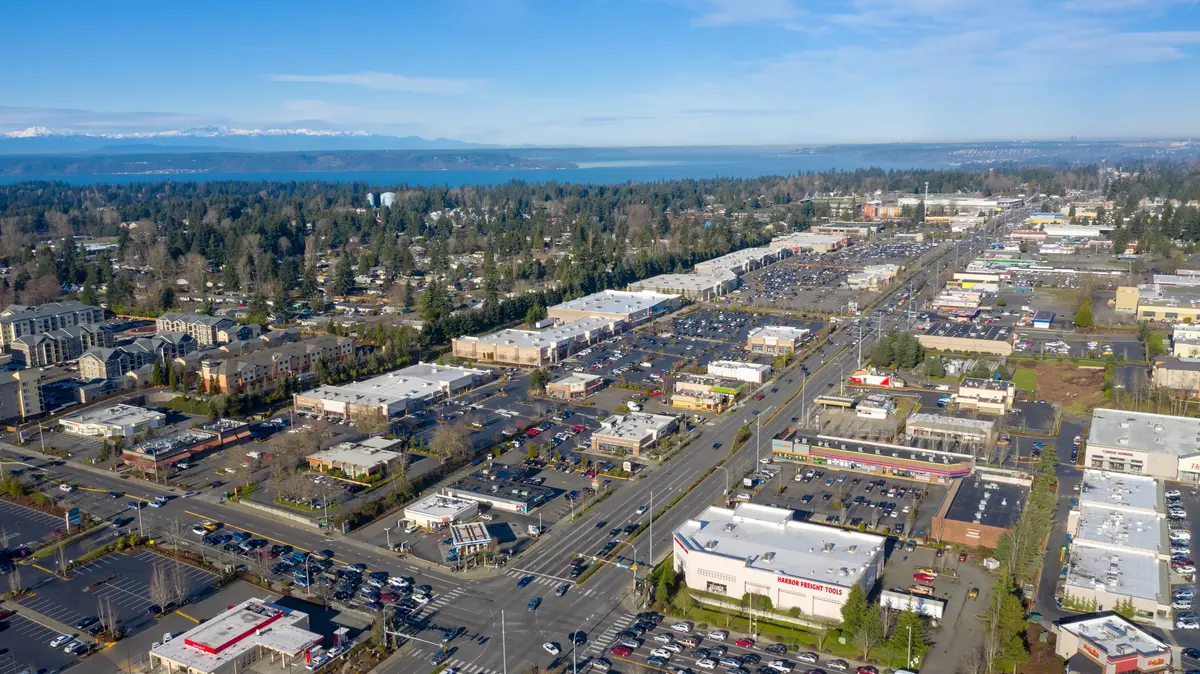
Federal Way sits in an interesting position in the Puget Sound housing market: it's far enough from Seattle to feel like a different world — quieter streets, lower stakes, a more grounded pace — but close enough (about 35 minutes up I-5) that Seattle salaries are still within reach. That gap between proximity and price is the core reason people look here. The city runs along the SR-99 corridor south of Sea-Tac, sandwiched between Tacoma to the south and the airport suburbs to the north, with Puget Sound to the west and a series of small lakes dotting the interior.
The honest posture on cost: Federal Way's overall cost of living runs approximately 16% above the national average in 2026, driven by housing, transportation, and groceries — all of which track the broader Seattle metro more than the national baseline. Against Seattle itself, though, the city looks noticeably more affordable across most spending categories. The median household income here is $86,909, which is enough to make homeownership plausible where it simply isn't in Seattle proper or Bellevue. Employers like World Vision U.S., Totem Ocean Trailer Express, and the Federal Way Public Schools system anchor local employment, while a significant share of residents commute north.
The arrival of Sound Transit's 1 Line light rail at Federal Way Downtown Station in December 2025 changed the commute calculus materially — a $99 monthly ORCA pass now buys unlimited rail access to Seattle, Sea-Tac Airport, and points in between, making the car-optional lifestyle possible for many residents for the first time. Utilities run about 5% below the national average, partly because Pacific Northwest hydropower keeps electricity rates lower than most U.S. metros. Groceries, on the other hand, run roughly 13% above the national average — a Seattle-metro reality no amount of local loyalty offsets at the checkout line.
Whether you're comparing Federal Way against Tacoma, running the numbers versus Auburn or Kent, or benchmarking it against what you'd pay in Seattle, the sections below break down housing, everyday costs, the nearby-city comparison, and the full tax picture so you can build a budget grounded in what things actually cost here.
What It Really Costs to Live in Federal Way
The Zillow Home Value Index for Federal Way stood at $564,681 as of June 2026 — sitting well below Seattle and the Eastside, but meaningfully above what you'd pay in Tacoma or the smaller Pierce County cities further south. That number is the anchor of Federal Way's affordability story: it's a real metro price, not a bargain, but it's reachable for dual-income households earning near or above the city's $86,909 median household income.
What drives the number here is a combination of location and land. Federal Way is still King County — that label carries a pricing premium relative to Pierce County neighbors like Tacoma and Edgewood — and I-5 access plus the new light rail connection have given the city a commuter premium it didn't fully have five years ago. Entry-level inventory is tighter than it looks at first glance, particularly for buyers coming from markets where $400K still buys something livable.
Outside housing, the cost story is mixed rather than uniformly expensive. Utilities come in below the national average, groceries run above it, and Washington's lack of a state income tax returns real money to most paychecks. Federal Way's combined 10.4% sales tax rate (effective Q3 2026) is among the higher rates in the region, but groceries and prescriptions are exempt from that figure at the state level, softening the daily impact for most households.
Housing: Rent vs Buy in Federal Way
The Buying Side
The city-wide median sold price tracks closely to the Zillow Home Value Index figure of $564,681 (June 2026). Entry-level single-family homes — older construction, smaller lots, often needing cosmetic updates — tend to start in the low-to-mid $400,000s, with that inventory concentrated in the more affordable pockets toward the city's eastern and southern edges. For anything move-in ready or near the waterfront corridors, expect to be closer to or above the median.
The effective property tax rate in Federal Way is approximately 0.83% — notably lower than many comparable suburban markets across the country, and one of the genuine financial advantages of buying here versus renting long-term. Use the mortgage calculator below to run your own monthly payment estimate; what matters for planning purposes is that the rate itself is modest relative to national norms.
The Renting Side
Federal Way has a substantial rental market, anchored by apartment complexes along the Pacific Highway S corridor and a mix of single-family rentals throughout the city's residential neighborhoods. Typical two-bedroom apartments run in the $1,700–$2,100 per month range, with newer or more amenity-rich units pushing toward the top of that band. That range is noticeably below Seattle, though it's climbed over the past two years alongside regional rent pressure.
When Renting Makes Sense Here
Renting first is worth considering if you're new to the Pacific Northwest entirely and haven't yet spent enough time in Federal Way to know whether you'd prefer the western neighborhoods closer to Puget Sound or the more suburban interior. The rental market gives you that runway without locking in on a block you might later regret. If you're planning to stay five or more years, the property-tax rate and the relative price point make buying a more defensible long-term position here than in Seattle or the Eastside suburbs.
Everyday Costs Beyond Housing in Federal Way
Utilities are one of Federal Way's quiet strengths. Residential electricity ran approximately 14¢ per kWh as of early 2026 — a figure that reflects the Pacific Northwest's hydropower-heavy grid and comes in roughly 24% below the national average. Rates did rise about 14% year-over-year as Puget Sound Energy invested in infrastructure, so build some upward cushion into your budget, but the baseline remains well below what most transplants from California or the Northeast are used to paying.
Groceries are the category that surprises people fastest. Prices run roughly 13% above the national average — not a Federal Way-specific quirk but a Seattle-metro reality that applies whether you're shopping in Federal Way, Des Moines, or Kent. Washington exempts groceries from the state's 6.5% sales tax, which takes some sting out of the register total, but the underlying shelf prices at most major chains reflect the regional cost base. Budget accordingly, especially if you're relocating from a lower-cost metro.
| Category | Typical Monthly Cost | Notes |
|---|---|---|
| Housing (2BR rent) | $1,700–$2,100 | Typical apartment range; owners should use the mortgage calculator above for a purchase estimate |
| Utilities (electricity, gas, water) | $130–$190 | Pacific Northwest rates run below national average; electric heat common in newer units |
| Groceries | $500–$700 | ~13% above national average; groceries exempt from WA state sales tax |
| Transportation & Gas | $200–$400 | Driver estimate; or ~$99/month unlimited ORCA pass for light rail + transit to Seattle |
| Phone & Internet | $100–$175 | Competitive provider options along the SR-99 corridor; gigabit internet widely available |
| Dining & Entertainment | $200–$450 | Wide range depending on habits; Jack's BBQ on Pacific Hwy S is a popular lower-cost option |
| Miscellaneous / Personal | $150–$300 | Clothing, household goods subject to 10.4% combined sales tax (Q3 2026) |
These are estimates for a single adult or couple — actual totals vary significantly by household size and lifestyle. The 10.4% combined sales tax rate applies to most non-grocery purchases, which adds up faster than residents from income-tax states typically expect.
Looking to buy in Federal Way? Estimate your payment.
Enter your numbers to see an estimated monthly mortgage payment.
Estimate only. Excludes HOA fees and mortgage insurance. The interest rate above is a starting point, not a quoted rate — replace it with your own to see real numbers. Insurance is a flat placeholder, not a Federal Way quote.
Federal Way vs Nearby Cities: Cost Comparison
| City | Median Home Price | Typical 2BR Rent | Cost vs Federal Way |
|---|---|---|---|
| Federal Way, WA | $564,681 (Zillow ZHVI, June 2026) | $1,700–$2,100/mo | — Baseline — |
| Seattle, WA | ~$850,000–$900,000 | $2,400–$3,000/mo | Substantially higher |
| Kent, WA | ~$530,000–$560,000 | $1,650–$2,000/mo | About the same |
| Auburn, WA | ~$500,000–$530,000 | $1,600–$1,950/mo | Slightly cheaper |
| Des Moines, WA | ~$560,000–$590,000 | $1,700–$2,050/mo | About the same |
| Tacoma, WA | ~$430,000–$470,000 | $1,450–$1,800/mo | Noticeably cheaper |
The pattern is clear: Federal Way prices are closely bracketed by Kent and Des Moines, all three sitting in a similar band, while Tacoma offers a meaningful discount for buyers willing to move further south and accept a longer Seattle commute.
Taxes & the Bottom Line for Federal Way
No State Income Tax
Washington has no state income tax, which is the single biggest structural tax advantage Federal Way residents hold over counterparts in Oregon, California, or most eastern states. For a household earning near the city's $86,909 median income, that's a real annual difference — money that many locals channel back into mortgage payments or savings rather than to a state revenue department.
Sales Tax: High, But With Carve-Outs
Federal Way's combined sales tax rate is 10.4% as of Q3 2026 — one of the higher rates you'll encounter in the Seattle metro. The practical hit is larger than newcomers expect on big-ticket purchases: appliances, furniture, vehicles, and electronics all carry it at full freight. Groceries and prescription medications are exempt from the state portion of the tax, which takes some edge off regular household spending.
Property Tax: A Modest Rate
The effective property tax rate of approximately 0.83% is the quieter good news for owners. Applied to the home-price range discussed earlier in this guide, it keeps the annual tax obligation well below what buyers in Texas, Illinois, or New Jersey would pay on a comparable property. This is one reason the long-term math of buying in Federal Way, rather than renting indefinitely, holds up reasonably well for households with a five-plus-year horizon.
Who Federal Way's Budget Fits
Federal Way makes the most financial sense for households earning $80,000 or more who want King County access without King County's highest price tags — remote workers, dual-income families priced out of Seattle, and commuters who can now use the 1 Line instead of sitting on I-5 every day. It tends to be a stretch for single-income households earning below the city median, particularly at today's mortgage rates, where even the entry-level price point demands a substantial down payment and disciplined monthly budgeting. Tacoma will be a more realistic target for those households.

Local Expert Takeaway: Federal Way's cost story in 2026 is really about the transit math. The 1 Line's arrival at Federal Way Downtown Station in December 2025 means a $99 monthly ORCA pass now replaces what used to be a daily I-5 grind for Seattle commuters — and that changes the rent-vs-buy calculation for anyone weighing Federal Way against pricier northern suburbs. The city isn't cheap by national standards, but between a home price noticeably below Seattle, an effective property tax rate of about 0.83%, no state income tax, and utility costs that run below the national average, Federal Way offers a combination that's genuinely hard to assemble inside the Seattle city limits.
Quick Takeaways & FAQs
✅ Washington's no-income-tax structure means Federal Way residents keep more of each paycheck than counterparts in most other states — a real financial advantage that compounds over time.
⚠️ Groceries run roughly 13% above the national average and the combined sales tax hits 10.4% on most non-food purchases — two costs that catch relocators off guard faster than housing does.
📍 Sound Transit's 1 Line now terminates at Federal Way Downtown Station (opened December 2025), making a $99 monthly ORCA pass a genuine alternative to daily I-5 driving for Seattle-bound commuters.
What is the median home price in Federal Way, WA?
Is Federal Way cheaper than Seattle?
What is the sales tax rate in Federal Way, WA?
How much does it cost to commute from Federal Way to Seattle?
What is the property tax rate in Federal Way?
Moving to Washington?
Tell us what you need help with and we'll connect you with local resources.
