What Is Living in Bellevue, Washington Like?
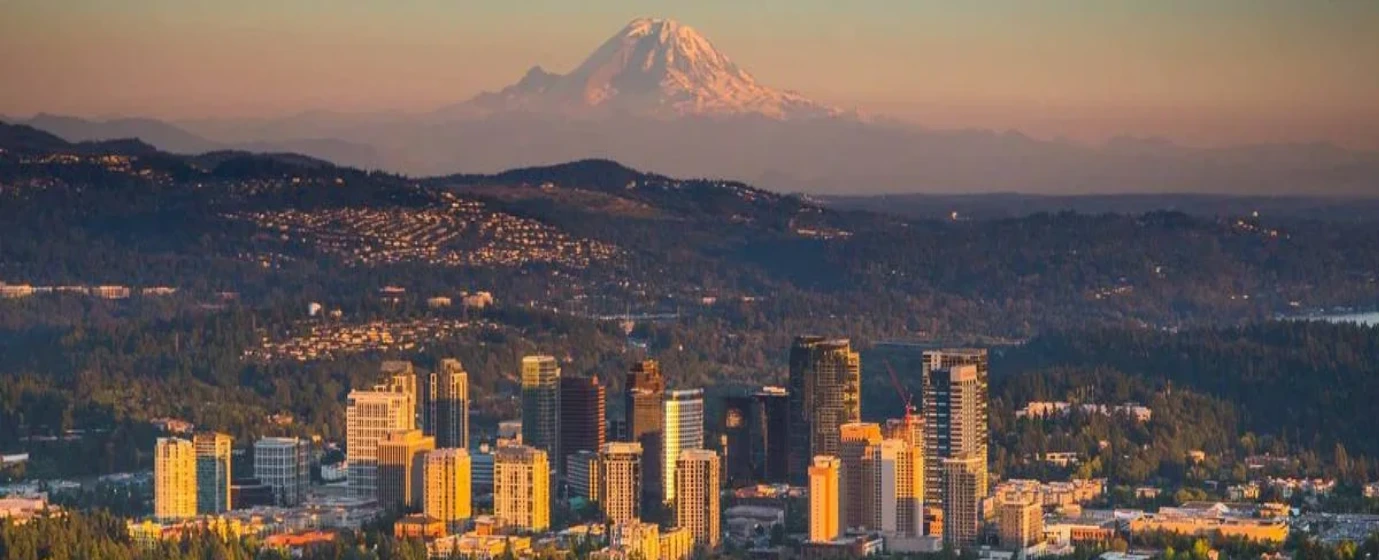
Maybe you got the offer from Amazon or Microsoft and Bellevue suddenly moved from abstract to immediate. Maybe you've been priced out of a closer-in Seattle neighborhood and someone pointed you east across Lake Washington. Either way, you're probably expecting a suburb — and Bellevue will correct that assumption fast. This is Washington's fifth-largest city, with a skyline of glass towers rising above Bellevue Way, roughly 160,000 jobs inside city limits, and a downtown that has added nearly 3.9 million square feet of new office space since 2021, surpassing downtown Seattle in new office construction over that stretch. It sits on the Eastside of Lake Washington, flanked by I-405 to the east and SR-520 and I-90 bridging it to Seattle to the west, with Redmond and Microsoft's campus a short drive up SR-520 and the rest of the Eastside tech corridor radiating out from there.
The economic backbone here is unmistakably tech, and the city's job density reflects it. Amazon has built out roughly 14,000 employees at its Bellevue 600 campus downtown. T-Mobile US is headquartered here. OpenAI signed a 296,000-square-foot lease at City Center Plaza, bringing more than 1,000 employees to the Eastside in one move. Symetra Financial and Puget Sound Energy round out a base of large employers that extends well beyond tech. The Bellevue School District has held the Niche #1 ranking in Washington for three consecutive years through 2026, serving more than 19,000 students — and that ranking is a primary driver of why families with school-age children choose Bellevue over comparable Eastside cities. The city is also notably diverse: approximately 43% Asian and 41% White by population, with a median age of 38.5, which gives it a cosmopolitan feel that surprises people arriving from less diverse markets.
Cost of living is high by any realistic measure. The Zillow Home Value Index stood at $1,296,767 in May 2026, and well-priced single-family homes regularly go to pending in around seven days. What you get in return is a city that takes its parks seriously — nearly 100 of them, earning Bellevue the self-description of "a city in a park" — alongside a downtown retail core anchored by The Bellevue Collection on Bellevue Square, walkable access to Meydenbauer Bay Park on Lake Washington, and the Bellevue Botanical Garden in the heart of the city. Washington's lack of a state income tax is a meaningful offset for high earners, and the effective property tax rate of approximately 0.88% runs below what many buyers arriving from California or the Northeast are accustomed to paying.
Whether you're weighing an offer, comparing neighborhoods, or just trying to understand what daily life here actually looks like, the sections below break down Bellevue's job market and who the city suits, what living here day to day feels like, how the housing market is moving right now, how commuting works in both directions, and where locals spend their weekends.
Bellevue at a Glance
Looking to buy in Bellevue? Estimate your payment.
Enter your numbers to see an estimated monthly mortgage payment.
Estimate only. Excludes HOA fees and mortgage insurance. The interest rate above is a starting point, not a quoted rate — replace it with your own to see real numbers. Insurance is a flat placeholder, not a Bellevue quote.
Why Are People Moving to Bellevue?
The short answer is jobs — specifically, tech jobs at a concentration you won't find anywhere else on the West Coast outside of San Francisco and Seattle proper. But Bellevue has shifted from being Seattle's commuter suburb to being a destination in its own right, and that shift is still accelerating.
The Tech Gravity
Amazon's Bellevue 600 campus is still filling in, and OpenAI's 296,000-square-foot footprint at City Center Plaza signals that the city's role as an AI industry hub is no longer speculative. The broader Seattle-Bellevue metro hosts over 32,000 AI specialists — the third-largest AI-specialty talent cluster in the country. If you're in tech, data science, or AI, this is where the work is moving.
T-Mobile's national headquarters being anchored here matters too. It creates a telecommunications talent pipeline that sits alongside the tech base rather than competing with it, which gives the local job market more resilience than a one-employer town ever would.
Who Actually Chooses Bellevue
| Buyer Type | Why Bellevue Works | Best Fit |
|---|---|---|
| Tech professionals | Amazon, Microsoft, OpenAI, T-Mobile all within a short commute | Tech Commuter |
| Families with school-age children | #1-ranked school district in WA, three years running | Families School |
| Buyers relocating from high-cost metros | No state income tax; property tax rate around 0.88% | Value Commuter |
| Luxury buyers | New construction high-rises downtown; Somerset and West Bellevue estates | Luxury Views |
| Renters priced into the city | Dense downtown rental stock; walkable to transit | Renter Transit |
| Nature-oriented buyers | Nearly 100 parks; Mercer Slough Nature Park within city limits | Nature Quiet |
The city suits people who want a legitimate urban environment — not a bedroom community — but aren't willing to trade the school district quality or the park access that Seattle proper can't always deliver.
The Honest Case Against It
Bellevue does not suit everyone. The price floor is real: the Zillow Home Value Index at $1,296,767 (May 2026) means entry-level ownership requires serious capital. Traffic on I-405 between Bellevue and Renton is a daily grind that no amount of optimism softens. And the city's rapid growth has brought construction noise and street-level disruption to downtown corridors that were quiet just five years ago.
People move out of Bellevue most often for two reasons: they want more land for less money — Sammamish or Issaquah offer that — or they want the cultural density and walkable restaurant scene of Seattle proper. Bellevue is excellent at what it is, but it is not trying to be Capitol Hill.
What Daily Life Feels Like in Bellevue
Bellevue runs on a rhythm that is distinctly different from Seattle's. The city is quieter, more planned, and more car-dependent the further east you go from downtown — but the downtown core itself has become genuinely walkable in a way that would have surprised anyone who knew it ten years ago.
Downtown and the Core
The Bellevue Collection anchors the retail heart of the city, with Bellevue Square and its surrounding blocks drawing weekday lunch crowds from the office towers above. Bellevue Downtown Park — a circular green space with a wide promenade and a waterfall canal — sits just a few blocks from the transit center and functions as the city's unofficial town square. On warm evenings, the park fills with families, dog walkers, and people coming off the 2 Line.
Meydenbauer Bay Park brings direct waterfront access to downtown for the first time in the city's history — a genuine community anchor that opened in phases and changed how downtown residents use the waterfront. It's the kind of park that makes people realize they could actually live car-light in Bellevue if they want to.
The Neighborhood Reality
Move east of I-405 and the feel shifts: more residential, quieter streets, larger lots. Crossroads has a community center and a park that functions as a genuine social hub for the international community that has settled in that area — weekend afternoons there look nothing like downtown. Somerset sits high on a ridge with territorial views toward the Olympics, and the community there skews toward established families who have been in Bellevue long enough to choose it deliberately.
Newcomers often expect Bellevue to feel like a wealthier version of a strip-mall suburb. The surprise, in month three, is usually how many distinct neighborhoods have their own character. The Best Neighborhoods page breaks down those geographic divides in detail.
Diversity and Community
Bellevue is approximately 43% Asian and 41% White — among the most diverse mid-sized cities in the Pacific Northwest by a significant margin. That diversity shows up in the restaurant options across the main commercial corridors on the city's east side, in the language mix you hear at Kelsey Creek Farm Park on a Saturday, and in the international school programming the district offers. It is one of the city's most underappreciated qualities for people arriving from less diverse markets.
A Seasonal Quirk Worth Knowing
The Bellevue Arts Museum Artsfair in late July brings significant crowds to the downtown core for two full weekends — parking becomes genuinely difficult, and streets around the park are closed. Newcomers who haven't planned around it tend to discover it the hard way their first summer. It's a great event, but if you're living downtown, it's worth marking the calendar before June.
For schools, the Schools page covers the district's Niche #1 ranking and individual school boundaries in full. For safety context, the Safety page covers the city's crime figures in detail.
The Bellevue Housing Market Right Now
Bellevue's housing market is expensive and fast. The Zillow Home Value Index stood at $1,296,767 in May 2026 — a figure that reflects the city-wide typical home value across all property types. That number is not a ceiling: well-priced single-family homes in the $1.45M–$1.85M range have been averaging roughly six days on market, and multiple-offer situations remain common on clean listings.
How Fast Is Fast?
The typical home goes to pending in approximately 7 days city-wide. That pace is not uniform — some attached condos and older construction take longer — but it sets the expectation correctly: Bellevue is not a market where deliberation works in a buyer's favor. Inventory is tight, and the continued arrival of tech employers (with OpenAI bringing more than 1,000 Eastside employees) keeps demand pressured from the employment side.
What's Driving Prices
The office construction numbers tell the story. Bellevue has added nearly 3.9 million square feet of new office space since 2021 — surpassing downtown Seattle in new construction over that stretch. Every square foot of office absorbs employees who then compete for housing within a reasonable commute of their workplace. That demand pressure is structural, not cyclical.
Washington's lack of a state income tax is a real factor for relocating buyers, particularly those arriving from California, Texas, or the Northeast where income taxes are meaningful. It does not make the prices feel low, but it changes the total cost calculation for high-income earners in ways that make the Bellevue premium more defensible on paper.
Renting First
Many people relocating to Bellevue for a first job in the area rent before buying — the pace of the market and the entry point make that a rational choice. For a full breakdown of rent figures and what the cost of living looks like across categories, see the Cost of Living page.
Some parts of the city cost noticeably more than others — the range from a Crossroads townhome to a Somerset single-family estate is wide. The Best Neighborhoods page maps that variation by area.
Bellevue Neighborhoods
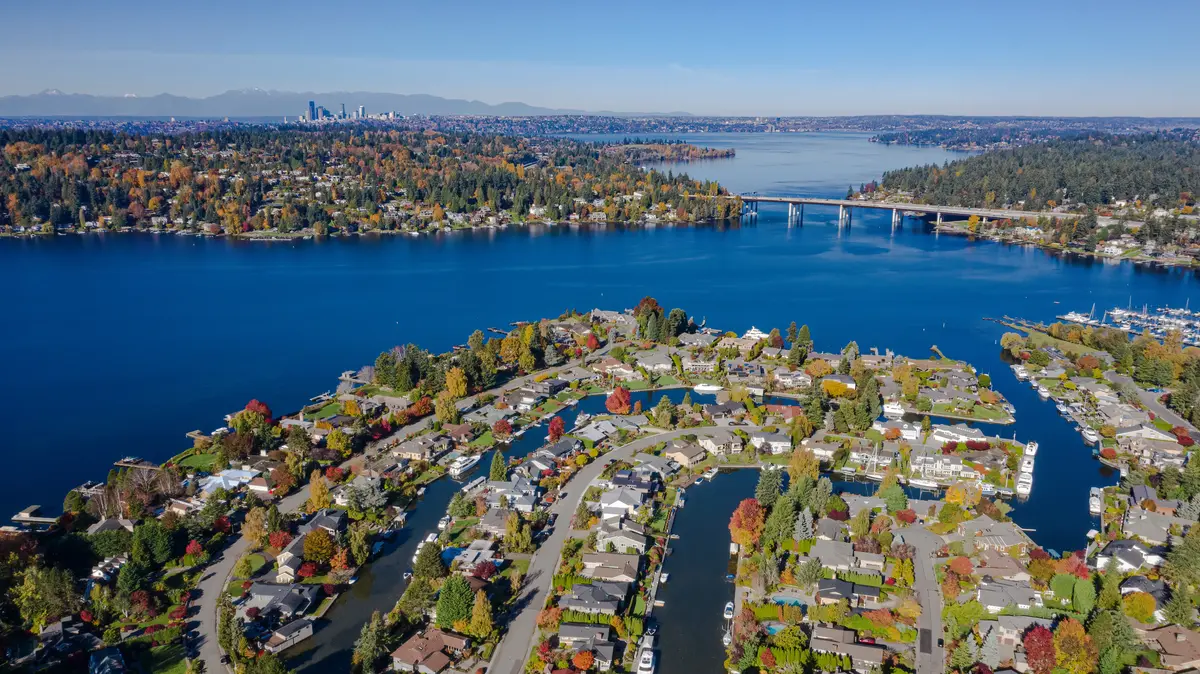
Bellevue has several distinct areas — each with its own character and appeal. Here’s a breakdown to help you narrow down where to focus your home search.
🏡 Downtown Bellevue
The city's urban core, defined by high-rise condos, the Bellevue Collection retail district, and immediate access to Bellevue Downtown Park and the 2 Line light rail stations. It suits professionals and renters who want walkability and don't need a yard.
🏠 Crossroads
Bellevue's most culturally diverse neighborhood, anchored by a community park and shopping center that functions as a genuine social hub for the international families who've settled there. Housing tends toward more modest single-family homes and apartments relative to the city median.
🌳 Somerset
A hillside neighborhood with territorial views toward the Olympic Mountains, known for established single-family homes on larger lots and one of the most sought-after addresses in Bellevue for families who've been here long enough to choose deliberately.
🏘 Newport Hills
A quieter residential area southeast of downtown with a strong neighborhood association, tree-lined streets, and proximity to the Coal Creek trail system — suits buyers who want suburban calm within Bellevue's boundaries.
🏔 Bridle Trails
Named for the equestrian trail network running through the state park at its center, this neighborhood has a genuine semi-rural feel despite sitting between Bellevue and Kirkland — popular with nature-oriented buyers who want space without leaving the Eastside.
🌆 Eastgate
A primarily residential area adjacent to I-90 and close to Kelsey Creek Farm Park, suited to families who want solid Bellevue School District access and more square footage than downtown allows, with a commute-friendly position for both Seattle and south Eastside jobs.
Pros & Cons of Living in Bellevue
The Pros
- Top-ranked public schools
- deep tech job market with major employers minutes away
- extensive parks and trail network ('a city in a park')
- vibrant
- walkable downtown with retail and dining
The Cons
- Among the most expensive home prices and rents in the state
- heavy commute-hour congestion on I-405
- I-90 and SR-520
- property crime (theft/car break-ins) notably above national average
Getting Around & Commuting in Bellevue
March 28, 2026 changed Bellevue's commuting math permanently. Sound Transit's 2 Line — East Link light rail — began full cross-lake service that day, connecting Bellevue to Seattle via the I-90 floating bridge by rail for the first time. Six 2 Line stations serve Bellevue, including a downtown tunnel, and the ride from Bellevue Downtown Station to Seattle's Westlake Station runs roughly 25–28 minutes.
The Rail vs. Road Reality
That same trip by car during rush hour can stretch to 45–60 minutes — and that's on a good day. The bridge crossings are the primary chokepoint for Bellevue-to-Seattle commuters, and SR-520 offers an alternative but carries its own congestion through the University District approach. The rail option is not just faster — it eliminates the stress variable entirely. For anyone working in downtown Seattle or at a stop along the 2 Line corridor, the calculus for living in Bellevue shifted meaningfully when the line opened.
Internal Bellevue Commutes
Getting around within Bellevue without a car remains uneven. Downtown is walkable and increasingly well-served by the 2 Line and King County Metro routes. But large portions of the city east of I-405 — Somerset, Newport Hills, Eastgate — require a car for most daily errands. I-405 itself is the dominant north-south artery, and the stretch through central Bellevue can back up significantly during afternoon rush hours heading south toward Renton.
What's Coming
| Service | Destination | Opens | Impact |
|---|---|---|---|
| 2 Line (East Link) | Seattle, Redmond, Mercer Island | Open (March 2026) | 25–28 min to downtown Seattle by rail |
| Stride BRT S1 Line | Renton / Burien | 2028 | Car-free connection south on I-405 corridor |
| Stride BRT S2 Line | Bothell / Lynnwood | 2029 | North Eastside connectivity without I-405 driving |
| King County Metro | Citywide + Seattle | Operating now | Supplements 2 Line; key for cross-Bellevue trips |
Bellevue Transit Center is being positioned as a regional hub — not just a park-and-ride. The BRT lines opening in 2028 and 2029 will make car-free living in Bellevue meaningfully more viable for people whose work is in the I-405 corridor.
Microsoft and Redmond
For anyone commuting to Microsoft's main campus in Redmond, the 2 Line's Redmond extension connects directly — cutting a drive that used to take 20–30 minutes down to a predictable rail trip. That connection is already influencing where tech workers choose to live, with Bellevue's downtown station serving as a natural midpoint between both major employers.
If You Drive
Own the timing. The I-90 crossing westbound in the morning, the downtown grid at midday, and I-405 heading south through central Bellevue at 5 p.m. are the three situations that will redefine your relationship with the city if you don't plan around them. Locals who work Eastside-to-Eastside often find the city far less congested than its reputation suggests — the traffic frustration is almost entirely tied to the lake crossings.
Schools in Bellevue
Families relocating to Bellevue have public, private, and higher-education options nearby. Here’s a quick overview.
🎓 School District
Bellevue School District serves K–12 students across Bellevue and the surrounding area. Rated A+ (source: Niche.com).
🏆 Graduation Rate
The 4-year high-school graduation rate here is approximately 87.7%.
📚 Higher Education
Washington’s public universities — the University of Washington, Washington State University, and Western Washington University — offer four-year degrees statewide, with a network of 34 community and technical colleges (SBCTC) providing two-year and workforce programs.
🌐 Online Learning
University of Washington Continuum College and Washington State University Online offer fully accredited online degrees for remote learners across the state.
Safety in Bellevue
A quick look at how Bellevue compares on the numbers that matter most when weighing a neighborhood or a move.
🛡 Violent Crime
Approximately 1 per 1,000 residents.
🔒 Property Crime
Approximately 34 per 1,000 residents.
Compared to the FBI’s most recent national data (2024), Bellevue’s violent crime is below the national average (about 3.6 per 1,000), and property crime is above the national average (about 17.6 per 1,000).
Against Washington as a whole, Bellevue’s violent crime is roughly a third of the state average, and property crime is somewhat above the state average (Bureau of Justice Statistics, Crime Known to Law Enforcement, 2024 (tables 2 and 3)).
Crime rates can vary a lot within a single city, so the citywide numbers above are only a starting point. Some neighborhoods in Bellevue run well below these averages, while others run higher — the kind of block-by-block detail that matters most when you’re actually choosing where to live. The full guide below breaks it down neighborhood by neighborhood.
Working in Bellevue
Bellevue’s largest employers span several industries — here are some of the anchors of the local job market.
💻 Amazon
Technology
💼 T-Mobile US
Telecommunications, headquarters
💻 Microsoft
Technology
🏦 Symetra Financial
Insurance
💼 Puget Sound Energy
Utilities
Parks & Recreation in Bellevue
Some of the outdoor spaces that shape everyday life in Bellevue.
🌱 Bellevue Downtown Park
🌱 Meydenbauer Bay Park
🌱 Mercer Slough Nature Park
🌱 Bellevue Botanical Garden
🌱 Kelsey Creek Farm Park
Bellevue residents don’t have to go far for green space — spots like Bellevue Downtown Park and Meydenbauer Bay Park are part of everyday life here, whether that’s a morning walk, a weekend hike, or just somewhere to unwind outside. The full guide below covers more of what Bellevue has to offer for parks and outdoor recreation.
Retiring in Bellevue
Bellevue draws retirees for its balance of amenities, outdoor access, and cost. Here’s what to weigh.
🌤 Climate
Bellevue gets around 150 sunny days per year — more than Seattle's reputation suggests — with mild, rainy winters that rarely drop below freezing. Summers are reliably dry and comfortable, typically in the low-to-mid 70s, which draws retirees outdoors from June through September. The trade-off is a gray stretch from November through March that takes some adjustment if you're arriving from sunnier climates.
🍴 Lifestyle
The Bellevue Botanical Garden, Mercer Slough Nature Park's walking trails, and the waterfront at Meydenbauer Bay Park give retirees genuine outdoor variety within city limits. The restaurant density across the city's main commercial corridors covers most cuisines without a Seattle trip. Bellevue's parks and recreation programming also includes classes and events specifically designed for older adults.
🏚 55+ Communities
Bellevue has a smaller inventory of dedicated active-adult communities than cities like Issaquah or Sammamish, but the area surrounding it offers more options for retirees with specific community needs. Downtown Bellevue's high-rise condos attract active retirees who want walkability and proximity to the arts. For a full picture of senior living options, the Retiring page covers healthcare access and community options in detail.
✈ Getting Around
The 2 Line light rail now connects downtown Bellevue to Seattle in roughly 25–28 minutes without driving — a genuine quality-of-life upgrade for retirees who prefer not to navigate the bridge crossings. Seattle-Tacoma International Airport is approximately 30–35 minutes south via I-405 and SR-518. Bellevue's street grid is well-maintained and parking in most neighborhoods outside downtown is straightforward.
🏛 Washington Taxes for Retirees — What to Know
- No state income tax — Washington does not tax personal income, so Social Security, pensions, and 401(k)/IRA withdrawals are all untaxed at the state level. There is no state return to file and no retirement exclusion to claim — the rate is simply zero.
- Military and public pensions — Because there is no income tax, military retirement pay and public-employee pensions are untaxed at the state level along with everything else.
- Sales tax is the tradeoff — The state sales tax is 6.5%, and local add-ons bring the combined rate in Bellevue to 10.3% (Washington State Department of Revenue, Q3 2026 local sales & use tax rate table, July 2026). Groceries and prescription drugs are exempt.
- Property taxes, with senior relief — The effective property tax rate is roughly 0.9%. Homeowners 61+ (or unable to work due to disability, or a qualifying disabled veteran) who own and occupy their home may qualify for a reduction. Income limits are set against each county’s median household income, so the threshold differs by county — check with your county assessor. A separate deferral program is available for those who don’t qualify for the exemption.
- Capital gains tax — but not on retirement income — Washington taxes 7% on long-term capital gains above a $278,000 standard deduction for 2025, rising to 9.9% on gains above $1,000,000. Retirement accounts and real estate sales are both exempt. It therefore does not reach ordinary retirement income or the sale of a home.
- Estate tax — the one to plan for — Unlike most no-income-tax states, Washington has its own estate tax. For deaths on or after July 1, 2026, the exemption is $3 million with graduated rates topping out at 20%. Retirement accounts count toward the taxable estate, so long-time homeowners with sizable balances can cross the line without expecting to.
- No inheritance tax — Washington has no inheritance tax, and no gift tax.
- WA Cares payroll premium — Working Washingtonians pay 0.58% of gross wages into the WA Cares Fund, the state long-term care program, with no income cap. It applies to W-2 wages, so retirees who have stopped working do not pay it — but anyone relocating while still employed will see it. The private-insurance opt-out closed at the end of 2022 and is not available to new applicants; the remaining exemptions are narrow (living outside Washington, military spouses, certain visa holders, and veterans with a 70%+ service-connected rating).
- The Oregon border effect — Oregon has no sales tax, so Washington residents near the river — Vancouver, Camas, Washougal, Longview — often cross over for large purchases. Washington use tax technically applies to goods brought back for use in-state, though it is rarely enforced on ordinary personal purchases.
Tax laws change frequently and individual situations vary. This is general information, not tax advice — always consult a qualified Washington tax professional or CPA for personalized retirement tax planning.
Weekends & Local Favorites in Bellevue
Bellevue's weekend life is more varied than its corporate skyline implies. The city's nearly 100 parks create a framework for outdoor time that locals use constantly, and the dining and brewery scene has developed enough depth that you don't need to cross the lake for a good Saturday.
The Parks That Define the City
Mercer Slough Nature Park is the one that surprises newcomers most — 320 acres of wetlands, blueberry farms, and walking trails tucked between I-90 and the Spring District, accessible from a canoe launch and several trailheads. It feels genuinely wild for something that's a five-minute drive from downtown. Kelsey Creek Farm Park in the Eastgate area is where parents with kids under ten spend a lot of weekend mornings — free admission, farm animals, and enough open space to run. The Parks and Recreation page has a full breakdown of trails, facilities, and access points.
Bellevue Botanical Garden is a legitimate destination, particularly in late spring when the rhododendron display peaks. The garden is free, well-maintained, and draws a mix of serious gardeners and casual walkers. It sits on 53 acres in the Wilburton neighborhood and is the kind of place locals take visiting family members without apology.
Where Locals Eat and Drink
The restaurant corridors on the city's east side reflect Bellevue's demographic mix in the best possible way — Korean, Japanese, Chinese, and Pan-Asian restaurants that are not dumbed down for a tourist audience sit alongside European spots and the kind of all-day brunch places that tech workers fill on Sunday mornings. The Spring District, built around Bellevue Brewing Company's brewpub on NE District Way, has become a genuine gathering spot — the kind of walkable, mixed-use neighborhood that Bellevue didn't really have five years ago.
Resonate Brewery + Pizzeria rounds out the local brewery scene with a neighborhood-pub feel that differs from the Spring District's more polished vibe. Both are worth knowing, and both are legitimately local rather than import chains.
The Eastside Weekend Circuit
One habit that distinguishes Bellevue residents from visitors: the Eastside runs on a Saturday-morning circuit that combines a farmers market (the Bellevue Farmers Market runs spring through fall near the Overlake area), time at one of the waterfront parks, and an afternoon that doesn't require getting on I-90. The city is large enough to spend an entire weekend without running out of things to do within its own boundaries — which is something people don't fully appreciate until they've lived here a season.
Meydenbauer Bay Park has changed the downtown waterfront in a way that's still settling in. Kayak and paddleboard rentals, a swimming beach, and a grass lawn that fills on any sunny afternoon — it functions as downtown Bellevue's answer to the question of where to go when the weather actually cooperates. In a city that gets around 150 sunny days a year, that question comes up more than Seattle's reputation suggests.
Top Things Locals Say About Bellevue
The best intel about a city comes from the people who actually live there. Here’s what Bellevue residents say when newcomers ask the questions everyone’s thinking.
“I expected to feel like I was living in a tech campus. What I didn't expect was how much time I'd spend in the parks — Mercer Slough especially — or how the Spring District would become my Friday spot just because it was walkable from the 2 Line station.”
— Recent Bellevue home buyer
“What's the most surprising thing about living in Bellevue?”
How much the city feels like itself — not like a satellite of Seattle. Once you stop thinking of it as 'Seattle's suburb,' Bellevue makes more sense. The downtown skyline is real, the job base is right here, and Mercer Slough Nature Park is the kind of place you don't expect to find minutes from a city center. Most people assume they'll miss Seattle and end up barely crossing the lake after the first few months.
“What do locals love most about Bellevue?”
The school district, honestly — but also the park system. Nearly 100 parks for a city of 154,000 is not an accident; it's a policy choice, and you feel it. Kelsey Creek Farm Park on a weekend morning, or an evening walk through the Bellevue Botanical Garden in May, are the kinds of things that make the price feel more defensible once you're actually living here rather than just looking at it on a spreadsheet.
“What should newcomers to Bellevue know?”
Plan around I-405 south of downtown before you commit to any commute pattern that runs that corridor in the afternoon — it backs up hard and nobody warns you adequately. Also: the Bellevue Arts Museum Artsfair in late July shuts down streets around the downtown park for two full weekends. Block it on your calendar before your first summer or you'll spend a Saturday wondering why nothing is where it usually is.
“Can you live in Bellevue without a car?”
If you're in a downtown high-rise and your job is on the 2 Line corridor — yes, comfortably. The rail connection to Seattle is real and the walk from Bellevue Downtown Station to Bellevue Square is five minutes. But if you're in Eastgate or Somerset, a car isn't optional for daily life right now. The BRT lines coming in 2028 and 2029 will change that math somewhat, but it's not there yet for the eastern neighborhoods.
Cities Near Bellevue
Other communities near Bellevue worth a look — each with its own character and price point.
| City | Distance | Best For | Vibe | Median Rent | Median Buy |
|---|---|---|---|---|---|
| Kirkland | 7 mi | Waterfront lifestyle, families | Walkable, lake views, artsy | $2,500 | $1,150,000 |
| Redmond | 9 mi | Microsoft commuters, tech families | Planned, trails-heavy, quieter | $2,600 | $1,150,000 |
| Issaquah | 11 mi | Outdoor lovers, more space | Foothills, newer construction, quieter | $2,300 | $950,000 |
More Helpful Guides for Bellevue
Going deeper on Bellevue? Our blog series covers everything from first-time buying to retiring here — explore the guides below.
Local Expert Takeaway: Bellevue is not a suburb that happens to have some good amenities — it's a functioning city with its own downtown, its own job base, and its own commute patterns. The 2 Line light rail opening in March 2026 rewrote the Seattle commute calculus: 25–28 minutes to Westlake by rail changes what it means to live in Bellevue without a car. Pair that with the Bellevue School District's #1 ranking in Washington and nearly 100 parks including Mercer Slough and Meydenbauer Bay, and you understand why demand stays relentless even at a $1.29M typical home price. The catch is the speed — well-priced homes move in a week, and I-405 south of downtown is a genuine daily friction point. Know that going in.
Quick Takeaways & FAQs
✅ Bellevue School District has ranked #1 in Washington three consecutive years through 2026, which is a primary driver for families choosing Bellevue over comparable Eastside cities.
⚠️ I-405 through central Bellevue backs up hard every weekday afternoon heading south — if your commute runs that corridor, budget the time honestly.
📍 The 2 Line light rail opened March 28, 2026, connecting Bellevue Downtown Station to Seattle's Westlake in roughly 25–28 minutes — a trip that takes 45–60 minutes by car during rush hour.
Is Bellevue worth the price compared to Seattle?
How competitive is the Bellevue housing market in 2026?
Can you live in Bellevue without a car?
What is the Bellevue School District actually like?
What are the major employers in Bellevue, WA?
Helpful Links for Moving to Bellevue
Moving to Washington?
Tell us what you need help with and we'll connect you with local resources.
