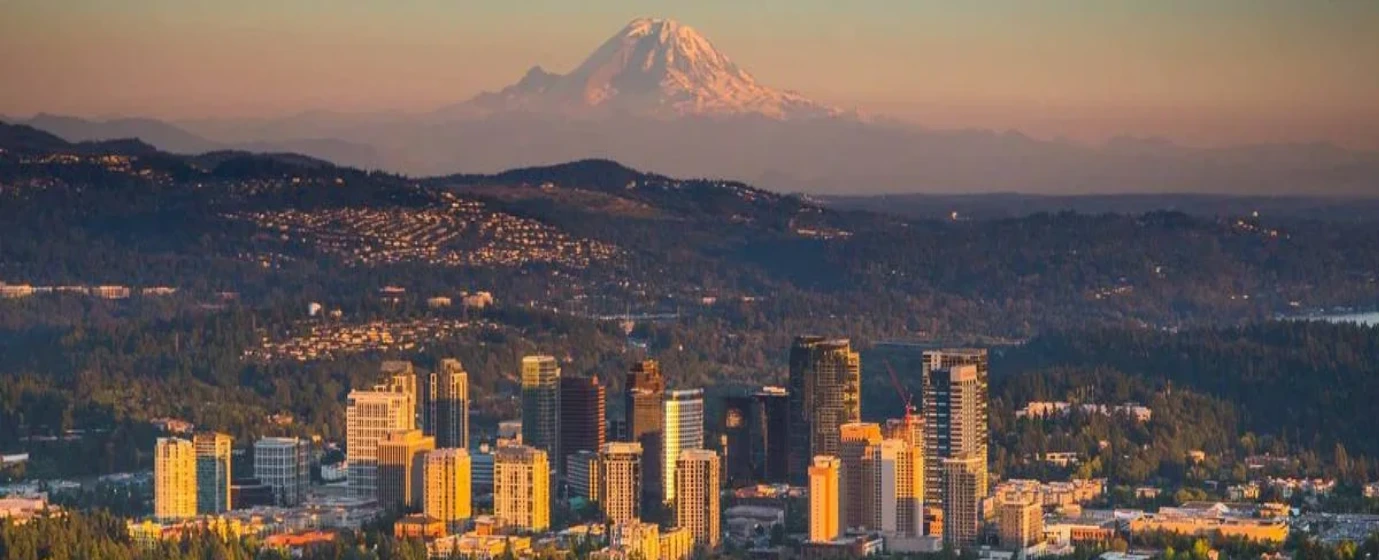
If you're moving to Bellevue from California, you've probably already run the numbers on income tax. Washington levies no state income tax on wages or salaries — zero — while California's brackets climb to 12.3% (13.3% at the top with the Mental Health Services Tax). That single fact reshapes what a Bellevue paycheck looks like versus what you were taking home in the Bay Area or Southern California. But the tax story isn't as clean as the headline, and the home-price story isn't as comfortable as you might hope. Bellevue sits on the eastern shore of Lake Washington, connected to Seattle by SR-520 and I-90, with a downtown skyline that surprises people who expect a quiet suburb. Microsoft is in neighboring Redmond, Amazon has a major Eastside presence here, and T-Mobile US is headquartered in Bellevue itself — this is not a bedroom community.
The employer base is one reason Californians — especially Bay Area tech workers — keep landing here. Amazon, Microsoft, T-Mobile US, Symetra Financial, and Puget Sound Energy anchor a job market with the same white-collar, high-income profile as Silicon Valley, but without California's tax structure. The Bellevue School District holds an A+ rating, according to Niche, and is a significant draw for parents who've dealt with overcrowded or underfunded schools further south. The population sits at roughly 154,000, which feels manageable compared to the sprawl of the South Bay or the San Fernando Valley.
The cost of living in Bellevue runs about 43% above the U.S. national average — expensive by almost any measure, though noticeably below San Francisco on a combined basis and roughly comparable to Los Angeles overall. The Zillow Home Value Index pegged the typical Bellevue home at $1,296,767 in May 2026. Entry-level inventory is thin, and detached single-family homes in most of the city reflect that scarcity in their pricing. The upside is that Washington's effective property tax rate of 0.88% is low compared to what many Californians pay in actual dollars — especially if you're coming from a market where Prop 13 stopped protecting you long ago.
Whether you're being relocated by your company, priced out of the Bay Area, or simply done with California's tax climate, this guide covers what Californians specifically need to know about Bellevue: the real tax comparison, the home price reality, the cost-of-living adjustments, the lifestyle shift, and what people consistently get wrong in the first six months.

The Tax Trade-Off: Where California Loses and Where It Gets Complicated
The income tax advantage is real and immediate. Washington has no state income tax on wages or salaries. California's state income tax brackets run from 1% to 12.3% for 2025, with the top effective rate reaching 13.3% once the Mental Health Services Tax applies to income over $1 million — the highest of any U.S. state.
For a dual-income household earning $180,000 combined, the difference translates to an estimated $12,000–$12,800 per month in take-home pay in Washington, versus approximately $10,200–$10,800 per month after California state taxes. That gap — up to $24,000 per year — is purely from the state tax advantage, before you factor in anything else.
The Sales Tax Adjustment
Washington funds its government somewhere, and sales tax is a big part of that answer. Bellevue's combined sales tax rate is approximately 10.3% (6.5% state plus 3.8% local) as of August 2026. Groceries and prescription drugs are exempt, which softens the daily impact.
For context: California's statewide base rate is 7.25%, and combined local rates frequently exceed 10% in major metro areas — so Bellevue's sales tax isn't dramatically higher than what you experienced in Los Angeles or San Diego. The real win is still the income tax, not the sales tax comparison.
Capital Gains: A Nuance Worth Knowing
Washington taxes 7% on long-term capital gains above a $278,000 standard deduction for 2025, rising to 9.9% on gains above $1,000,000. California, by contrast, taxes capital gains as ordinary income — meaning the same 1%–13.3% brackets apply with no preferential rate. For most Californians selling a primary residence and using the federal exclusion, this won't trigger Washington's capital gains tax on the home sale itself. But for tech workers vesting RSUs or selling stock, it's a line item that warrants a conversation with a CPA before you move.
The Millionaires' Tax on the Horizon
High earners should mark their calendar for 2028. Washington's legislature passed Senate Bill 6346 in 2026, establishing a 9.9% income tax on adjusted gross income exceeding $1 million, effective January 1, 2028 — with first returns due in 2029. If your household income sits near or above that threshold, the long-term tax calculus is less straightforward than the current zero-rate headline suggests. Below $1 million, Washington remains a dramatically lower-tax state than California for income purposes.
| Tax Category | California (2025) | Washington / Bellevue (2025–2026) |
|---|---|---|
| State income tax (wages) | 1%–13.3% | 0% |
| Capital gains tax | Ordinary income rate (up to 13.3%) | 7% on long-term gains above $278,000 standard deduction (2025); 9.9% above $1,000,000 |
| State income tax (future, >$1M AGI) | 13.3% (current) | 9.9% effective Jan. 1, 2028 |
| Combined sales tax (typical major market) | ~10%+ in LA, SF, San Diego | ~10.3% in Bellevue |
| Groceries taxed? | Generally exempt (state level) | Exempt |
| State SDI / payroll additions | ~1.2%–1.3% SDI (uncapped) | No comparable state SDI |
Property Taxes and What Your California Intuition Gets Wrong
Californians have complicated feelings about property taxes, and most of those feelings are calibrated to Prop 13. If you bought your California home years ago, your assessed value may be far below market, and your effective rate could feel almost invisible. The moment you buy in Bellevue, you reset entirely — at full market value, at the current rate.
Bellevue's effective property tax rate is 0.88%. On the Zillow Home Value Index figure of $1,296,767 (May 2026), that works out to a meaningful annual bill — but the rate itself is low by national standards and lower than what many Californians without Prop 13 protection were actually paying in coastal markets. For a buyer coming from a new California purchase at a comparable price point, the Washington annual tax will feel roughly similar in dollars, not dramatically worse.
What Catches Buyers Off Guard
The misconception runs both directions. Buyers from Southern California sometimes expect Washington to be dramatically cheaper on property taxes because of the income tax headline — then see the dollar amount on a $1.3M home and feel surprised. Buyers from San Francisco or Silicon Valley who were sitting on a locked-in Prop 13 assessment experience the biggest sticker shock, because they've been sheltered from full-market taxation for years.
Washington has no estate tax exemption at the state level that mirrors federal thresholds, which is another planning point for buyers bringing significant assets from California. It's not a reason to avoid the move, but it belongs in a conversation with an estate attorney before you close.
For a full breakdown of how property taxes, income taxes, and sales taxes stack up across daily expenses, the cost of living in Bellevue page has the detailed numbers by category.

Home Prices: The California Transplant's Reality Check
The typical home value in Bellevue is $1,296,767 (Zillow Home Value Index, May 2026). If you're relocating from San Francisco or the South Bay, that number won't shock you. If you're coming from Sacramento, Fresno, or anywhere in the Inland Empire expecting a discount on the tech-industry lifestyle, the price will land hard.
Bellevue does not have a starter-home market in any meaningful sense. The market is driven by the same high-compensation tech employer base that makes the city attractive in the first place, and inventory at lower price points moves quickly when it appears. For a detailed look at how specific areas compare, the Bellevue neighborhoods guide breaks down character and positioning area by area.
The Bay Area Comparison
Bay Area buyers generally find Bellevue's prices legible, because the market context feels similar: tech-driven demand, limited land, and bidding wars on well-located inventory. Bellevue is noticeably more affordable than San Francisco on a combined cost basis — but it isn't cheap, and conflating "no income tax" with "affordable housing" is the single most common mistake California transplants make in year one.
Los Angeles buyers tend to find Bellevue roughly comparable in price-per-square-foot on the Westside and noticeably cheaper in lower-density residential areas that would parallel the San Fernando Valley. The lifestyle, however, is quite different: Bellevue's density is high downtown and drops off quickly into lower-density residential zones. There is no sprawling freeway grid to redistribute buyers across a wide price range the way LA's geography does.
What Your California Equity Buys Here
If you're selling a California home and bringing equity into Bellevue, the calculus shifts meaningfully. Arriving with substantial equity from a Bay Area or coastal Southern California sale puts you in a genuinely stronger position than a renter relocating or a buyer making a lateral move at similar price points who needs to stretch to compete.
Inventory moves quickly. Expecting the market to behave the way a slower California market might — with time to deliberate, inspect carefully, and negotiate — is a setup for frustration. Bellevue's well-located homes still attract multiple offers, and days on market can be short for anything priced at or below the area average.
Looking to buy in Bellevue? Estimate your payment.
Enter your numbers to see an estimated monthly mortgage payment.
Estimate only. Excludes HOA fees and mortgage insurance. The interest rate above is a starting point, not a quoted rate — replace it with your own to see real numbers. Insurance is a flat placeholder, not a Bellevue quote.
Daily Life: What Feels Different After Six Months
The first thing most Californians notice after settling in Bellevue isn't the rain — it's the gray. Not heavy, dramatic winter storms, but a persistent, low-cloud overcast from November through March that's nothing like San Diego's June Gloom and doesn't share anything with Bay Area marine layer. It stays. If you're used to 260+ sunny days a year, this is the most significant lifestyle adjustment you will make, and it hits harder than people expect in month three.
The second thing is how quiet the streets are. Downtown Bellevue has real urban density — the Bellevue Collection, the restaurant corridor near NE 8th Street, the growing Spring District — but the residential areas surrounding downtown feel genuinely calm compared to any major California city. Saturday mornings at Bellevue Downtown Park or Kelsey Creek Farm Park pull in families with kids, but there is no equivalent of Venice Beach or Dolores Park energy. That is either a relief or a loss, depending on what you're leaving.
The Commute Reset
Seattle is about 25 minutes from downtown Bellevue under normal conditions via SR-520 — but SR-520 during peak hours is not normal conditions. Californians who survived the 405 or Highway 101 are not automatically immune to the frustration of the floating bridge at rush hour. The difference is that Bellevue itself has become a major employment center, which means many tech workers no longer commute into Seattle at all. Amazon's Bellevue campus, Microsoft's Redmond campus, and T-Mobile's Bellevue headquarters put a large share of tech jobs on the Eastside, reducing Seattle commuter dependency significantly. For more on Eastside job distribution and commute patterns, the living in Bellevue overview covers it in depth.
The School Advantage Is Real
Parents who struggled with California's public school lottery systems, overcrowded classrooms, or uneven district performance tend to react to the Bellevue School District's strong reputation with some skepticism — then stay impressed after actually enrolling. The district serves the whole city, is consistently ranked among Washington's top public systems, and is a genuine draw for families with school-age children relocating from California markets where private school felt like the only reliable option. Details on individual schools and test score ranges are on the Bellevue schools page.
Where Locals Actually Spend Time
Weekend routines center on Mercer Slough Nature Park for trail walks, Bellevue Botanical Garden for something slower, and Meydenbauer Bay Park when the sun appears. The Spring District has become an after-work gathering point for Eastside tech workers, with a handful of independent breweries and restaurant spots that have taken root around the new office buildings. Health insurance premiums generally run noticeably below California rates, though for specialized care beyond routine treatment, you'll find fewer options locally than you had in a large California metro.
What Californians Get Wrong (and Right) About the Move
The biggest miscalculation is treating the income tax savings as a housing discount. The math doesn't work that way. The tax advantage increases your take-home pay — it doesn't lower Bellevue's purchase prices, which are determined by local demand, Amazon and Microsoft compensation packages, and constrained inventory. You are competing against other high-income tech workers who are also benefiting from the same tax structure. The savings show up in your checking account, not in the asking price.
The second miscalculation is assuming that "comparable cost of living" to Los Angeles means a comparable lifestyle footprint. Bellevue is smaller, quieter, and significantly less diverse in its entertainment options than LA. The restaurant scene is genuinely good and has grown significantly in the last decade, but it is not LA or SF. If you moved to California partly for the cultural density, plan for that adjustment.
What Californians Tend to Get Right
The families who land in Bellevue from California and stay tend to have made a deliberate set of trade-offs: they want the tech-job proximity without the California tax burden, they value the school district enough to prioritize it over urban amenity, and they've decided that outdoor access — the Cascades are genuinely close, Lake Washington is on the doorstep — substitutes for California's year-round beach culture more than adequately.
Those who struggle usually underestimated one of two things: the cost of housing, which consumes more of the tax savings than projected, or the weather, which is not dramatic enough to be a good story but is persistent enough to erode mood by February. Going in clear-eyed about both makes the difference between a transplant who thrives in Bellevue and one who returns to California within three years.
One thing that genuinely surprises almost everyone after six months: how many other Californians are here. The Spring District, Crossroads, and the areas near Bellevue's Amazon campus are full of people who made the same move you're considering. That community can be a resource for navigating the city — and a useful check on your own assumptions about what the move will actually deliver.
For buyers navigating the purchase process itself in Washington for the first time, the first-time homebuyer guide covers state-specific steps that differ from California's escrow and disclosure process.
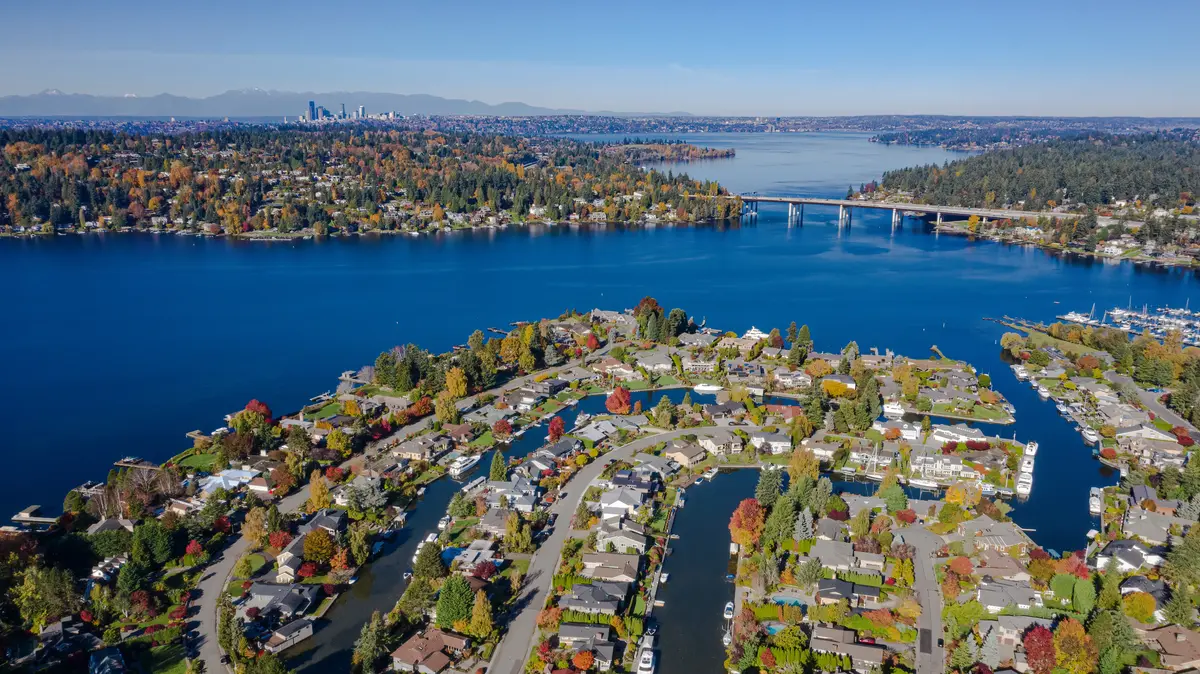
Local Expert Takeaway: The income tax headline is accurate but incomplete. A dual-income tech household earning $180,000 keeps meaningfully more of every paycheck in Bellevue than in California — but those same dollars are competing against a $1,296,767 typical home price driven by the same employer base that generated the income. The families who make this move work are the ones who bring California equity to the table, commit to the Bellevue School District, and genuinely want Cascade trail access over year-round sunshine. The ones who struggle are usually chasing the tax savings as if it will make Bellevue affordable — it makes it more livable, which is a real but different thing.
Quick Takeaways & FAQs
✅ Washington's zero state income tax on wages can add up to $24,000 per year in take-home pay for a dual-income household compared to California — a real and immediate financial advantage.
⚠️ Bellevue's typical home value is $1,296,767 (Zillow Home Value Index, May 2026), meaning the income tax savings improve your cash flow but do not soften the purchase price in one of the Pacific Northwest's most competitive markets.
📍 Beginning January 1, 2028, Washington will impose a 9.9% income tax on adjusted gross income over $1 million via Senate Bill 6346 — high-earning tech relocators should factor this into any long-term financial plan.
Is Washington state really cheaper than California for taxes overall?
How do Bellevue home prices compare to Bay Area prices?
Does Bellevue have good public schools compared to California?
What should I know about Washington's capital gains tax before selling California assets?
What do Californians consistently underestimate about moving to Bellevue?
Moving to Washington?
Tell us what you need help with and we'll connect you with local resources.
