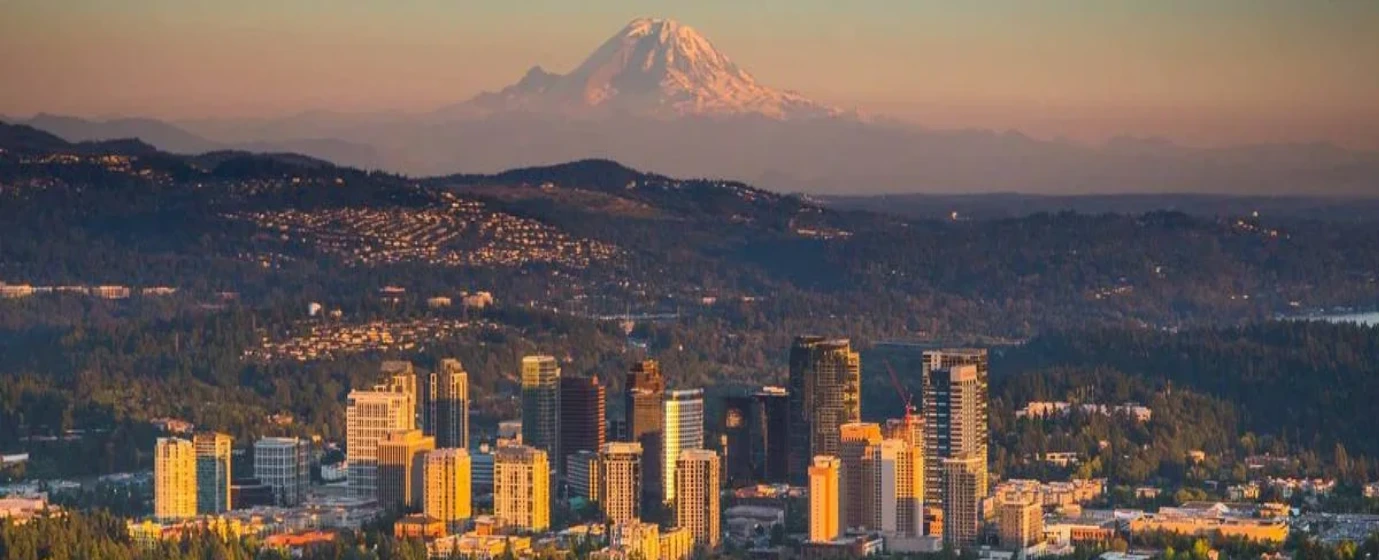
You might not expect a city anchored by Amazon and Microsoft offices to be a serious retirement destination. But Bellevue keeps drawing retirees — particularly people who want the cultural depth and medical infrastructure of a major metro without actually living inside Seattle. The city sits on the eastern shore of Lake Washington, connected to Seattle via I-90 and SR-520, and since April 2024, by Sound Transit's 2 Line light rail. What drives retirement decisions here isn't the tech economy — it's the hospitals, the parks, and the fact that Washington State doesn't touch your Social Security check, your pension, or your IRA withdrawals.
The honest tension is cost. The Zillow Home Value Index put Bellevue's typical home value at $1,296,767 in May 2026 — a figure that immediately sorts out who this guide is and isn't for. Retirees arriving from coastal California or the San Francisco Bay Area often find the prices familiar. Those coming from the Midwest or the South frequently do not. That said, the buyers who make Bellevue work in retirement tend to share a profile: they're selling a long-held home with substantial equity, they want walkable access to medical care and culture, and they've done the math on Washington's tax posture for retirees — which turns out to be quite favorable on income, if not on estate planning.
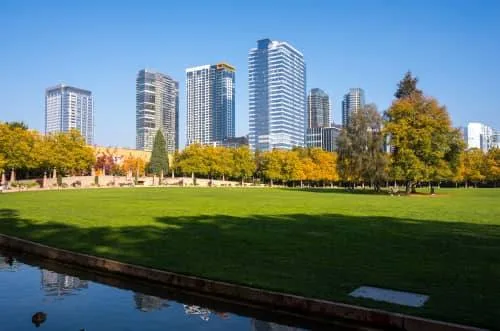
Day-to-day life for retirees here centers on places like Bellevue Botanical Garden, Mercer Slough Nature Park, and the Bellevue Downtown Park — a 21-acre green space steps from the shopping at The Bellevue Collection. The North Bellevue Community Center runs a robust senior program. Overlake Medical Center & Clinics, now part of MultiCare Health System, provides Eastside residents with a Level III Trauma Center and a 2026-designated stroke care program without a bridge crossing to Seattle. The city is hilly in sections and car-dependent in most neighborhoods outside Downtown, which matters more than newcomers anticipate.
Whether you're weighing a full move or comparing Bellevue to nearby alternatives like Kirkland, Issaquah, or Renton, the sections below cover healthcare access, the retiree tax picture, daily budget realities, walkability, downsizing options, and an honest side-by-side with the Eastside's other retirement-relevant towns.
Why Retirees Are Choosing Bellevue
The retirees who thrive here tend to have three things in common: meaningful home equity to deploy, a preference for an urban-adjacent lifestyle over a rural or small-town one, and a genuine appreciation for medical infrastructure being close at hand. Bellevue delivers on all three. With a typical home value of $1,296,767 (Zillow Home Value Index, May 2026), it is not a budget retirement market — but for people arriving with a paid-off home in a pricier West Coast city, the numbers can pencil out surprisingly well once Washington's income-tax posture enters the equation.
The city also rewards retirees who want cultural depth without the friction of Seattle. The Bellevue Arts Museum, the Bellevue Philharmonic, and a downtown restaurant row that has expanded significantly in the last decade all exist within a walkable radius for residents who choose to live in or near Downtown. Parks like the Bellevue Botanical Garden and Kelsey Creek Farm Park offer low-impact outdoor activity year-round — and the Pacific Northwest's mild winters mean you're rarely snowed in.
Bellevue is the wrong call, though, for retirees on a fixed income without significant assets. Dining, services, and everyday spending all carry Eastside pricing. Anyone expecting to coast on a modest Social Security benefit and a small pension will find the cost of living here relentless. Sammamish and Issaquah offer a lower price point with many of the same Eastside amenities — and for retirees who want more walkable downtown access on a tighter budget, Kirkland's waterfront core is worth serious consideration before committing to Bellevue.
Healthcare & Medical Access in Bellevue
The Anchor Facility: Overlake Medical Center & Clinics
Overlake Medical Center & Clinics at 1035 116th Ave NE is Bellevue's primary hospital — a 349-bed nonprofit regional medical center that operates 24 hours a day and holds the distinction of being the Eastside's first Level III Trauma Center. In 2024, it joined the MultiCare Health System, expanding its specialist network and referral pathways significantly. For retirees, the affiliation matters: MultiCare's broader system includes additional specialty centers across the Puget Sound region.
Overlake received the American Heart Association's 2026 Get With The Guidelines® Silver Plus award for stroke care and carries Washington State's Level 3 Stroke Center designation. That's not a ceremonial honor — it reflects documented protocols for time-sensitive response to stroke events, which is one of the most acute concerns retirees have about proximity to medical care. If you're choosing between neighborhoods and one of your criteria is hospital distance, the central and east Bellevue areas — Somerset, Eastgate, Newport Hills — put Overlake within roughly 10 minutes.
Specialty Care and the Seattle Question
For most primary care, cardiology, orthopedics, and post-acute rehab, Bellevue residents don't need to cross Lake Washington. Where the calculus changes is for highly specialized procedures: major cancer surgery, complex neurosurgery, or transplant programs. Those live at University of Washington Medical Center and Swedish Medical Center in Seattle — accessible via I-90 or the 2 Line, but a real commute when you or a family member is unwell.
The honest read for retirees: Bellevue's healthcare infrastructure is genuinely strong for a city of 154,000, with day-to-day and emergency medical needs well covered locally. The gap, relative to living inside Seattle, is subspecialty depth — and most retirees find that gap acceptable given the trade-off in daily quality of life and cost. Having a primary care physician who refers within the MultiCare network helps bridge that gap considerably.
Senior-Specific Medical Services
The Overlake Clinics network includes outpatient locations across Bellevue and the surrounding Eastside, with geriatric care and chronic disease management available closer to home than the main hospital campus. The Eastgate area, in particular, is close to both Overlake and the Emerald Heights continuing care retirement community — a combination that makes it a pragmatic choice for retirees who know they'll be navigating the healthcare system frequently.

The Retiree Budget in Bellevue
Washington's Retirement Tax Advantage
Washington has no individual state income tax. That means Social Security benefits, pension distributions, IRA withdrawals, and 401(k) income are entirely untaxed at the state level — every dollar comes to you without a state withholding line. For a couple drawing $80,000 to $120,000 per year from retirement accounts and Social Security, this represents a meaningful real-dollar advantage over states like Oregon (which taxes retirement income) or California.
Washington does impose a 7% capital gains tax on long-term gains above $278,000 (2025 threshold, indexed annually) — but the law explicitly exempts gains realized through retirement accounts, including IRAs and 401(k)s. Most retirees' primary income sources are untouched by this. The one planning consideration worth flagging: Washington levies an estate tax with a relatively low exemption threshold — well below the federal estate tax floor — which can affect retirees with substantial estates. Work with a Washington-licensed estate attorney before assuming your federal estate plan is sufficient here.
Property Taxes and Daily Cost of Living
Bellevue's effective property tax rate runs approximately 0.88% — on the lower end for a major Puget Sound city, though on a high-value home the absolute annual figure is still significant. For context, see the full cost of living breakdown for how this compares across the region. The effective rate itself hasn't been the primary complaint from retirees here — the bigger friction is daily spending. Dining out, services, and routine purchases all reflect a high-income-area price level that catches fixed-income retirees off guard in year one.
Retirees who budget carefully tend to find Bellevue manageable if they own their home outright or carry a very small remaining balance, use the North Bellevue Community Center for low-cost fitness and social programming, and treat the city's extensive park system as a primary leisure outlet rather than relying entirely on paid entertainment. Those who don't model their budget carefully before moving — especially renters — often discover that Eastside housing costs consume more of a fixed income than projected.
What Surprises People After Year One
The tax picture feels like a windfall when you first move from a state that taxed your pension. Six months in, many retirees recalibrate: the sales tax on everyday purchases (Washington's is among the higher rates nationally), the cost of eating out, and the cumulative weight of Eastside pricing on services and routine errands adds up faster than the income-tax savings suggests. The net is still positive for most — but "no income tax" is not the same as "low cost of living," and conflating the two is the most common financial miscalculation newcomers make.
Looking to buy in Bellevue? Estimate your payment.
Enter your numbers to see an estimated monthly mortgage payment.
Estimate only. Excludes HOA fees and mortgage insurance.
Walkability, Community & Staying Active in Bellevue
The Walkability Reality
Bellevue's citywide Walk Score is 41 — the city as a whole is car-dependent. That number, though, masks a wide range within city limits. Downtown Bellevue scores substantially higher, with the 2 Line light rail stations (Bellevue Transit Center, East Main, Wilburton, Spring District, BelRed) making it possible to reach Seattle and Redmond without a car for the first time. Retirees who plant themselves within half a mile of Downtown's core — near NE 8th Street, Bellevue Way, or the park blocks — can genuinely handle daily errands, medical appointments, and restaurant meals on foot or by transit.
The outer neighborhoods — Somerset, Newport Hills, Eastgate, Bridle Trails — require a car for essentially everything. The terrain in Somerset and Newport Hills is legitimately steep in places, which matters more as mobility changes over time. If driving cessation is a horizon you're planning for, the neighborhood decision here is consequential in a way it wouldn't be in a flatter, more uniformly walkable city.
The North Bellevue Community Center: Where Seniors Actually Gather
The North Bellevue Community Center is the practical hub of Bellevue's organized senior social life. Programming funded in part by the King County Veterans, Seniors and Human Services Levy covers Silver Sneakers Exercise, Tai Chi, Line Dancing, Pickleball, Duplicate Bridge, a community Chorus, and a Russian-Speaking Senior Day Program — reflecting the substantial Russian-speaking immigrant population that has settled on the Eastside over the past three decades. Meals on Wheels partnerships and community dining rounds out a calendar that gives retirees a low-cost reason to leave the house most days of the week.
Beyond the community center, the Bellevue Botanical Garden draws a steady volunteer community — people who want purposeful outdoor time with a social layer attached. Mercer Slough Nature Park, just south of Downtown, offers flat walking paths through wetlands that are genuinely accessible for older adults with limited mobility. Kelsey Creek Farm Park in Eastgate has a quieter following among early-morning walkers who want something other than a paved trail.
The Social Layer That Takes Time to Find
Bellevue's senior community is real but not immediately visible. Unlike smaller retirement towns where social life organizes itself around a single community center or church hall, Bellevue's social fabric for retirees is more distributed — classes at the community center, volunteer programs at the botanical garden, faith communities, and informal groups that form around the 2 Line stations. It exists; it just takes a few months of showing up before it feels like a network rather than a set of scheduled activities.
Right-Sizing: Downsizing in Bellevue
The Inventory Challenge
Bellevue has at least 13 senior living communities operated by 9 different operators, spanning independent living, assisted living, memory care, respite care, hospice, and 55+ housing — a meaningful inventory for a city this size. The catch is that demand consistently outpaces supply at the quality end, and waitlists at the most established communities are common. If downsizing into a Bellevue senior living community is part of your plan, the time to start exploring is 12 to 24 months before you expect to need a spot, not six months.
Emerald Heights: The CCRC Benchmark
Emerald Heights in Bellevue's Eastgate neighborhood is the closest thing to a benchmark continuing care retirement community (CCRC) on the Eastside. Sitting on 23 acres, it offers independent living cottages alongside assisted living, memory care, and skilled nursing on the same campus — meaning a couple can enter at independent living and age in place through the full continuum without relocating. Amenities include a woodworking shop, arts studio, library, and a fitness center with a heated pool. It's not inexpensive, but it's the kind of community where the depth of programming and on-site care genuinely justifies the price point for retirees who value continuity.
Assisted Living and Adult Family Homes
For retirees who need care support but aren't ready for a full CCRC, Bellevue's assisted living market runs approximately $5,500 to $8,000 per month in 2025, with fees typically bundling meals, housekeeping, transportation, and activities. Adult family homes — smaller, residential-scale care settings — average $4,500 to $6,500 per month and can offer a more intimate alternative for retirees who find larger facilities institutional. Both ranges are high by national standards, reflecting Eastside labor and real estate costs.
Single-Level and Condo Downsizing
For retirees not ready for a senior community, Bellevue's condo market in and around Downtown offers a realistic downsizing path — one-level living, building maintenance off the table, and proximity to the 2 Line. The trade-off is price: entry-level condos in Downtown Bellevue don't start cheap, and HOA fees on newer high-rise buildings can be substantial. Patio-home inventory is thinner and competes with a broader buyer pool. Retirees who want single-level detached living in Bellevue proper face genuinely limited options; many find that Issaquah or Redmond offer more inventory at a lower price point if the attached-condo lifestyle doesn't appeal.
Bellevue vs Nearby Retirement Destinations
| City | Cost vs Bellevue | Primary Hospital | Walkability | Senior Living Depth | Overall Retirement Fit |
|---|---|---|---|---|---|
| Bellevue | Anchor | Overlake Medical Center (MultiCare) — Level III Trauma, Level 3 Stroke | Car-dependent overall; Downtown walkable with 2 Line access | Strong — 13+ communities, CCRC at Emerald Heights | Premium Best for retirees with substantial equity and active lifestyle priorities |
| Kirkland | Noticeably cheaper | EvergreenHealth Medical Center — full-service regional hospital with strong cardiac program | Downtown Kirkland waterfront is genuinely walkable; outer neighborhoods less so | Moderate — good options but fewer CCRCs | Walkable Strong alternative for retirees who want waterfront walkability at a lower price |
| Redmond | Somewhat cheaper | EvergreenHealth Redmond — urgent care and outpatient; EvergreenHealth main campus in Kirkland nearby | Improving — Downtown Redmond walkable; 2 Line eastern terminus here | Growing — newer communities, less established than Bellevue | Value Good fit for active retirees who want tech-corridor walkability at a lower price point |
| Issaquah | Moderately cheaper | Swedish/Issaquah — full-service hospital with emergency department; part of Providence system | Old Town Issaquah walkable; most of the city car-dependent | Moderate — solid assisted living options, limited CCRC depth | Nature Best for retirees who want mountain-adjacent lifestyle with good local hospital access |
| Sammamish | About the same or pricier | No on-city hospital; Overlake in Bellevue and EvergreenHealth in Kirkland are both 15–25 minutes | Low — almost entirely car-dependent; limited commercial core | Limited — younger city, few established senior living options | Quiet Works for retirees who drive, value privacy, and already have established medical relationships |
| Renton | Significantly cheaper | Valley Medical Center — large regional hospital, UW Medicine affiliate with emergency and specialty services | Downtown Renton improving; city-wide car-dependent | Moderate — more affordable assisted living options than Bellevue | Budget-Conscious Best value on the south Eastside; right call if price is the primary driver |
Kirkland is the most direct competitor to Bellevue for retirees — it offers a walkable waterfront core, solid hospital access through EvergreenHealth, and a noticeably lower price point without giving up the Eastside's fundamental lifestyle. Issaquah wins on nature access and has a real local hospital in Swedish/Issaquah, but the downtown walkability doesn't match Kirkland's, and the senior living inventory is thinner. Sammamish looks appealing on paper but fails the hospital-proximity test — there's no on-city facility, and retirees who stop driving eventually find its limited transit options isolating. Renton is the honest answer for retirees who want Eastside proximity on a genuinely constrained budget; Valley Medical Center gives it hospital credibility that some smaller nearby cities can't match. Bellevue remains the right call primarily for retirees who want the deepest senior living infrastructure, the strongest local hospital, and the most developed transit-linked Downtown — and who have the assets to pay for it.
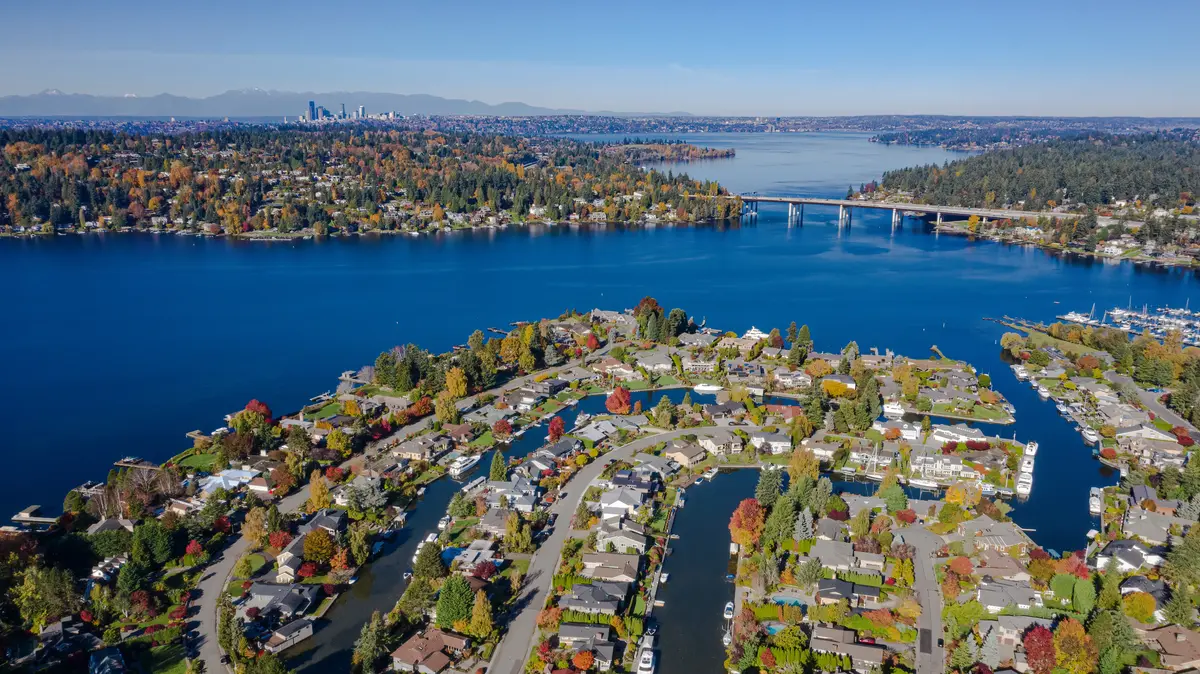
Local Expert Takeaway: The retirees who get Bellevue right start the downsizing conversation early — Emerald Heights waitlists, and quality assisted living in this city fills faster than people expect. They also plant themselves geographically near Downtown or Eastgate if they're thinking about a future without a car: the 2 Line light rail, Overlake Medical Center, and the North Bellevue Community Center's Silver Sneakers and Pickleball programs are all accessible from those areas without navigating Somerset's hills or Bridle Trails' cul-de-sacs. Washington's no-income-tax advantage is real and meaningful — just don't mistake it for a low-cost-of-living guarantee.
Quick Takeaways & FAQs
✅ Washington State exempts Social Security, pensions, and IRA withdrawals from state income tax entirely — a genuine financial advantage that retirees arriving from Oregon or California feel immediately.
⚠️ Bellevue is car-dependent in most neighborhoods outside Downtown, and the terrain in Somerset and Newport Hills is steep enough to matter as mobility changes — location within the city is a retirement planning decision, not just a lifestyle preference.
📍 Overlake Medical Center at 1035 116th Ave NE is the Eastside's only Level III Trauma Center and holds a 2026 Level 3 Stroke Center designation — a meaningful reason retirees on the Eastside don't need to cross Lake Washington for most medical emergencies.
Does Washington State tax Social Security or pension income for retirees?
What is the closest hospital to Bellevue for retirees?
Are there 55+ or active-adult communities in Bellevue?
Is Bellevue walkable enough for retirees who don't want to drive?
How does retiring in Bellevue compare to nearby Kirkland or Issaquah?
Moving to Washington?
Tell us what you need help with and we'll connect you with local resources.
