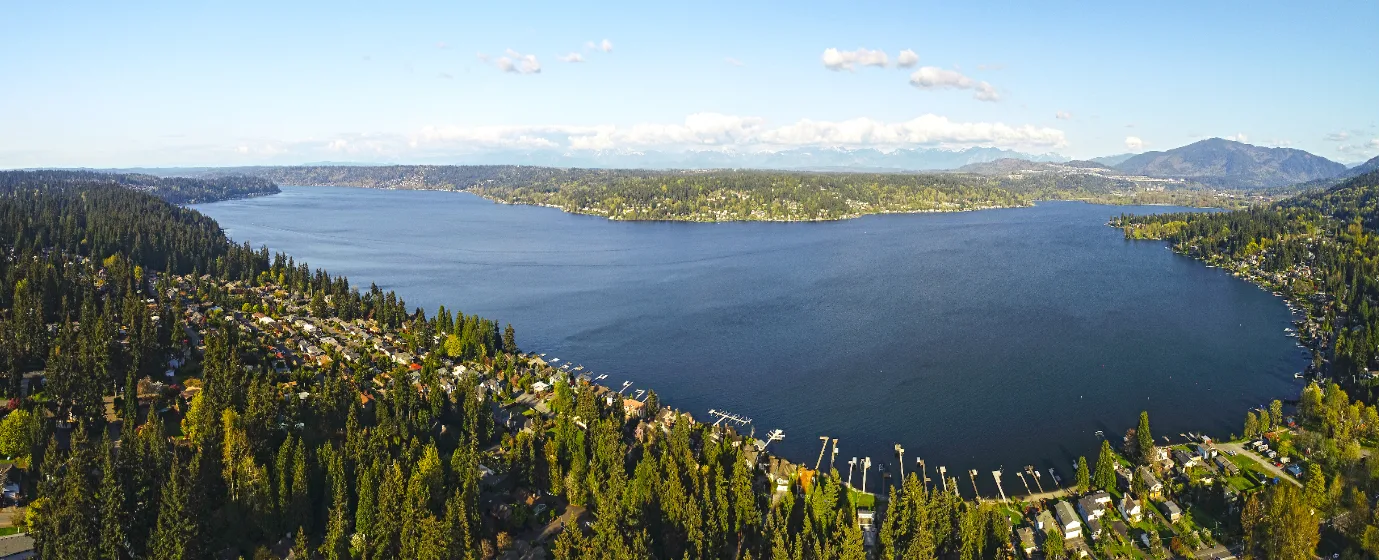
What Is Living in Sammamish, Washington Like?
If you're choosing between Sammamish and somewhere else on the Eastside, the decision usually comes down to this: you want the best schools in the region, a genuinely low-crime environment, and easy access to Microsoft and Amazon campuses — and you're prepared to pay for all three and own a car to make it work. Sammamish sits on the hilly plateau east of Lake Sammamish, incorporated only in 1999 and now one of Washington's fastest-grown cities at roughly 66,500 residents. I-90 is the spine that connects this plateau to the rest of the metro; without it, the 25-minute drive to Bellevue and the 30-to-45-minute run into Seattle wouldn't be possible. What shapes daily life here more than anything else is that the city was designed around the car and, two-plus decades in, still is.
The economic backbone here is unmistakably tech. Microsoft's sprawling Redmond campus sits roughly 15 minutes north, Amazon draws residents south toward Bellevue and Seattle, and Boeing's Puget Sound footprint adds an aerospace layer to the mix. The Lake Washington School District — rated A and consistently among the top-performing districts in the state — is a primary reason families with school-age children choose this plateau over comparable Eastside communities. The city's demographic story follows directly: roughly 37% of residents identify as Asian, many of them first- and second-generation tech-worker households who arrived specifically for the district's reputation and the proximity to Microsoft's Redmond headquarters.
None of this comes cheap. The Zillow Home Value Index for Sammamish reached $1,461,158 as of June 2026, making it one of the most expensive suburban markets in the Pacific Northwest. U.S. News & World Report ranked Sammamish #21 nationally on its 2026–2027 Best Places to Live list — the highest of any Washington city — and #3 in the nation for job market strength. Day-to-day life centers on the East Lake Sammamish Trail for walking and cycling, Soaring Eagle Regional Park and Duthie Hill Mountain Bike Park for outdoor recreation, and the Sammamish Farmers Market for weekend routines. What you give up is a traditional walkable downtown — the long-promised Town Center is only now taking shape — and the sense that you can get anywhere without your keys.
Whether you're being relocated by a tech employer, priced out of Bellevue, or simply researching whether Sammamish fits your life, the sections below break down neighborhoods, housing costs, commuting realities, local employers, schools, and what day-to-day life here actually looks like.
Sammamish at a Glance
Looking to buy in Sammamish? Estimate your payment.
Enter your numbers to see an estimated monthly mortgage payment.
Estimate only. Excludes HOA fees and mortgage insurance. The interest rate above is a starting point, not a quoted rate — replace it with your own to see real numbers. Insurance is a flat placeholder, not a Sammamish quote.
Why Are People Moving to Sammamish?
The case for Sammamish is easy to make in three words: schools, safety, and proximity to tech. The case against it is shorter but worth reading before you make an offer — it's a suburb built for a specific life, and if that life doesn't match yours, the price tag will sting.
The Tech Corridor Pull
Sammamish is the residential answer to a very particular professional question: where do you live when you work at Microsoft in Redmond or somewhere along the Bellevue–Seattle Amazon corridor and want the best public schools available? The Lake Washington School District covers the city and earns an A rating, drawing households who treat school boundaries the way other buyers treat commute times — as a hard constraint. Microsoft's main campus is roughly 15 minutes north on SR-202, and Bellevue's tech office cluster is about 25 minutes via I-90.
A Legitimately Low-Crime Environment
Sammamish recorded 11.2 crimes per 1,000 residents in 2024 — among the lowest of any Eastside city and a fraction of the Washington state average of 56.21 per 1,000. For families relocating from higher-crime metros, that number lands as a genuine differentiator, not marketing language. For more on how that compares across specific areas, see the Sammamish safety page.
Who Actually Moves Here
| Buyer Type | Why Sammamish Fits | What to Know |
|---|---|---|
| Families | Lake Washington School District, low crime, trail access | Budget well above $1.4M median; car is mandatory |
| Tech Workers | 15 min to Microsoft Redmond; 25 min to Bellevue tech core | I-90 congestion is real; remote-work days change the math |
| School-Focused Buyers | #1-ranked Washington city two editions running (U.S. News) | School boundary lines shift; verify before buying |
| Outdoor Enthusiasts | Duthie Hill MTB, Soaring Eagle, East Lake Sammamish Trail | Nearly all recreation requires driving to the trailhead |
| Suburban Seekers | Low density, quiet cul-de-sac neighborhoods, no urban noise | Limited nightlife, dining, and walkable retail in the city itself |
| Remote/Hybrid Workers | Space, quiet, good internet infrastructure in newer homes | On full-office days, commute timing matters enormously |
The city's profile skews toward dual-income households with children — the median household income is $239,690, and the community built around that reality shows in the quality of parks, the caliber of school facilities, and the near-absence of affordable entry-level housing.
The Honest Friction
What surprises people after six months here is how much the lack of a real downtown affects social life. Sammamish has no Main Street to anchor the week. The annual Farmers Market at Sammamish Commons draws a genuine crowd, and a neighborhood cafe along the main corridor fills the role of gathering spot — but the city's commercial infrastructure remains thin relative to its population and price point. The Town Center project broke ground on 38 townhomes in 2024 and eventually promises around 600 apartments and retail space, but that future is still several years away for most residents.
What Daily Life Feels Like in Sammamish
Sammamish moves at a specific rhythm: school drop-off, a commute window that matters a great deal, and then evenings oriented around trails, youth activities, and quiet neighborhoods. That rhythm works beautifully for families with a certain life structure. It can feel constraining for everyone else.
The Geographic Reality
The city sits on a plateau at roughly 400 feet elevation, which gives many neighborhoods tree-lined streets and Pacific Northwest forest as their literal backyard. Soaring Eagle Regional Park's 640-plus acres press right up against residential streets in the eastern part of the city. Big Rock Park and Beaver Lake Park offer local green space that residents treat as weekend routines rather than destination trips.
The East Lake Sammamish Trail runs along the lake's eastern shore — a paved multi-use path that connects Sammamish to Issaquah to the south and Redmond to the north. On summer mornings it's genuinely one of the better cycling commutes in the metro, if your office is in the right direction. Duthie Hill Mountain Bike Park draws serious riders from across the region to Sammamish's own backyard, which is an unusual amenity for a suburb of this size. For more on specific parks and recreation assets, see the parks and recreation page.
What Locals Know
The seasonal quirk nobody warns newcomers about: the plateau fog. On winter mornings when Seattle is merely overcast, Sammamish can sit under dense fog that burns off two hours later than anything at lake level. It doesn't change the weather fundamentally — this is still the western Washington pattern of mild, gray winters — but new residents from sunnier climates consistently underestimate how isolating the plateau fog feels in January and February.
Where families actually gather is less "downtown" and more distributed. Beaver Lake Park and Lodge is a genuine community anchor — the lodge books up for weekend events months out. The Sammamish Commons green space hosts the Farmers Market and serves as the closest thing to a town square. A neighborhood cafe and restaurant along the main commercial corridor has built a reputation as the spot where you'll see familiar faces on weekend mornings.
The City in Numbers
| Category | Sammamish | Context |
|---|---|---|
| Population (2024) | 66,474 | 19th-largest city in Washington |
| Median Household Income | $239,690 | Among highest in King County |
| School District | Lake Washington SD | A-rated; top-performing in WA |
| U.S. News Ranking (2026–27) | #21 nationally | #1 in Washington state |
| Job Market Ranking (U.S. News) | #3 nationally | Reflecting Eastside tech cluster |
| Effective Property Tax Rate | ~0.82% | Below WA Eastside average |
Washington has no state income tax, which meaningfully shapes the financial calculus for high-earning tech households relocating from California or New York. For a full breakdown of the tax picture and cost of living, see the cost of living page.
Community Composition
About 37% of residents identify as Asian — a reflection of the city's deep ties to the tech industry's immigrant workforce, drawn from countries across Asia and representing a genuinely international community character. That diversity shows up in local elementary school PTA demographics, in the mix of cuisine options that have opened over the years, and in the community's broadly international character. Sammamish is not a monoculture, even if its income bracket is fairly narrow.
The Sammamish Housing Market Right Now
The Sammamish housing market rewards patience and punishes hesitation. Well-priced homes in desirable school zones — particularly those feeding into the Lake Washington School District's top-rated middle and high schools — generate multiple offers quickly, even at these price levels.
Where Prices Stand
The Zillow Home Value Index for Sammamish reached $1,461,158 as of June 2026 — a figure that reflects the plateau-wide premium for the school district, the low crime environment, and the Eastside tech employment corridor. That is the city-wide benchmark; some areas of the city carry noticeably higher price points, while pockets of older construction sit below that figure. For neighborhood-level character and how different parts of the city compare, see the best neighborhoods page.
* ZHVI = Zillow Home Value Index.
What the Market Looks Like in Practice
Inventory tightens sharply in spring. Families trying to close in time for the fall school year create predictable demand spikes in March through June, and that seasonal pattern is more pronounced here than in most Eastside communities because of how school-district-motivated the buyer pool is. Summer listings attract a broader set of buyers and sometimes sit longer — which can be an opening for buyers who aren't constrained by school-year timing.
The product mix skews heavily toward detached single-family homes in planned subdivisions from the late 1990s through the 2010s. True walkable infill and attached housing have been almost nonexistent until the Town Center project's recent groundbreaking — 38 townhomes under construction in 2024, with roughly 600 apartments to follow in later phases. That pipeline will eventually add a different price tier to the city, but it's several years from delivering meaningful inventory.
Renting in Sammamish
Rental supply is thin — the city was built predominantly for ownership, and the landlord-tenant market reflects that. For current rental price ranges, see the cost of living page, which tracks the city-wide figures.
Market Pace
Homes priced correctly for their school zone and condition move fast. Coming in without a clear sense of the district's boundary lines — and how those boundaries affect resale value — is one of the most common mistakes buyers make in this market. A home that looks identical on a map to its neighbor can carry a meaningfully different demand profile based on which school it feeds.
Sammamish Neighborhoods
Sammamish has several distinct areas — each with its own character and appeal. Here’s a breakdown to help you narrow down where to focus your home search.
🏡 Klahanie
Klahanie sits in the southwestern corner of Sammamish, with an established HOA community feel, mature landscaping, and its own neighborhood park and pool system that creates a self-contained social life for families. It's one of the more connected parts of the city to Issaquah, making the commute south on I-90 particularly convenient.
🏠 Sahalee
Sahalee is organized around the private Sahalee Country Club golf course, giving its streets a manicured, quiet character unlike much of the rest of the city. Homes back to the fairways or to deep forest, and the neighborhood draws buyers who prioritize privacy and a country-club lifestyle alongside the Lake Washington School District access.
🌳 Pine Lake
Pine Lake centers on its namesake small lake and the adjacent park, creating a genuinely neighborhood-scaled outdoor asset that families use year-round for fishing, picnics, and trail access. The housing stock here mixes older ranch-style homes with newer construction, giving it a slightly more varied feel than the plateau's newer subdivisions.
🏘 Beaver Lake
Beaver Lake is anchored by Beaver Lake Park and the historic Beaver Lake Lodge, which serves as a genuine community gathering venue for events year-round. Streets here tend toward larger lots with mature evergreen buffers, and the neighborhood's proximity to Soaring Eagle Regional Park makes it a draw for outdoor-oriented buyers.
🏔 Trossachs
Trossachs is a planned community in the eastern part of Sammamish with newer construction, an HOA-maintained feel, and straightforward access to the Soaring Eagle Regional Park trail system. It suits families who want move-in-ready homes and the kind of maintained common spaces that reduce weekend maintenance overhead.
🌆 Timberline
Timberline occupies the northern edge of Sammamish near the Redmond border, putting Microsoft's campus closer than almost any other neighborhood on the plateau — a detail that matters for daily commute math. The neighborhood has a quiet, residential character with tree-lined streets and proximity to the East Lake Sammamish Trail's northern access points.
Pros & Cons of Living in Sammamish
The Pros
- Top-rated public schools
- abundant parks
- trails and lake access
- low crime rate
- close proximity to major Eastside tech employers
The Cons
- Very high home prices
- car-dependent with limited public transit
- limited walkable retail/dining core
Getting Around & Commuting in Sammamish
Own a car. That sentence is not a caveat — it is the operating reality of daily life in Sammamish. The city was platted and built around the automobile, and a decade of incomplete Town Center planning hasn't changed that equation. What follows is an honest look at how the commute actually works.
The I-90 Reality
I-90 is the lifeline. Westbound in the morning and eastbound in the evening — that is the rhythm of roughly 60% of employed Sammamish residents. Bellevue runs about 25 minutes in normal traffic, close enough to feel manageable. Downtown Seattle is typically 30–45 minutes, but that range widens significantly during incidents or peak compression: a Friday afternoon during a Seahawks home game can push I-90 to an hour or more from the plateau.
The on-ramps matter. The SE 56th Street feeding onto I-90 at Issaquah can back up during school drop-off overlap with the commute window. Residents who've been here a while know the five-minute difference between leaving at 7:20 and 7:40 — the later departure can cost 20 minutes on the highway.
The Transit Situation — Read This Carefully
In August 2025, King County Metro significantly reduced Route 218 — historically the main bus connection from Sammamish to Seattle. Direct Seattle service was eliminated entirely. The route now terminates at Mercer Island Station, requiring riders to transfer to Link Light Rail to continue into the city. Frequency dropped from every 15 minutes to every 30 minutes. Sound Transit Route 554 continues to serve the South Sammamish Park & Ride on select trips, giving some residents a park-and-ride option into Bellevue and Seattle's transit network.
The city supplements fixed-route service with King County Metro Flex (an on-demand shuttle operating within a defined local zone), a Community Van rideshare program, vanpools, and a SchoolPool program for families. These are useful for hyper-local trips, but they do not replace a car for anyone with a traditional downtown commute.
Commute Map: Major Destinations
| Destination | Typical Drive (off-peak) | Typical Drive (peak AM) | Transit Option |
|---|---|---|---|
| Bellevue downtown | ~25 min via I-90 | 30–40 min | Route 554 to Issaquah TC, then connect |
| Redmond (Microsoft) | ~20 min via SR-202 or NE 40th | 25–35 min | Limited; most drive |
| Seattle downtown | ~35 min via I-90 | 40–60 min | Route 218 to Mercer Island, transfer to Link |
| Issaquah | ~10 min | 15–20 min | King County Metro Flex (local zone) |
| Kirkland | ~25 min via NE 8th/NE 85th | 30–45 min | No direct service |
| Sea-Tac Airport | ~40 min via I-90 W + I-405 | 50–70 min | Drive to Mercer Island, take Link (long route) |
Hybrid and remote schedules have meaningfully shifted how residents experience this commute — a two-day-a-week office schedule turns the I-90 crunch from a daily tax into an occasional inconvenience. That shift has made Sammamish more livable for many tech workers than it was in the full-office era.
Biking and Walking
The East Lake Sammamish Trail is a genuine asset — a paved, flat path along the lake's eastern shore that connects Issaquah to the south and Redmond to the north. It's a viable cycling commute route for residents in the right geography and working in the right direction. Within the plateau itself, suburban street patterns make walking for errands largely impractical. Most daily needs — grocery runs, coffee, medical appointments — require a car.
Employer Access at a Glance
| Employer | Industry | Location | Typical Commute from Sammamish |
|---|---|---|---|
| Microsoft | Technology | Redmond | ~20 min (off-peak) |
| Amazon | Technology | Seattle / Bellevue | 35–50 min (peak, Seattle); 25–35 min (Bellevue) |
| Costco Wholesale | Retail / HQ | Issaquah | ~10–15 min |
| Lake Washington School District | Education | Redmond (HQ) / Sammamish campuses | In-city or ~15 min |
| Boeing | Aerospace | Puget Sound (multiple sites) | 40–60 min to Renton; 50+ min to Everett |
The dominant employment story here is tech — Microsoft and Amazon together account for a substantial share of resident commutes, and the city's income profile reflects that concentration. Boeing and Costco diversify the employer base, but Sammamish's economic identity runs through the Eastside tech corridor.
Schools in Sammamish
Families relocating to Sammamish have public, private, and higher-education options nearby. Here’s a quick overview.
🎓 School District
Lake Washington School District serves K–12 students across Sammamish and the surrounding area. Rated A (source: Niche.com).
🏆 Graduation Rate
The 4-year high-school graduation rate here is approximately 94.2%.
📚 Higher Education
Washington’s public universities — the University of Washington, Washington State University, and Western Washington University — offer four-year degrees statewide, with a network of 34 community and technical colleges (SBCTC) providing two-year and workforce programs.
🌐 Online Learning
University of Washington Continuum College and Washington State University Online offer fully accredited online degrees for remote learners across the state.
Safety in Sammamish
A quick look at how Sammamish compares on the numbers that matter most when weighing a neighborhood or a move.
🛡 Violent Crime
Approximately 0.5 per 1,000 residents.
🔒 Property Crime
Approximately 5.5 per 1,000 residents.
Compared to the FBI’s most recent national data (2024), Sammamish’s violent crime is below the national average (about 3.6 per 1,000), and property crime is below the national average (about 17.6 per 1,000).
Against Washington as a whole, Sammamish’s violent crime is a small fraction of the state average, and property crime is roughly a quarter of the state average (Bureau of Justice Statistics, Crime Known to Law Enforcement, 2024 (tables 2 and 3)).
Crime rates can vary a lot within a single city, so the citywide numbers above are only a starting point. Some neighborhoods in Sammamish run well below these averages, while others run higher — the kind of block-by-block detail that matters most when you’re actually choosing where to live. The full guide below breaks it down neighborhood by neighborhood.
Working in Sammamish
Sammamish’s largest employers span several industries — here are some of the anchors of the local job market.
💻 Microsoft
Technology, Redmond
💻 Amazon
Technology, Seattle/Bellevue
🎓 Lake Washington School District
Education
🛒 Costco Wholesale
Retail, Issaquah
💼 Boeing
Aerospace, Puget Sound region
Parks & Recreation in Sammamish
Some of the outdoor spaces that shape everyday life in Sammamish.
🌱 Beaver Lake Park and Lodge
🌱 Big Rock Park
🌱 Soaring Eagle Regional Park
🌱 East Lake Sammamish Trail
🌱 Duthie Hill Mountain Bike Park
Sammamish residents don’t have to go far for green space — spots like Beaver Lake Park and Lodge and Big Rock Park are part of everyday life here, whether that’s a morning walk, a weekend hike, or just somewhere to unwind outside. The full guide below covers more of what Sammamish has to offer for parks and outdoor recreation.
Retiring in Sammamish
Sammamish draws retirees for its balance of amenities, outdoor access, and cost. Here’s what to weigh.
🌤 Climate
Sammamish shares the western Washington pattern of mild, wet winters and genuinely beautiful summers — but the plateau elevation adds a fog layer in winter months that can feel heavier than at lake level. Summers from June through September are reliably dry and temperate, with high temperatures typically in the low-to-mid 70s. Snow is rare but occasional ice on shaded plateau roads is a real winter consideration.
🍴 Lifestyle
Daily amenities — grocery stores, pharmacies, a handful of restaurants along the main commercial corridor — are accessible without leaving the city, though the dining and cultural scene remains thin for a community this size. The Farmers Market at Sammamish Commons and Beaver Lake Lodge anchor community social life. Issaquah and Bellevue, both within 25 minutes, significantly expand the dining and cultural options available to residents.
🏚 55+ Communities
Sammamish does not have a large concentration of purpose-built 55+ or active-adult communities — its housing stock skews toward family-sized suburban homes built for ownership. The incoming Town Center apartments may eventually provide smaller-footprint options, but that supply is years away. Nearby Issaquah and Redmond have somewhat more established senior-living options for those who want age-targeted amenities.
✈ Getting Around
Driving is the primary mode for nearly all daily trips, and a car is essential. Sea-Tac Airport is roughly 40–50 minutes via I-90 and I-405 in normal traffic. The East Lake Sammamish Trail accommodates walking and cycling for recreation and some point-to-point trips. Public transit options are limited following 2025 service reductions, making car ownership non-optional for most residents.
🏛 Washington Taxes for Retirees — What to Know
- No state income tax — Washington does not tax personal income, so Social Security, pensions, and 401(k)/IRA withdrawals are all untaxed at the state level. There is no state return to file and no retirement exclusion to claim — the rate is simply zero.
- Military and public pensions — Because there is no income tax, military retirement pay and public-employee pensions are untaxed at the state level along with everything else.
- Sales tax is the tradeoff — The state sales tax is 6.5%, and local add-ons bring the combined rate in Sammamish to 10.3% (Washington State Department of Revenue, Q3 2026 local sales & use tax rate table, July 2026). Groceries and prescription drugs are exempt.
- Property taxes, with senior relief — The effective property tax rate is roughly 0.9%. Homeowners 61+ (or unable to work due to disability, or a qualifying disabled veteran) who own and occupy their home may qualify for a reduction. Income limits are set against each county’s median household income, so the threshold differs by county — check with your county assessor. A separate deferral program is available for those who don’t qualify for the exemption.
- Capital gains tax — but not on retirement income — Washington taxes 7% on long-term capital gains above a $278,000 standard deduction for 2025, rising to 9.9% on gains above $1,000,000. Retirement accounts and real estate sales are both exempt. It therefore does not reach ordinary retirement income or the sale of a home.
- Estate tax — the one to plan for — Unlike most no-income-tax states, Washington has its own estate tax. For deaths on or after July 1, 2026, the exemption is $3 million with graduated rates topping out at 20%. Retirement accounts count toward the taxable estate, so long-time homeowners with sizable balances can cross the line without expecting to.
- No inheritance tax — Washington has no inheritance tax, and no gift tax.
- WA Cares payroll premium — Working Washingtonians pay 0.58% of gross wages into the WA Cares Fund, the state long-term care program, with no income cap. It applies to W-2 wages, so retirees who have stopped working do not pay it — but anyone relocating while still employed will see it. The private-insurance opt-out closed at the end of 2022 and is not available to new applicants; the remaining exemptions are narrow (living outside Washington, military spouses, certain visa holders, and veterans with a 70%+ service-connected rating).
- The Oregon border effect — Oregon has no sales tax, so Washington residents near the river — Vancouver, Camas, Washougal, Longview — often cross over for large purchases. Washington use tax technically applies to goods brought back for use in-state, though it is rarely enforced on ordinary personal purchases.
Tax laws change frequently and individual situations vary. This is general information, not tax advice — always consult a qualified Washington tax professional or CPA for personalized retirement tax planning.
Weekends & Local Favorites in Sammamish
The honest weekend reality in Sammamish is that residents often leave it to find what they want. That's not a knock — it's a function of living 25 minutes from Bellevue's restaurant row and 40 from Seattle's neighborhoods. But within the city itself, the outdoor infrastructure is legitimately excellent.
On the Trails
Duthie Hill Mountain Bike Park is the city's most distinctive recreational asset — a 120-acre park with professionally designed flow trails and technical features that draws serious riders from across the metro. If you mountain bike, this alone justifies a close look at Sammamish. Soaring Eagle Regional Park's forested trails cover over 640 acres and function as the city's de facto wilderness backyard, with enough elevation and tree cover to feel genuinely removed from suburban life within 10 minutes of a trailhead parking lot.
The East Lake Sammamish Trail is where weekday cyclists and weekend families converge. On summer Saturday mornings, the trailhead access points fill early. It's a flat, accessible path that works for all fitness levels — the kind of infrastructure that makes the plateau feel less car-dependent for recreation even when it remains car-dependent for everything else.
Local Gathering Points
A neighborhood cafe and restaurant along the main commercial corridor has established itself as the closest thing the city has to a local anchor — a low-key vibe and a clientele that skews resident rather than destination. Beaver Lake Lodge books up months in advance for community events and private gatherings; it's where Sammamish residents celebrate milestones. The Sammamish Commons green space doubles as the Farmers Market venue through the warmer months and as an informal gathering lawn the rest of the year.
Getting Off the Plateau
Issaquah, 10 minutes south on I-90, fills in many of the gaps — independent coffee shops, Gilman Boulevard dining, and the Issaquah Alps trailheads at Cougar and Tiger Mountain. Redmond's Overlake and downtown core are 20 minutes north. Bellevue's Bravern and Bellevue Square corridors represent the closest concentration of upscale retail and dining. Most Sammamish residents treat those three cities as extensions of their weekend options rather than separate destinations.
Year-Round Outdoors
Winter doesn't shut down the trails here the way it might in mountain communities — the elevation is low enough that Sammamish stays mostly above the snow line, though occasional ice on shaded neighborhood roads is a legitimate seasonal consideration new residents underestimate. The real outdoor season runs April through October, and that window is long enough to justify the investment in a good bike or a pair of trail shoes. Snoqualmie Pass, for skiing, is roughly 45 minutes east on I-90 — close enough for day trips, but far enough that you'll check the snow forecast before committing to the drive on a powder day when everyone else in the metro has the same idea.
For a full rundown of parks, trails, and recreation facilities, the parks and recreation page goes deep on what's accessible and where the best access points are.
Top Things Locals Say About Sammamish
The best intel about a city comes from the people who actually live there. Here’s what Sammamish residents say when newcomers ask the questions everyone’s thinking.
“I expected the schools and the trails — those were the reasons we moved. What I didn't expect was how much I'd miss being able to walk anywhere. Six months in, you realize that 'grabbing a coffee' means getting in the car, and that's just the deal you make.”
— Recent Sammamish home buyer
“What's the most surprising thing about living in Sammamish?”
The plateau fog in winter catches almost everyone off guard. When Seattle is just overcast, Sammamish can be locked in dense fog until mid-morning — especially in the neighborhoods on the eastern side of the plateau. It lifts, but those January and February mornings feel genuinely isolating in a way that the Pacific Northwest reputation doesn't quite prepare you for.
“What do locals love most about Sammamish?”
The combination of Duthie Hill, Soaring Eagle, and the East Lake Sammamish Trail — all within 15 minutes of any neighborhood — makes the outdoor access feel disproportionate to the city's suburban setting. And the schools really do deliver. If you moved here for the Lake Washington School District, you're unlikely to be disappointed once your kids are actually in it.
“What should newcomers to Sammamish know?”
Leave for I-90 earlier than you think you need to. The SE 56th Street on-ramp in Issaquah backs up when school drop-off overlaps with the commute window, and what looks like a 25-minute drive to Bellevue can become 45 minutes if you leave at the wrong time. The difference between a 7:20 and 7:45 departure is not marginal. Also, school boundary lines matter enormously to resale value here — verify which schools a specific address feeds before making an offer.
“Can you live in Sammamish without a car?”
Realistically, no. The city was designed around the car and the transit network here, following cuts in August 2025, is more limited than ever. King County Metro Flex provides on-demand local shuttles, but for anything beyond a hyperlocal trip — groceries, work, medical appointments — you need a car. The East Lake Sammamish Trail handles recreation and some cycling commutes, but it doesn't replace a vehicle for daily life on the plateau.
Cities Near Sammamish
Other communities near Sammamish worth a look — each with its own character and price point.
| City | Distance | Best For | Vibe | Median Rent | Median Buy |
|---|---|---|---|---|---|
| Issaquah | 6 mi | families seeking more dining and walkable streets | small-town feel, mountain access, established | $2,300 | $950,000 |
| Redmond | 9 mi | tech workers wanting a shorter Microsoft commute | bike-friendly, urban amenities, growing density | $2,500 | $1,300,000 |
| Bellevue | 12 mi | buyers wanting urban walkability near tech employers | cosmopolitan, high-rise options, restaurant-rich | $2,700 | $1,600,000 |
More Helpful Guides for Sammamish
Going deeper on Sammamish? Our blog series covers everything from first-time buying to retiring here — explore the guides below.
Local Expert Takeaway: Sammamish delivers on its core promises — Lake Washington School District, low crime, and fast access to the Eastside tech corridor — at a price that reflects exactly how well it knows its own value. The city rewards buyers who move with clarity about what they need: a great school district, a safe plateau neighborhood, and a car. If you're expecting the walkable energy of Bellevue's Bel-Red corridor or the urban texture of Kirkland's waterfront, you'll be leaving Sammamish to find it. But if Saturday morning means a mountain bike lap at Duthie Hill, a stop at the Farmers Market at Sammamish Commons, and Sunday dinner sourced from whatever Bellevue or Issaquah has on offer — this plateau life is extremely well-suited to that rhythm.
Quick Takeaways & FAQs
✅ Sammamish is the #1-ranked city in Washington state on U.S. News & World Report's Best Places to Live list, driven by the Lake Washington School District and the Eastside tech job market.
⚠️ The housing market is genuinely expensive — the Zillow Home Value Index hit $1,461,158 in June 2026 — and a car is non-negotiable for daily life on the plateau.
📍 King County Metro Route 218 lost its direct Seattle service in August 2025; if you're commuting into the city without a car, plan around the Mercer Island transfer to Link Light Rail.
Is Sammamish a good place to raise a family?
How far is Sammamish from Microsoft and Amazon?
What is the cost of living in Sammamish like?
Can you get around Sammamish without a car?
Is Sammamish safe compared to other Seattle suburbs?
Helpful Links for Moving to Sammamish
Moving to Washington?
Tell us what you need help with and we'll connect you with local resources.
