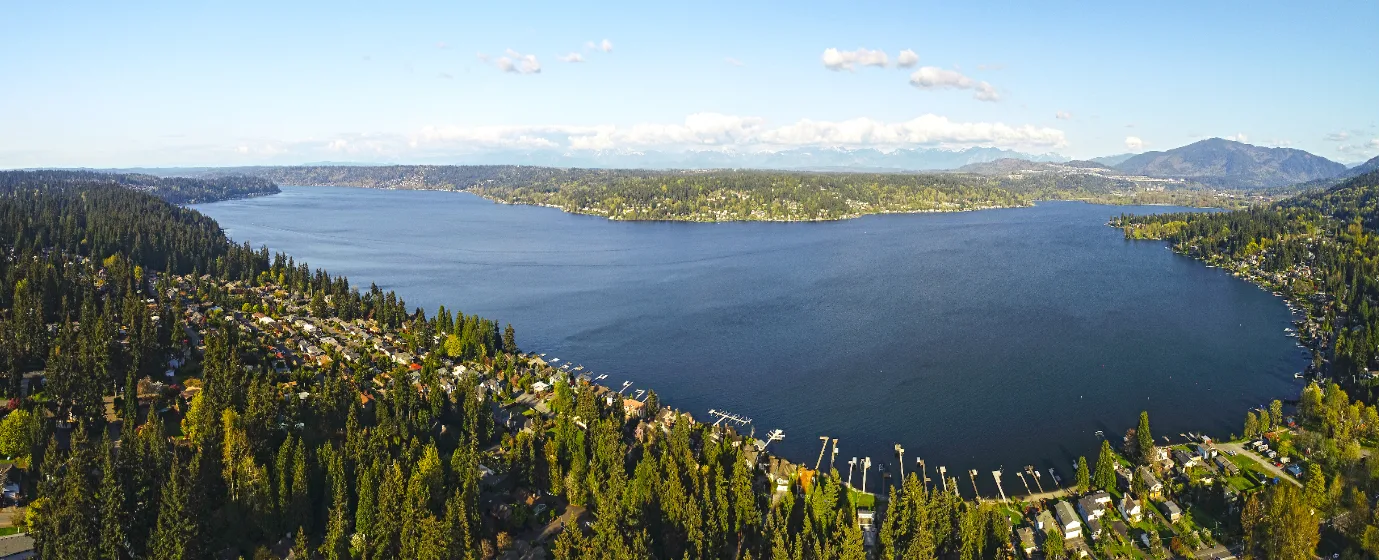
You've probably run the numbers twice already. The paycheck looks the same, but without California's state income tax eating into it, it goes noticeably further. Sammamish sits 20 miles east of Seattle on the Eastside — a planned, heavily forested plateau city of about 66,000 people where Microsoft employees commute north to Redmond and Amazon engineers head west to Bellevue or Seattle. The draw for most California tech workers isn't just the tax math; it's the combination of elite public schools, quiet cul-de-sacs, and trail access that turns out to be a real upgrade over what the same salary buys in the South Bay or the East Bay. The catch, and there is one, is that Sammamish is genuinely expensive — this is not a place where you escape California prices, just California taxes.
The employers who land people here are the same ones relocating them out of California in the first place. Microsoft's main campus in Redmond is the single biggest draw, and Boeing's Puget Sound operations pull aerospace professionals who might otherwise be looking at the Bay Area or Southern California. Amazon's Seattle and Bellevue offices bring a second wave. The Lake Washington School District serves Sammamish and holds an A rating, according to Niche — that is the reason families with school-age children specifically target this side of the lake over other Eastside cities. The community skews young, educated, and heavily tech-adjacent, which means the social fabric feels familiar to people arriving from Silicon Valley or Orange County faster than you'd expect.
Overall cost of living in Sammamish runs approximately 42% above the U.S. national average — but for anyone relocating from San Francisco or the Peninsula, the overall picture is noticeably lower than what you left behind. The Zillow Home Value Index put the typical Sammamish home at $1,461,158 as of June 2026, which is a real number that lands hard if you're coming from Sacramento but feels relatively contained if you're coming from the Bay Area. Day-to-day life runs on trails — the East Lake Sammamish Trail, Soaring Eagle Regional Park, and Duthie Hill Mountain Bike Park give the city an outdoor identity that California transplants consistently cite as the thing they didn't fully anticipate loving. See the cost-of-living page for a full breakdown of groceries, utilities, and transportation.
Whether you've already accepted an offer in Redmond or you're still deciding between staying in California and making the leap, the sections below break down the real tax and price comparison, what the housing market asks of a California buyer, the daily lifestyle shift, what most transplants get wrong in their first year, and the honest reasons some people eventually move back.
The Tax Math: What Leaving California Actually Saves You
Washington has no personal income tax on wages or salaries — zero. California taxes income at rates up to 13.3%, a figure that applies to the income bracket many Sammamish-bound tech workers occupy. For a household earning $300,000 in California, eliminating state income tax represents a savings in the range of $25,000 to $30,000 per year at marginal rates. That is not a rounding error; that is a mortgage payment.
The comparison isn't perfectly clean, though, and you should go in with clear eyes.
| Tax Category | California | Sammamish / Washington |
|---|---|---|
| State income tax (wages) | Up to 13.3% | None |
| Capital gains (long-term, stocks) | Taxed as ordinary income — up to 13.3% | 7% on long-term capital gains above a $278,000 standard deduction for 2025, rising to 9.9% on gains above $1,000,000 |
| Capital gains — home sale | Taxed as ordinary income after federal exclusion | Exempt from WA capital gains tax; federal rules still apply |
| Sales tax (combined) | Varies by county; commonly 8.25–10.25% | 10.3% combined in Sammamish (2026); groceries exempt |
| Effective property tax rate | Typically near 1.1–1.2% (Prop 13 can lower it) | 0.82% |
| State estate / inheritance tax | None | Washington imposes an estate tax on estates above $2.193M |
The sales tax rate of 10.3% in Sammamish will feel high if you're comparing it to a California county with a lower combined rate — but groceries are fully exempt in Washington, so it hits differently in practice than the headline number suggests.
The Capital Gains Wrinkle High-Income Tech Workers Need to Know
If your California departure involves selling a large stock position — RSUs, ISOs, or an ESPP tranche — Washington's capital gains excise tax matters to you in a way it doesn't matter to a W-2 worker with no investment income to speak of. Washington taxes 7% on long-term capital gains above a $278,000 standard deduction for 2025, rising to 9.9% on gains above $1,000,000. California would have taxed all of it at ordinary income rates — up to 13.3% — so Washington still wins on a net basis, but it's not a free pass.
One thing that actually is a clean win: if you're selling your California home and buying in Sammamish, Washington's capital gains tax explicitly exempts real estate sales. Federal exclusion rules still apply, but you won't owe Washington state anything on the home-sale proceeds themselves.
Property Tax: Lower Rate, Higher Base
Sammamish's effective property tax rate of 0.82% is lower than California's nominal 1% baseline — and much lower than what many California homeowners pay on a recently purchased property before Proposition 13 mechanics kick in. The catch is that the base is large. At the Zillow Home Value Index figure of $1,461,158 (June 2026), the annual property tax bill works out to meaningful money. Californians who bought their homes years ago and have been protected by Proposition 13's assessment cap will feel this shift most acutely — your assessed value in Washington resets to purchase price, full stop.
Home Prices: What California Money Buys in Sammamish
The typical home value in Sammamish was $1,461,158 as of the Zillow Home Value Index for June 2026. That is the authoritative benchmark for this guide. If you were hoping for a dramatic escape from California home prices, Sammamish is not your destination — but if you're coming from the Bay Area, you're likely looking at a market that is noticeably below what you left behind.
What the Market Looks Like Right Now
Homes in Sammamish were selling in around 30 days on average as of late 2025, receiving approximately one offer — meaning the frenzied multi-offer bidding wars of 2021 and 2022 have cooled substantially. This is a competitive market, not a panic market. A prepared buyer with financing in order has time to make a considered decision without losing a home to a cash offer submitted in 48 hours.
What that $1.46 million typically gets you is meaningful square footage — often 2,400 to 3,200 square feet — on a wooded lot in a planned community. Areas like Klahanie and Pine Lake have an established feel: mature trees, community amenities, and homes built in the 1990s and early 2000s that have been maintained and updated. Neighborhoods like Trossachs and The Reserve trend newer and larger. For a deeper look at how specific areas compare, the neighborhoods page breaks down each one.
The California Comparison in Real Terms
Buyers relocating from San Francisco, the Peninsula, or Silicon Valley are generally moving into a market that is noticeably lower in overall cost — even at Sammamish price levels. Buyers coming from Sacramento, the Inland Empire, or San Diego may experience the opposite: Sammamish's typical price is well above those markets, and the shock is real.
One practical difference that surprises many California buyers: Washington does not have a state income tax, which changes how much of your gross income is available for a mortgage payment. A household that qualified for a $1.2 million purchase in California may qualify for a meaningfully larger purchase in Washington on the same gross income, once the state income tax drag is removed from the DTI picture. Talk through the specifics with a lender who understands both states; the buying process page covers loan programs and down payment expectations for the Sammamish market.
Renting First Is a Real Option
Some California transplants — especially those arriving on a company relocation timeline — choose to rent for a year before buying. It's a legitimate strategy in a market where neighborhood character varies considerably and you don't want to buy in the wrong area based on a two-day house-hunting trip. Renting also keeps you liquid while you watch how the market moves. The trade-off is that renting in Sammamish is not cheap either, and a year of rent paid is a year of equity not built in a market that has historically appreciated. Neither path is wrong; both are chosen regularly by people in exactly your situation.
The Daily Life Shift: What California Didn't Prepare You For
The Weather Is the Biggest Adjustment, Full Stop
Sammamish gets roughly 54 inches of precipitation per year. That's not snow — it's grey. From mid-October through early May, overcast skies and persistent drizzle are the default. Temperatures stay mild: lows rarely drop below 37°F, and summers peak around 76°F. The summers are genuinely beautiful — dry, green, and warm without being hot — but they are short. July and August average less than half an inch of rain per month combined. If you're arriving from San Diego or the Central Valley expecting that to be the norm, months three through seven will recalibrate your expectations.
Most California transplants cite the winter weather as the thing they underestimated most. Not because it's dangerous or extreme, but because six months of grey sky has a cumulative psychological effect that sunshine-adapted people don't fully anticipate. Invest in a rain jacket, not an umbrella — Sammamish locals barely use umbrellas — and build your outdoor habit early rather than waiting for spring.
Where Sammamish Life Actually Happens
Sammamish is a trail city more than a street city. On a weekend morning, Soaring Eagle Regional Park and the East Lake Sammamish Trail are where you'll find the community: runners, cyclists, families with strollers, mountain bikers heading toward Duthie Hill. The social life that happens in a walkable downtown in California happens here on a trail or in a community park like Sammamish Commons or Big Rock Park. It's a genuinely different rhythm — more intentional, more outdoors-oriented — and most people who stay long-term end up loving it. People who need a walkable restaurant scene within a ten-minute walk of home tend to be less satisfied.
Sammamish Cafe & Spirits on NE 8th St is one of the few locally rooted spots for a sit-down meal inside city limits. The dining and café scene is thinner than what California cities of comparable income levels typically support — most residents drive to Issaquah, Redmond, or Bellevue for a wider range of options. That's not a dealbreaker, but it is a real adjustment if your California life included walking to a neighborhood restaurant three nights a week.
Groceries, Insurance, and the Healthcare Trade-Off
Groceries are exempt from Washington's 10.3% sales tax, which matters more than it sounds at checkout. Health insurance premiums for comparable coverage tend to run noticeably below what you were paying through California employer plans or the individual market, though you will drive farther for specialist care than you would have near a major California metro. Routine care is well-covered on the Eastside; advanced specialist appointments sometimes mean a trip to Seattle. It is worth factoring into your planning if your household has ongoing specialist needs.
Looking to buy in Sammamish? Estimate your payment.
Enter your numbers to see an estimated monthly mortgage payment.
Estimate only. Excludes HOA fees and mortgage insurance. The interest rate above is a starting point, not a quoted rate — replace it with your own to see real numbers. Insurance is a flat placeholder, not a Sammamish quote.
Schools, Community, and Who Actually Moves Here
The Lake Washington School District draws families the way Microsoft draws engineers — it is the primary reason many households target this specific city over other affordable Eastside options. The district holds an A rating, according to Niche, and consistently places among the higher-performing districts in Washington state. For the full picture on school boundaries, individual school ratings, and what the district's advanced academic programs look like, the schools page covers it in detail.
The Demographic Reality
Sammamish has one of the highest concentrations of tech-adjacent households in the state. The median household income is $239,690 — a figure that reflects a community dominated by dual-income tech and engineering professionals, not a statistical outlier at the top. Expect your neighbors to work at Microsoft, Amazon, or one of the Eastside's mid-size software companies. The community is ethnically diverse, strongly international in character across significant neighborhoods, and strongly family-oriented. If you're a tech worker moving from the Bay Area, the social environment will feel familiar in ways that go beyond just the employers.
What Californians Bring That Sammamish Doesn't Have
California transplants sometimes arrive expecting a density of independent restaurants, farmers markets, and cultural venues proportional to the income level of the community. Sammamish doesn't have that. The city is almost entirely residential — it grew quickly as a bedroom community and the commercial infrastructure never caught up with the tax base. The Friday spot for many families is a trail, not a downtown bar. The Saturday routine involves driving to Issaquah or Redmond rather than walking somewhere local. That's a genuine trade-off, and it's worth being honest with yourself about whether you'll adapt to it or fight it for years.
Families with kids who play organized sports find the community builds its own social gravity quickly — youth leagues, school events, and neighborhood parks become the connective tissue. Parents without school-age children sometimes find the community harder to break into, at least in the first year.
Honest Reasons People Leave — and Why Most Stay
Why Some California Transplants Eventually Go Back
The most common reason people leave Sammamish after two or three years isn't taxes or home prices — it's the weather. A person who grew up in San Diego or spent a decade in Los Angeles and genuinely needs sunlight to function can find six months of Pacific Northwest grey genuinely corrosive to their wellbeing. This is not a personality weakness; it is a legitimate climate mismatch that no amount of outdoor gear fully solves. If you've never lived through a Pacific Northwest winter, consider visiting in February before you commit to buying a home.
The second most common reason is the car dependency. Sammamish is one of the least walkable cities in the Puget Sound region — virtually everything requires a drive, including most grocery runs. Californians from suburban areas adapt quickly; people arriving from San Francisco, Oakland, or any neighborhood where they walked or took transit regularly find the adjustment harder than expected. The living in Sammamish page covers commute patterns and transit options in more detail.
Why Most People Who Move Here Stay
The short answer is the schools and the trails. Parents who move here when their kids are in elementary school tend to stay through high school graduation — the Lake Washington School District academic trajectory is strong enough that uprooting a kid mid-stream feels like a genuine cost. And the outdoor access, once it becomes habitual, is genuinely hard to give up. People who build a mountain biking or trail running habit at Duthie Hill or Soaring Eagle Regional Park consistently say it recalibrated what they wanted from a place to live in ways they didn't anticipate when they were looking at spreadsheets in California.
The tax math also keeps people anchored. A household that has spent two years watching their net pay behave differently without California's income tax bite tends to feel the cost of going back in a way that makes the grey winters easier to tolerate. You don't give up the Washington income tax advantage lightly once you've lived with it.
One Thing to Get Right Before You Buy
Don't buy without driving your actual commute at actual commute times. Sammamish's location east of Lake Sammamish means westbound routes toward Bellevue and Seattle funnel through a limited number of corridors, and the morning drive that looks fine on a map can feel very different at 8 a.m. on a Tuesday in November. Many buyers who end up frustrated with Sammamish's commute bought based on off-peak timing or a weekend visit. Crime in Sammamish is among the lowest in the region — the safety page has the specifics — but traffic friction is the friction most people didn't budget for emotionally.

Local Expert Takeaway: The income tax savings are real and substantial — a $300K household coming from California will see $25,000 to $30,000 more per year in take-home pay, and that changes the calculus on a $1.46 million home significantly. But Sammamish is not a bargain market; it's a trade of one set of California costs for a different but still expensive set of Pacific Northwest costs, with a genuinely strong school district, trail access at Soaring Eagle and Duthie Hill, and six months of grey sky thrown in. The people who land well here are the ones who walk the East Lake Sammamish Trail in February before they sign anything.
Quick Takeaways & FAQs
✅ Washington's zero state income tax saves a household earning $300K roughly $25,000–$30,000 per year compared to California — one of the most immediate financial improvements a California tech worker will feel after moving.
⚠️ Sammamish is not a retreat from high home prices: the Zillow Home Value Index put the typical home at $1,461,158 as of June 2026, and the property tax resets to purchase price — a real adjustment for Californians protected by Prop 13.
📍 The driest months in Sammamish are July and August with barely any rainfall — but from October through April, overcast grey is the norm, and most California transplants say the winter weather is the adjustment they most underestimated.
Do I pay California income tax if I move to Sammamish mid-year?
Will I owe Washington capital gains tax when I sell my California home and buy in Sammamish?
How does Sammamish's overall cost of living compare to the Bay Area?
Is Washington's 10.3% sales tax in Sammamish higher than what I paid in California?
What should I know about the Sammamish housing market before making an offer?
Moving to Washington?
Tell us what you need help with and we'll connect you with local resources.
