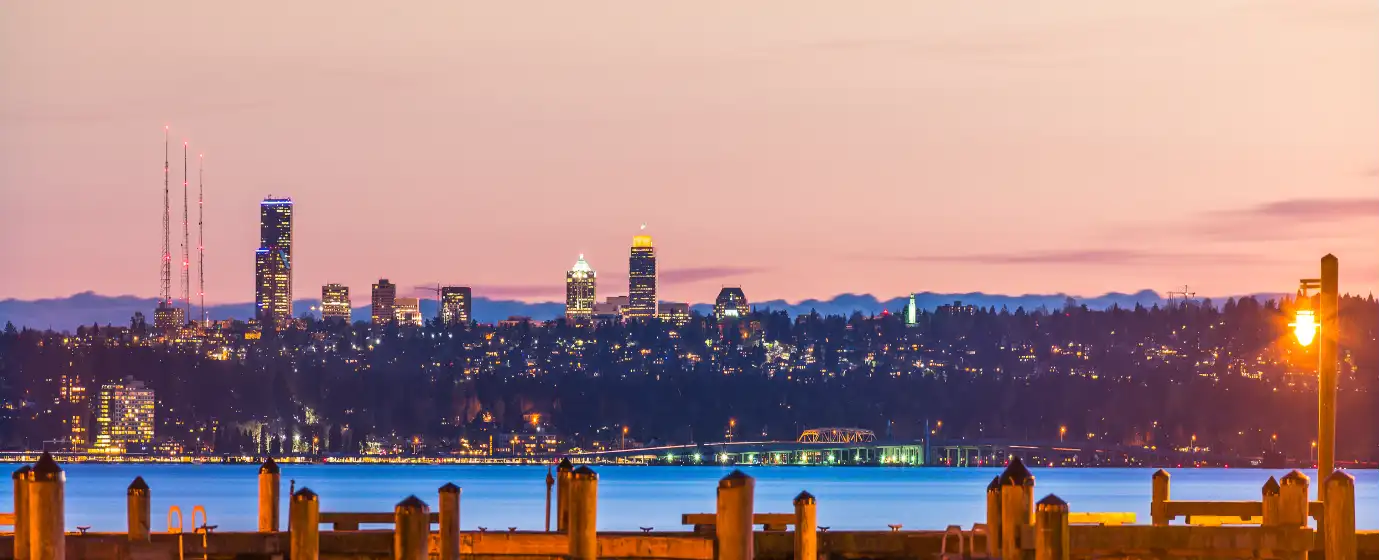
What Is Living in Kirkland, Washington Like?
Most people discover Kirkland one of two ways: a job offer from Google or one of the hundred-plus tech companies clustered on the Eastside, or a waterfront visit that makes Seattle's commuter suburbs look completely different than expected. The city sits on the western shore of Lake Washington, directly across from Seattle, connected by SR-520 and I-405 in ways that make your daily route matter enormously. Marina Park and the waterfront public art walk give Kirkland a downtown feel that most suburbs can't claim, but make no mistake — this is still a car-dependent, high-cost market where the freeway interchange you live near will define your mornings.
The economic engine here is unmistakably tech. Google's Kirkland Urban campus alone covers 760,000 square feet across four buildings embedded in a mixed-use waterfront development — one of the largest tech footprints on the entire Eastside. Tableau/Salesforce, Meta, Apple, and Physio-Control/Stryker add depth to a job base that also includes the Lake Washington School District, consistently one of the highest-rated districts in Washington state, and a major regional health system anchoring the Totem Lake neighborhood. The median household income sits at $150,414, and the community that income reflects — dual-income tech households, parents who relocated specifically for the schools, longtime residents who bought before the market transformed — shapes everything from Friday night traffic on Lake Street to the waitlist at the better weekend breakfast spots.
Cost of living is the honest conversation you need to have early. Kirkland is noticeably more affordable than central Seattle or the most premium pockets of Bellevue, but it is still firmly in premium Eastside territory. The full cost-of-living breakdown covers taxes, groceries, and utilities in detail, but at a glance: Washington's lack of state income tax softens the blow, and the effective property tax rate of approximately 0.82% is lower than many comparable coastal markets. Parks like Peter Kirk Park and the Cross Kirkland Corridor — a paved multi-use trail running through the city along a former rail right-of-way — give daily life an outdoorsy texture that's hard to put a dollar value on. The Kirkland Performance Center, seating fewer than 400, pulls in Grammy-winning artists and Broadway productions in a venue that feels genuinely local.
Whether you're weighing a relocation offer, comparing Kirkland against Redmond or Bothell, or just trying to understand what the waterfront city actually feels like to live in, the sections below cover Kirkland's neighborhoods, housing market, commute realities, employer landscape, and weekend life in concrete terms.
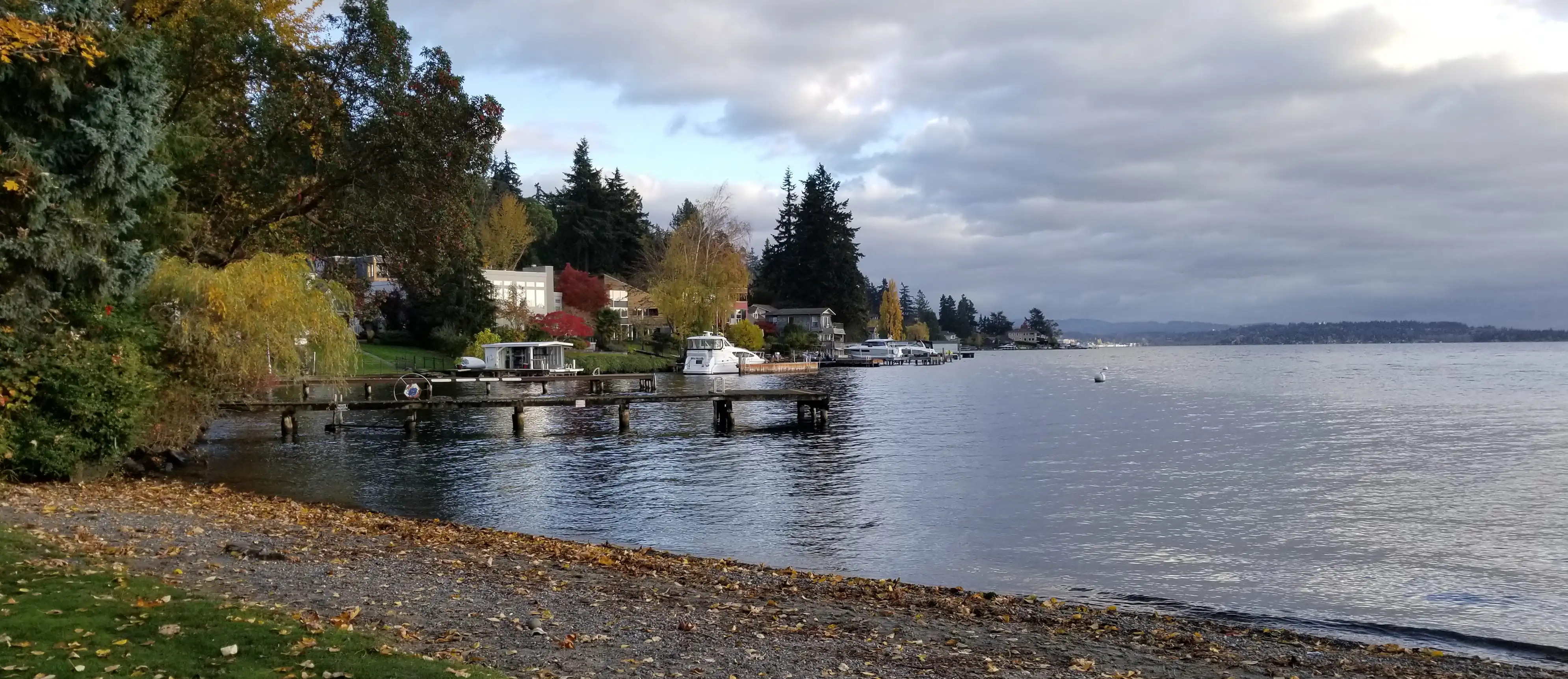
Kirkland at a Glance
Looking to buy in Kirkland? Estimate your payment.
Enter your numbers to see an estimated monthly mortgage payment.
Estimate only. Excludes HOA fees and mortgage insurance. The interest rate above is a starting point, not a quoted rate — replace it with your own to see real numbers. Insurance is a flat placeholder, not a Kirkland quote.
Why Are People Moving to Kirkland?
The short answer: jobs, schools, and the waterfront — roughly in that order for most households arriving from out of state.
The Tech Campus Effect
Google's presence here isn't peripheral. The Kirkland Urban campus is a destination-sized tech hub, and its gravitational pull has brought Meta, Apple, Tableau/Salesforce, and more than 100 other technology firms into the same corridor. If you're a software engineer, product manager, or data professional relocating to the Pacific Northwest, Kirkland lets you live within a 15-minute commute of multiple major employers without being pinned to Redmond's Microsoft campus traffic patterns.
Physio-Control/Stryker adds a medical device dimension that draws engineers and clinical professionals from across the country. The Lake Washington School District holds an A rating, according to Niche, and that reputation is its own recruiting engine, pulling in parents with school-age children who are willing to pay Eastside prices specifically to access those schools.
Who Actually Moves Here
| Buyer Type | Primary Draw | Best Fit |
|---|---|---|
| Tech dual-income households | Google, Meta, Tableau campuses; short in-city commute | Tech Commuter |
| Families with school-age children | Lake Washington School District's top-rated reputation | Families School |
| Seattle escapees | Waterfront lifestyle without Seattle density or city income tax | Walkable Views |
| Medical device / healthcare professionals | Stryker/Physio-Control, regional medical campus | Commuter |
| Eastside upgraders | More character than Redmond, more affordable entry than Bellevue's premium zones | Luxury Value |
| Remote workers prioritizing lifestyle | Cross Kirkland Corridor, Lake Washington access, downtown walkability | Walkable Nature |
Kirkland also draws a quieter cohort: longtime Pacific Northwest residents who've watched Seattle's density rise and want the feel of a real lakeside town with urban-level amenities.
The Honest Pull
What Kirkland offers that its Eastside neighbors don't is a genuine downtown — Lake Street, the waterfront sculpture garden, Marina Park, the weekend farmers market — that feels civic rather than commercial. You can walk from a tech campus to a waterfront park to a live performance at the Kirkland Performance Center within about a mile. That geographic compression of work, life, and recreation is genuinely unusual at this latitude.
What it doesn't offer: affordability by any relative standard, and easy access if I-405 or SR-520 is your daily route during peak hours. Those are the trade-offs almost everyone learns to navigate after month one.
What Daily Life Feels Like in Kirkland
Kirkland doesn't feel like a suburb that accidentally acquired a waterfront. It feels like a lake town that grew into a city — and the tension between those two identities is what daily life here is actually about.
The Waterfront Rhythm
Marina Park and the surrounding public art collection anchor the downtown in a way that makes weekend mornings genuinely pleasant on foot. The sculpture walk along the water draws locals and visitors alike, and on a clear day — which in Kirkland means roughly May through September — the views across Lake Washington toward Seattle are striking enough that people stop in the middle of a run to take them in.
Peter Kirk Park, a few blocks from the waterfront, is where parents with kids in tow actually spend their Saturday afternoons. It has the well-maintained, centrally located feel of a park that a community has decided to invest in rather than simply maintain.
The Cross Kirkland Corridor
The CKC is the city's connective tissue for anyone on foot or a bike. Running through the heart of the city along a former rail right-of-way, it links neighborhoods from Totem Lake in the north down toward Bellevue's borders — and it's used daily, not just on weekends. Longtime residents treat it the way other cities treat a main street.
Totem Lake vs. Downtown
Life in the Totem Lake neighborhood, anchored by The Village at Totem Lake — a 360,000-square-foot lifestyle center with 63 stores and services rebuilt from a former mall — feels noticeably different from the lakefront core. It's more car-oriented, more suburban, and more convenient for errands. Neither is wrong; they're genuinely different towns that share a city boundary.
What Surprises People After Six Months
Two things catch newcomers off guard. First: the gray season runs longer than transplants from California or Colorado expect — not just November and December but often through March, with low cloud cover that sits on the lake and makes the waterfront views disappear for weeks at a time. Second: the community is considerably smaller in feel than 95,000 people suggests. The same faces appear at the Kirkland Performance Center, Peter Kirk Park, and the weekend market. For people who moved here for anonymity, that's unexpected. For people who moved here to feel rooted, it's the whole point.
For a full picture of the parks, trails, and outdoor access woven into daily life, the parks and recreation page covers it in detail.
The Kirkland Housing Market Right Now
Kirkland is a million-dollar market with some softening — but not the kind of softening that changes the fundamental calculus of buying here.
Where Prices Stand
The Redfin median sale price for November 2025 was $1,323,750, down 10.4% year-over-year. The Zillow Home Value Index — a modeled index rather than a transaction median — stood at $1,102,670 as of mid-2026, also reflecting a meaningful pullback from the peak. Both figures point in the same direction: prices have come off their highs, but Kirkland remains firmly in premium Eastside territory, well above the statewide average.
Some areas within the city skew higher, others offer more approachable entry points — the best neighborhoods page breaks that down by area without the city-wide median obscuring the variation.
Market Pace
Homes averaged 33 days on market in November 2025, up from 18 days the prior year — a meaningful shift toward buyers having more time to make decisions. Redfin's Compete Score for Kirkland sat at 75 out of 100, still rated "Very Competitive," which means well-priced homes in desirable areas still move quickly, and waiting for a perfect deal at a steep discount rarely plays out.
The softening has been real enough that the frenzied offer-by-Sunday dynamic of 2021–2023 has eased, but Kirkland hasn't tipped into a buyer's market in any structural sense. Inventory remains tight relative to demand, and the employer base hasn't contracted in ways that would change that equation.
The Honest Picture
If you're coming from a lower-cost market, the sticker price will be the first shock. If you're coming from San Francisco or New York, the price-per-square-foot looks different — and Washington's lack of a state income tax adds meaningful take-home pay that changes the monthly math in ways a list price alone doesn't capture.
For the full cost of living context — including what taxes, utilities, and day-to-day expenses actually add up to here — see the cost of living page.
Kirkland Neighborhoods
Kirkland has several distinct areas — each with its own character and appeal. Here’s a breakdown to help you narrow down where to focus your home search.
🏡 Downtown/Moss Bay
The most walkable part of Kirkland, centered on the Lake Washington waterfront, Marina Park, and the Kirkland Performance Center. It suits buyers who want to walk to the water, the farmers market, and dinner without getting in a car — and who are willing to pay the premium that kind of access commands on the Eastside.
🏠 Norkirk
A residential neighborhood just north of downtown with a quiet, established feel and easy access to Peter Kirk Park. It draws families who want proximity to the waterfront core without the full downtown density or price tag.
🌳 Highlands
An elevated neighborhood with broader lots and more separation from the waterfront's weekend foot traffic. It suits buyers looking for established single-family homes with a traditional suburban feel and relatively quick I-405 access.
🏘 Bridle Trails
Named for the equestrian trail network running through Bridle Trails State Park, this neighborhood attracts buyers who want larger lots, tree cover, and access to riding trails within city limits — a combination that's genuinely rare this close to a major tech corridor.
🏔 Rose Hill
A mid-city neighborhood that sits between the waterfront core and the Totem Lake end of Kirkland, popular with families for its mix of housing types, relatively accessible entry points compared to the downtown area, and proximity to NE 85th Street retail.
🌆 Juanita
A lakeside neighborhood anchored by Juanita Beach Park — one of the only sandy swimming beaches on Lake Washington's eastern shore — that draws families who want water access without downtown pricing. It has a more residential, less commercial feel than Moss Bay.
Pros & Cons of Living in Kirkland
The Pros
- Walkable downtown waterfront on Lake Washington
- strong tech-sector job base including a major Google campus
- highly rated Lake Washington School District
- abundant parks
- beaches
- and lakefront recreation
The Cons
- Very high home prices relative to national averages
- traffic congestion on I-405 and SR-520 during peak commute hours
- limited new housing inventory due to built-out geography
Getting Around & Commuting in Kirkland
Kirkland's commute story is both its biggest selling point and its most consistent frustration — sometimes within the same morning.
The Geographic Reality
Kirkland sits between I-405 running north-south and SR-520 angling southwest toward Seattle and Redmond. For most residents, one of those two corridors governs daily life. If your office is in Seattle's South Lake Union tech district, SR-520 connects you in roughly 25 minutes on a good day — which, in practice, means outside of the 7–9 a.m. and 4–6:30 p.m. windows. Inside those windows, that same trip can stretch to 45–55 minutes with bridge traffic.
The I-405 corridor running toward Bellevue to the south and Bothell to the north is Kirkland's other main artery. The stretch through downtown Kirkland and into Bellevue clogs predictably during peak hours, and the variable-rate toll lanes on I-405 help — if you're willing to use them and pay rates that spike during congestion.
In-City and Eastside Commutes
| Destination | Route | Typical Off-Peak | Typical Peak |
|---|---|---|---|
| Google Kirkland Urban Campus | In-city, Lake Street / Central Way | 5–10 min | 10–20 min (parking adds time) |
| Bellevue Downtown | I-405 S or surface via NE 8th | 12–18 min | 25–40 min |
| Redmond / Microsoft | NE 124th St / SR-520 EB | 15–20 min | 25–35 min |
| Seattle South Lake Union | SR-520 WB | 20–28 min | 40–55 min |
| Bothell / Canyon Park | I-405 N | 15–20 min | 25–40 min |
| SeaTac Airport | I-405 S to I-5 S | 35–45 min | 50–70 min |
Transit: The Current State and What's Coming
Today's bus network covers the basics but won't replace a car for most households. King County Metro routes connect Kirkland to the Eastside and to Seattle's bus tunnel, and the I-405 Stride BRT gives faster access along the highway corridor.
The bigger transit story is the RapidRide K Line, planned for launch by 2030. The K Line will run a 16-mile north-south corridor from the Totem Lake Transit Center in Kirkland south to the Eastgate Park-and-Ride in Bellevue, connecting to Sound Transit's Link light rail and the I-405 Stride BRT. For residents in the Totem Lake and Finn Hill neighborhoods especially, that connection changes the commute calculus significantly — it's worth factoring into a long-term housing decision even though service hasn't started yet.
What Locals Know
The single best adjustment in Kirkland isn't a route — it's timing. People who shift their schedule 30–45 minutes earlier or later than the peak window consistently report cutting their commute by a third. The city is small enough that remote and hybrid workers who only hit the road two or three days a week find the car-dependent reality far more manageable than full-time commuters do. If you're evaluating a job with a downtown Seattle commute five days a week from a neighborhood east of I-405, run that math honestly before you make an offer.
Schools in Kirkland
Families relocating to Kirkland have public, private, and higher-education options nearby. Here’s a quick overview.
🎓 School District
Lake Washington School District serves K–12 students across Kirkland and the surrounding area. Rated A (source: Niche.com).
🏆 Graduation Rate
The 4-year high-school graduation rate here is approximately 94.2%.
📚 Higher Education
Washington’s public universities — the University of Washington, Washington State University, and Western Washington University — offer four-year degrees statewide, with a network of 34 community and technical colleges (SBCTC) providing two-year and workforce programs.
🌐 Online Learning
University of Washington Continuum College and Washington State University Online offer fully accredited online degrees for remote learners across the state.
Safety in Kirkland
A quick look at how Kirkland compares on the numbers that matter most when weighing a neighborhood or a move.
🛡 Violent Crime
Approximately 1 per 1,000 residents.
🔒 Property Crime
Approximately 19 per 1,000 residents.
Compared to the FBI’s most recent national data (2024), Kirkland’s violent crime is below the national average (about 3.6 per 1,000), and property crime is above the national average (about 17.6 per 1,000).
Against Washington as a whole, Kirkland’s violent crime is roughly a third of the state average, and property crime is roughly two-thirds of the state average (Bureau of Justice Statistics, Crime Known to Law Enforcement, 2024 (tables 2 and 3)).
Crime rates can vary a lot within a single city, so the citywide numbers above are only a starting point. Some neighborhoods in Kirkland run well below these averages, while others run higher — the kind of block-by-block detail that matters most when you’re actually choosing where to live. The full guide below breaks it down neighborhood by neighborhood.
Working in Kirkland
Kirkland’s largest employers span several industries — here are some of the anchors of the local job market.
Technology
💻 Tableau/Salesforce
Software
🏥 EvergreenHealth
Healthcare
🎓 Lake Washington School District
Education
🏥 Physio-Control/Stryker
Medical devices
Parks & Recreation in Kirkland
Some of the outdoor spaces that shape everyday life in Kirkland.
🌱 Marina Park
🌱 Peter Kirk Park
Kirkland residents don’t have to go far for green space — spots like Marina Park and Peter Kirk Park are part of everyday life here, whether that’s a morning walk, a weekend hike, or just somewhere to unwind outside. The full guide below covers more of what Kirkland has to offer for parks and outdoor recreation.
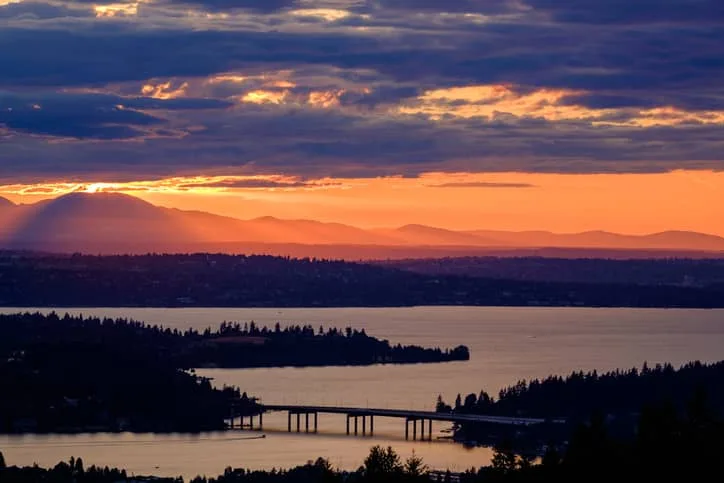
Retiring in Kirkland
Kirkland draws retirees for its balance of amenities, outdoor access, and cost. Here’s what to weigh.
🌤 Climate
Kirkland's mild Pacific Northwest climate means temperatures rarely drop below freezing or climb above the mid-80s. Summers from June through September are warm, dry, and exceptional on the water. The trade-off is a long overcast season from November through March that delivers persistent gray and steady rain — manageable for most, but meaningful for retirees accustomed to more sun.
🍴 Lifestyle
The waterfront public art walk, Marina Park, and the Kirkland Performance Center give retirees a genuinely active cultural calendar without requiring a trip into Seattle. The downtown restaurant and café scene on Lake Street covers everything from casual waterfront dining to independent neighborhood spots, and the Saturday farmers market runs through the warmer months within walking distance of the lakefront.
🏚 55+ Communities
The Totem Lake area, anchored by a major regional health system's medical campus, is the most convenient part of Kirkland for retirees prioritizing healthcare access and single-level living. Active-adult communities and senior-focused housing options exist in the northern end of the city and in neighboring Bothell, which borders Kirkland's Totem Lake neighborhood.
✈ Getting Around
Most daily errands are car-dependent outside of the downtown core. The Village at Totem Lake consolidates shopping and services for residents in the north end, while the waterfront downtown handles dining and recreation for those centrally located. Seattle-Tacoma International Airport is roughly 35–45 minutes by car outside of peak hours.
🏛 Washington Taxes for Retirees — What to Know
- No state income tax — Washington does not tax personal income, so Social Security, pensions, and 401(k)/IRA withdrawals are all untaxed at the state level. There is no state return to file and no retirement exclusion to claim — the rate is simply zero.
- Military and public pensions — Because there is no income tax, military retirement pay and public-employee pensions are untaxed at the state level along with everything else.
- Sales tax is the tradeoff — The state sales tax is 6.5%, and local add-ons bring the combined rate in Kirkland to 10.4% (Washington State Department of Revenue, Q3 2026 local sales & use tax rate table, July 2026). Groceries and prescription drugs are exempt.
- Property taxes, with senior relief — The effective property tax rate is roughly 0.9%. Homeowners 61+ (or unable to work due to disability, or a qualifying disabled veteran) who own and occupy their home may qualify for a reduction. Income limits are set against each county’s median household income, so the threshold differs by county — check with your county assessor. A separate deferral program is available for those who don’t qualify for the exemption.
- Capital gains tax — but not on retirement income — Washington taxes 7% on long-term capital gains above a $278,000 standard deduction for 2025, rising to 9.9% on gains above $1,000,000. Retirement accounts and real estate sales are both exempt. It therefore does not reach ordinary retirement income or the sale of a home.
- Estate tax — the one to plan for — Unlike most no-income-tax states, Washington has its own estate tax. For deaths on or after July 1, 2026, the exemption is $3 million with graduated rates topping out at 20%. Retirement accounts count toward the taxable estate, so long-time homeowners with sizable balances can cross the line without expecting to.
- No inheritance tax — Washington has no inheritance tax, and no gift tax.
- WA Cares payroll premium — Working Washingtonians pay 0.58% of gross wages into the WA Cares Fund, the state long-term care program, with no income cap. It applies to W-2 wages, so retirees who have stopped working do not pay it — but anyone relocating while still employed will see it. The private-insurance opt-out closed at the end of 2022 and is not available to new applicants; the remaining exemptions are narrow (living outside Washington, military spouses, certain visa holders, and veterans with a 70%+ service-connected rating).
- The Oregon border effect — Oregon has no sales tax, so Washington residents near the river — Vancouver, Camas, Washougal, Longview — often cross over for large purchases. Washington use tax technically applies to goods brought back for use in-state, though it is rarely enforced on ordinary personal purchases.
Tax laws change frequently and individual situations vary. This is general information, not tax advice — always consult a qualified Washington tax professional or CPA for personalized retirement tax planning.
Weekends & Local Favorites in Kirkland
Kirkland's weekends organize themselves around the water, the trail, and a downtown small enough to walk end-to-end in twenty minutes.
The Waterfront and Downtown Core
Marina Park is the weekend center of gravity. On a Saturday morning in July, you'll find kayakers launching from the dock, families on the grass, and a slow procession of people along the waterfront sculpture walk — a public art collection spread across several blocks of the lakefront that Kirkland has been building for decades. It's the kind of amenity that feels earned rather than installed.
The downtown restaurant and café scene on Lake Street and Central Way runs the range from family-owned spots to waterfront dining with lake views. The Kirkland Performance Center, tucked into the downtown a short walk from the water, pulls in acts that would fill a 2,000-seat venue elsewhere — the sub-400-seat intimacy is either the draw or the limitation depending on who you ask, but it keeps the city feeling civic rather than just commercial.
The Cross Kirkland Corridor on a Weekend
The CKC on a Saturday morning is Kirkland's version of a town square. Cyclists, runners, dog walkers, and families with strollers share the paved former rail corridor in a way that makes the city feel genuinely connected. Access points drop in at multiple neighborhoods, and the trail links to longer regional routes for cyclists heading toward Bellevue or Redmond.
Totem Lake and the Northern End
The Village at Totem Lake — rebuilt from a former mall into a 360,000-square-foot lifestyle center with over 60 tenants — handles the errands and weekend shopping that the downtown core doesn't. It's less atmospheric than the waterfront but far more practical, and its anchor position next to a major regional health system has made the northern end of the city feel substantially more complete than it did a decade ago.
The Seasonal Reality
Summers here are genuinely spectacular — warm, dry, and oriented around the lake in a way that makes the housing premium feel reasonable. Winters are not severe by Midwest or Northeast standards, but the low-cloud gray that settles in from November through March is relentless in a way that people from sunnier climates underestimate. The waterfront, which defines the city's identity in July, disappears behind overcast for months at a time. Locals who thrive here have made peace with that rhythm; those who haven't tend to leave by year three.
For what the parks and outdoor scene look like across all four seasons, the parks and recreation page has the full picture.
Top Things Locals Say About Kirkland
The best intel about a city comes from the people who actually live there. Here’s what Kirkland residents say when newcomers ask the questions everyone’s thinking.
“I knew the waterfront would be nice, but I didn't realize the Cross Kirkland Corridor would become something I use literally every day — it connects our neighborhood to the downtown in a way that made me rethink how much I actually need the car. What I didn't expect was how quickly I knew my neighbors. It's a smaller community feel than 95,000 people sounds like.”
— Recent Kirkland home buyer
“What's the most surprising thing about living in Kirkland?”
How distinctly different the northern and southern ends of the city feel. Totem Lake has a completely different energy from the downtown waterfront — it's more suburban, more practical, more errand-friendly. People who buy in Finn Hill or Totem Lake thinking they'll walk to the waterfront regularly tend to be surprised by how far away that lifestyle actually is in practice. And the gray season from November through March is longer and more relentless than people coming from Colorado or California expect — the lake views literally disappear behind cloud cover for weeks.
“What do locals love most about Kirkland?”
The waterfront is the honest answer. Marina Park, the sculpture walk, the ability to launch a kayak or just sit on the grass with a view of the lake and the Seattle skyline — it's genuinely accessible and genuinely free. The Kirkland Performance Center also comes up constantly. Getting to see world-class acts in a room that holds fewer than 400 people is something people mention years after moving here as one of the things that made the city feel like home.
“What should newcomers to Kirkland know?”
Test your actual commute route at actual peak hours before you finalize a neighborhood. The difference between a home west of I-405 and one east of it matters enormously if your office is in Seattle. Also: parking in the downtown core on a summer weekend is genuinely difficult — locals who live within walking or biking distance of Lake Street have a real quality-of-life advantage over people who drive in from Rose Hill or Highlands on a Saturday. The Cross Kirkland Corridor access points closest to your home are worth checking on a map before you buy.
“Can you live in Kirkland without a car?”
Today, mostly no — unless you work at or near the Kirkland Urban campus and live in the Downtown/Moss Bay or Norkirk area within walking or biking distance. Current bus service covers major corridors but isn't frequent or reliable enough to replace a car for most households. The RapidRide K Line, projected for 2030, will change this meaningfully for residents near the Totem Lake corridor. If you're buying now with a 10-year horizon and car-free living matters to you, it's worth thinking about which neighborhoods sit along that future route.
Cities Near Kirkland
Other communities near Kirkland worth a look — each with its own character and price point.
| City | Distance | Best For | Vibe | Median Rent | Median Buy |
|---|---|---|---|---|---|
| Bellevue | 8 mi | corporate HQ workers, premium buyers | polished, dense, upscale Eastside core | $2,600 | $1,300,000 |
| Redmond | 9 mi | Microsoft employees, families, new builds | tech-campus suburban, quieter pace | $2,400 | $1,150,000 |
| Bothell | 8 mi | value-seekers, Canyon Park commuters | growing, more affordable, family-oriented | $2,100 | $750,000 |
More Helpful Guides for Kirkland
Going deeper on Kirkland? Our blog series covers everything from first-time buying to retiring here — explore the guides below.
Local Expert Takeaway: Kirkland works best for households that can afford the entry price and have a clear answer to the commute question. If your office is in the Kirkland Urban campus area or on the Eastside generally, the city's combination of Lake Washington access, Lake Washington School District quality, and genuine downtown walkability is hard to match at any nearby price point. If your daily commute crosses SR-520 into Seattle during peak hours, run that scenario on a Tuesday in October before you commit — the drive from a neighborhood east of I-405 to South Lake Union can double in time compared to what Google Maps shows at noon. The Cross Kirkland Corridor and Marina Park are genuinely part of daily life here, not just weekend amenities.
Quick Takeaways & FAQs
✅ Kirkland holds one of the strongest school districts in Washington state, with the Lake Washington School District consistently earning top ratings — a primary reason tech-employed parents pay the Eastside premium.
⚠️ The median sale price of $1,323,750 (November 2025) means Kirkland is firmly a million-dollar market even after a meaningful pullback from peak, and SR-520 bridge congestion during peak hours is the daily friction point most newcomers underestimate.
📍 The Cross Kirkland Corridor — a paved multi-use trail on a former rail right-of-way — connects neighborhoods from Totem Lake to the Bellevue border and functions as the city's most-used public gathering space, not just a recreation amenity.
Is Kirkland WA a good place to live?
What is the cost of living in Kirkland WA compared to Seattle?
What are the best neighborhoods in Kirkland WA?
How far is Kirkland from Seattle?
What is Kirkland WA known for?
Helpful Links for Moving to Kirkland
Moving to Washington?
Tell us what you need help with and we'll connect you with local resources.
