
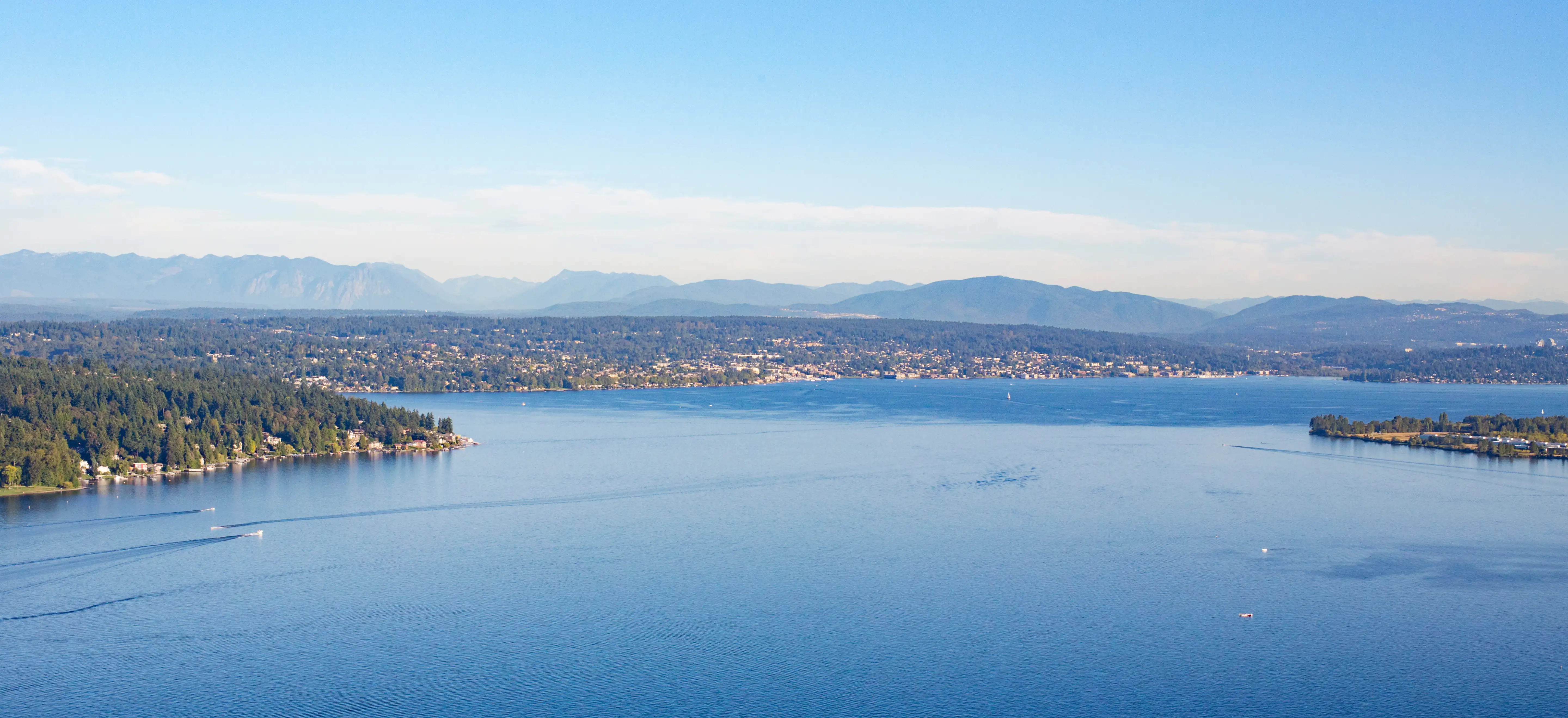
Maybe you've been priced out of Seattle and someone mentioned Kirkland. Maybe your adult children live in Redmond and you want to be close without being dependent. Or maybe you've simply driven the waterfront on Lake Washington and thought: this is where I want to spend my next chapter. What surprises people who actually move here is the combination of world-class healthcare sitting inside a genuinely walkable downtown — not a suburban strip mall version of it, but a real lakeside neighborhood with public art, farmer's markets, and waterfront dining steps from the water. Kirkland sits 25 minutes east of Seattle via I-405 or SR-520, with Bellevue directly to the south and Redmond directly east, giving retirees serious urban access without requiring them to live in either city.
What drives retirees here is rarely a single thing. The headline is EvergreenHealth Medical Center — the only hospital in Washington State ranked among America's 50 Best Hospitals by Healthgrades for 2025 — which sits right inside the city. That matters enormously when you're planning a decade or more of your life around a single community. Kirkland is also among the safer mid-sized cities in the Seattle metro area, and the stable, well-maintained housing stock that drew families for decades now appeals to downsizers. The city's median household income reflects a community that has long attracted professionals and retirees with resources.
Cost is the honest friction point. A median sale price of $1,323,750 (Redfin, November 2025) means Kirkland is a premium retirement destination by any measure. Washington's zero state income tax erases taxation on Social Security, pensions, and retirement-account withdrawals — a genuine structural advantage over states like Oregon or California. But the cost of housing here, combined with the Pacific Northwest's overall cost of living, means your retirement dollar stretches further in Bothell or Woodinville if pure affordability is the goal. For retirees who own appreciated equity elsewhere and want to land in a place with elite healthcare, walkable errands, and Lake Washington 50 yards away, the math can still work. For more on day-to-day costs, see the full cost-of-living breakdown.
Whether you're weighing Kirkland against Bellevue, considering downsizing from a family home into a lakeside condo, or simply trying to understand what retirement here actually looks and feels like on a fixed income, the sections below cover healthcare access, the retiree tax picture, walkability, senior community options, and how Kirkland stacks up against five nearby alternatives.

Why Retirees Are Choosing Kirkland
Kirkland earns serious consideration from retirees for a specific reason: it's one of the few cities in the Pacific Northwest where you can walk to a hospital-adjacent medical campus, catch a waterfront concert at the Kirkland Performance Center, and have a grocery run done on foot — all without getting on a freeway. That combination of genuine urban walkability and suburban safety is rare at any price point in the Seattle metro.
The retirees who thrive here are typically those arriving with equity. Selling a long-held California, Oregon, or even a Seattle home and rolling that into a Kirkland condo or single-level townhome often makes the arithmetic work. Washington's zero state income tax means every dollar of Social Security, pension, or IRA withdrawal stays whole — a structural advantage that Oregon and California retirees feel immediately.
Kirkland is not the right fit for retirees on a tight fixed income. The median sale price of $1,323,750 (Redfin, November 2025) places even the entry point for condos well above what most retirement budgets assume. If your priority is stretching a modest retirement income as far as possible, Bothell and Woodinville offer meaningfully lower price points with reasonable access to healthcare. But if you're asking where in the Seattle metro area you can age in place with elite on-site medical care, a walkable downtown, and a community that has invested seriously in senior infrastructure — Kirkland is the answer.
Healthcare & Medical Access in Kirkland
EvergreenHealth Medical Center: The Anchor
EvergreenHealth Medical Center sits within Kirkland's city limits — not a drive away, not a suburb over. That distinction matters when you're 75 and need a cardiac workup at 2 a.m. The system serves more than one million residents across King and Snohomish counties and operates more than 30 specialty practices on its main Kirkland campus, alongside primary care, urgent care, a full pharmacy, and a state-of-the-art emergency department.
The credentials are not marketing. Healthgrades ranked EvergreenHealth among America's 50 Best Hospitals for 2025 — the only Washington State hospital to receive that designation — and it has held a top-1% national ranking for overall care excellence for five consecutive years, from 2021 through 2025. The Leapfrog Group issued its 12th consecutive 'A' for patient safety in November 2024. U.S. News rates it high-performing in heart attack, heart failure, hip fracture, hip replacement, and pneumonia — exactly the conditions that define healthcare risk for adults over 65.
Specialty Depth and What It Means for Planning
For most retirees, EvergreenHealth handles the full spectrum of routine and acute care without leaving Kirkland. Cardiology, orthopedics, oncology, neurology, and geriatric care are all represented on campus. The honest caveat: for highly specialized tertiary procedures — certain complex cancer surgeries, organ transplants, Level I trauma — Seattle's major academic medical centers (roughly 25 minutes west via SR-520) provide depth that no suburban system can fully replicate. But for the vast majority of what retirees actually need, day-to-day and in urgent moments, having this caliber of hospital inside your city is an exceptional advantage that very few Seattle-area cities can claim.
Kirkland also has a network of urgent care clinics, physical therapy practices, and specialist offices that orbit the main EvergreenHealth campus. Retirees with mobility concerns can often find what they need within a short drive or, from certain downtown areas, by foot or rideshare — no highway required.
The Retiree Budget in Kirkland
Washington's Tax Advantage for Retirees
Washington State levies no personal income tax. Social Security benefits, pension income, IRA withdrawals, and 401(k) distributions are all entirely exempt from state taxation — not partially exempt, not capped at a threshold, but fully outside the state's reach. For a retiree drawing $80,000 or $100,000 a year from a combination of these sources, that represents thousands of dollars annually that would disappear in Oregon, California, or many Midwestern states.
One nuance worth knowing: Washington does impose a 7% capital gains tax on long-term gains exceeding $278,000 annually (2025 threshold) from taxable brokerage accounts. Gains from home sales and retirement-account transactions are specifically exempt. For the typical retiree living on Social Security, a pension, and retirement-account draws, this tax will never apply. If you actively trade a large taxable portfolio, have your CPA review the structure before you file your first Washington return.
Property Tax and Daily Costs
Kirkland's effective property tax rate is approximately 0.82% — among the lower rates in the King County region, which helps retirees who own outright keep carrying costs manageable relative to home value. Washington has no income tax at the state level, but does carry a sales tax that touches daily purchases; for a full breakdown of how groceries, utilities, and transportation costs stack up, the cost-of-living page covers this in detail.
Daily life on a fixed income in Kirkland is genuinely expensive compared to smaller Washington cities. Dining on the waterfront, independent grocery options downtown, and the premium pricing that comes with any high-demand Seattle suburb all add up. Retirees who cook at home, use transit or rideshare rather than maintaining two cars, and downsize from a mortgage to a paid-off condo find the monthly picture more manageable. Those expecting to replicate a full suburban household budget from a working-years income of $60,000 or $70,000 will find Kirkland tight.
Looking to buy in Kirkland? Estimate your payment.
Enter your numbers to see an estimated monthly mortgage payment.
Estimate only. Excludes HOA fees and mortgage insurance. The interest rate above is a starting point, not a quoted rate — replace it with your own to see real numbers. Insurance is a flat placeholder, not a Kirkland quote.
Walkability, Community & Staying Active in Kirkland
The Walkability Reality
Kirkland's citywide Walk Score of 51 is a number that undersells and overpromises at the same time. Downtown Kirkland and the Juanita area genuinely earn a higher score — you can walk to the waterfront, hit Peter Kirk Park, grab coffee at an independent café on Central Way, and run errands along the lake without a car. The Highlands, Bridle Trails, and Finn Hill areas are quieter and hillier; a car is a practical necessity there. If walkable daily life is a retirement priority, the downtown core and Juanita are where to focus your housing search.
The Cross Kirkland Corridor is the standout infrastructure win for active retirees. This 5.75-mile former rail corridor runs as a paved, flat, car-free trail through the middle of the city, connecting neighborhoods that would otherwise require navigating hills or arterials. For retirees who walk daily for health, use a bike or e-bike, or simply want a consistent outdoor loop that isn't a cul-de-sac, the Corridor is the kind of asset that genuinely improves daily quality of life. It links to Kirkland's broader parks and trail network with connections to Juanita Beach Park and points north.
Senior Community and Social Life
Kirkland's senior social infrastructure is quieter than its healthcare profile. The city doesn't have a marquee senior center on the scale of some larger cities, but it does have organized programming through the Kirkland Parks & Community Services department, volunteer opportunities through local organizations, and a downtown fabric — the Kirkland Performance Center, the waterfront art collection, the Marina Park farmers market — that naturally draws an older crowd on weekday mornings. The social life here is woven into the neighborhood rather than sequestered in a dedicated facility.
Retirees who move here from lower-density places sometimes take longer than expected to build social connections — this is one of the honest six-month surprises. The tech-industry demographic that dominates much of Kirkland's residential life moves fast and works long hours. Retirees who plug into arts organizations, volunteer with the library system, or join activity groups through EvergreenHealth's wellness programming tend to build community faster than those who wait for it to come to them.
Right-Sizing: Downsizing in Kirkland
What the Market Offers
Downsizing in Kirkland is financially meaningful. If you're selling a family home at or near the city's median and moving into a condo or patio home, you are making one of the more significant liquidity events of your retirement. The good news is that the condominium inventory in downtown Kirkland and along the waterfront offers genuine single-level or elevator-served options — buildings on the lake with views of the Olympics, units within walking distance of EvergreenHealth, and newer construction in Totem Lake that skews toward lower-maintenance living. The catch is that even the entry-level condo tier in Kirkland is not an affordable-retirement product; expect prices that would be mid-market in many major metros to represent the floor here.
Townhomes and smaller single-family homes in Juanita and Rose Hill offer a middle path — less square footage than a family home, often still single-level primary living on the main floor, with garages and small yards. For retirees who want to stay in Kirkland but shed maintenance without fully surrendering outdoor space, this format tends to be the most satisfying compromise.
Independent and Assisted Living Options
Kirkland's senior living continuum is comprehensive. Assisted living in Kirkland typically ranges from $5,500 to $8,000 per month (Silver Age Care, 2025), while adult family homes — smaller, more residential settings — average $4,500 to $6,500 monthly. These figures are consistent with Seattle-area pricing and reflect the premium that comes with Kirkland's location and care quality.
The headline arrival in the independent living category is Parkshore Juanita Bay, which opened in 2026 in the Juanita neighborhood on Lake Washington. It is the Pacific Northwest's first satellite independent living community specifically for adults 62 and older, holds LEED Platinum certification, and brings a level of purpose-built design to Kirkland's senior living landscape that previously didn't exist locally. For retirees who want independent living with Lake Washington access and proximity to EvergreenHealth, this is the most directly relevant new option in the market. The broader continuum — memory care, skilled nursing, adult day programs — is served through EvergreenHealth's affiliated network and a cluster of independent facilities that have grown up around the medical campus over the years.
One honest note: retirees who want a true 55+ or active-adult community in the golf-course-and-clubhouse sense will not find it inside Kirkland's city limits. That format exists in greater abundance in Woodinville and parts of Bothell. Kirkland's offering is urban and vertically oriented — it suits retirees who want walkable density, not those seeking a gated campus with a driving range.
Kirkland vs Nearby Retirement Destinations
| City | Cost vs Kirkland | Primary Hospital | Walkability | Senior Living Depth | Overall Retirement Fit |
|---|---|---|---|---|---|
| Kirkland | Anchor | EvergreenHealth Medical Center — top 1% nationally, on-site | Moderate citywide; excellent downtown and Juanita | Strong — full continuum including new Parkshore Juanita Bay | Walkable Luxury Best for retirees with equity and healthcare priority |
| Bellevue | Pricier | Overlake Medical Center — well-regarded regional hospital nearby | High in downtown Bellevue core; car-dependent in outer areas | Extensive — larger city with more senior facility options | Luxury Strong urban amenities; higher price floor than Kirkland |
| Redmond | About the same | EvergreenHealth network access; closest full ER is Kirkland | Moderate; downtown Redmond walkable, outer areas less so | Moderate — growing but fewer dedicated senior communities | Quiet Good if you want Eastside living with slightly lower density |
| Bothell | Noticeably cheaper | EvergreenHealth Monroe or drive to Kirkland; no major on-site hospital | Lower — mostly car-dependent; some walkable pockets near Canyon Park | Moderate — a growing selection of assisted living facilities | Value Best cost-to-access trade-off for retirees who can drive |
| Woodinville | Noticeably cheaper | Closest major ER is Evergreen in Kirkland (~20 min); no local hospital | Low — car essential for most errands | Moderate — some 55+ communities and assisted living options | Nature Quiet Wine country appeal; trade-off is car dependence and hospital distance |
| Seattle | Pricier | Multiple academic medical centers including UW Medicine — deepest specialty care in region | Very high in most neighborhoods; transit-rich | Extensive — largest inventory of senior living in the region | Transit Best for retirees who want maximum urban access and don't mind density |
On pure cost, Bothell and Woodinville offer the clearest financial relief compared to Kirkland — retirees who can comfortably drive and don't need a hospital within walking distance often find those two cities give them the most retirement dollar per square foot in the greater Seattle area.
On healthcare depth, Seattle's academic medical centers are unmatched for tertiary and subspecialty care, but Kirkland's EvergreenHealth is the only suburban option in the metro that carries legitimate national recognition — making it the strongest choice for retirees who want elite care without living inside the city of Seattle. Bellevue has solid hospital access and superior walkability in its downtown core, but at a price floor that runs above Kirkland's already-high baseline. For retirees drawn to quiet and open space over walkability, Woodinville's wine-country character and lower density are genuinely appealing — just go in knowing that a medical appointment of any complexity means a 20-minute drive to Kirkland or longer.

Local Expert Takeaway: The retirees who land in Kirkland and stay are almost always the ones who did two things before buying: walked the Cross Kirkland Corridor on a Tuesday morning to see who else was out there, and toured EvergreenHealth's campus to understand what they were actually buying proximity to. The waterfront on a July evening is easy to fall for — and the city earns that first impression. But the real case for Kirkland in retirement is less romantic and more practical: nowhere else in the Seattle metro puts a nationally ranked hospital, a flat car-free trail, and a functioning downtown within a half-mile radius. If that combination justifies a premium housing cost to you, Kirkland will likely exceed your expectations. If it doesn't, Bothell will stretch your budget further with reasonable access to the same EvergreenHealth network.
Quick Takeaways & FAQs
✅ EvergreenHealth Medical Center is the only hospital in Washington State ranked among America's 50 Best by Healthgrades for 2025 — and it sits inside Kirkland's city limits, not a drive away.
⚠️ Washington's zero state income tax is a genuine retirement advantage, but Kirkland's median sale price of $1,323,750 means the city rewards retirees who arrive with equity, not those stretching a modest fixed income.
📍 Parkshore Juanita Bay opened in 2026 as the Pacific Northwest's first satellite independent living community for adults 62+, with LEED Platinum certification and direct Lake Washington access in the Juanita neighborhood.
Is Kirkland a good place to retire on a fixed income?
What hospital serves retirees in Kirkland?
Are there 55+ or active adult communities in Kirkland?
Does Washington State tax retirement income or Social Security?
How walkable is Kirkland for retirees who don't want to drive everywhere?
Moving to Washington?
Tell us what you need help with and we'll connect you with local resources.
