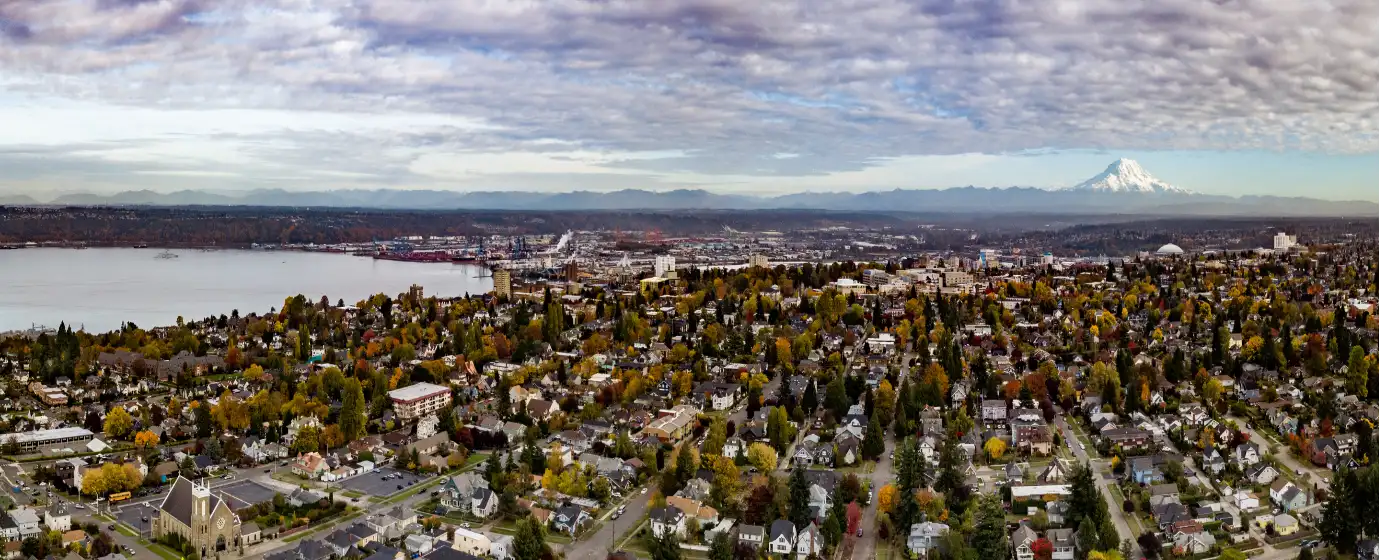
What Is Living in Tacoma, Washington Like?
Maybe you've been priced out of Seattle and someone pointed you south on I-5. Maybe Joint Base Lewis-McChord is sending you here with 60 days' notice. Either way, the first thing newcomers notice about Tacoma isn't the waterfront or the glass museum — it's the gap between the city's reputation and the city they actually land in. Tacoma sits 32 miles southwest of Seattle on the southern end of Puget Sound, bisected by I-5 and shaped by its bay, its bluffs, and a military installation that anchors the entire regional economy. The city that once carried the nickname "the city of destiny" has spent the last decade quietly making good on it.
The economic backbone here is genuinely diverse. Joint Base Lewis-McChord is among the largest military installations in the country and drives an enormous share of Pierce County employment. Two major health systems together employ thousands of local residents, and Tacoma Public Schools is itself one of the city's largest employers. The State of Washington's Pierce County presence adds another layer of stability. The median household income sits at $85,884, and the median resident age is 37.2 — a city that skews working-age, with a mix of military families, healthcare workers, public employees, and a growing creative class drawn by lower rents and a genuine arts infrastructure.
What draws people here most clearly, though, is price. Tacoma's Zillow Home Value Index stood at $496,203 as of July 2026 — noticeably below what buyers face in Seattle. That gap has made Tacoma the default answer for buyers who want Puget Sound proximity without Seattle pricing. Day-to-day life is shaped by Point Defiance Park — one of the largest urban parks in the country — the Ruston Way waterfront path, the T Line light rail threading through downtown, and a Tacoma Creates cultural program that distributed roughly $6.4 million to 80 local arts organizations in its 2026–27 funding cycle. Washington has no state income tax, which matters when you're running numbers on the move.
Whether you're weighing a military PCS, chasing affordability, or genuinely curious whether Tacoma works for your life, the sections below break down the city's neighborhoods, housing market, commute realities, employer landscape, and what weekends actually look like here.
Tacoma at a Glance
Looking to buy in Tacoma? Estimate your payment.
Enter your numbers to see an estimated monthly mortgage payment.
Estimate only. Excludes HOA fees and mortgage insurance. The interest rate above is a starting point, not a quoted rate — replace it with your own to see real numbers. Insurance is a flat placeholder, not a Tacoma quote.
Why Are People Moving to Tacoma?
Tacoma added roughly 2,600 residents in the year ending April 2026, reaching an estimated 231,000 people and ranking second in Washington State for numeric population growth. That's not coincidental growth — it's the product of a specific economic and geographic logic.
The Military Factor
Joint Base Lewis-McChord shapes Tacoma in ways that no other employer replicates. Thousands of active-duty service members and civilian employees cycle through Pierce County on PCS orders, which means Tacoma has a rental market and a real estate market permanently calibrated to people arriving with 60 days to find a home. That steady institutional demand keeps the market from going fully cold even when other regional markets soften.
The Seattle Pressure Valve
For workers who commute north to Seattle or Bellevue, Tacoma represents a straightforward calculation: Seattle's home values ran noticeably higher than Tacoma's $496,203 (July 2026 Zillow Home Value Index) as of mid-2026. For buyers who can tolerate a 45-minute commute to King Street Station on the Sounder S Line, the savings are real and substantial. The same logic applies to renters — for a full breakdown of what renting costs here, the cost-of-living page has current figures.
The Employers Beyond the Base
For people who aren't military-connected, Tacoma's civilian economy is more robust than its reputation suggests. Two major regional health systems employ large numbers of nurses, technicians, administrators, and support staff. Pierce County government, UW Tacoma, and Tacoma Public Schools add a stable public-sector floor.
| Employer Sector | Key Employer | Who It Draws | Stability Profile |
|---|---|---|---|
| Military | Joint Base Lewis-McChord | Active-duty, civilian DOD, contractors | Commuter Families |
| Healthcare | MultiCare Health System | Clinical and administrative staff | Value Stable |
| Healthcare | Virginia Mason Franciscan Health | Physicians, nurses, allied health | Value |
| Education | Tacoma Public Schools | Teachers, staff, administrators | Families School |
| Government | State of Washington | State agency workers, Pierce County staff | Commuter |
| Higher Education | University of Washington Tacoma | Faculty, staff, graduate students | Walkable Transit |
What people who move here for work often discover after six months: the economy is more recession-resistant than they expected, precisely because so much of it is anchored in federal spending and healthcare demand rather than any single private-sector industry.
Why Some People Leave
Honest answer: crime statistics are a real reason some buyers reconsider Tacoma or choose to concentrate their search in specific neighborhoods. The city-wide figures are higher than some neighboring communities, and the safety page breaks down which areas of the city look meaningfully different from each other. The other common exit reason is the commute — people who expected 45 minutes to Seattle and got 75 minutes in I-5 traffic on a typical Wednesday morning.
What Daily Life Feels Like in Tacoma
Tacoma doesn't ask you to drive to the edge of the metro for a weekend outdoors — it puts Point Defiance Park, 760 acres of old-growth forest and saltwater shoreline, inside city limits. The Ruston Way waterfront path runs along the city's bay for nearly two miles, and that stretch is where you'll find Tacoma's version of casual Friday-evening life: people walking dogs, watching the container ships move through the Sound, and stopping at one of the waterfront spots for a beer. It's a genuinely local scene, not a tourist corridor.
Arts and Culture, Seriously
Tacoma Creates — Washington's first local arts funding program of its kind — pumped approximately $6.4 million into 80 nonprofit arts, culture, heritage, and science organizations for the 2026–27 cycle. That money shows up in lived experience: Tacoma Arts Month in 2025 produced 150 events and drew roughly 75,000 participants across the city.
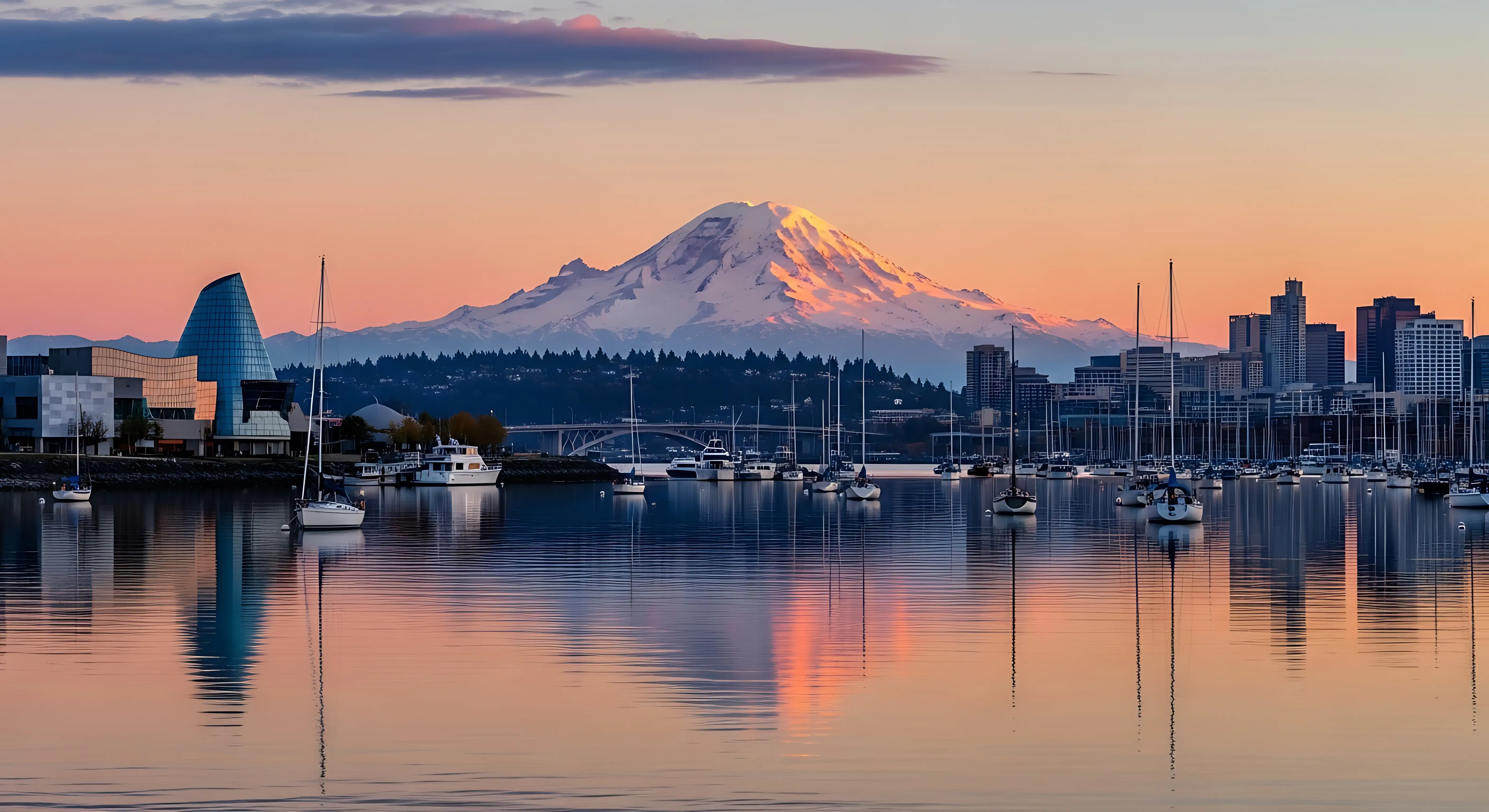
The Museum of Glass anchors the cultural waterfront and is connected to the Washington State History Museum by a pedestrian bridge spanning the highway below. The LeMay — America's Car Museum near the Tacoma Dome holds the world's largest collection of automobiles open to the public. These aren't minor attractions — they're institutions with national reputations that happen to sit in a mid-sized city.
The Brewpub Scene
On N Pine St, E9 Firehouse operates as a gastropub out of a converted historic firehouse. The same operation runs E9 Brewing Co. & Taproom separately on Fawcett Ave, where the production side of the brewery anchors a taproom worth an afternoon. Tacoma has a genuinely developed craft beer culture that punches above what the city's size would suggest.
What Newcomers Don't Expect
The seasonal quirk that catches people off guard: Tacoma winters are mild by national standards but persistently grey and damp from November through March. People who moved from sunnier climates report this as the hardest adjustment — not cold, not snow, just a relentless marine overcast that makes the summer months feel like a completely different city. The flip side is that summers here, with long evenings and temperatures that rarely exceed the mid-80s, are objectively excellent.
For a full look at Tacoma's parks, trails, and outdoor options, the parks page goes deep on Point Defiance, the waterfront, and the trail network.
Where Families Actually Gather
The Proctor District functions as the neighborhood's main street — a compact stretch with independent cafés, a farmers market on summer Saturdays, and the kind of walkable-streets energy that much of Tacoma doesn't have. Parents with school-age children tend to cluster there and in the city's northeast residential areas, where the neighborhood feel is quieter and access to Tacoma Public Schools options varies considerably by address.
The Tacoma Housing Market Right Now
The Zillow Home Value Index for Tacoma stood at $496,203 as of July 2026, down approximately 0.1% year over year. That near-flat movement reflects a market that stabilized after years of rapid appreciation — not a market in retreat.
Redfin's Compete Score rated Tacoma's market at 90 out of 100 as of July 2026, with homes typically going to pending in 8–9 days and the average home selling at or slightly above list price. That pace is not hypothetical — buyers who treat Tacoma like a slow, secondary market and take a week to schedule a second showing are routinely losing out to offers already on the table.
What the Market Feels Like on the Ground
Entry-level inventory — older construction, smaller footprints, higher-need condition — does exist in Tacoma, and it enters the market at prices noticeably below the city-wide figure. The upper end of the market, particularly in the waterfront corridor and the city's established northern residential areas, pushes well above that same figure. Some areas cost meaningfully more than others; the neighborhoods page breaks down character and relative price positioning across the city.
For renters deciding between buying and staying in the rental market, the cost-of-living page has current city-wide rent figures and a fuller picture of what monthly expenses look like across housing types.
The Tax Context
Washington has no state income tax — a significant factor for buyers relocating from states that do. The effective property tax rate in Tacoma runs approximately 0.94%, which is relatively modest by national standards and sits close to the Washington State average. For the full picture on property, income, and sales tax, the cost-of-living page has the details.
Who the Market Favors Right Now
Buyers who already live in Pierce County or have done serious local research have a meaningful edge over remote buyers who haven't walked the neighborhoods. The market moves fast enough that surprises — a block that looks fine on Zillow but sits adjacent to a noisy freight corridor, or a stretch of a neighborhood that feels different from the rest of its zip code — cost you a house if you find them after you've made an offer rather than before.
Tacoma Neighborhoods
Tacoma has several distinct areas — each with its own character and appeal. Here’s a breakdown to help you narrow down where to focus your home search.
🏡 North End/Proctor
The Proctor District anchors this area with a walkable main street of independent shops and cafés, and the residential blocks running off it feature Craftsman bungalows and established trees. Point Defiance Park sits at the neighborhood's western edge, making it one of the most consistently sought-after corners of the city.
🏠 Stadium District
The Stadium District takes its name from the historic high school — the turreted castle-like building perched above the city — and offers Victorian and early 20th-century housing stock with views of the bay. It's popular with buyers who want older architectural character and walkable access to downtown.
🌳 Old Town
Old Town sits along the waterfront just north of downtown and is one of Tacoma's oldest platted areas, with a mix of historic commercial buildings and residential streets close to the Ruston Way path. It suits buyers who want a quieter waterfront-adjacent setting without paying a premium for the most established northern neighborhoods.
🏘 Hilltop
Hilltop is Tacoma's most rapidly changing neighborhood, now connected directly to the Tacoma Dome and downtown by the T Line's 2023 extension. It has a dense, urban character and a mix of longtime residents and newer arrivals drawn by relatively lower prices and improving transit access.
🏔 West End
The West End occupies the peninsula between Puget Sound and the Tacoma Narrows, offering some of the city's most dramatic water views and a quieter residential pace. It's a long drive from downtown but appeals to buyers who prioritize views and space over walkability.
🌆 South Tacoma
South Tacoma is the city's most affordable major district, with working-class roots, a diverse commercial corridor along South Tacoma Way, and housing stock that skews older and more varied in condition. It suits buyers who prioritize price and are willing to do more due diligence on specific blocks.
Pros & Cons of Living in Tacoma
The Pros
- Far more affordable than Seattle while still on the same commuter rail/I-5 corridor
- walkable
- historic neighborhoods with strong arts and museum scene
- dramatic Puget Sound and Mount Rainier views from waterfront parks
- growing downtown with University of Washington Tacoma anchoring revitalization
The Cons
- Higher-than-average violent and property crime rates in parts of the city
- gray
- rainy winters with limited sunshine
- I-5 commute into Seattle can stretch well beyond an hour during peak traffic
Getting Around & Commuting in Tacoma
Tacoma's commute story has two completely different chapters depending on how you travel. For drivers heading north to Seattle on I-5, the theoretical 45-minute trip becomes 60–90 minutes on a normal weekday morning. For riders on the Sounder S Line commuter rail, the trip from Tacoma Dome Station to King Street Station in Seattle is scheduled, consistent, and runs without the I-5 variable. Those two experiences belong to different lives.
The Rail Network
The Sounder S Line is the commuter workhorse for Seattle-bound workers. Trains run between Lakewood, Tacoma Dome Station, and King Street Station, and the schedule is tight enough that regular riders build their entire morning around it. It doesn't run late evenings or weekends, which matters for anyone whose job or social life doesn't fit a 9-to-5 pattern.
Inside the city, Sound Transit's T Line light rail covers 4.0 miles across 12 stations, connecting Downtown Tacoma, the Stadium District, Hilltop, and UW Tacoma. The Hilltop extension, completed in 2023, doubled the line's reach and finally connected one of Tacoma's most densely populated neighborhoods to the Tacoma Dome Station. Trains run every 12 minutes at peak times and recorded nearly 987,000 total boardings in 2025 — a real transit line, not a symbolic one.
The Bus Network
Pierce Transit operates roughly 29 bus routes serving neighborhoods across Tacoma and connecting to Lakewood, Puyallup, and the surrounding communities. In March 2026, updated routes and schedules went into effect to improve reliability across the network. Coverage is meaningful within the core of the city; outer residential areas require more planning to make car-free life work.
Driving Within Tacoma
I-5 and SR-16 are the city's main arterials, and both have predictable congestion windows. SR-16 toward Gig Harbor and the Kitsap Peninsula moves well except at rush hour near the Tacoma Narrows Bridge. The city adopted a Transportation and Mobility Plan in June 2025 that lays out a 20-year framework for pedestrian, bicycle, and transit investments — so the infrastructure picture is actively evolving, not static.
| Mode | Route / Line | Destination | Typical Travel Time | Best For |
|---|---|---|---|---|
| Commuter Rail | Sounder S Line | Seattle (King Street) | ~60 min scheduled | Commuter |
| Light Rail | T Line | Downtown ↔ Tacoma Dome | ~20 min end-to-end | Transit Walkable |
| Bus | Pierce Transit (29 routes) | City + Lakewood, Puyallup | Varies by route | Renter Transit |
| Driving | I-5 North | Seattle | 45–90 min (variable) | Commuter Families |
| Driving | SR-16 West | Gig Harbor / Kitsap | 20–40 min | Commuter |
| Driving | I-5 South / SR-512 | Puyallup / JBLM | 15–30 min | Families Commuter |
One thing the Sounder commuters learn quickly: the train doesn't solve the last-mile problem. Getting from King Street Station to an employer in South Lake Union or on the Eastside still requires a connection, which is why many Tacoma-based Seattle commuters use the train for part of the week and drive on days when the schedule doesn't fit.
Living Without a Car
It's possible in parts of Tacoma — specifically the urban core, downtown, the Stadium District, and neighborhoods near the T Line. It's genuinely difficult in the city's southern and outer eastern neighborhoods, where bus frequency drops and destinations are spaced farther apart. The honest answer is that most Tacoma households own at least one car, and the transit network is strongest for the downtown-to-Seattle commute rather than for general car-free living across the whole city.
Schools in Tacoma
Families relocating to Tacoma have public, private, and higher-education options nearby. Here’s a quick overview.
🎓 School District
Tacoma Public Schools (Tacoma School District No. 10) serves K–12 students across Tacoma and the surrounding area. Rated C+ (source: Niche.com).
🏆 Graduation Rate
The 4-year high-school graduation rate here is approximately 91.4%.
📚 Higher Education
Washington’s public universities — the University of Washington, Washington State University, and Western Washington University — offer four-year degrees statewide, with a network of 34 community and technical colleges (SBCTC) providing two-year and workforce programs.
🌐 Online Learning
University of Washington Continuum College and Washington State University Online offer fully accredited online degrees for remote learners across the state.
Safety in Tacoma
A quick look at how Tacoma compares on the numbers that matter most when weighing a neighborhood or a move.
🛡 Violent Crime
Approximately 10.6 per 1,000 residents.
🔒 Property Crime
Approximately 56 per 1,000 residents.
Compared to the FBI’s most recent national data (2024), Tacoma’s violent crime is above the national average (about 3.6 per 1,000), and property crime is above the national average (about 17.6 per 1,000).
Against Washington as a whole, Tacoma’s violent crime is about three times the state average, and property crime is about double the state average (Bureau of Justice Statistics, Crime Known to Law Enforcement, 2024 (tables 2 and 3)).
Crime rates can vary a lot within a single city, so the citywide numbers above are only a starting point. Some neighborhoods in Tacoma run well below these averages, while others run higher — the kind of block-by-block detail that matters most when you’re actually choosing where to live. The full guide below breaks it down neighborhood by neighborhood.
Working in Tacoma
Tacoma’s largest employers span several industries — here are some of the anchors of the local job market.
🏛 Joint Base Lewis-McChord
Military
🏥 MultiCare Health System
Healthcare
🏥 Virginia Mason Franciscan Health
Healthcare
🎓 Tacoma Public Schools
Education
🏛 State of Washington
Government
Parks & Recreation in Tacoma
Some of the outdoor spaces that shape everyday life in Tacoma.
🌱 Point Defiance Park & Zoo
Tacoma residents don’t have to go far for green space — spots like Point Defiance Park & Zoo are part of everyday life here, whether that’s a morning walk, a weekend hike, or just somewhere to unwind outside. The full guide below covers more of what Tacoma has to offer for parks and outdoor recreation.
Retiring in Tacoma
Tacoma draws retirees for its balance of amenities, outdoor access, and cost. Here’s what to weigh.
🌤 Climate
Tacoma's marine climate means mild, wet winters and genuinely pleasant summers — temperatures rarely push above the mid-80s from June through September. The grey stretch from November through March is real and persistent, which is the hardest adjustment for retirees arriving from sunnier climates. Snow is rare and usually brief.
🍴 Lifestyle
Point Defiance Park, the Ruston Way waterfront path, the Museum of Glass, and the LeMay — America's Car Museum give retirees a genuine roster of daily and weekly destinations. The Tacoma Creates program funds 80 local arts organizations, so live music, gallery events, and cultural programming are distributed across the city rather than concentrated in one venue.
🏚 55+ Communities
The Tacoma area has active-adult and senior-living options distributed across Pierce County, including communities in neighboring Lakewood and University Place that offer quieter settings with Tacoma amenities nearby. For a full picture of healthcare access and senior-living options, the retiring page at /washington/tacoma/retiring covers both in detail.
✈ Getting Around
Retirees who drive will find the city manageable outside of peak commute hours on I-5 and SR-16. The T Line light rail is useful for reaching downtown, the waterfront, and UW Tacoma without parking. Seattle-Tacoma International Airport is roughly 30 minutes north via I-5, making longer travel straightforward.
🏛 Washington Taxes for Retirees — What to Know
- No state income tax — Washington does not tax personal income, so Social Security, pensions, and 401(k)/IRA withdrawals are all untaxed at the state level. There is no state return to file and no retirement exclusion to claim — the rate is simply zero.
- Military and public pensions — Because there is no income tax, military retirement pay and public-employee pensions are untaxed at the state level along with everything else.
- Sales tax is the tradeoff — The state sales tax is 6.5%, and local add-ons bring the combined rate in Tacoma to 10.5% (Washington State Department of Revenue, Q3 2026 local sales & use tax rate table, July 2026). Groceries and prescription drugs are exempt.
- Property taxes, with senior relief — The effective property tax rate is roughly 0.9%. Homeowners 61+ (or unable to work due to disability, or a qualifying disabled veteran) who own and occupy their home may qualify for a reduction. Income limits are set against each county’s median household income, so the threshold differs by county — check with your county assessor. A separate deferral program is available for those who don’t qualify for the exemption.
- Capital gains tax — but not on retirement income — Washington taxes 7% on long-term capital gains above a $278,000 standard deduction for 2025, rising to 9.9% on gains above $1,000,000. Retirement accounts and real estate sales are both exempt. It therefore does not reach ordinary retirement income or the sale of a home.
- Estate tax — the one to plan for — Unlike most no-income-tax states, Washington has its own estate tax. For deaths on or after July 1, 2026, the exemption is $3 million with graduated rates topping out at 20%. Retirement accounts count toward the taxable estate, so long-time homeowners with sizable balances can cross the line without expecting to.
- No inheritance tax — Washington has no inheritance tax, and no gift tax.
- WA Cares payroll premium — Working Washingtonians pay 0.58% of gross wages into the WA Cares Fund, the state long-term care program, with no income cap. It applies to W-2 wages, so retirees who have stopped working do not pay it — but anyone relocating while still employed will see it. The private-insurance opt-out closed at the end of 2022 and is not available to new applicants; the remaining exemptions are narrow (living outside Washington, military spouses, certain visa holders, and veterans with a 70%+ service-connected rating).
- The Oregon border effect — Oregon has no sales tax, so Washington residents near the river — Vancouver, Camas, Washougal, Longview — often cross over for large purchases. Washington use tax technically applies to goods brought back for use in-state, though it is rarely enforced on ordinary personal purchases.
Tax laws change frequently and individual situations vary. This is general information, not tax advice — always consult a qualified Washington tax professional or CPA for personalized retirement tax planning.
Weekends & Local Favorites in Tacoma
Tacoma weekends have a specific texture that visitors from Seattle don't always expect: the city is unhurried in a way that feels chosen rather than sleepy. Point Defiance Park is the center of gravity for outdoor life — trails through old-growth forest, a working zoo and aquarium, a beach, and saltwater views that remind you exactly where you are on the Sound.
The Waterfront
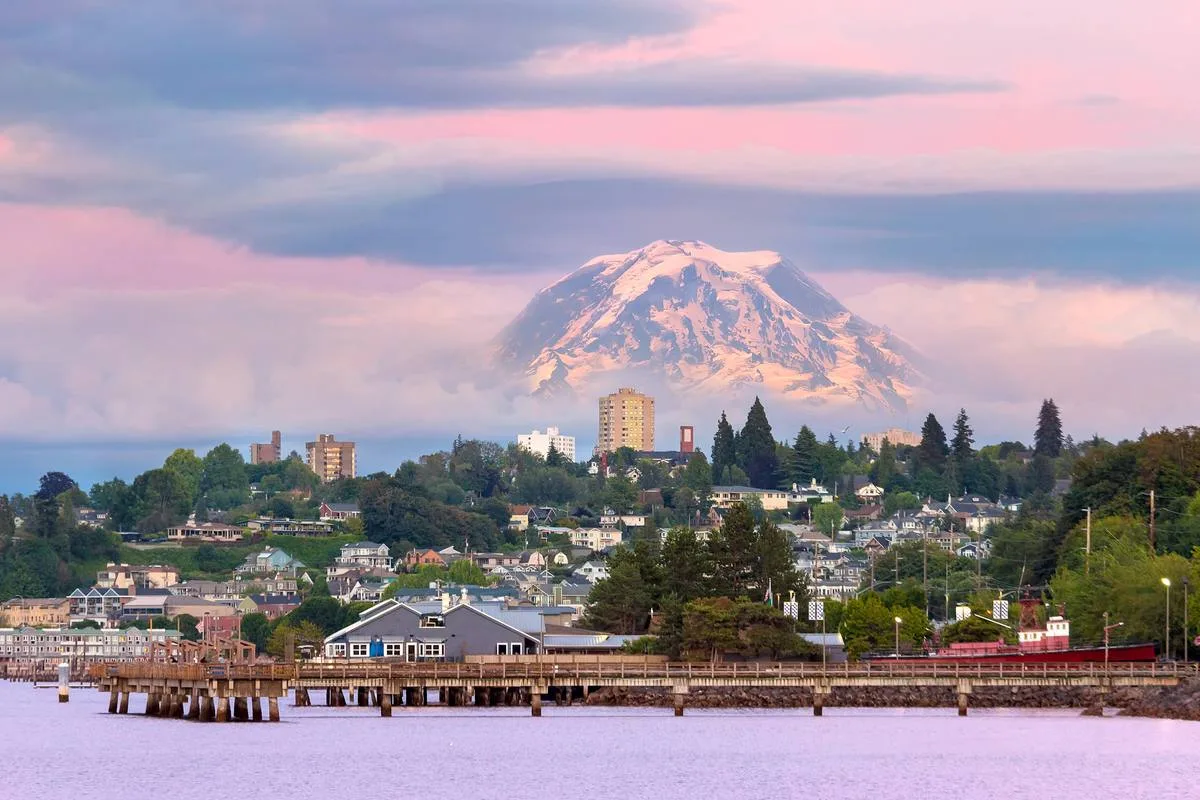
Ruston Way runs along the city's bay for nearly two miles, flat and paved, with the water on one side and a mix of restaurants and open space on the other. On summer evenings this is where Tacoma congregates — it's the closest thing the city has to a public living room. The views of Mount Rainier on clear days from this stretch are legitimately dramatic.
Culture and Museums
The Museum of Glass operates a working hot shop where artists create glass pieces live while visitors watch. A pedestrian bridge connects it across the highway below to the Washington State History Museum and the broader downtown waterfront — you can walk the whole cultural corridor on foot. The LeMay — America's Car Museum anchors the Tacoma Dome area with a collection that draws visitors from across the region, not just car enthusiasts.
Tacoma Arts Month each April has grown into a genuine citywide event — 150 events in 2025, including the Tacoma Studio Tour that opened 106 artist spaces to the public and drew 3,000 people in a single weekend. That kind of programmed cultural density is unusual for a city of this size.
Food and Drink
The Proctor District has a walkable cluster of independent restaurants and cafés that serves as its social core. Downtown has a developing restaurant scene concentrated along Pacific Avenue and the waterfront blocks. E9 Firehouse on N Pine St draws a mixed crowd — the converted firehouse setting is genuinely distinctive, and the food matches the room. E9 Brewing Co. & Taproom on Fawcett Ave is where to go if the focus is the beer itself.
What surprises people who move here from bigger markets: Tacoma has not been overrun by the kind of chain-restaurant monoculture that follows suburban sprawl. The independent food scene is real, if concentrated in specific neighborhoods rather than spread evenly across the city.
Day Trips and Proximity
Gig Harbor is 15 minutes across the Tacoma Narrows Bridge — a small waterfront city with a marina and a distinctly different pace. Mount Rainier National Park is roughly 90 minutes from central Tacoma via SR-7. The Olympic Peninsula is a few hours by ferry from the northern edge of the Sound. For outdoor-oriented buyers, Tacoma's position in the south Puget Sound gives it access to a remarkable range of environments without requiring a Seattle address as the starting point.
Top Things Locals Say About Tacoma
The best intel about a city comes from the people who actually live there. Here’s what Tacoma residents say when newcomers ask the questions everyone’s thinking.
“I thought I'd figured Tacoma out from the Zillow photos and a weekend visit. Three months in, I realized the Proctor District and the neighborhood two miles south of it are essentially different cities — the street-level difference caught me completely off guard. And nobody warned me that the T Line would become my actual lifeline for getting downtown.”
— Recent Tacoma home buyer
“What's the most surprising thing about living in Tacoma?”
The arts scene surprises almost everyone who moves here from outside the region. Most people picture a port city and a military town — they don't expect the Museum of Glass, a citywide arts funding program, and 150 events during Arts Month in April. The Proctor District on a summer Saturday also catches newcomers off guard: it's genuinely walkable and local in a way that feels more like a neighborhood in Portland than what people expect from Pierce County.
“What do locals love most about Tacoma?”
Point Defiance Park is the consistent answer — it's enormous, it's inside city limits, it has old-growth trees and saltwater beach access, and most people who don't live here don't know it exists. The Ruston Way waterfront on a clear evening with Mount Rainier filling the eastern sky is the other one. Tacoma has real geography, and once you're living here rather than just visiting, it becomes part of your daily life in a way that's hard to replicate in a more suburban setting.
“What should newcomers to Tacoma know?”
Try the Sounder train before you decide your commute to Seattle is undoable. A lot of people drive I-5 for three months, decide Tacoma doesn't work for a Seattle commute, and never discover that the train from Tacoma Dome Station makes the trip scheduled and predictable. Also: the city looks very different neighborhood by neighborhood — do the driving tour before you narrow your search to a zip code, because the same zip code can feel very different block to block.
“Can you live in Tacoma without a car?”
Yes, in specific parts of it — the urban core, downtown, and neighborhoods near the T Line stations are genuinely walkable and transit-served. In the city's southern districts or the outer east side, car-free life requires real planning and tolerance for gaps in bus frequency. Most Tacoma households own at least one car. The honest framing is that Tacoma is better for car-light living than car-free living, and your experience depends heavily on where exactly you land.
Cities Near Tacoma
Other communities near Tacoma worth a look — each with its own character and price point.
| City | Distance | Best For | Vibe | Median Rent | Median Buy |
|---|---|---|---|---|---|
| Lakewood | 8 mi | Military families & value buyers | Suburban, practical, JBLM-adjacent | $1,650 | $420,000 |
| University Place | 7 mi | Families seeking quieter streets | Established, waterfront views, low-key | $1,750 | $520,000 |
| Puyallup | 12 mi | Space, new construction, school options | Growing, small-town feel, fair-famous | $1,700 | $480,000 |
More Helpful Guides for Tacoma
Going deeper on Tacoma? Our blog series covers everything from first-time buying to retiring here — explore the guides below.
Local Expert Takeaway: Tacoma rewards buyers who do the neighborhood-level homework before making an offer. The city-wide numbers — a $496,203 Zillow Home Value Index, a 90-out-of-100 Redfin Compete Score, homes pending in 8–9 days — describe a fast market at a compelling price point relative to Seattle. What they don't tell you is that the waterfront corridor and the city's established northern neighborhoods feel like different cities from parts of central or southern Tacoma. The Sounder S Line to Seattle is genuinely underused by people who default to driving I-5 and then complain about the commute. And Tacoma Creates, the city's cultural funding program, makes this a meaningfully better arts city than its reputation suggests to outsiders.
Quick Takeaways & FAQs
✅ The Sounder S Line commuter rail to Seattle's King Street Station offers a scheduled, traffic-free alternative to the I-5 grind that many Tacoma residents underutilize.
⚠️ City-wide crime figures are higher than neighboring Lakewood and University Place, and the variation between Tacoma neighborhoods is significant enough to make where you buy matter as much as what you pay.
📍 Tacoma Creates — Washington's first local cultural access program — distributed $6.4 million to 80 arts organizations in 2026–27, making Tacoma's arts infrastructure much deeper than its city-size would predict.
Is Tacoma safe to live in?
What is the commute from Tacoma to Seattle like?
How much do homes cost in Tacoma?
What are the best neighborhoods in Tacoma for families?
Does Tacoma have good public transit?
Helpful Links for Moving to Tacoma
Moving to Washington?
Tell us what you need help with and we'll connect you with local resources.
