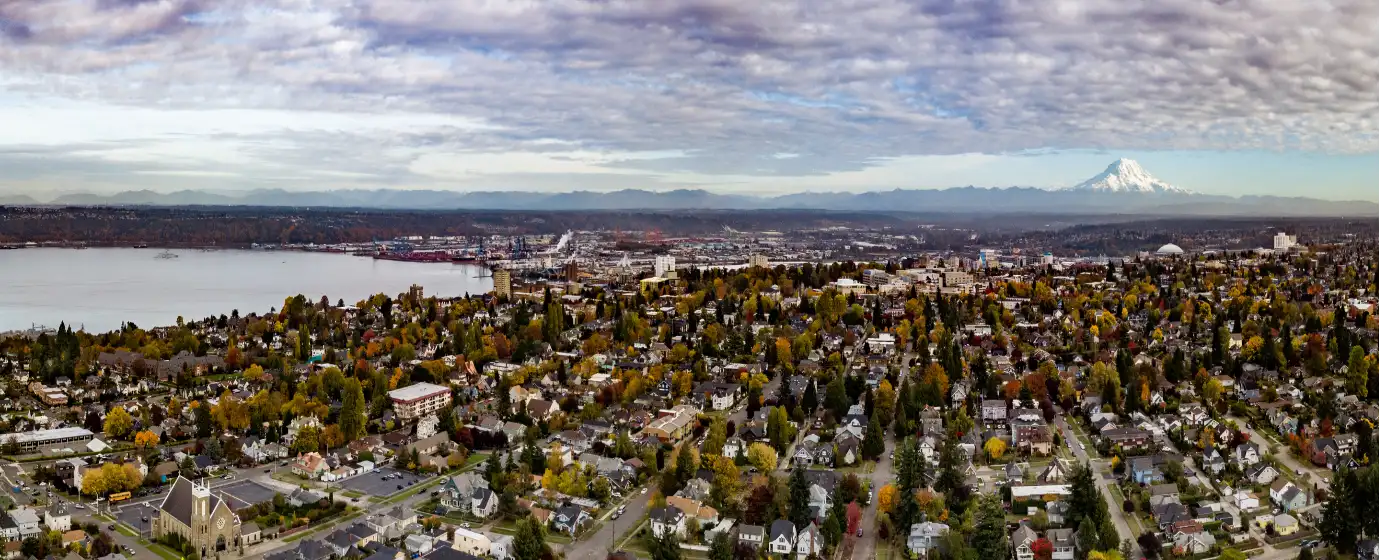
If you're moving to Tacoma with kids in tow, the question you'll hear most often is: "What about the schools?" It's the right question, and the honest answer is more layered than a single rating can capture. Tacoma Public Schools (District No. 10) is one of the largest districts in Washington State, serving approximately 28,272 students across 69 schools — a scale that produces everything from nationally recognized magnet programs to neighborhood schools wrestling with genuine resource constraints. The district sits inside a city shaped by Joint Base Lewis-McChord to the south and the Puget Sound to the west, and its student population reflects that complexity: 70% minority enrollment, 43.1% economically disadvantaged, and approximately 2,500 students experiencing homelessness in a single school year.
That last figure — one of the highest McKinney-Vento counts of any district in Washington State — tells you something important. TPS is not a suburban district optimized for one kind of family. It is a large urban district doing real work under real pressure. Consecutive budget shortfalls of $40 million for 2024–25 and an estimated $30 million for 2025–26 have produced staff reductions and program cuts that families with school-age children need to understand before signing a purchase agreement. At the same time, the district's choice-enrollment system opens access to three strong magnet programs — Science and Math Institute (SAMI), Industrial Design Engineering and Art (IDEA), and Tacoma School of the Arts — that rank among the best high schools in the state. The magnet pathway is genuinely exceptional. The neighborhood pathway is uneven.
Daily life for Tacoma families with kids extends well past the classroom. Point Defiance Park and the city's broader parks system anchor an outdoor culture that younger residents grow up inside — from soccer fields to waterfront trails. Parks Tacoma runs structured youth recreation leagues that keep the cost of entry low, and a competitive club scene has developed alongside them for families who want something more intense. Whether your child is a future STEM researcher or a weekend soccer player (or both), Tacoma has infrastructure for it — you just have to know where to look.
This guide covers the Tacoma Public Schools district at the level that actually matters for a relocation decision: an honest district-level summary, the three standout schools worth knowing by name, the youth sports landscape for kids of all ages, and a candid section on who TPS is not the right fit for. Read it alongside a conversation with a local parent, and you'll have the full picture.

Tacoma Public Schools: The District at a Glance
Tacoma Public Schools runs 36 elementary schools, 13 middle schools, 11 high schools, and four early learning centers — a footprint large enough that the district's averages can mask wide school-to-school variation. The student-to-teacher ratio district-wide was 17.63 for the 2023–24 school year, which sits above the Washington State average and is something to weigh when evaluating individual schools.
| Metric | Tacoma Public Schools |
|---|---|
| Total students | ~28,272 |
| Total schools | 69 (preschool–grade 12) |
| Elementary schools | 36 |
| Middle schools | 13 |
| High schools | 11 |
| Student-to-teacher ratio | 17.63 (2023–24) |
| Minority enrollment | 70% |
| Economically disadvantaged | 43.1% |
| Students experiencing homelessness | ~2,500 (2024–25) |
| Math proficiency (best school) | Under 38% on state assessments |
That math proficiency figure is the district's most consistent academic challenge. No single TPS school exceeded 38% math proficiency on state assessments as of 2025 — a district-wide gap that shows up across grade levels and matters especially for families whose children are heading into middle and high school mathematics.
The Diversity Story
The student body is 34.6% white, 23% Hispanic/Latino, 12.5% Black, 8.5% Asian/Pacific Islander, and 16.6% two or more races. For families moving from more homogeneous suburbs — University Place or Gig Harbor, for instance — this diversity is one of TPS's genuine assets, not a caveat.
Budget Pressure Is Real
The district faced a $40 million shortfall in 2024–25, followed by an estimated $30 million gap for 2025–26. Staff reductions and program cuts followed in both cycles. This is not a temporary blip: it reflects structural funding tension between state per-pupil allocations and the actual cost of serving a high-needs urban student population. Families should ask prospective schools directly which programs have been cut or reduced in the last two years before enrolling.
Three Standout Schools Worth Knowing
TPS's magnet system is where the district punches well above its weight. Rather than listing every school, three deserve specific attention — two public magnet programs and one comprehensive high school with an unusually strong AP culture.
Science and Math Institute (SAMI)
SAMI is ranked 21st among all Washington State high schools by U.S. News & World Report, making it the highest-ranked school in the district by a significant margin. It sits inside Point Defiance Park — which is not a metaphor; the building is literally within the park boundary — and its curriculum is built around project-based, environmental, and STEM learning that leans heavily on that setting.
Apply early and plan ahead: SAMI is a choice-enrollment school, meaning your child will not be assigned here by neighborhood. You apply, and if accepted, you provide transportation. The school competes in the WIAA at a smaller enrollment classification than the district's comprehensive high schools, which affects athletic program size but not academic reputation.
Best for: Students who want rigorous STEM and environmental science work in a small-school setting.
Stadium High School
Stadium is the most recognizable school in Tacoma — the 1906 castle-like building above the waterfront is hard to miss, and its interior has appeared in more than one film. But the academic case for Stadium is more than architecture: it ranks 53rd–54th among Washington State high schools and carries the highest AP participation rate among the district's comprehensive high schools at 47%, with 377 seniors enrolled in recent data.
The school sits in the Stadium District neighborhood, within walking distance of the waterfront and Old Town. Families assigned to that boundary land here automatically; families elsewhere in TPS can apply through choice enrollment.
Best for: Students who want a large comprehensive high school with strong AP access and a dense college-prep culture.
Industrial Design Engineering and Art (IDEA)
IDEA ranks 83rd among Washington State high schools — below SAMI and Stadium, but notably above the district average. It functions as a second magnet-track option for students whose interests sit at the intersection of design, engineering, and the arts rather than pure STEM. Academic performance runs above district averages, and it offers a smaller community than Stadium without the narrow STEM focus of SAMI.
Like SAMI, IDEA is choice-only with no district-provided transportation. Families in South Tacoma or Central Tacoma who want a high-performing option should look here as a strong alternative.
Best for: Students drawn to creative-technical work — product design, engineering, studio art — in a mid-size magnet environment.
A Note on Elementary and Middle Schools
The district does not have elementary or middle schools that rank as decisively as its top three high schools. Quality at those levels varies considerably by neighborhood boundary. Families with younger children should use the district's school-finder tool, attend enrollment information nights held each fall, and talk directly to parents at the specific neighborhood school they'd be assigned to — not to TPS in the abstract.
How Choice Enrollment Actually Works
The choice-enrollment system is TPS's most important structural feature for relocating families — and one of the most misunderstood. Every student has a neighborhood school assigned by address. But every student also has the right to apply to any other district school, including the magnet programs, regardless of where they live.
What "Choice" Means in Practice
Acceptance into SAMI, IDEA, or Tacoma School of the Arts is not guaranteed. Schools fill spots from a pool of applicants, and popular programs have competitive admissions windows. The annual enrollment information nights — held each October and November at middle and high schools across the district — are the practical starting point for any family considering a magnet application for the following year.
The transportation catch is significant: the district does not provide busing for choice placements. If your child is accepted into SAMI and you live in South Tacoma, getting them there every day is your logistical problem to solve. For families without flexible schedules or a second vehicle, this matters more than the rankings do.
The Tacoma School of the Arts (SOTA)
SOTA deserves a mention even though it falls outside this guide's three named standouts. It is a performing and visual arts magnet serving students interested in theater, music, dance, and visual arts — a legitimate fourth pathway for families with creatively oriented teenagers. It operates on the same choice-enrollment rules as SAMI and IDEA.
Enrollment Timing
Neighborhood enrollment is straightforward: register with a proof-of-address document, and your child is in. Choice enrollment has an annual window, typically opening in winter for the following fall. Missing that window means waiting another year or returning to a neighborhood assignment — something families who relocate mid-year often discover too late.
Looking to buy in Tacoma? Estimate your payment.
Enter your numbers to see an estimated monthly mortgage payment.
Estimate only. Excludes HOA fees and mortgage insurance. The interest rate above is a starting point, not a quoted rate — replace it with your own to see real numbers. Insurance is a flat placeholder, not a Tacoma quote.
Youth Sports and Kids Activities in Tacoma
The kids' activity landscape in Tacoma divides cleanly into two tracks: the city's own Parks Tacoma recreation programs, which are affordable and broadly accessible, and the club circuit, which is more competitive and considerably more expensive.
Parks Tacoma Recreation Leagues
Parks Tacoma runs some of the most structured municipal youth sports programming in the South Puget Sound region. Soccer is the anchor: the Tacoma School Recreation League groups kids in grades K–5 by their school community, which is an intentional choice to build neighborhood cohesion rather than just field teams. For older players, the Community Competitive League runs ages 9–15 in age-grouped brackets. Fall 2025 soccer registration ran August 11 through September 19 — registration windows for these leagues close faster than most newcomers expect.
Beyond soccer, Parks Tacoma offers flag football (beginning with toddler programs through age 15), baseball and softball, and a youth golf program at Meadow Park Golf Course for ages 7–17. Financial aid is available for Tacoma residents who face cost barriers — a meaningful provision in a city where 43% of district students are economically disadvantaged.
Competitive Club Sports
South Tacoma United (STU) is the primary club soccer organization for youth in the South Tacoma corridor, competing in Washington Youth Soccer events including the 2025 Founders Cup. Club fees, travel costs, and gear requirements run significantly higher than Parks Tacoma leagues — expect a meaningful annual commitment if your child plays at a competitive level year-round.
Club volleyball, basketball, and competitive swim programs operate across the Tacoma metro, with many families from the northeast and north portions of the city traveling to University Place or Federal Way for programs that aren't locally based. This is a regular feature of Tacoma family life that nobody mentions until you're already planning your Saturday.
WIAA High School Athletics
TPS high schools compete under the Washington Interscholastic Activities Association (WIAA). Stadium High School and several other comprehensive high schools are classified at the 4A level — the second-largest classification in the state — which means competitive rosters, established programs, and, for some sports, genuinely difficult paths to a starting spot. SAMI competes at a smaller enrollment classification given its magnet school size, which means more playing time is available but the competitive level differs from the big-school programs.
Stadium's football and soccer programs draw consistent attention, and the school's location near the waterfront means Friday night games have an atmosphere that's hard to replicate in a suburban setting. For families who want high school sports to be a meaningful part of their child's experience, TPS's 4A programs deliver that — budget cuts have not yet dismantled the athletic infrastructure the way they have some elective academic programs.
Beyond Sports
The Museum of Glass runs youth education programming; the Tacoma Art Museum has ongoing family and school-partnership events; and the waterfront along Ruston Way gives families an informal gathering corridor that functions year-round despite what the weather suggests in November. The city also has a robust YMCA presence across multiple neighborhoods, offering swim lessons, youth basketball, and after-school programming that fills gaps left by district budget reductions.
Who Tacoma Public Schools Is NOT the Right Fit For
This section exists because honest relocation writing requires it. TPS is not the right district for every family, and knowing that before you buy saves everyone time.
Families Who Need Stable Elective Programming
If your child is midway through a music program, a specific language sequence, or an arts elective that requires continuity, the consecutive budget cuts of 2024–25 and 2025–26 are a real risk factor. Programs that existed when a family toured a school in spring 2024 were not guaranteed to exist in fall 2025. The district has not stabilized its budget situation, and families who depend on elective continuity — rather than core academics — should ask point-blank what was cut and what is funded going forward.
Families Expecting Neighborhood School Consistency
The magnet system is excellent. The neighborhood system is uneven. If your child's assigned school is not one of the standout programs, the quality of their experience depends heavily on which specific school and which specific teachers they land with. Families accustomed to suburban districts where neighborhood school quality is relatively uniform will find TPS requires more active management of their child's academic path.
Families Unwilling to Drive for Choice Placements
There is no district transportation for choice-enrolled students. SAMI, IDEA, and SOTA all require families to self-transport. If your household has one car, both parents work early hours, or you're moving from a place where the district bus came to your door, this is a practical dealbreaker — not a minor inconvenience.
Families Prioritizing Math Achievement
Math proficiency on state assessments tops out below 38% at every school in the district. Families whose children are on an accelerated math track or who struggled with math at a previous school and need strong intervention support should investigate individual school-level programs carefully rather than relying on district averages. Private tutoring and supplemental programs are a common part of Tacoma family life for exactly this reason.
Families Comparing to Neighboring Districts
Puyallup School District, Clover Park School District, and the Tacoma metro's private school options all draw families who toured TPS and decided it wasn't the match. That's a legitimate outcome. The families who thrive in TPS tend to engage actively with the choice system, understand the magnet pathways, and have the flexibility to make those pathways work logistically. Passive enrollment into a neighborhood school and hoping for the best is a lower-upside strategy here than it might be in a more uniformly resourced district.
What to Ask Before You Enroll
The single most useful thing a relocating family can do — before the offer goes in, not after — is attend one of TPS's fall enrollment information nights. These events run each October at middle and high schools across the district and are the practical gateway to understanding which magnet programs still have capacity, what the application timeline looks like, and which neighborhood schools have seen the most program disruption from recent budget rounds.
Questions That Surface the Real Picture
- Which elective or specialty programs were reduced or eliminated in the 2024–25 and 2025–26 budget cycles? Ask this of the principal, not the district communications office.
- What is the current math curriculum and proficiency data for this specific school? District-wide figures obscure school-level variation in both directions.
- If my child applies to a magnet program, what is the realistic acceptance rate and the waitlist history?
- For choice-enrolled students: what are the actual daily logistics, and is there any shuttle, carpool network, or community transportation arrangement other families use?
- What after-school programming is available on-site, and is it funded or dependent on grants that renew annually?
Timing Your Move
Families moving to Tacoma in summer have the cleanest enrollment path: neighborhood registration is straightforward with a proof-of-address document, and choice applications for the following fall open in winter. Families arriving mid-year face more friction — magnet seats are already filled, and some elective sections close to new students after October.
If your child is entering 8th or 9th grade — years when high school pathway decisions lock in — the timing of your move within the school year matters more than most families realize when they're focused on the transaction itself. Moving in July rather than January can mean the difference between a choice placement at a top magnet school and four years at a neighborhood school that wasn't your first preference.
Private School Context
Tacoma has a functioning private school market — including faith-based elementary schools, a Montessori presence, and independent secondary options — that absorbs some of the families for whom TPS is not the right fit. These options exist and are worth researching if the district picture gives you pause, but they represent a meaningful additional cost on top of a city where Tacoma's general cost of living is already higher than many relocating buyers expect relative to their origin market.
Local Expert Takeaway: The families who do well in Tacoma Public Schools are the ones who treat the district's choice system as a tool, not a default. SAMI ranks legitimately among the top 25 high schools in Washington State — a remarkable thing for a public school in a city this size — but it requires a winter application, an accepted spot, and your own transportation plan every single day. Stadium High School delivers a real AP culture inside one of the most architecturally striking buildings in the Pacific Northwest. The families who move here, enroll in whatever neighborhood school their address assigns them to, and don't engage with the magnet system are leaving the best of TPS on the table. Show up to the October enrollment information nights before your child starts, not after.
Quick Takeaways & FAQs
✅ SAMI ranks 21st among all Washington State high schools — a genuinely top-tier public STEM magnet inside Point Defiance Park, open to any TPS student who applies and is accepted.
⚠️ Consecutive budget shortfalls of $40M and $30M across 2024–25 and 2025–26 have cut staff and programs district-wide — families relying on elective continuity should ask specifically what remains funded at their target school.
📍 Parks Tacoma's youth soccer leagues group K–5 kids by school community, not just by age — fall registration closes faster than newcomers expect, with the 2025 window running only through late September.
How do I get my child into SAMI or IDEA in Tacoma?
Are Tacoma Public Schools good for families moving from a high-performing suburban district?
What youth sports leagues are available for kids in Tacoma?
Has the Tacoma school district budget crisis affected programs families care about?
Can my child attend Tacoma Public Schools if we live in University Place or Lakewood?
Moving to Washington?
Tell us what you need help with and we'll connect you with local resources.
