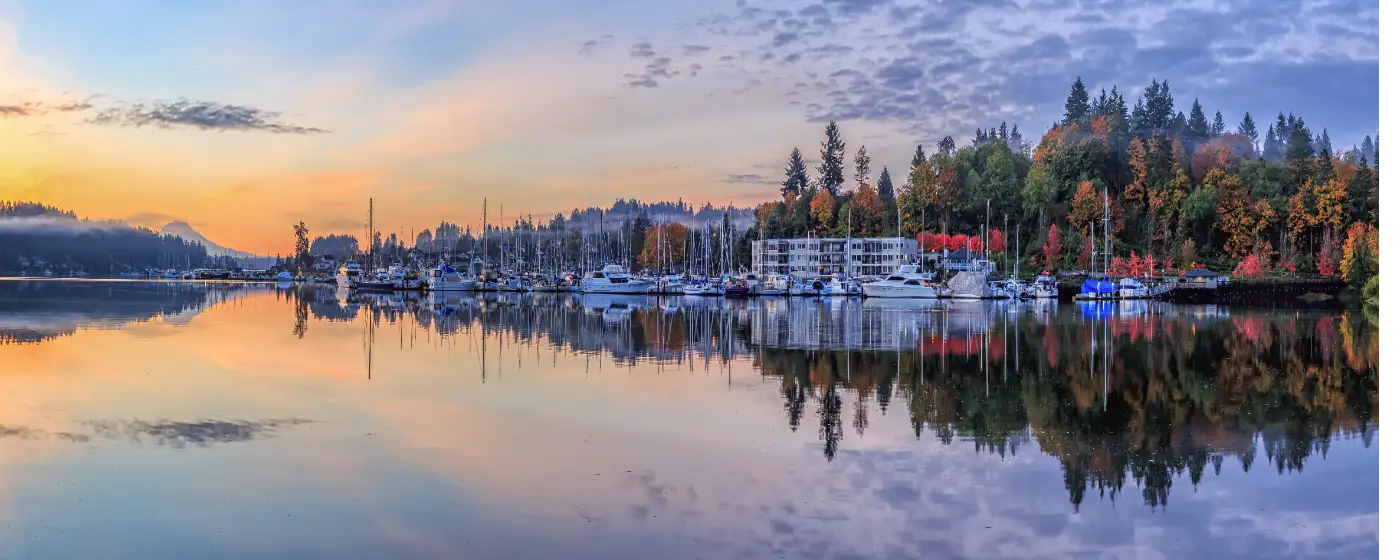
What Is Living in Gig Harbor, Washington Like?
Maybe you've been priced out of Seattle's Eastside. Maybe you drove across the Tacoma Narrows Bridge on a clear day, saw the harbor below, and thought: what is that place? Gig Harbor sits on the western shore of Puget Sound in Pierce County, separated from Tacoma by a single bridge and, in many ways, by an entirely different pace of life. State Route 16 is the artery everything runs on — it delivers you to Tacoma in roughly 20 minutes on a good morning, and it is also the single point of failure when that bridge has one of its recurring maintenance shutdowns. That geographic reality — beautiful setting, real isolation risk — is the central fact of life here, and understanding it shapes everything from where you buy to how you schedule your day.
The Peninsula School District anchors community life in ways that go well beyond academics. Ranked 16th best school district in Washington by Niche in 2026, with a district-reported four-year graduation rate of approximately 93%, it draws parents with school-age children from across Pierce County who want suburban stability without giving up the Pacific Northwest outdoors. The city's largest employers reflect a classic South Puget Sound mix: the school district itself, a major regional health system, and a substantial contingent of Boeing and Joint Base Lewis-McChord workers who live here and commute east. The median age of 46.6 years tells you something honest: this is a city of established households, not a young-professional starter scene.
Gig Harbor's median household income of $118,395 funds a lifestyle that leans heavily on water access, trails, and weekend proximity to the Olympic Peninsula. The Zillow Home Value Index stood at $764,493 in June 2026 — meaningfully higher than Tacoma but still noticeably below the Seattle-side suburbs that many relocators are comparing it to. The Peninsula Metropolitan Park District manages 21 parks and the 6.2-mile Cushman Trail north of downtown. The waterfront on Harborview Drive has the coffee shops, the breweries, and the weekend boat traffic that make the city feel like a destination. Renters face a tight market; the median gross rent ran approximately $2,409 per month in 2024.
Whether you're considering a move or just researching the area, the sections below break down Gig Harbor's job market and major employers, what daily life actually looks like, current housing conditions, the commute reality across the Narrows, and where locals spend their weekends.
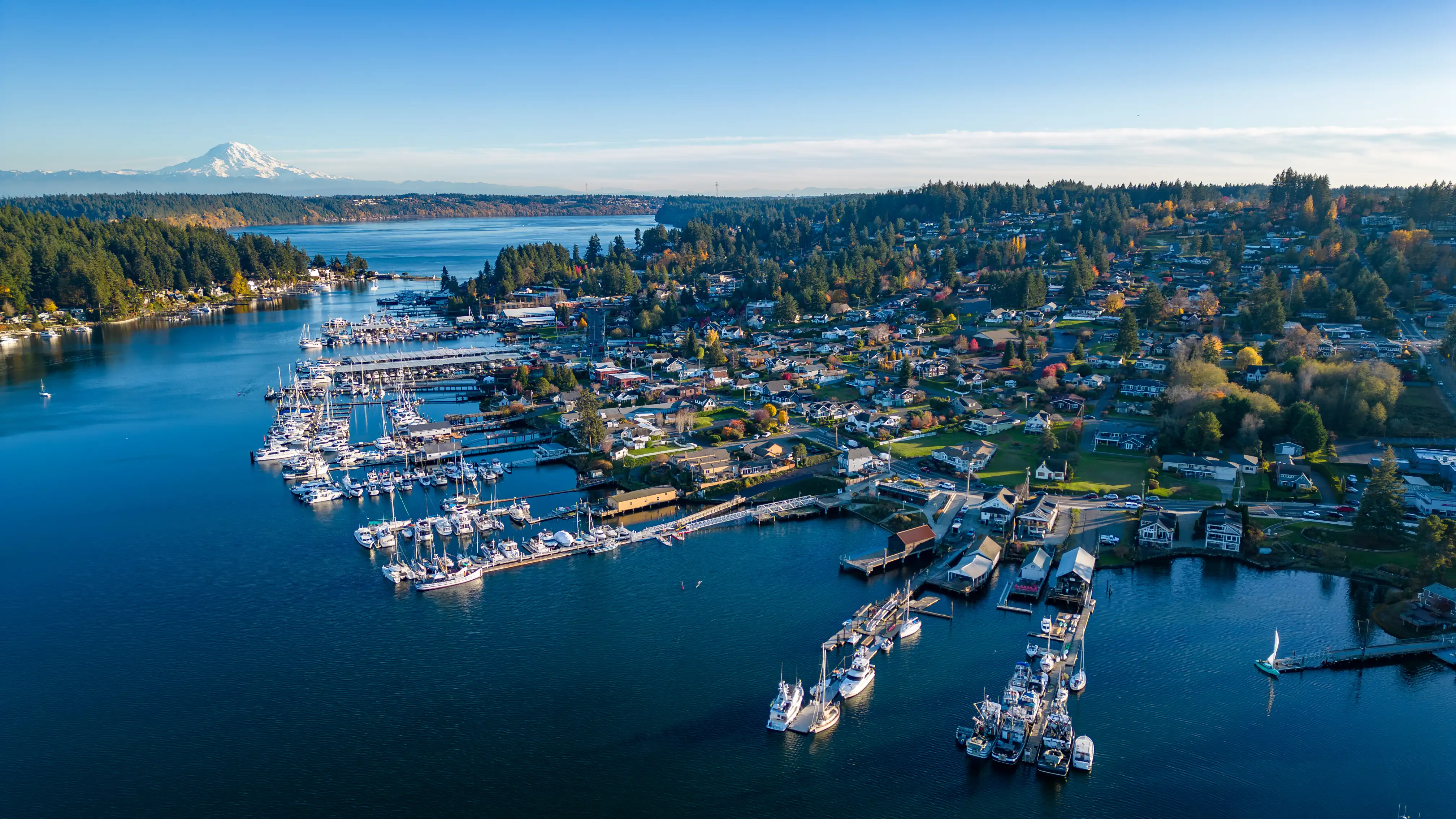
Gig Harbor at a Glance
Looking to buy in Gig Harbor? Estimate your payment.
Enter your numbers to see an estimated monthly mortgage payment.
Estimate only. Excludes HOA fees and mortgage insurance. The interest rate above is a starting point, not a quoted rate — replace it with your own to see real numbers. Insurance is a flat placeholder, not a Gig Harbor quote.
Why Are People Moving to Gig Harbor?
The short answer: people want the Pacific Northwest without the Seattle price tag and density, and Gig Harbor makes a convincing case. The longer answer involves a specific kind of buyer — one who has done the math on SR 16 and decided the bridge is worth it.
Who's Actually Coming Here
The city has grown about 5.6% since the 2020 Census, adding residents steadily through a period when many Washington markets were surging and then correcting. The growth isn't driven by one employer landing here — it's driven by a cumulative appeal: good schools, water access, lower density than the east side of Puget Sound, and a median household income ($118,395) that reflects who can afford to live here.
Parents with school-age children are the most reliable driver. The Peninsula School District's B+ rating and its Niche ranking consistently draw families who want suburban stability within Pierce County. Once a family is in the district, they tend to stay.
The Employer Landscape
Gig Harbor is not a company town — it's a commuter town with a strong anchor institution. The Peninsula School District is the largest local employer, which tells you something about the city's character. A major regional health system employs a significant share of local residents, particularly in healthcare support and administrative roles.
The two largest regional employment draws — Boeing and Joint Base Lewis-McChord — are east of the bridge, in Tacoma and south Pierce County. A substantial portion of Gig Harbor households have at least one person making that SR 16 crossing daily. Marine and tourism businesses along the harbor provide local employment, but these skew seasonal and lower-wage relative to the city's income profile.
Why People Leave
The honest friction moment: after two or three winters, some residents discover that the bridge's charm wears off faster than they expected. Emergency closures for bridge maintenance — five in 2024 alone on the westbound 1950 span, three more in 2025 — can strand commuters for hours with no practical alternative route. A handful of families who moved from Tacoma expecting a quiet upgrade find themselves resenting the bridge dependency more than they anticipated. If your job requires you in Tacoma or at JBLM unpredictably, that risk is worth pricing honestly before you buy.
| Buyer Profile | Best Fit? | Why |
|---|---|---|
| Families | Strong yes | Peninsula School District, parks, lower density than Seattle suburbs |
| JBLM/Boeing Commuters | Yes, with eyes open | 20-min bridge crossing, but bridge closures are a real variable |
| Water & Lifestyle Buyers | Strong yes | Harbor waterfront, Puget Sound access, Kopachuck State Park nearby |
| Remote Workers | Yes | No bridge dependency; harbor setting with no commute penalty |
| Renters | Cautious | Tight rental supply; ~$2,409/mo median rent in a predominantly ownership market |
| First-Time Buyers | Selective | Entry prices are real; see the cost-of-living page for full context |
| Car-Free Households | No | Transit coverage is limited; a car is effectively required for daily life |
What Daily Life Feels Like in Gig Harbor
Gig Harbor has a median age of 46.6. That number does more work than any lifestyle description: this is a city of established households, weekend boaters, and parents cheering at Peninsula High School WIAA games on Friday nights — not a place with a rooftop bar scene or a dense young-professional core.
The Waterfront Is the Living Room
Harborview Drive is where the city gathers. On summer weekends, the walk from Skansie Brothers Park past Eddon Boat Park is genuinely lovely — boats in the water, the Olympic Mountains visible on a clear day, and the Harbor History Museum free to visit Wednesday through Saturday. The museum's restored Skansie net shed and a 1906 gas boat give you the Croatian and Scandinavian fishing heritage that shaped the harbor in ways that feel specific and earned rather than manufactured for tourism.
7 Seas Brewing on Harborview Drive is the waterfront anchor for the post-work crowd. Evergreen State Brewing, also on Harborview Drive, opened under that name in early 2025 after a rebrand of the prior waterfront taproom — they're doing locally inspired beers with water views. Millville Pizza Co. operates as a food-truck partner in 7 Seas' lot, which means a draft beer and a wood-fired pizza on the water is a genuinely accessible weeknight option.
The Seasonal Quirk Nobody Mentions
Summer in Gig Harbor is when the city becomes someone else's destination, not just your hometown. The seasonal trolley connecting Downtown and Uptown runs mid-June through September, which is useful — but Harborview Drive fills with day-trippers and boaters in a way that can make simple errands take twice as long between July Fourth and Labor Day. Locals learn quickly which coffee spots and which parking windows belong to them and which belong to the weekend crowds.
The Cushman Trail Commute Alternative
The 6.2-mile Cushman Trail is paved, multi-use, and connects several neighborhoods north of downtown through Peninsula Metropolitan Park District land. For residents near the trail, it's a genuine daily utility — not just a weekend amenity — and it's one of the details that separates Gig Harbor's outdoor infrastructure from smaller Pierce County cities.
The Harbor History Museum, the Skansie net shed, Eddon Boat Park, and the seasonal trolley are all within walking distance of each other downtown. For a city of roughly 12,600 people, the concentration of functional public space along the waterfront is unusually high. The parks and recreation page covers the full park system, Kopachuck State Park, and the trail network in detail.
The Gig Harbor Housing Market Right Now
The Zillow Home Value Index for Gig Harbor stood at $764,493 in June 2026, down 2.7% year-over-year — a meaningful pullback from the peak, but still well above where this market was four years ago. Redfin's median sale price for November 2025 came in at $815,000, with homes averaging 48 days on market. Those two figures together tell a consistent story: prices have softened slightly, days on market have stretched, and buyers have more negotiating room than they did in 2022 — but this is still not a cheap market by any regional standard.
The rental side is equally firm. The median gross rent ran approximately $2,409 per month in 2024, which reflects how thoroughly Gig Harbor operates as an ownership market. Rental inventory is thin and tends to move quickly when it appears.
What the Market Pace Actually Means
Forty-eight days on market is meaningfully longer than the frenzied 2021-2022 pace, when well-priced homes here drew multiple offers within days. Today's market rewards buyers who've done their homework on specific areas — some parts of the city move faster than others based on school proximity, water views, and lot size — but the era of offers due in 48 hours on everything is not the current reality.
Some parts of the city carry noticeably higher price points than the city-wide figure; others come in below it. For a full breakdown of what different neighborhoods cost and what you actually get, the best neighborhoods page covers that in detail. Effective property tax runs approximately 0.94%, which is close to the state average and contributes to the overall cost of ownership here. A broader look at taxes, utilities, and what your dollar buys across cost categories lives on the cost-of-living page.
Gig Harbor Neighborhoods
Gig Harbor has several distinct areas — each with its own character and appeal. Here’s a breakdown to help you narrow down where to focus your home search.
🏡 Downtown/Harbor Historic District
The most walkable part of Gig Harbor, centered on Harborview Drive and the waterfront — Skansie Brothers Park, Eddon Boat Park, the Harbor History Museum, and the waterfront breweries are all within easy reach. It suits buyers who want to walk to the water daily and don't mind paying for that proximity.
🏠 Gig Harbor North
The newer, more suburban face of Gig Harbor, clustered around the Uptown retail corridor along Point Fosdick Drive and Borgen Boulevard. Newer construction, more inventory turnover, and easier parking than downtown make it the practical choice for families prioritizing space and school access over waterfront walks.
🌳 Canterwood
A gated golf course community with a notably different character from the rest of Gig Harbor — private, established, and oriented around the Canterwood Golf Club course. It draws buyers who want acreage, prestige, and seclusion within city limits.
🏘 Point Fosdick
A quieter, more spread-out area on the south end of the peninsula with a mix of older and newer homes on larger lots. It appeals to buyers who want Gig Harbor's school district and outdoor access without the waterfront premium or the North area's suburban density.
🏔 Rosedale
A semi-rural residential area west of downtown with a low-key, neighborhood-first feel and properties that tend toward larger parcels. Families and buyers who want genuine breathing room — and don't need to walk to Harborview Drive — find it fits their priorities well.
🌆 Artondale
Situated between the waterfront core and the North area, Artondale has a mix of established single-family homes and a community feel that's more grounded than the downtown tourist zone. It's a practical middle-ground neighborhood for families wanting reasonable proximity to both the harbor and the Uptown shopping corridor.
Pros & Cons of Living in Gig Harbor
The Pros
- Picturesque working harbor with a strong boating and maritime culture
- highly-rated Peninsula School District
- walkable
- boutique-filled historic downtown with waterfront dining
- relatively quick access to Tacoma and Seattle via the Narrows Bridge
The Cons
- Home prices well above the Pierce County average
- Tacoma Narrows Bridge toll and rush-hour bottleneck
- comparatively cloudy Pacific Northwest climate with fewer sunny days than the national average
Getting Around & Commuting in Gig Harbor
Every commute conversation in Gig Harbor starts and ends with the Tacoma Narrows Bridge. SR 16 is the only road in or out heading east, and the bridge is both the city's greatest convenience and its most persistent vulnerability.
The Bridge: What You Need to Know
On a normal weekday morning, the crossing takes roughly 20 minutes to downtown Tacoma. The bridge carries 8 lanes of SR 16 traffic plus a dedicated pedestrian and bicycle path open during daylight hours — the path offers unobstructed views of the Sound in both directions and is used by cyclists making the full crossing into Tacoma.
The eastbound toll applies only heading toward Tacoma. With a Good To Go pass transponder, the rate is $4.50 per crossing for passenger cars; without one, the cash/credit rate runs $5.50. For a household making five crossings per week, that's a real annual line item worth factoring into your budget.
The bigger issue is reliability. The westbound 1950 span — the older of the two bridge structures — required five emergency joint repairs in 2024 and three more in 2025. Each closure pushes westbound traffic back across the bridge or onto SR 302 through Purdy, adding 30 to 45 minutes or more to the return commute. This is not a rare event. It is a recurring feature of life here, and buyers who commute daily should ask themselves honestly how they'll handle it when it happens — not if.
Public Transit and the Alternatives
Pierce Transit Route 100 connects Purdy to the Tacoma Community College Transfer Center with a stop at TCC's Gig Harbor annex. Sound Transit Route 595 provides service to Seattle — useful for the subset of residents making the longer cross-Sound commute. Neither route replaces a car for the daily logistics of Gig Harbor life; they function as supplements for specific trip types, not a car-free lifestyle.
The seasonal trolley running Downtown to Uptown from mid-June through September is a genuine quality-of-life amenity for residents and visitors moving between the waterfront and the Uptown retail corridor — but it operates only in daylight, only in summer, and only within the city core. Anyone living north in Gig Harbor North or in Wollochet is driving.
Remote Work Changes the Calculus
The single biggest shift in who moves to Gig Harbor since 2020 is the rise of remote and hybrid workers for whom the bridge is a weekend inconvenience rather than a daily variable. For that buyer, the city's trade-offs collapse almost entirely in Gig Harbor's favor: waterfront access, Peninsula School District, 21 parks, and a city-wide median price noticeably below the Seattle-side suburbs, with no bridge crossing required Monday through Friday.
| Destination | Typical Drive Time | Route | Notes |
|---|---|---|---|
| Tacoma (downtown) | ~20 min | SR 16 E, Narrows Bridge | Toll applies eastbound; bridge closures add 30-45 min |
| JBLM Main Gate | ~30-40 min | SR 16 E to I-5 S | Morning traffic on I-5 is the variable, not the bridge |
| Seattle (downtown) | ~60-75 min | SR 16 E, I-5 N or SR 512/167 | Sound Transit 595 is an option for transit commuters |
| Sea-Tac Airport | ~45-55 min | SR 16 E to I-5 N | Avoid 7-9 am and 4-6:30 pm windows |
| Purdy (SR 302 alternate) | ~15 min | SR 16 W, SR 302 | Bridge closure alternate; adds significant time eastbound |
| Bremerton (ferry to Seattle) | ~25-30 min drive | SR 16 W to SR 3 | WSF Bremerton-Seattle ferry is ~60 min crossing |
Schools in Gig Harbor
Families relocating to Gig Harbor have public, private, and higher-education options nearby. Here’s a quick overview.
🎓 School District
Peninsula School District serves K–12 students across Gig Harbor and the surrounding area. Rated B+ (source: Niche.com).
🏆 Graduation Rate
The 4-year high-school graduation rate here is approximately 88.7%.
📚 Higher Education
Washington’s public universities — the University of Washington, Washington State University, and Western Washington University — offer four-year degrees statewide, with a network of 34 community and technical colleges (SBCTC) providing two-year and workforce programs.
🌐 Online Learning
University of Washington Continuum College and Washington State University Online offer fully accredited online degrees for remote learners across the state.
Safety in Gig Harbor
A quick look at how Gig Harbor compares on the numbers that matter most when weighing a neighborhood or a move.
🛡 Violent Crime
Approximately 2 per 1,000 residents.
🔒 Property Crime
Approximately 29.6 per 1,000 residents.
Compared to the FBI’s most recent national data (2024), Gig Harbor’s violent crime is below the national average (about 3.6 per 1,000), and property crime is above the national average (about 17.6 per 1,000).
Against Washington as a whole, Gig Harbor’s violent crime is roughly two-thirds of the state average, and property crime is somewhat above the state average (Bureau of Justice Statistics, Crime Known to Law Enforcement, 2024 (tables 2 and 3)).
Crime rates can vary a lot within a single city, so the citywide numbers above are only a starting point. Some neighborhoods in Gig Harbor run well below these averages, while others run higher — the kind of block-by-block detail that matters most when you’re actually choosing where to live. The full guide below breaks it down neighborhood by neighborhood.
Working in Gig Harbor
Gig Harbor’s largest employers span several industries — here are some of the anchors of the local job market.
🎓 Peninsula School District
Education
🏥 CHI Franciscan St. Anthony Hospital
Healthcare
💼 Boeing
Aerospace, regional commuters
🏛 Joint Base Lewis-McChord
Military, regional commuters
🏥 local marine and tourism businesses
Marine/hospitality
Parks & Recreation in Gig Harbor
Some of the outdoor spaces that shape everyday life in Gig Harbor.
🌱 Skansie Brothers Park & Net Shed
🌱 Eddon Boat Park
Gig Harbor residents don’t have to go far for green space — spots like Skansie Brothers Park & Net Shed and Eddon Boat Park are part of everyday life here, whether that’s a morning walk, a weekend hike, or just somewhere to unwind outside. The full guide below covers more of what Gig Harbor has to offer for parks and outdoor recreation.
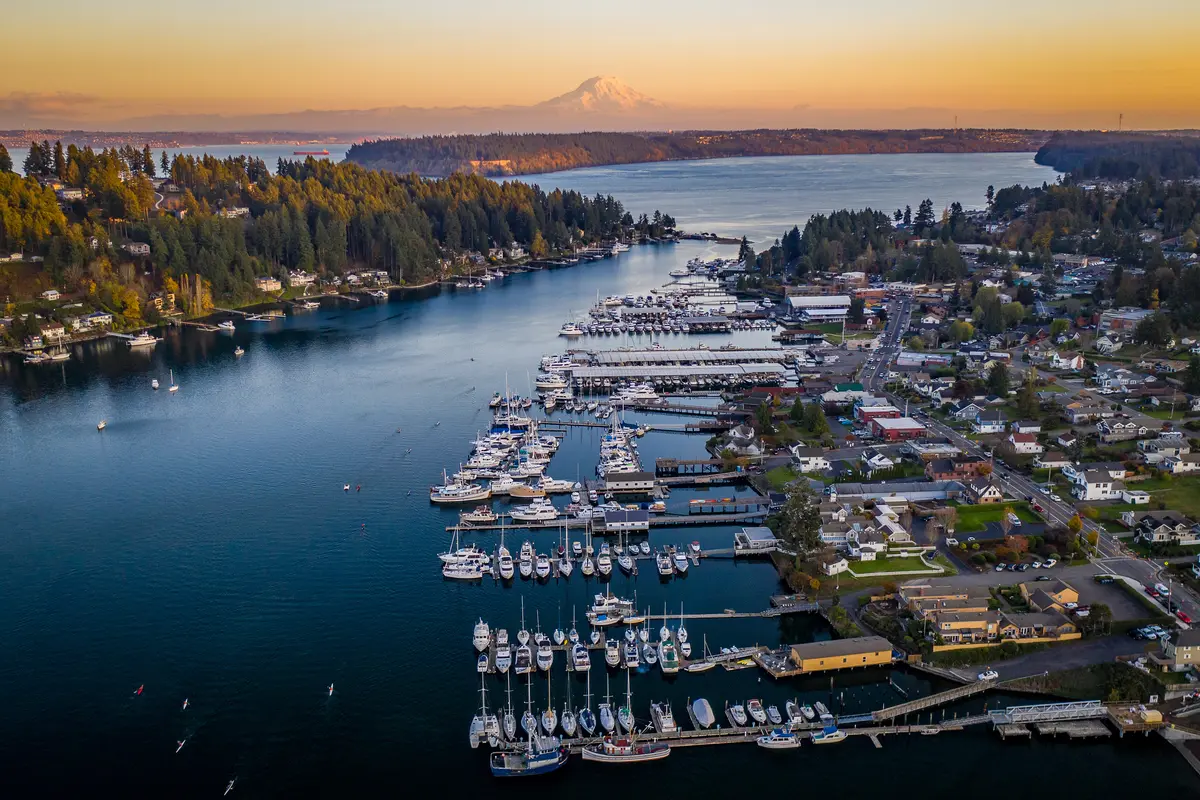
Retiring in Gig Harbor
Gig Harbor draws retirees for its balance of amenities, outdoor access, and cost. Here’s what to weigh.
🌤 Climate
Gig Harbor sits in the mild marine climate of South Puget Sound — summers are dry and warm with low humidity, rarely exceeding the mid-80s. Winters are grey and wet rather than cold, with occasional frost but very little snow. The consistent overcast from November through March is the one condition that surprises retirees from sunnier regions most.
🍴 Lifestyle
The waterfront on Harborview Drive — with the Harbor History Museum, independent cafés, breweries like 7 Seas Brewing, and the Skansie net shed — provides a walkable daily rhythm that many retirees find genuinely satisfying. Kopachuck State Park is 7 miles northwest for saltwater beach days. The pace is unhurried, the median age skews toward your cohort, and the Peninsula Metropolitan Park District's 21 parks give you outdoor options year-round.
🏚 55+ Communities
Gig Harbor and the surrounding Gig Harbor Peninsula area have active-adult and senior-living options ranging from independent-living communities to assisted-care facilities. The city's overall character — established, low-density, community-oriented — attracts downsizers who want space and quiet without sacrificing proximity to Tacoma's services. The retiring page covers the healthcare and senior-living landscape in detail.
✈ Getting Around
A car is essential for daily life here. The Tacoma Narrows Bridge puts Tacoma's full range of services 20 minutes away, and Sea-Tac Airport is a 45-to-55-minute drive on a clear run. The pedestrian and bicycle path on the bridge is open during daylight hours for non-motorized crossings. Limited local transit exists but is not designed for car-free living.
🏛 Washington Taxes for Retirees — What to Know
- No state income tax — Washington does not tax personal income, so Social Security, pensions, and 401(k)/IRA withdrawals are all untaxed at the state level. There is no state return to file and no retirement exclusion to claim — the rate is simply zero.
- Military and public pensions — Because there is no income tax, military retirement pay and public-employee pensions are untaxed at the state level along with everything else.
- Sales tax is the tradeoff — The state sales tax is 6.5%, and local add-ons bring the combined rate in Gig Harbor to 9.2% (Washington State Department of Revenue, Q3 2026 local sales & use tax rate table, July 2026). Groceries and prescription drugs are exempt.
- Property taxes, with senior relief — The effective property tax rate is roughly 0.9%. Homeowners 61+ (or unable to work due to disability, or a qualifying disabled veteran) who own and occupy their home may qualify for a reduction. Income limits are set against each county’s median household income, so the threshold differs by county — check with your county assessor. A separate deferral program is available for those who don’t qualify for the exemption.
- Capital gains tax — but not on retirement income — Washington taxes 7% on long-term capital gains above a $278,000 standard deduction for 2025, rising to 9.9% on gains above $1,000,000. Retirement accounts and real estate sales are both exempt. It therefore does not reach ordinary retirement income or the sale of a home.
- Estate tax — the one to plan for — Unlike most no-income-tax states, Washington has its own estate tax. For deaths on or after July 1, 2026, the exemption is $3 million with graduated rates topping out at 20%. Retirement accounts count toward the taxable estate, so long-time homeowners with sizable balances can cross the line without expecting to.
- No inheritance tax — Washington has no inheritance tax, and no gift tax.
- WA Cares payroll premium — Working Washingtonians pay 0.58% of gross wages into the WA Cares Fund, the state long-term care program, with no income cap. It applies to W-2 wages, so retirees who have stopped working do not pay it — but anyone relocating while still employed will see it. The private-insurance opt-out closed at the end of 2022 and is not available to new applicants; the remaining exemptions are narrow (living outside Washington, military spouses, certain visa holders, and veterans with a 70%+ service-connected rating).
- The Oregon border effect — Oregon has no sales tax, so Washington residents near the river — Vancouver, Camas, Washougal, Longview — often cross over for large purchases. Washington use tax technically applies to goods brought back for use in-state, though it is rarely enforced on ordinary personal purchases.
Tax laws change frequently and individual situations vary. This is general information, not tax advice — always consult a qualified Washington tax professional or CPA for personalized retirement tax planning.
Weekends & Local Favorites in Gig Harbor
The weekend rhythm here is unhurried in the way that only a city with water access and genuine outdoor infrastructure can be. Nobody is driving to Gig Harbor for the nightlife. They're here for the harbor walk, the trail, the state park 7 miles up the road, and a pint with a view.
The Waterfront Circuit
The stretch of Harborview Drive from Skansie Brothers Park through Eddon Boat Park is the city's natural gathering place on Saturday mornings. The Harbor History Museum at 4121 Harborview Drive is free to enter and runs Wednesday through Saturday, 11 am to 4 pm — a genuinely good 90-minute stop that covers the Croatian and Scandinavian fishing families who built the original harbor economy, anchored by the restored Skansie net shed and a 1906 gas boat that locals treat as a landmark.
7 Seas Brewing on Harborview Drive is the most established waterfront taproom and draws a mix of locals and day-trippers. Evergreen State Brewing, a rebranded operation that took over the neighboring waterfront taproom space in early 2025, has been building a following with locally inspired craft beers in an equally well-positioned setting. Millville Pizza Co. runs a food-truck operation in 7 Seas' lot — the combination of a draft pint and a pizza at a picnic table above the water is Gig Harbor at its most functional and enjoyable.
Out of Town, But Close
Kopachuck State Park sits about 7 miles northwest of downtown: 25 campsites, a saltwater beach, a boat launch, and kayak access to Cutts Island — a marine state park you can only reach by water. Campsites fill fast in July and August; if you're planning a summer weekend there, book as early as the reservation system opens.
The Olympic Peninsula is an hour's drive west and serves as Gig Harbor's de facto backyard for longer weekend trips. Point Defiance Park and Zoo in Tacoma is 20 minutes across the bridge. Residents who moved from the east side of Puget Sound often note that their access to the Olympic Peninsula improved dramatically once they stopped needing to cross Seattle to get to a ferry terminal.
What Families Do on Fridays
Peninsula School District athletics — WIAA competition across soccer, football, lacrosse, and more — are the anchor of the Friday night social calendar for families with kids in the system. The Sports Complex partnership with the Tom Taylor YMCA, with Phase 1B completed in 2025 and Phase 1A under construction, is adding lighted synthetic-turf fields that will expand the local sports calendar further. For parks and recreation detail, the full parks page has the complete picture on the Cushman Trail, the park district, and Kopachuck.
Top Things Locals Say About Gig Harbor
The best intel about a city comes from the people who actually live there. Here’s what Gig Harbor residents say when newcomers ask the questions everyone’s thinking.
“I knew about the bridge toll before we moved, but I didn't really understand the bridge closures until we'd lived here through a winter. The first time it shut down in the middle of my commute home and I sat on SR 16 for an hour with no options, it hit me differently than reading about it ever did. We still love living here — I'd make the same call again — but I wish someone had made that specific thing more concrete for us upfront.”
— Recent Gig Harbor home buyer
“What's the most surprising thing about living in Gig Harbor?”
How quickly the summer crowds change the waterfront. Between July Fourth and Labor Day, Harborview Drive belongs to day-trippers and boaters on weekends. Locals figure out fast which coffee spots to avoid on Saturday mornings and which windows — early weekday mornings, early fall — give you the harbor back to yourself. It's not a complaint exactly, but it catches newcomers off guard how seasonal the neighborhood feel is down there.
“What do locals love most about Gig Harbor?”
The combination of the water and the school district is hard to beat in Pierce County. You can walk from Skansie Brothers Park to Eddon Boat Park on a Tuesday evening in September with almost no one around, watch the boats in the harbor, and it genuinely doesn't feel like you've compromised anything to live here. The Cushman Trail north of downtown is a year-round utility that people use for actual transportation, not just weekend exercise.
“What should newcomers to Gig Harbor know?”
Turn on bridge alerts through the state's travel app before you move here — SR 16 bridge closures happen with enough regularity that you want to know about them before you're already on the on-ramp. Also: grocery runs and appointments on the Tacoma side get mentally bundled together here. You'll notice within a few months that you're timing east-of-the-bridge errands more deliberately than you ever did before.
“Can you live in Gig Harbor without a car?”
Not practically. Pierce Transit Route 100 and Sound Transit Route 595 exist and serve specific trip types, but they don't cover daily logistics for most households. Groceries, school pickups, medical appointments, most employers — a car is effectively required. The seasonal trolley between Downtown and Uptown is useful in summer but doesn't change the underlying reality. If car-free living is important to you, Gig Harbor is the wrong market.
Cities Near Gig Harbor
Other communities near Gig Harbor worth a look — each with its own character and price point.
| City | Distance | Best For | Vibe | Median Rent | Median Buy |
|---|---|---|---|---|---|
| Tacoma | 8 mi | Urban access, diverse housing stock | Gritty, walkable, culturally active | $1,800 | $420,000 |
| University Place | 10 mi | Families, established neighborhoods | Quiet, suburban, well-maintained | $1,900 | $550,000 |
| Fox Island | 6 mi | Privacy seekers, waterfront lifestyle | Rural, serene, bridge-accessed | $2,000 | $650,000 |
More Helpful Guides for Gig Harbor
Going deeper on Gig Harbor? Our blog series covers everything from first-time buying to retiring here — explore the guides below.
Local Expert Takeaway: The Tacoma Narrows Bridge is not a background detail — it is the central fact of Gig Harbor life. Remote workers and retirees can ignore it almost entirely and get a waterfront lifestyle at prices well below Seattle-side suburbs, access to Kopachuck State Park, and a school district ranked 16th in Washington. Daily commuters to Boeing or JBLM need to build bridge-closure days into their mental model before they sign anything. Get that math right, and Gig Harbor is one of the more livable cities in South Puget Sound.
Quick Takeaways & FAQs
✅ Peninsula School District ranks 16th best in Washington (Niche 2026) with a district-reported graduation rate of approximately 93% — a genuine draw for families with school-age children.
⚠️ The Tacoma Narrows Bridge required eight emergency repairs across 2024-2025; daily commuters east should factor in recurring closure delays as a real, not theoretical, risk.
📍 The Harbor History Museum on Harborview Drive is free to enter and covers Gig Harbor's Croatian and Scandinavian fishing heritage — it's one of the best free afternoons in Pierce County.
What is the typical home price in Gig Harbor, WA?
How bad is the commute from Gig Harbor to Tacoma?
Is Gig Harbor good for families with kids?
What are the best neighborhoods in Gig Harbor?
Is Gig Harbor a good place to retire?
Helpful Links for Moving to Gig Harbor
Moving to Washington?
Tell us what you need help with and we'll connect you with local resources.
