
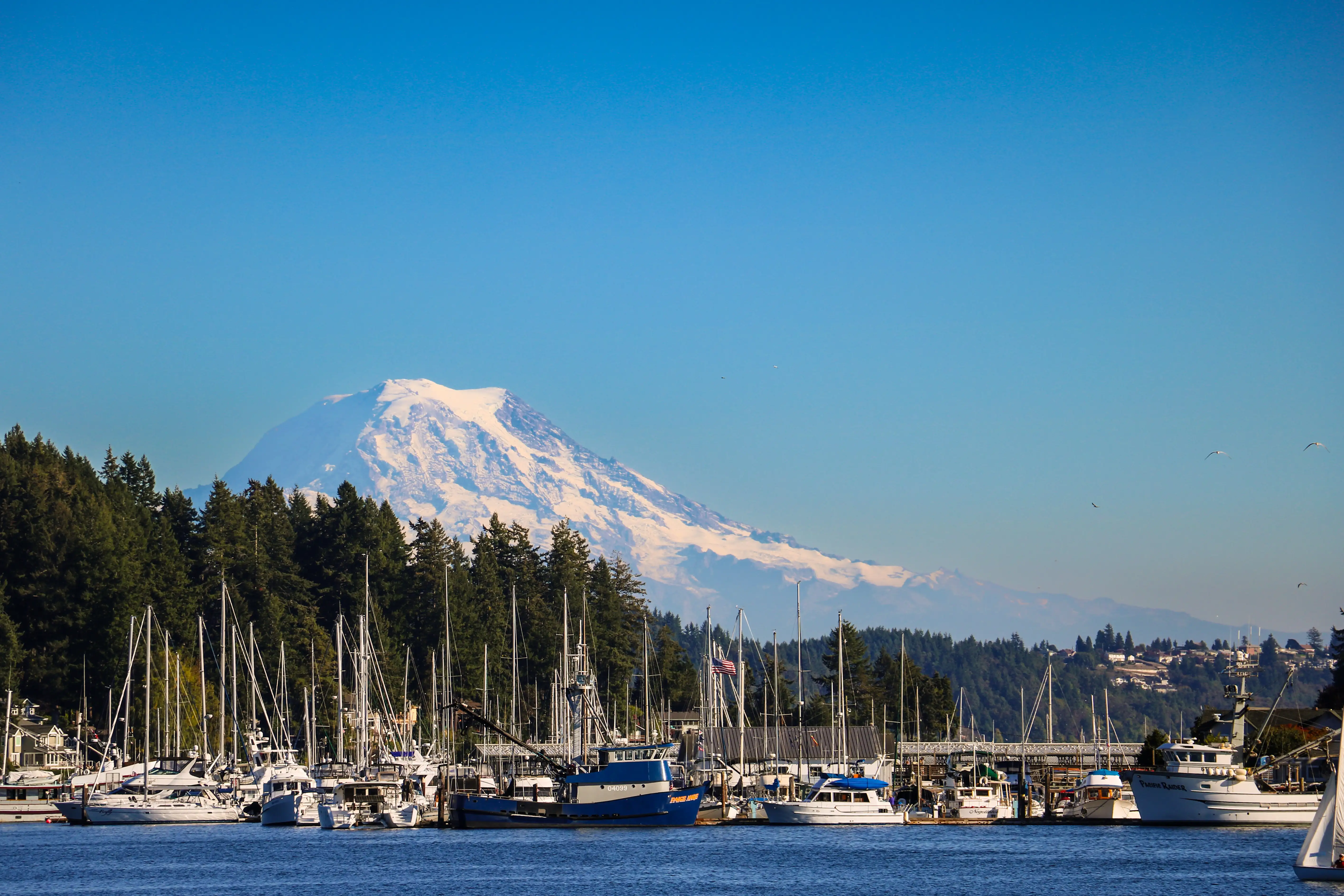
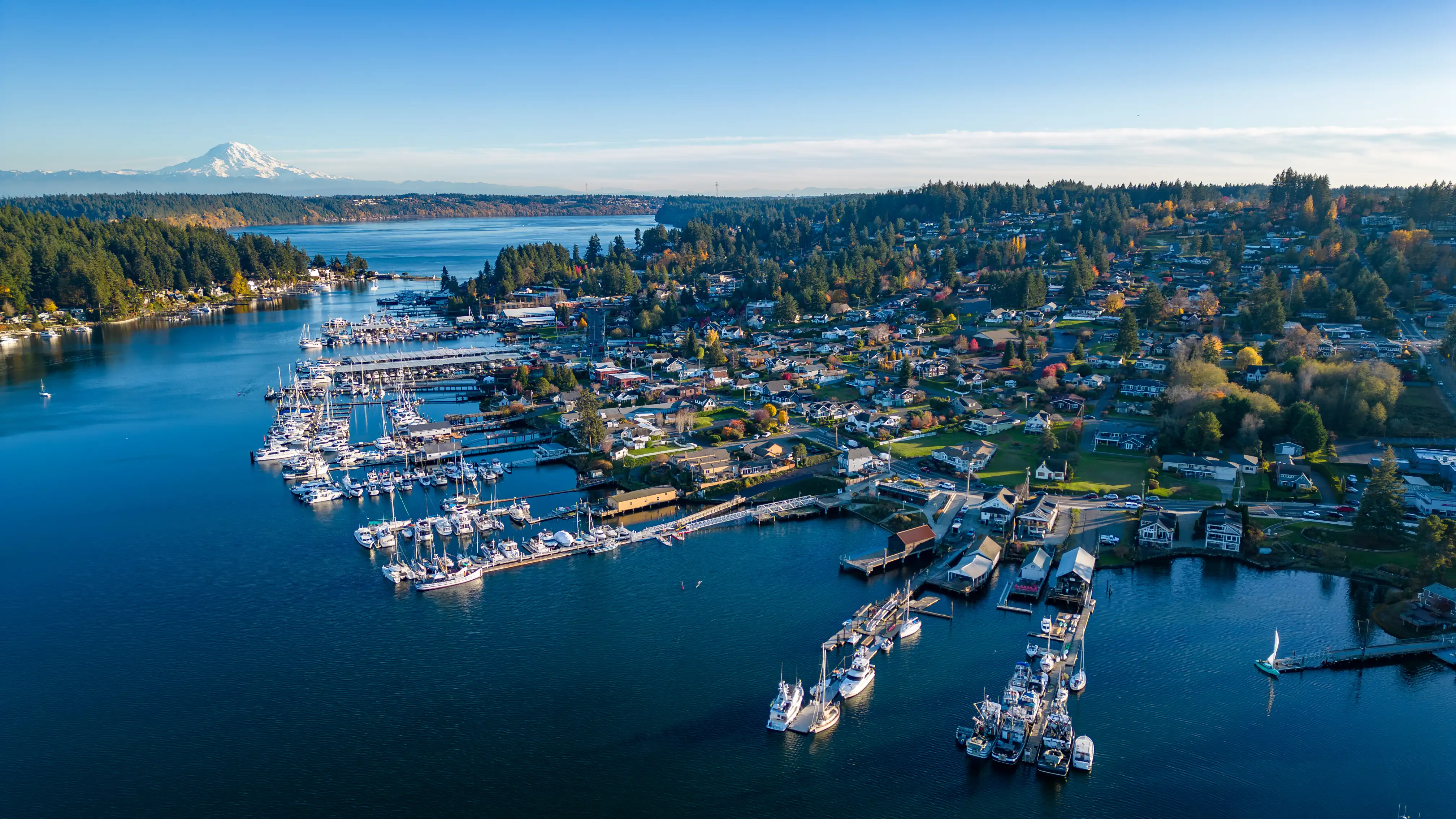
If you're choosing between Gig Harbor and somewhere less expensive, the decision usually comes down to one honest question: how much do you actually want to look at the water every day? The harbor itself — sailboats moored at anchor, the Olympics framing the horizon, herons walking the pilings — is not incidental to life here. It is the whole point. Gig Harbor sits on a protected inlet off Puget Sound in Pierce County, connected to the Tacoma side by the Tacoma Narrows Bridge and about 20 minutes from a full urban medical and cultural infrastructure. The city is small — roughly 12,600 residents — which means it functions more like a tight-knit maritime village than a suburb, even as the surrounding North end continues to grow.
The economic and social backbone of Gig Harbor has historically been its marine trades, fishing heritage, and later, its role as a bedroom community for Boeing workers, Joint Base Lewis-McChord personnel, and South Sound professionals. That mix produced something unusual: a walkable historic downtown with an independent spirit, surrounded by car-dependent residential areas with good bones and well-kept streets. The presence of St. Anthony Hospital — a full acute-care facility right on Canterwood Boulevard — means retirees have real medical access without driving into Tacoma for routine care.
Cost is the honest conversation nobody wants to start. The Zillow Home Value Index puts the typical home in Gig Harbor at $764,493 as of June 2026 — meaningfully above what you'd pay in Tacoma or University Place, and a number that requires either equity from a prior home sale or a deliberate downsizing strategy. The upside is Washington's tax posture for retirees, which is among the most favorable in the Pacific Northwest: no state income tax on Social Security, pensions, or retirement account withdrawals. Daily costs for groceries and dining run above national averages, as they do across the Puget Sound region, but the outdoor lifestyle — kayaking off Skansie Brothers Park, walking the waterfront trail, catching a weekday matinee at the independent cinema — costs next to nothing.
Whether you're seriously weighing a move or just doing early research, the sections below cover Gig Harbor's retirement fit, healthcare reality, budget math for fixed incomes, walkability and community life, downsizing options, and how the city stacks up against nearby retirement destinations.

Why Retirees Are Choosing Gig Harbor
Gig Harbor genuinely suits a specific kind of retiree: someone who has spent a career near a major metro, wants to stay close enough to access it, and is ready to trade traffic and urban density for a harbor view and a slower pace — without sacrificing medical access or cultural amenities entirely. The people who land here and stay tend to be active, independent, and willing to drive a car for most errands. Many come from the Seattle and Eastside markets, where their equity converts neatly into a waterfront condo or a craftsman cottage near the downtown core.
The typical home value of $764,493 (Zillow Home Value Index, June 2026) sets the entry bar clearly. Retirees arriving with significant equity from a California or King County sale will find Gig Harbor accessible; those on a fixed income without a prior home to sell will find the numbers tight. That's the honest version. The city rewards buyers who right-size intentionally — a 1,400-square-foot single-level home near the harbor delivers a quality of life that a much larger house elsewhere in the region cannot replicate.
Gig Harbor is probably not your city if you need to walk to a pharmacy or a grocery store without a car, if you want the density of arts programming you'd get in Tacoma, or if budget is the primary driver. Retirees who thrive here describe the same three things after six months: the quiet on a Tuesday morning, the way neighbors actually wave, and the fact that Tacoma's full range of hospitals, restaurants, and theaters is genuinely only 20 minutes away — close enough to feel like an amenity, far enough to feel optional.
Healthcare & Medical Access in Gig Harbor
St. Anthony Hospital: What's on Your Doorstep
St. Anthony Hospital sits at 11567 Canterwood Boulevard NW, roughly five minutes from most of Gig Harbor North and about ten from downtown. It's a 112-bed acute-care facility operating under Virginia Mason Franciscan Health, and it covers the core services most retirees reach for most often: a 24-hour emergency department, cancer care, cardiac services through Franciscan Heart & Vascular Associates, surgical suites, and full diagnostic imaging. A sky bridge connects the main hospital directly to the Milgard Medical Pavilion next door, where outpatient specialty care — orthopedics, neurology, oncology follow-up — is handled without leaving the campus.
St. Anthony holds Pathway to Excellence® designation from the American Nurses Credentialing Center (ANCC), a national recognition tied to nursing culture and practice environment. That matters practically: lower nurse-to-patient ratios and a more engaged nursing staff tend to translate into better inpatient experiences, which is exactly the kind of detail that becomes relevant when you or a spouse has an extended stay.
When Tacoma Is the Right Call
For complex cardiac procedures, neurosurgery, level-I trauma, or subspecialties not available at a 112-bed community hospital, the Tacoma Narrows Bridge puts MultiCare Tacoma General and CHI Franciscan St. Joseph Medical Center approximately 20 minutes east. That's a real and important safety net. Retirees managing serious chronic conditions — or those who want to be within a 10-minute drive of a quaternary medical center — should factor this honestly: Gig Harbor's hospital is excellent for community-level acute care, but it is not a regional referral center.
The practical day-to-day picture is strong. Primary care practices, cardiology clinics, orthopedic specialists, and physical therapy are well-represented in the Gig Harbor North corridor near Costco and along Point Fosdick Drive. Most retirees report that routine care — annual physicals, specialist follow-ups, lab work, imaging — stays on the peninsula without a trip to Tacoma. It's the outlier situations where distance matters, and the 20-minute bridge crossing is the honest answer to that concern.
The Retiree Budget in Gig Harbor
Washington's Tax Posture for Retirees
Washington State levies no personal income tax. That means Social Security benefits, pension distributions, IRA withdrawals, and 401(k) income are fully exempt from state taxation — a meaningful advantage over Oregon, Idaho, or most Midwest states where retirees commonly originate. For a household drawing $80,000 to $120,000 in annual retirement income, the savings versus a state with a 5–7% income tax rate are substantial and immediate.
Two nuances matter for higher-asset retirees. Washington's 7% capital gains tax applies to long-term gains above the indexed annual deduction (approximately $278,000 for 2025) — but it does not touch gains realized inside 401(k)s, IRAs, Roth IRAs, or defined-benefit plans. Retirees with substantial taxable brokerage accounts should model their exposure before assuming the "no income tax" headline covers everything. Washington also levies an estate tax with rates up to 20% on larger estates, which is a planning consideration if you intend to pass significant wealth to heirs. Both situations call for a conversation with a Washington-licensed tax attorney rather than a general assumption.
Property Tax and Daily Costs
Gig Harbor's effective property tax rate is approximately 0.94%. That's relatively moderate for a Puget Sound waterfront community, and it holds even as home values have risen. Washington's senior property tax exemption program can meaningfully reduce the carrying cost for qualifying homeowners: if you're 61 or older, owner-occupying your home, and your household income falls below the Pierce County threshold, the program freezes your assessed value at the application-year level — shielding you from future assessment increases regardless of how much the market moves. Verify the current Pierce County income threshold at piercecountywa.gov/Assessor before applying, as the county sets its own cutoff.
Groceries and dining in Gig Harbor run above national averages — this is the Puget Sound reality, not specific to Gig Harbor. The independent cafés and waterfront restaurants along Harborview Drive are beloved but not cheap. Tides Tavern on Harborview is a local institution for a reason: the deck, the boats, the afternoon pint. NetShed No. 9, also on Harborview, does brunch in a converted net shed with harbor views. These are not budget spots, but they are genuinely good ones. For a full breakdown of cost-of-living figures, see the Gig Harbor cost of living page.
Looking to buy in Gig Harbor? Estimate your payment.
Enter your numbers to see an estimated monthly mortgage payment.
Estimate only. Excludes HOA fees and mortgage insurance. The interest rate above is a starting point, not a quoted rate — replace it with your own to see real numbers. Insurance is a flat placeholder, not a Gig Harbor quote.
Walkability, Community & Staying Active in Gig Harbor
The Walkability Reality
Downtown Gig Harbor's waterfront — Harborview Drive, Skansie Brothers Park, the Harbor History Museum, Eddon Boat Park — is genuinely walkable at addresses close to the water, putting it in the "somewhat walkable" category by most measures. Within that zone, a retiree who lives close to the harbor can walk to independent restaurants, the Saturday farmers market, the library branch, and the waterfront trail without touching a car. That is a genuinely pleasant way to spend a retirement morning.
Outside downtown, the picture changes. Gig Harbor North, Canterwood, Rosedale, Artondale — the residential areas where most of the housing inventory actually lives — are car-dependent for grocery runs, pharmacy visits, and most daily errands. If driving becomes difficult or you plan ahead for a time when it might, the car-dependency of Gig Harbor's broader geography is the most honest practical challenge of retiring here.
Transit Options for Non-Drivers
Pierce Transit Route 100 runs year-round between Gig Harbor and the Tacoma Community College Transfer Center, with connections across the South Sound, at a $1 senior fare per trip. The Pierce Transit Runner, an on-demand service covering gaps in the fixed-route network, operates at the same $1 senior fare — book via the smartphone app or by calling (253) 581-8000. Pierce Transit also offers free Travel Training, a self-paced program that helps seniors build confidence riding the bus independently. Sound Transit's weekday Route 595 express connects Gig Harbor directly to downtown Seattle for those days when the city beckons.
Community, Clubs & Staying Connected
The Gig Harbor Senior Center is the social anchor for older residents — it runs fitness classes, day trips, art programs, and the kind of Tuesday-afternoon card games that turn acquaintances into actual friends. The waterfront farmers market, the Harbor History Museum's volunteer corps, and the active boating community all function as informal social networks. Retirees who arrive expecting a ready-made social life tend to find one faster than they expected; the city is small enough that showing up twice to the same thing makes you a regular.
Outdoor activity is woven into daily life in a way that doesn't require a gym membership or a long drive. Kayaking off Skansie Brothers Park, walking the Cushman Trail toward Tacoma, cycling the quieter roads around Fox Island on weekdays — these are the rhythms locals describe when asked what they actually do. For a deeper look at the trail and park network, see the Gig Harbor parks and recreation page.
Right-Sizing: Downsizing in Gig Harbor
What the Market Offers
Downsizing in Gig Harbor is real but requires patience. The inventory of single-level homes — the no-stairs, low-maintenance configuration most retirees actually want — is limited relative to demand, and the units that do appear near the waterfront move quickly. Harbor-view condos on or near Harborview Drive represent the most turnkey downsizing option: smaller square footage, HOA-managed exteriors, and morning coffee with a direct water view. Entry points for condos in the downtown zone start well above $500,000 and climb steeply for anything with an unobstructed view.
Patio homes and zero-lot-line cottages exist throughout the Gig Harbor North corridor and in developments off Rosedale Street — these tend to offer single-level layouts, attached garages, and HOA landscaping without the density of a condominium building. They are the practical choice for retirees who want independence of a freestanding home without a large yard to maintain. Prices in these communities generally track the city-wide median closely, occasionally running slightly below it depending on condition and distance from the waterfront.
55+ and Active-Adult Options
Gig Harbor does not have a large concentration of age-restricted 55+ master-planned communities on the scale of what you'd find in the Phoenix metro or the Carolinas. What it has instead is a handful of smaller active-adult condominium projects and senior living campuses — independent living, assisted living, and memory care — clustered primarily along the Peacock Hill and Gig Harbor North corridors. Pegasus Senior Living operates a campus in Gig Harbor that covers the independent-to-assisted continuum, and there are additional assisted living communities within a short drive.
The honest read on inventory: if you want a single-level detached home under $650,000 within 10 minutes of the waterfront, you will wait for the right listing. If you're flexible on format — a condo, a patio home, or a ground-floor unit in a small community — the market is workable. Retirees who move here after selling a larger home in a higher-cost market typically find the equity conversion comfortable even at Gig Harbor prices. Those arriving without significant equity should run the numbers carefully before committing.
Gig Harbor vs Nearby Retirement Destinations
| City | Cost vs Gig Harbor | Primary Hospital | Walkability | Senior Living Depth | Overall Retirement Fit |
|---|---|---|---|---|---|
| Gig Harbor, WA | Anchor | St. Anthony Hospital (on-peninsula, 112-bed acute care) | Walkable downtown core; car-dependent elsewhere | Moderate — smaller campus options, limited 55+ inventory | Views Quiet Strong fit for equity-rich, active retirees |
| Tacoma, WA | Noticeably cheaper | MultiCare Tacoma General + CHI Franciscan St. Joseph (major regional medical centers) | Stronger citywide walkability; urban density | Deep — wide range of senior living, continuing care communities | Transit Value Better for budget-focused retirees or those needing frequent hospital access |
| University Place, WA | Somewhat cheaper | Close to Tacoma medical centers (~10 min) | Moderate; more walkable pockets near Chambers Bay | Good — several established senior communities | Value Community Solid middle-ground option; quieter than Tacoma, less premium than Gig Harbor |
| Steilacoom, WA | About the same | Relies on Tacoma medical centers (~20 min) | Small walkable historic downtown; limited services | Limited — very small community, few dedicated senior facilities | Quiet Views Appeals to retirees who want Puget Sound water access in a smaller, older town |
| Fircrest, WA | Noticeably cheaper | Adjacent to Tacoma medical infrastructure | Moderate; quiet residential streets, some walkable areas | Moderate — established community, some senior options | Quiet Value A practical, low-key choice for retirees prioritizing budget and proximity to Tacoma |
| Purdy, WA | Somewhat cheaper | Relies on St. Anthony Hospital or Tacoma (~25-30 min) | Car-dependent; rural feel with some waterfront access | Very limited — largely residential, few dedicated senior services | Nature Privacy Best for self-sufficient retirees who want seclusion over services |
Tacoma is the clearest winner on healthcare depth and budget — if frequent access to a major regional medical center is your top priority, or if Gig Harbor's price point strains the plan, Tacoma delivers more of both at a lower cost. University Place threads a middle path: meaningfully cheaper than Gig Harbor, still close to Tacoma's hospitals, and with a calmer residential character than downtown Tacoma itself.
Steilacoom is the comparison that surprises people — a historic waterfront town with genuine appeal and similar pricing to Gig Harbor, but with almost none of Gig Harbor's senior living infrastructure and a more limited commercial core. It suits a specific retiree: independent, healthy, unbothered by driving to Tacoma for everything. Fircrest and Purdy appeal primarily on price and quiet; they give up the walkable waterfront identity that makes Gig Harbor worth its premium in the first place. For retirees arriving with equity and wanting the full South Puget Sound experience — harbor views, a real downtown to walk, good healthcare close by, and Tacoma a bridge-crossing away — Gig Harbor is the harder case to argue against.
Local Expert Takeaway: Gig Harbor's retirement appeal is real and specific: you get an acute-care hospital five minutes from most of the city, a harbor-front downtown you can actually walk on a Tuesday morning, Washington's zero-tax treatment of retirement income, and Tacoma's full medical and cultural infrastructure 20 minutes east over the Narrows. The catch is the price point — $764,493 is the typical home value as of mid-2026, and single-level inventory moves fast. Retirees who arrive with equity from a prior home sale and time their search patiently tend to land well. Those who need to stretch their budget should model the numbers against University Place or Tacoma before falling in love with the harbor view.
Quick Takeaways & FAQs
✅ Washington's no-income-tax policy means your Social Security, pension, and IRA withdrawals are fully state-tax-free — a genuine financial advantage that compounds over a long retirement.
⚠️ Most of Gig Harbor outside the downtown waterfront is car-dependent for daily errands, and single-level homes in the most walkable zones sell quickly and above median — plan your housing search accordingly.
📍 St. Anthony Hospital on Canterwood Boulevard NW puts emergency care, cardiac services, cancer care, and outpatient specialty clinics within a five-minute drive of most of the city, with MultiCare Tacoma General just 20 minutes east for complex cases.
Is Gig Harbor a good place to retire on a fixed income?
What hospital serves Gig Harbor retirees?
Does Washington State tax Social Security or pension income?
Can I get around Gig Harbor without a car in retirement?
Are there 55+ or active-adult communities in Gig Harbor?
Moving to Washington?
Tell us what you need help with and we'll connect you with local resources.
