
If you've been priced out of the Bay Area or are watching your Southern California homeowners insurance renewal with dread, someone has probably mentioned Gig Harbor. It sits on a protected inlet of Puget Sound, about 20 minutes west of Tacoma across the Tacoma Narrows Bridge — a town of roughly 12,600 people where working waterfront, independent dining along Harborview Drive, and a genuine downtown still coexist with suburban subdivisions spreading north toward Purdy. The surprise isn't that Californians are moving here. The surprise is how many of them say they should have done it five years earlier.
The economic pull is real and specific. Washington state has no individual state income tax on wages or salaries — through 2027, you will owe $0 in state income tax on earned income, compared to California's top marginal rate of 13.3%. For a household earning around the city's median of $118,395 (U.S. Census Bureau American Community Survey 2024), that difference alone is substantial. The city functions as a bedroom community for large regional employers: Joint Base Lewis-McChord and Boeing draw commuters over the bridge toward Tacoma and beyond, and the Peninsula School District holds a B+ rating, according to Niche, making it a consistent draw for parents with school-age children relocating from competitive California districts.
Gig Harbor's cost of living runs approximately 22.7% above the U.S. average, which sounds like a lot until you compare it to San Francisco, where costs run dramatically higher — the difference between the two cities is substantial. Home prices are real: the Zillow Home Value Index pegged the typical home value at $764,493 as of June 2026, which is a genuine number that will require a real down payment. But wildfire risk is negligible here, homeowners insurance premiums are among the lowest in the country, and you can walk from the Harbor History Museum to Evergreen State Brewing Co. at 3155 Harborview Drive on a Tuesday evening without fighting for parking. That kind of ease is what people mean when they say Pacific Northwest lifestyle.
Whether you're a Bay Area tech worker going fully remote, a military family transferring to Joint Base Lewis-McChord, or a Southern California homeowner cashing out equity and looking to reset — the sections below break down Gig Harbor's tax picture, home prices, what California's Prop 13 muscle memory will cost you here, insurance differences, lifestyle trade-offs, and what locals wish they'd known before they moved.

The Income Tax Calculation Every Californian Runs First
The number that makes Californians stop scrolling is the income tax rate: Washington charges $0 in state income tax on wages and salaries. California's top marginal rate is 13.3%, and even middle-income earners in San Francisco or San Diego are paying 9.3% on income above roughly $68,000. For most households, switching states is the largest single raise they will ever receive without changing jobs.
What Changes in 2028
Washington's Legislature passed Senate Bill 6346 in 2026, enacting a 9.9% state income tax on adjusted gross income exceeding $1 million for individuals — effective January 1, 2028, though the law faces anticipated legal challenges and is best described as enacted, pending legal review. If your household income stays under that threshold, the calculus doesn't change. If you're a high-earning tech executive or a couple with significant investment income, watch the litigation closely before structuring anything around this.
The Capital Gains Catch
Washington taxes 7% on long-term capital gains above a $278,000 standard deduction for 2025, rising to 9.9% on gains above $1,000,000. For a Californian selling an appreciated home or a large stock position before relocating, this is not a footnote. A single sale of a Bay Area property can clear that threshold easily. Run the numbers before you sell: depending on the size of your gain and whether the federal exclusion covers most of it, the Washington capital gains tax may be smaller than what California would have collected, or it may be comparable. The point is to calculate it deliberately rather than discover it after closing.
| Tax | California | Washington / Gig Harbor |
|---|---|---|
| State income tax (wages) | Up to 13.3% marginal rate | $0 through 2027 (no tax on earned income) |
| State income tax ($1M+ income) | 13.3% top rate applies | 9.9% enacted Jan 1 2028, pending legal review |
| Capital gains tax (long-term) | Taxed as ordinary income (up to 13.3%) | 7% on gains above $278,000 standard deduction (2025), rising to 9.9% on gains above $1,000,000 |
| Sales tax (combined) | 10.25%+ in many cities | 9.1%–9.2% in Gig Harbor (Q3 2026) |
| Social Security / retirement income | Not taxed at state level | Not taxed at state level |
| Estate / inheritance tax | None at state level | Washington estate tax applies above $2.193M |
The sales tax comparison deserves a moment: Gig Harbor's combined rate of 9.1%–9.2% is lower than the 10.25%+ that most California cities charge, and Washington exempts food for home consumption from the state portion of the tax. Your grocery bill math changes favorably. Routine purchases at the hardware store or auto dealer, however, still carry the full rate.
Retirement income — Social Security, pension payments, 401(k) and IRA withdrawals — is not taxed at the state level in Washington. For Californians planning a transition into retirement after relocating, that is a meaningful structural advantage.
Home Prices: What Your California Equity Actually Buys Here
The typical home value in Gig Harbor was $764,493 as of June 2026 (Zillow Home Value Index) — a real price that requires serious cash or strong financing. That figure will feel either like relief or sticker shock depending entirely on where you're coming from in California.
The Bay Area Perspective
If you're leaving San Francisco or the broader Bay Area, Gig Harbor's price point is noticeably lower than what you left. Bay Area medians in established neighborhoods routinely exceed $1.3–1.5 million. Selling a California property with equity built over a decade can put a Gig Harbor buyer in a genuinely strong position — potentially all-cash, or with a down payment large enough to avoid mortgage insurance entirely.
The Southern California Perspective
Orange County and San Diego buyers will find the gap smaller but still present. If you've been watching coastal Southern California communities drift toward $1.4–1.6 million for anything livable, Gig Harbor's $764,493 median looks compelling. Los Angeles proper varies enough by neighborhood that the gap could be wide or narrow, but the combination of price and no state income tax creates a straightforward case for the move.
The Prop 13 Reset — The Cost Nobody Mentions
Here is the friction moment that catches long-tenured California homeowners off guard: Prop 13 capped California property tax assessments at the original purchase price plus modest annual increases. A California homeowner who bought in 2005 for $500,000 might be paying taxes on an assessed value well below today's market price. When you sell and buy in Washington, that protection disappears entirely.
Washington assesses at current market value. Gig Harbor's effective property tax rate is approximately 0.94% — below the national average and lower than California's effective rate of 1.1–1.2% for newer buyers. But if you were paying Prop 13 rates on a 2003 purchase price, your actual dollar tax bill is going up, even though the rate is technically lower. Budget for it before you close.
For a full breakdown of what costs look like month to month, see the Gig Harbor cost of living page.
Insurance: The Relief You Didn't Expect
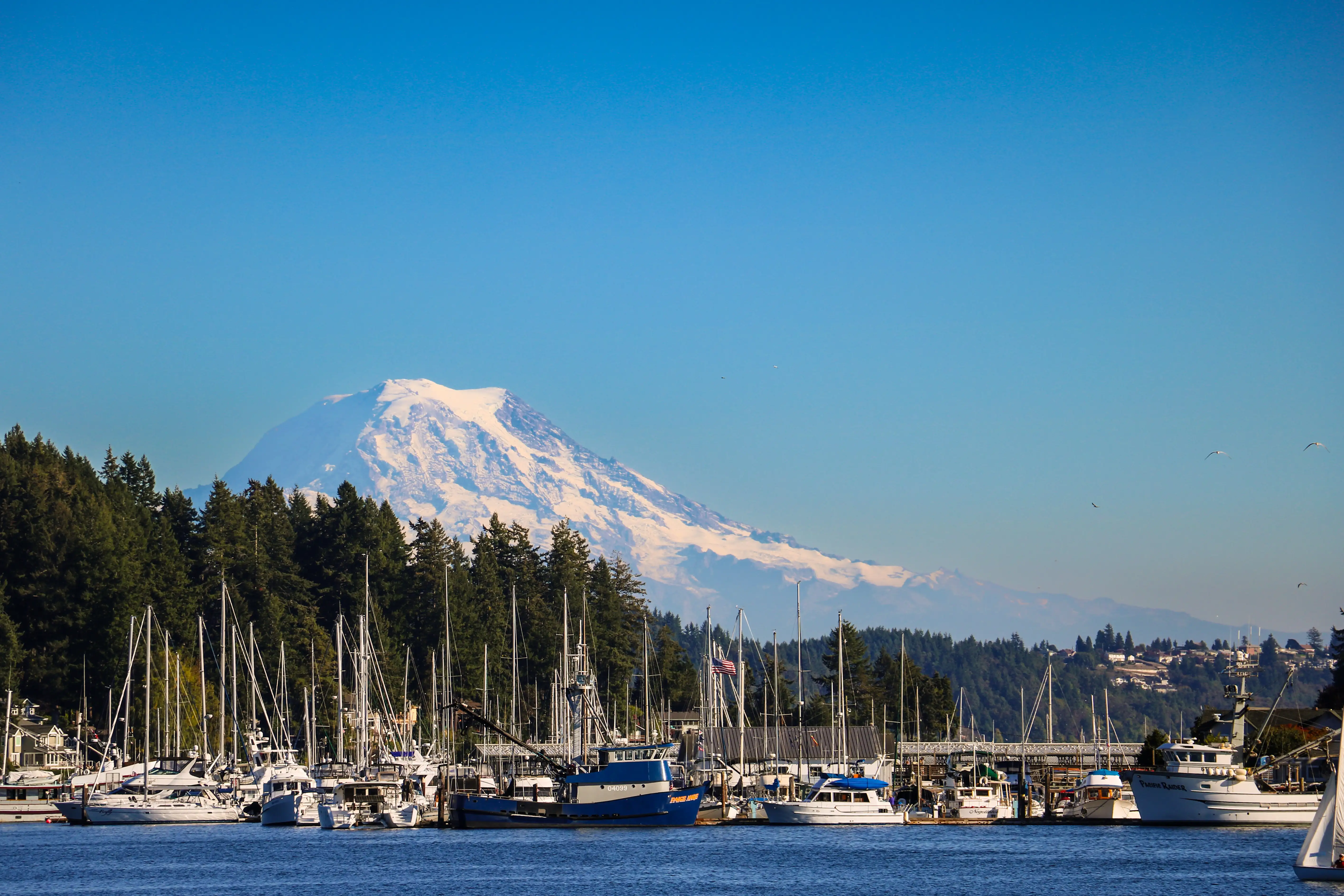
Many Californians relocating to Gig Harbor describe the homeowners insurance conversation as the most pleasant surprise of the process. Washington premiums are among the lowest in the country. In contrast, California wildfire exposure has pushed premiums sharply higher — and in some zip codes has produced outright non-renewals, leaving homeowners scrambling for the state's insurer of last resort at far higher cost. In Gig Harbor, the risk profile simply doesn't exist in the same way. The hillside lots above Peacock Hill and Rosedale are forested, but western Washington's rainfall pattern produces a fundamentally different fire environment than the Diablo wind zones many California buyers are leaving behind.
What Daily Life Actually Costs When You Get Here
Taxes and home prices are the headline numbers. The day-to-day picture is more nuanced, and for Californians used to paying premium prices for everything, some of it is genuinely better and some of it is not.
Groceries and Dining
Washington exempts food for home consumption from the state portion of the sales tax, which helps at the register. Grocery prices in Gig Harbor run roughly comparable to a mid-tier California suburb — not San Francisco prices, but not inland Sacramento prices either. There is no Trader Joe's in Gig Harbor itself; the nearest locations are in Tacoma, which is 20 minutes across the bridge on a clear day.
Along Harborview Drive in the Downtown/Harbor Historic District, you'll find the kind of independent dining scene that takes most small waterfront towns decades to build. Brix 25 on Harborview Drive is a chef-owned fine dining restaurant with a waterfront view and a reservation book that fills on weekends. Evergreen State Brewing Co. at 3155 Harborview Drive draws a local crowd most evenings. These aren't novelty tourist spots — they're where Gig Harbor residents actually eat.
Healthcare Costs and Coverage
Health insurance premiums in Washington run noticeably below what most Californians were paying, which partially offsets the loss of any subsidized California employer plan you're leaving behind. The honest trade-off is distance: routine care is readily available in Gig Harbor, but for certain specialist appointments you will drive to Tacoma or toward Seattle — something California metro residents, accustomed to dense provider networks, don't always anticipate.
Utilities and Transportation
Electricity rates in Washington are among the lowest in the country, driven by abundant hydropower — a meaningful contrast to California utility bills, particularly if you're heating a larger home. Gasoline prices track closer to Oregon than to California, typically running below Southern California pump prices. The Tacoma Narrows Bridge does charge a toll for the eastbound crossing, which adds a recurring cost for anyone commuting toward Tacoma daily — budget for it and factor it into your commute math. For employer and commute details, see the living in Gig Harbor overview.
The Six-Month Surprise
Almost every Californian who moves to Gig Harbor says the same thing by spring: they underestimated the gray. Not the rain — actual rainfall totals are often lower than people expect — but the unbroken overcast from November through March. If your California lifestyle was built around outdoor morning runs in January sunshine, Puget Sound winters require a genuine adjustment. People who thrive here lean into it: waterfront walks in drizzle, the brewery, a kitchen that gets more use in winter. People who fight it are often back in California within two years. Know which type you are before you move.
Looking to buy in Gig Harbor? Estimate your payment.
Enter your numbers to see an estimated monthly mortgage payment.
Estimate only. Excludes HOA fees and mortgage insurance. The interest rate above is a starting point, not a quoted rate — replace it with your own to see real numbers. Insurance is a flat placeholder, not a Gig Harbor quote.
California vs. Gig Harbor: Side-by-Side Reality Check
The abstract tax comparison matters. So does the lived experience of what you're trading. This table is designed for the specific Californian buyer sitting across from a decision — not for a general relocation audience.
| Category | California (typical coastal) | Gig Harbor, WA | Honest Read |
|---|---|---|---|
| State income tax | Up to 13.3% | $0 through 2027 | Major financial win for Gig Harbor |
| Typical home price | $1.3M+ (Bay Area); $900K–$1.5M (SoCal coastal) | $764,493 (Zillow Home Value Index, June 2026) | Gig Harbor noticeably lower; Southern CA gap is smaller |
| Effective property tax rate | ~1.1–1.2% (new buyers); much lower under Prop 13 | ~0.94% | Rate is lower in WA; long-tenured CA owners lose Prop 13 protection |
| Homeowners insurance | Rising sharply; non-renewals in fire zones | Among lowest in the U.S. | Significant ongoing savings in Gig Harbor |
| Sales tax | 10.25%+ in most cities | 9.1%–9.2%; groceries partly exempt | Slight edge to Gig Harbor |
| School quality | Varies widely by district | Peninsula School District, one of the stronger systems in Pierce County | Competitive; see full schools breakdown |
| Wildfire / insurance risk | High in many areas | Very low; wet climate | Peace of mind most Californians undervalue |
| Outdoor lifestyle | Year-round sun, dry trails | Water, trails, mountains — 9 months out of 12 | Requires adapting to gray winters |
| Urban amenities | Full metro access | Tacoma ~20 min, Seattle ~60 min | Adequate; some CA amenities genuinely absent |
| Population density / pace | Dense, fast, expensive | 12,600 people; waterfront small-town pace | The whole point of the move — or a dealbreaker |
The neighborhoods of Gig Harbor range from the walkable waterfront of the Downtown/Harbor Historic District to the larger-lot privacy of Canterwood and Peacock Hill — each with a different feel and price point. For a full breakdown of where to look, see the Gig Harbor neighborhoods guide.
The one category that genuinely surprises California buyers on arrival: the pace. Gig Harbor is a small town of 12,600 people on a protected harbor. There is no equivalent of a Third Street Promenade, no late-night food hall, no 24-hour anything. The Skansie Brothers Park and Net Shed area is where people gather on summer evenings — families walking the docks, kayakers coming off the water, the Eddon Boat Park a few minutes south for a quieter view. If you're craving that, Gig Harbor delivers it every evening. If you need the density and stimulation of a California metro, you will be driving to Tacoma regularly.
Before You Make an Offer: What California Buyers Get Wrong
Most California buyers arrive with the tax math already done. What they underestimate is the transaction itself and the first year of ownership.
The Equity Timing Question
Washington taxes 7% on long-term capital gains above a $278,000 standard deduction for 2025, rising to 9.9% on gains above $1,000,000 — meaning the sequence of your sale matters. If you're selling a California property with $800,000 in long-term appreciation, that gain needs to run through a tax advisor before you decide whether to sell before establishing Washington residency, after, or in stages. This is not a situation to solve with a search engine — the interaction between the federal home-sale exclusion, California's clawback rules, and Washington's capital gains tax is specific enough to require an actual CPA who works with interstate moves.
The Assessed Value Reset
Washington counties reassess at current market value annually. If you buy at $764,000 and the county assesses at full purchase price, your property tax calculation is straightforward at 0.94%. What catches California buyers is the expectation — built by decades of Prop 13 — that assessed value drifts below market over time. It doesn't work that way here. Annual reassessments mean your tax bill tracks the market. Budget accordingly rather than anchoring to what you paid in year one.
The Neighborhood Research You Should Do First
Gig Harbor is not one neighborhood. The Downtown/Harbor Historic District and the Gig Harbor North corridor are fundamentally different places to live — different commute patterns, different lot sizes, different community feel. Buyers who skip the neighborhood research and buy purely on price sometimes find themselves in the right city but the wrong part of it. The neighborhoods guide breaks down each area. If you're new to the buying process in Washington state specifically, the first-time homebuyer page covers the mechanics.
The Safety Reality, Briefly
Violent crime in Gig Harbor runs at 2 per 1,000 residents — well below Washington state averages and noticeably below most comparable California coastal cities. For the full picture, see the safety page. Most California buyers who ask about crime find the answer a relief; it's rarely the deciding factor here.
What People Move Back For
Gig Harbor does lose some California transplants, and the reason is almost never taxes or home prices. It's the winters and the distance from family. The overcast season is long and genuinely oppressive for people who grew up with California's winter sun. And if your parents are in Los Angeles or your kids are in college in San Diego, the distance feels abstract in July and very real in December. These aren't reasons not to move here — they're reasons to visit in February before you commit, and to be honest with yourself about what you're giving up alongside what you're gaining.
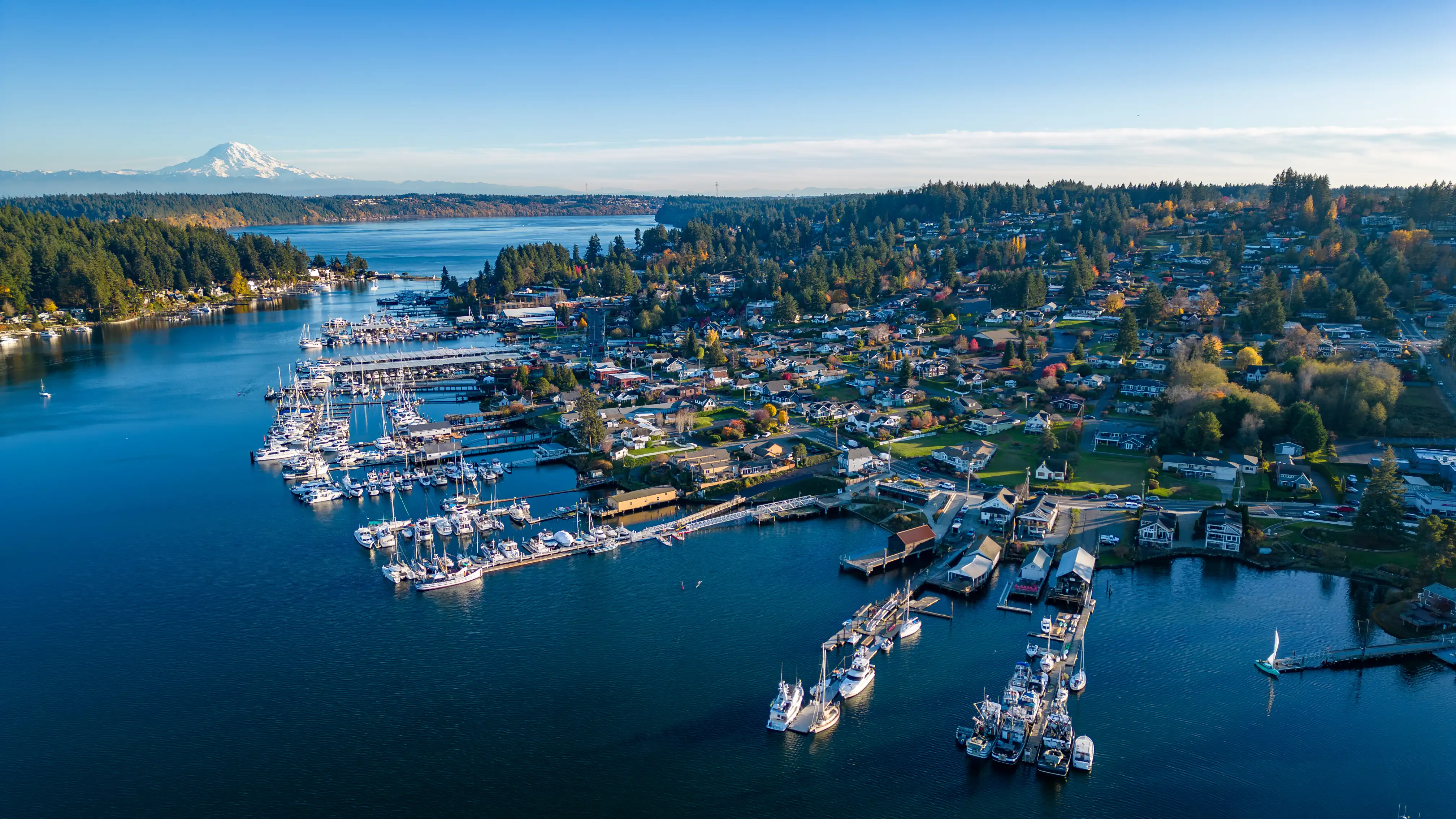
Local Expert Takeaway: The financial case for moving to Gig Harbor from California is among the clearest of any Pacific Northwest city: no state income tax on wages, an effective property tax rate of 0.94%, homeowners insurance that won't blindside you, and a $764,493 median home price that Bay Area equity can meet head-on. The lifestyle case is real too — waterfront walks from Skansie Brothers Park, dinner at Brix 25 on Harborview Drive, and a small-town pace that is genuinely different from what you left. The honest caveat: winters here are gray in a way that California doesn't prepare you for, and the distance from a full metro is real. Visit in February. If you still want it in February, you've found your place.
Quick Takeaways & FAQs
✅ Washington's $0 state income tax on wages through 2027 is the single largest financial advantage Gig Harbor offers Californians — California's top marginal rate is 13.3%.
⚠️ Long-tenured California homeowners lose Prop 13 protection entirely when they reset to Washington's market-value assessment basis, which can mean a higher dollar tax bill even at Gig Harbor's lower 0.94% effective rate.
📍 Evergreen State Brewing Co. at 3155 Harborview Drive and the walkable waterfront around Skansie Brothers Park are where you'll understand why people who move here stop looking elsewhere.
Do I pay state income tax if I move from California to Gig Harbor?
Will I owe Washington capital gains tax when I sell my California home?
How do Gig Harbor home prices compare to what I'm leaving in California?
What happens to my property taxes when I move from California to Washington?
Is Gig Harbor actually a small town or does it have real amenities?
Moving to Washington?
Tell us what you need help with and we'll connect you with local resources.
