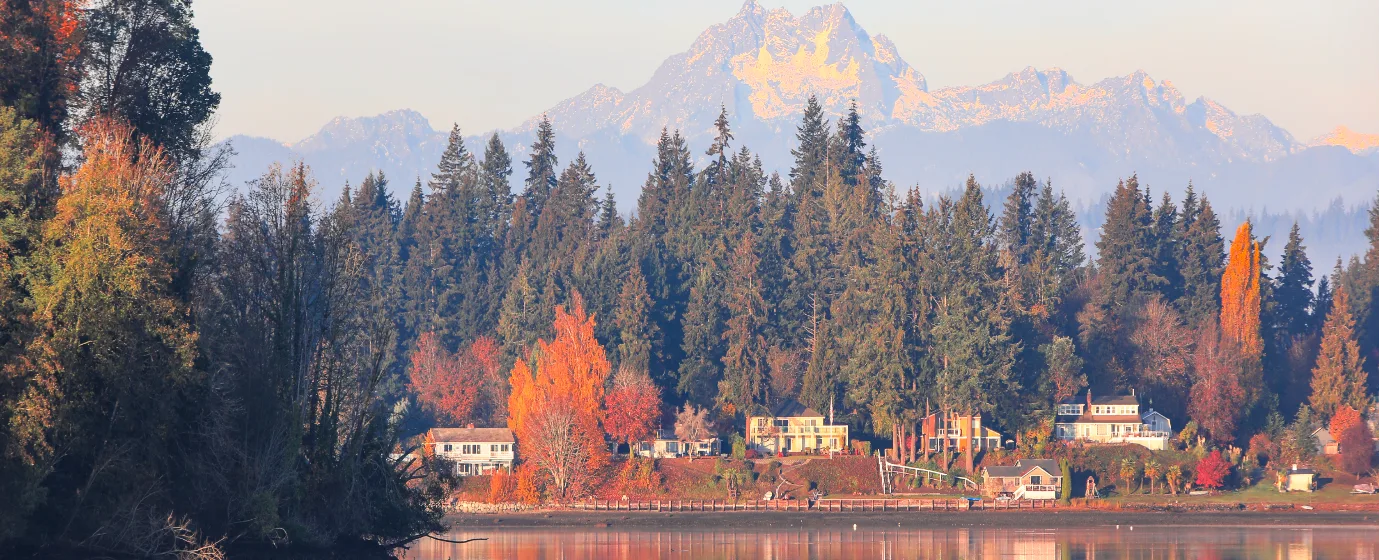
What Is Living in Bremerton, Washington Like?
You've probably heard Bremerton described as "the affordable side of the Sound" — and that's true, but it sells the place short. This is a working waterfront city of roughly 44,800 people on the Kitsap Peninsula, separated from Seattle by about 60 minutes of Puget Sound ferry crossing and connected to the rest of Kitsap County by Highway 3 and Highway 16. The city's identity is inseparable from the water: the Bremerton Boardwalk faces the Sound, the Washington State Ferries terminal anchors downtown, and Puget Sound Naval Shipyard lines the western shore. If you're expecting a sleepy satellite suburb, you'll be surprised. Bremerton has its own economic gravity, its own culture, and — increasingly — its own momentum.
Defense and shipbuilding are the backbone here. Puget Sound Naval Shipyard and the Bremerton Annex of Naval Base Kitsap together represent the city's single largest employment driver, attracting active-duty military families, federal civil service workers, and skilled trades professionals who rotate in from across the country. Beyond the shipyard, the Bremerton School District employs hundreds, Kitsap County government keeps a steady administrative workforce, and a major regional health system provides healthcare employment throughout the peninsula. The result is an economy that's more recession-resistant than most comparably priced cities in western Washington — and a community with a median age of just 33.2, meaning this is a genuinely young city, not a retirement destination.
Prices here are noticeably lower than Seattle, Bainbridge Island, or even much of the Eastside — see the full cost picture on the cost of living page. Day-to-day life combines maritime access, proximity to Olympic Peninsula trails, and a downtown that has been actively rebuilding its walkable core around the ferry terminal with new waterfront condos, an expanded marina, and a renovated transportation center. Kitsap Transit runs 40 fixed bus routes and two passenger ferry routes, and the Kitsap Fast Ferry logged nearly 1.2 million riders in 2025 alone — transit here is more functional than newcomers expect.
Whether you're being relocated by the Navy, priced out of Seattle and looking west, or simply drawn to a waterfront city with room to breathe, this guide covers Bremerton's neighborhoods, housing market, daily life, commute reality, local favorites, and the honest trade-offs you should weigh before making an offer.
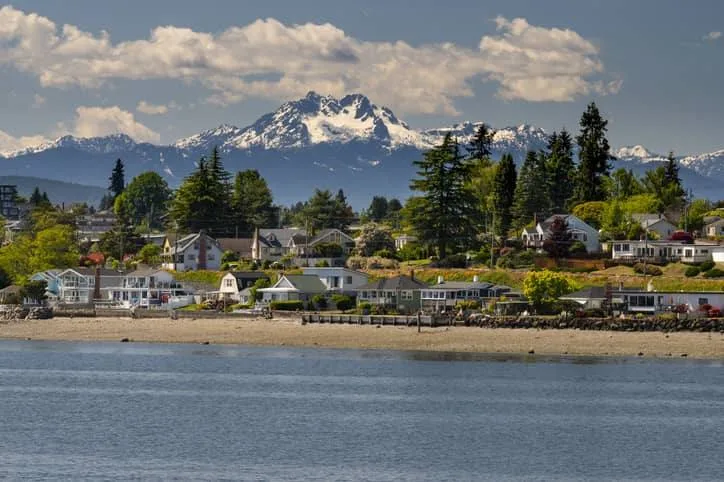
Bremerton at a Glance
Looking to buy in Bremerton? Estimate your payment.
Enter your numbers to see an estimated monthly mortgage payment.
Estimate only. Excludes HOA fees and mortgage insurance. The interest rate above is a starting point, not a quoted rate — replace it with your own to see real numbers. Insurance is a flat placeholder, not a Bremerton quote.
Why Are People Moving to Bremerton?
The Defense Economy Pulls Thousands In
Puget Sound Naval Shipyard — one of the largest naval ship repair facilities in the country — is why Bremerton exists and why it keeps growing. Active-duty military, federal civilian employees, and contract workers tied to Naval Base Kitsap cycle through on a scale that creates a self-sustaining relocation pipeline. If you or your partner received military orders to the region, Bremerton is the most logical base city: you live minutes from the gate rather than commuting from Silverdale or Port Orchard.
Bremerton's population has grown approximately 5.4% since the 2020 census and continues expanding at roughly 0.89% per year. That pace is steady rather than explosive — enough to support new commercial investment downtown without the growing-pain congestion of Renton or Puyallup.
The Pricing Argument Is Real
The Zillow Home Value Index for Bremerton stood at $459,702 in June 2026 — meaningfully lower than comparable waterfront communities across the Sound. That gap is what sends Seattle renters and first-time buyers to the ferry terminal. For what a one-bedroom condo costs in a central Seattle neighborhood, you can own a house with a water view in Manette or a craftsman on a quiet street in Charleston.
The compromise is the commute. If your job is in Seattle and you're not working remotely or on the shipyard, you are building your life around the ferry schedule. That reality filters self-selection: people who move here and stay tend to be remote workers, federal employees who work on-peninsula, or Seattle commuters who have genuinely done the math and decided the trade-off works.
Who Actually Moves Here
| Buyer Type | Why Bremerton Works | Best Fit |
|---|---|---|
| Military & federal employees | Lives minutes from Naval Base Kitsap and PSNS; on-base housing alternatives nearby | Commuter |
| Remote workers priced out of Seattle | Home ownership well below Seattle prices; fast ferry for occasional in-office days | Value Views |
| Families with school-age children | Lower cost of entry frees up budget; Kitsap parks and waterfront access for active families | Families |
| First-time buyers | Entry-level homes still accessible; city is growing in the direction of higher values | First-Time Value |
| Trades professionals | PSNS and local shipbuilding demand skilled labor at competitive wages | Commuter |
| Nature-focused buyers | Olympic Peninsula day trips and Puget Sound water access from your backyard | Nature Views |
Downtown revitalization has started attracting a younger wave of buyers who want walkable urban density without Seattle pricing — a trend that's visible in the new condo projects rising near the Bremerton Boardwalk.
What Daily Life Feels Like in Bremerton
The Pace Is Different from Seattle — Intentionally
Six months after moving here, most newcomers say the same thing: they didn't realize how much of their mental energy Seattle was consuming until it stopped. The morning rush on the Bremerton waterfront feels nothing like I-5. You walk to the ferry terminal or a nearby café, you know your neighbors' names, and the Harborside Fountain Park is never actually crowded on a Tuesday.
That said, Bremerton is not a small town pretending to be a city. It has real urban texture: a growing restaurant and brewery corridor along 4th Street, the historic Admiral Theatre hosting national touring acts, and a monthly First Friday Art Walk that moves through the Manette, Downtown, and Callow Avenue neighborhoods from 5 to 8 p.m. The scene is modest by Seattle standards, but it's genuinely there.
The Seasonal Reality Nobody Warns You About
Western Washington's gray winters are well-documented, but Bremerton's version has a specific twist: the ferry can be delayed by dense fog rolling in off the Sound, sometimes without much advance notice. If you're a ferry commuter, you learn to build buffer time into your schedule from November through March. Missing a sailing by three minutes on a cold Wednesday morning is a rite of passage here.
Summers, by contrast, are legitimately spectacular. The Puget Sound sparkles, the Bremerton Boardwalk fills with people, and the proximity to the Olympic Peninsula means a world-class weekend is always within 90 minutes. That seasonal swing is part of why people who commit to Bremerton tend to stay.
Where Locals Actually Gather
The Food Truck Friday rotation at Quincy Square runs every Friday from April through October and functions as the city's informal town square — a reliable spot to run into half your neighborhood. The First Friday Art Walk brings a different crowd, connecting the Manette Bridge's gallery-and-café strip to the downtown core. Remedy Speakeasy on 4th Street draws the after-work crowd in a restored downtown space that feels nothing like a strip-mall bar. For a neighborhood read on schools and safety, the schools page and safety page go deeper on both.
Daily errands are car-dependent for most residents outside the immediate downtown core. Grocery options have improved, but a full big-box run still sends many people to Silverdale. That's a 15-minute drive — annoying, not a dealbreaker, but worth knowing before you fall in love with a house in East Bremerton and assume you can walk to everything.
The Bremerton Housing Market Right Now
Prices Have Pulled Back — and Homes Still Move Fast
The Zillow Home Value Index for Bremerton registered $459,702 in June 2026, down 5.9% from the prior year. That correction has made the market more accessible than it was at the 2022–2023 peak, but the pace hasn't softened to match: homes typically go to pending in around 7 days. The combination of lower prices and fast movement means buyers who are underprepared still lose.
Some parts of the city command noticeably higher prices than the city-wide figure — waterfront proximity, views of the Sound, and the walkable Manette corridor all push values above the median. The best neighborhoods page breaks down the character and price positioning of each area in detail.
What the Market Rewards Right Now
Downtown revitalization is creating new inventory where there wasn't any — waterfront condos, renovated mixed-use buildings, and infill construction within walking distance of the ferry terminal. That's a different product than the single-family craftsmen that dominate the older residential streets, and it's attracting a buyer who a few years ago wouldn't have considered Bremerton at all.
The effective property tax rate here runs approximately 0.80% — lower than many comparably priced markets in the region, which meaningfully affects carrying costs over time. Washington State has no income tax, which factors into the full affordability calculation for buyers relocating from income-tax states. The full tax picture — property, sales, and income — lives on the cost of living page.
The Honest Read
Bremerton's market rewards buyers who move decisively. Seven-day pending timelines don't leave room for a second weekend of open houses. The price correction has improved the entry point, but well-located homes — especially those within walking distance of the ferry or the Manette Bridge corridor — are still fielding competitive interest.
Bremerton Neighborhoods
Bremerton has several distinct areas — each with its own character and appeal. Here’s a breakdown to help you narrow down where to focus your home search.
🏡 Manette
Manette sits east of the Manette Bridge with its own walkable main street and a mix of craftsman bungalows and updated homes that attract buyers who want neighborhood character over suburban quiet. It's the most identifiable sub-community in Bremerton, and properties here hold appeal that goes beyond just pricing.
🏠 East Bremerton
East Bremerton covers a broad swath of residential streets with a range of housing ages and styles, generally offering more space and lower entry points than Manette or the downtown core. It suits families with school-age children and buyers prioritizing square footage over walkability.
🌳 West Bremerton
West Bremerton sits closer to the shipyard and the older industrial waterfront, with a working-class residential character and some of the city's more affordable housing stock. It's a practical choice for shipyard employees and trades workers who want a short commute to the naval installation.
🏘 Downtown Bremerton
Downtown is the city's most walkable area, built around the Washington State Ferries terminal, the Bremerton Boardwalk, and the growing 4th Street corridor of restaurants and bars. New condo construction here is attracting buyers who want urban density at prices that feel impossible on the other side of the Sound.
🏔 Charleston
Charleston is a quieter, established residential area in the northern part of the city with a mix of mid-century homes and newer construction, popular with families who want breathing room without being far from the peninsula's main employment centers.
🌆 Bay Vista
Bay Vista is a hillside neighborhood with elevated views over Puget Sound, attracting buyers who prioritize the visual payoff of water views alongside the practical benefits of Bremerton's price point compared to waterfront markets across the Sound.
Pros & Cons of Living in Bremerton
The Pros
- Dramatically lower home prices than Seattle with a scenic waterfront setting
- Fast ferry gets commuters into downtown Seattle in about 30 minutes
- Strong
- stable job base anchored by the Navy shipyard and military
- Growing downtown with restaurants
- breweries
The Cons
- Crime rates
- especially property crime
- run notably above national and state averages
- School district test scores and graduation rates trail Washington state averages
- Long
Getting Around & Commuting in Bremerton
The Ferry Is the Whole Equation
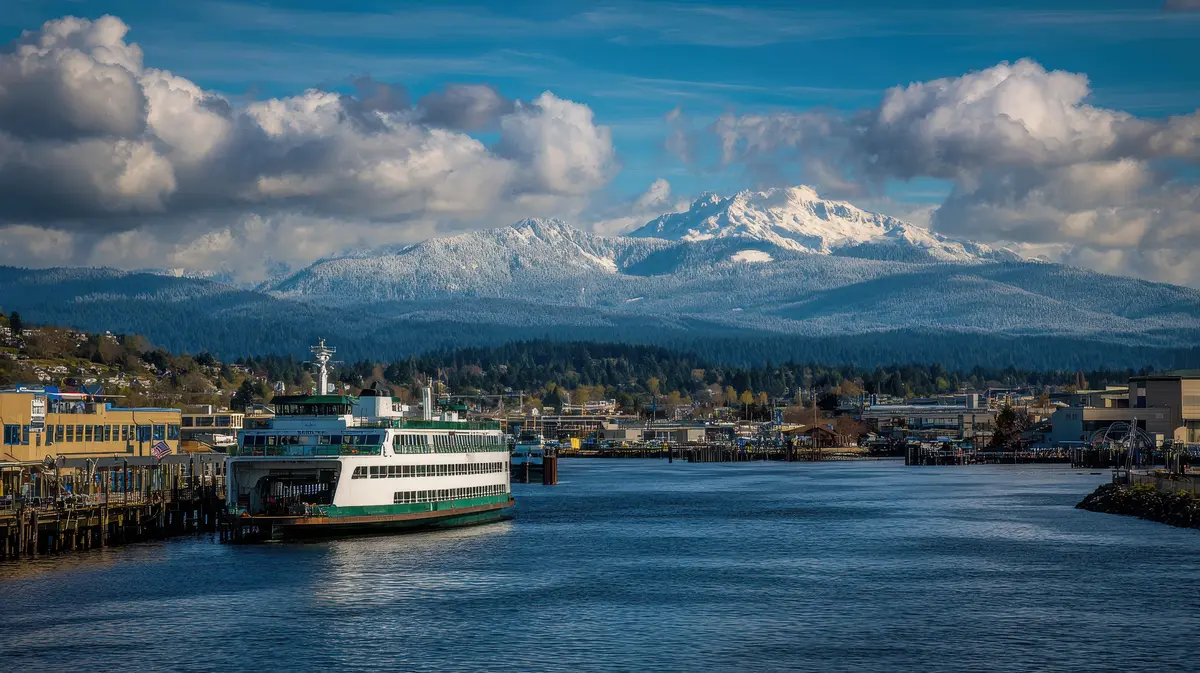
Bremerton's relationship with Seattle runs entirely through Puget Sound. Washington State Ferries restored two-boat service on the Seattle–Bremerton route starting June 15, 2025 — a significant upgrade in frequency that commuters had been waiting years to see. The standard car-ferry crossing runs approximately 60 minutes. If you're walking on and live near the Bremerton Transportation Center, the Kitsap Fast Ferry gets you dock-to-dock in roughly 30 minutes, putting downtown Seattle 45 to 70 minutes from your front door.
The Fast Ferry logged 1,187,800 riders in 2025. That's not a niche option — it's a mature commuter corridor with real ridership density, and it has meaningfully changed the calculus for remote workers who need to be in Seattle two or three days a week.
Getting Around On-Peninsula
Inside Kitsap County, Kitsap Transit operates 40 fixed bus routes and a vanpool system, all headquartered in Bremerton. For peninsula-based employers — Naval Base Kitsap, county government, the school district — a car-free or car-light lifestyle is achievable in ways that would surprise people arriving from car-dependent parts of the country.
Driving to Seattle is technically possible via Highway 16 south and then north on I-5 through Tacoma, but that route typically runs 75 to 90 minutes in normal conditions and much longer during rush hour. Almost nobody who lives in Bremerton and works in Seattle drives that way regularly. The ferry is the commute.
Driving Within Bremerton
Local driving is uncomplicated by Puget Sound standards. The Manette Bridge connects the east side of the city to downtown, and it can back up during morning and afternoon peaks — plan around it if you live in Manette and need to reach the ferry terminal by a specific sailing. Highway 3 north toward Silverdale and south toward Port Orchard handles peninsula traffic efficiently outside of peak windows.
| Route | Mode | Typical Time | Notes |
|---|---|---|---|
| Bremerton → Downtown Seattle | Kitsap Fast Ferry (walk-on) | 30 min dock-to-dock; 45–70 min door-to-door | Requires living near Transportation Center |
| Bremerton → Downtown Seattle | Washington State Ferry (car or walk-on) | ~60 min crossing | Two-boat service restored June 2025 |
| Bremerton → Silverdale | Car via Hwy 3 | ~15 min | Main retail/shopping hub for Kitsap |
| Bremerton → Port Orchard | Car via Hwy 16 | ~15 min | Kitsap County seat; additional services |
| Bremerton → Seattle | Car via Hwy 16 south through Tacoma | 75–90+ min | Rush hour adds significantly; rarely used |
| Within Kitsap County | Kitsap Transit bus | Varies by route | 40 fixed routes; vanpool also available |
The ferry schedule governs social and professional life in ways that take a few months to fully internalize. Missing the last sailing of the night after a Seattle event means a very long drive home — most Bremerton residents build their evening plans around departure times the way urban dwellers build plans around the last subway.
Schools in Bremerton
Families relocating to Bremerton have public, private, and higher-education options nearby. Here’s a quick overview.
🎓 School District
Bremerton School District serves K–12 students across Bremerton and the surrounding area. Rated C+ (source: Niche.com).
🏆 Graduation Rate
The 4-year high-school graduation rate here is approximately 72.8%.
📚 Higher Education
Washington’s public universities — the University of Washington, Washington State University, and Western Washington University — offer four-year degrees statewide, with a network of 34 community and technical colleges (SBCTC) providing two-year and workforce programs.
🌐 Online Learning
University of Washington Continuum College and Washington State University Online offer fully accredited online degrees for remote learners across the state.
Safety in Bremerton
A quick look at how Bremerton compares on the numbers that matter most when weighing a neighborhood or a move.
🛡 Violent Crime
Approximately 4.28 per 1,000 residents.
🔒 Property Crime
Approximately 37.71 per 1,000 residents.
Compared to the FBI’s most recent national data (2024), Bremerton’s violent crime is above the national average (about 3.6 per 1,000), and property crime is above the national average (about 17.6 per 1,000).
Against Washington as a whole, Bremerton’s violent crime is somewhat above the state average, and property crime is about one and a half times the state average (Bureau of Justice Statistics, Crime Known to Law Enforcement, 2024 (tables 2 and 3)).
Crime rates can vary a lot within a single city, so the citywide numbers above are only a starting point. Some neighborhoods in Bremerton run well below these averages, while others run higher — the kind of block-by-block detail that matters most when you’re actually choosing where to live. The full guide below breaks it down neighborhood by neighborhood.
Working in Bremerton
Bremerton’s largest employers span several industries — here are some of the anchors of the local job market.
💼 Puget Sound Naval Shipyard
Defense/shipbuilding
🏛 Naval Base Kitsap
Military
🏥 St. Michael Medical Center
Healthcare
🎓 Bremerton School District
Education
🏛 Kitsap County government
Public administration
Parks & Recreation in Bremerton
Some of the outdoor spaces that shape everyday life in Bremerton.
🌱 Harborside Fountain Park
Bremerton residents don’t have to go far for green space — spots like Harborside Fountain Park are part of everyday life here, whether that’s a morning walk, a weekend hike, or just somewhere to unwind outside. The full guide below covers more of what Bremerton has to offer for parks and outdoor recreation.
Retiring in Bremerton
Bremerton draws retirees for its balance of amenities, outdoor access, and cost. Here’s what to weigh.
🌤 Climate
Bremerton sits in the rain shadow of the Olympic Mountains, which makes it somewhat drier than Seattle — though 'drier' is relative in western Washington. Expect mild, overcast winters with temperatures rarely dropping below the mid-30s, and genuinely beautiful summers with long daylight hours and low humidity. The maritime air keeps things temperate year-round, which suits retirees who want seasons without extremes.
🍴 Lifestyle
The Bremerton Boardwalk, Harborside Fountain Park, and the Admiral Theatre form the cultural core for retirees who want activity without driving far. The monthly First Friday Art Walk and the summer Food Truck Friday series at Quincy Square provide regular low-key social anchors. For longer excursions, the Olympic Peninsula is within an easy drive.
🏚 55+ Communities
Bremerton and the broader Kitsap Peninsula have active-adult and senior-living communities suited to retirees who want to stay connected to the water and the outdoors without the cost of Seattle-area alternatives. Options range from independent senior apartments near the downtown core to more established residential communities in the surrounding hills. The retiring page covers healthcare access and senior housing in detail.
✈ Getting Around
Retirees who live near the downtown core can manage most daily needs without a car — Kitsap Transit's bus network covers the peninsula, and the ferry to Seattle runs with improved frequency since 2025. For those who prefer to drive, Highway 3 connects Bremerton to Silverdale's retail corridor in about 15 minutes. The nearest major airport is Seattle-Tacoma International, approximately 60 to 75 minutes away depending on traffic and crossing method.
🏛 Washington Taxes for Retirees — What to Know
- No state income tax — Washington does not tax personal income, so Social Security, pensions, and 401(k)/IRA withdrawals are all untaxed at the state level. There is no state return to file and no retirement exclusion to claim — the rate is simply zero.
- Military and public pensions — Because there is no income tax, military retirement pay and public-employee pensions are untaxed at the state level along with everything else.
- Sales tax is the tradeoff — The state sales tax is 6.5%, and local add-ons bring the combined rate in Bremerton to 9.2% (Washington State Department of Revenue, Q3 2026 local sales & use tax rate table, July 2026). Groceries and prescription drugs are exempt.
- Property taxes, with senior relief — The effective property tax rate is roughly 0.9%. Homeowners 61+ (or unable to work due to disability, or a qualifying disabled veteran) who own and occupy their home may qualify for a reduction. Income limits are set against each county’s median household income, so the threshold differs by county — check with your county assessor. A separate deferral program is available for those who don’t qualify for the exemption.
- Capital gains tax — but not on retirement income — Washington taxes 7% on long-term capital gains above a $278,000 standard deduction for 2025, rising to 9.9% on gains above $1,000,000. Retirement accounts and real estate sales are both exempt. It therefore does not reach ordinary retirement income or the sale of a home.
- Estate tax — the one to plan for — Unlike most no-income-tax states, Washington has its own estate tax. For deaths on or after July 1, 2026, the exemption is $3 million with graduated rates topping out at 20%. Retirement accounts count toward the taxable estate, so long-time homeowners with sizable balances can cross the line without expecting to.
- No inheritance tax — Washington has no inheritance tax, and no gift tax.
- WA Cares payroll premium — Working Washingtonians pay 0.58% of gross wages into the WA Cares Fund, the state long-term care program, with no income cap. It applies to W-2 wages, so retirees who have stopped working do not pay it — but anyone relocating while still employed will see it. The private-insurance opt-out closed at the end of 2022 and is not available to new applicants; the remaining exemptions are narrow (living outside Washington, military spouses, certain visa holders, and veterans with a 70%+ service-connected rating).
- The Oregon border effect — Oregon has no sales tax, so Washington residents near the river — Vancouver, Camas, Washougal, Longview — often cross over for large purchases. Washington use tax technically applies to goods brought back for use in-state, though it is rarely enforced on ordinary personal purchases.
Tax laws change frequently and individual situations vary. This is general information, not tax advice — always consult a qualified Washington tax professional or CPA for personalized retirement tax planning.
Weekends & Local Favorites in Bremerton
Downtown Has More Than It Used To
The Bremerton waterfront has changed meaningfully in the last several years. The Bremerton Boardwalk is an easy walk from the ferry terminal and puts you at the water's edge with views back toward the Olympic Mountains on clear days. The USS Turner Joy Museum Ship — a decommissioned Navy destroyer moored just off the boardwalk — is one of those local landmarks that out-of-town visitors love and longtime residents completely take for granted.
The 4th Street corridor is where the food and nightlife action concentrates. Remedy Speakeasy on 4th Street has become a reliable anchor for the after-work and date-night crowd in a restored downtown space. A handful of independent taprooms and bars round out the corridor for a casual weekend afternoon. The Admiral Theatre, a restored 1941 cinema and performance venue on Pacific Avenue, brings touring musical acts and films to a room that seats around 1,200 — a genuine civic gem for a city this size.
The Free Stuff That Actually Matters
Food Truck Friday at Quincy Square runs every Friday from April through October and costs nothing to attend. The monthly First Friday Art Walk covers ground from Manette through downtown to the Callow Avenue area, 5 to 8 p.m., with galleries, studios, and pop-up music spilling onto the sidewalks. These recurring events create the kind of low-friction social fabric that makes a city feel like a community rather than just a place to sleep.
Harborside Fountain Park on the waterfront is where families stake out a patch of grass on summer evenings. It's genuinely lovely — and genuinely underutilized compared to what a similar park would look like in a Seattle neighborhood. That's either a draw or a tell, depending on what you're looking for.
Getting Out of Town
Bremerton's location on the Kitsap Peninsula puts you at the literal jumping-off point for the Olympic Peninsula. The western reaches of the peninsula are about 30 to 60 minutes away depending on your destination. Olympic National Park's backcountry is about 90 minutes. A short drive up the peninsula connects you to the Bainbridge Island ferry, which puts you on a very different island in 35 minutes. Locals who love the outdoors treat Bremerton as a basecamp, not a destination, and that framing makes the commute trade-off feel much more reasonable. For a deeper look at parks, trails, and water access, the parks and recreation page covers the full picture.
Top Things Locals Say About Bremerton
The best intel about a city comes from the people who actually live there. Here’s what Bremerton residents say when newcomers ask the questions everyone’s thinking.
“I kept telling people the commute would be an hour and they'd look at me like I was crazy. But you're sitting on the water watching the Olympics with a coffee — it's not like sitting in traffic on I-5. After about three months I stopped thinking of it as a commute and started thinking of it as the best part of my day.”
— Recent Bremerton home buyer
“What's the most surprising thing about living in Bremerton?”
How much the Manette neighborhood feels like its own little village. Before I moved, I thought Bremerton was just the ferry terminal and the shipyard. Then I crossed the Manette Bridge and found a whole walkable strip with its own identity. That divide between east and west Bremerton is real — people on the Manette side rarely feel like they need to go downtown for anything except the ferry.
“What do locals love most about Bremerton?”
The access. You can be heading toward the Olympic Peninsula in 30 minutes, on a boat in the Sound by afternoon, or exploring Olympic National Park by the time someone in Seattle is still stuck on 520. And in the summer, the Bremerton Boardwalk on a clear evening with the Olympics in the background — it's genuinely hard to beat. People who move here for the price stay for the view.
“What should newcomers to Bremerton know?”
Learn the ferry schedule before you fall in love with a social life in Seattle. Missing the last Fast Ferry sailing means either crashing in the city or a very long drive around through Tacoma — neither is fun at midnight. Most longtime residents build their evening plans around departure times the way you'd plan around a last subway in New York. Also: the Manette Bridge backs up predictably on weekday mornings. Give yourself an extra ten minutes if you need to reach the terminal for a specific sailing.
“Can you live in Bremerton without a car?”
If you work downtown or at an employer near the waterfront, it's very doable — the Kitsap Transit bus network is real and functional, and the ferry terminal is walkable from the core neighborhoods. The honest answer for most people is car-light rather than car-free: you'll want one for grocery runs to Silverdale, weekend trips to the Olympic Peninsula, and anything west of town. Downtown Bremerton is the most walkable part of the city; the further east or north you go, the more you'll miss having a car.
Cities Near Bremerton
Other communities near Bremerton worth a look — each with its own character and price point.
| City | Distance | Best For | Vibe | Median Rent | Median Buy |
|---|---|---|---|---|---|
| Port Orchard | 6 mi | Families, new construction, slower pace | Quieter, suburban, Kitsap County seat | $1,900 | $565,709 |
| Silverdale | 8 mi | Retail access, top-rated schools | Suburban, commercial, family-friendly | $1,950 | $609,559 |
| Bainbridge Island | 12 mi | Luxury buyers, Seattle commuters | Affluent, walkable, scenic ferry town | $2,600 | $1,150,000 |
More Helpful Guides for Bremerton
Going deeper on Bremerton? Our blog series covers everything from first-time buying to retiring here — explore the guides below.
Local Expert Takeaway: Bremerton rewards buyers who plan their life around the ferry and genuinely embrace the peninsula. The Fast Ferry's 30-minute crossing to Seattle's downtown waterfront is the city's most underrated asset — buy within walking distance of the Bremerton Transportation Center and your Seattle commute becomes one of the most pleasant in the region. Skip the car ferry for daily use, build your evenings around the sailing schedule, and spend your weekends heading toward the Olympic Peninsula or the Bremerton Boardwalk instead of back across the Sound. The buyers who struggle here are the ones who moved for the price alone and kept their social and professional lives anchored in Seattle.
Quick Takeaways & FAQs
✅ The Kitsap Fast Ferry reaches downtown Seattle in roughly 30 minutes dock-to-dock — one of the most functional commuter ferry routes in the Pacific Northwest.
⚠️ Bremerton's property crime rate runs notably higher than many Kitsap Peninsula communities, so neighborhood research matters more here than in lower-crime alternatives like Silverdale or Poulsbo.
📍 Food Truck Friday at Quincy Square runs every Friday from April through October — it's the city's informal town square, and the easiest way to get a feel for who actually lives here.
How long is the commute from Bremerton to Seattle?
Is Bremerton a good place to buy a house in 2026?
What is the main employer in Bremerton, WA?
What neighborhoods in Bremerton are best for families?
Does Bremerton have good public transit?
Helpful Links for Moving to Bremerton
Moving to Washington?
Tell us what you need help with and we'll connect you with local resources.
