
What Is Living in Port Orchard, Washington Like?
Most people who move to Port Orchard arrive expecting a sleepy ferry town on the wrong side of Puget Sound. What they find instead is Kitsap County's fastest-growing city — a place where a $10 million Bay Street reconstruction project and an $11 million retail center at McCormick Village are underway simultaneously, while the waterfront Farmers Market that's been running for nearly 50 years still draws Saturday crowds. Port Orchard sits across Sinclair Inlet from Bremerton, anchored by State Route 16 to the south and State Route 160 east to the Southworth ferry terminal. Its population has grown roughly 32% since the 2020 Census, and that growth is visible in every direction: new subdivisions pushing out from McCormick Woods, cranes visible downtown, and a steady stream of buyers arriving from King County with spreadsheets and sticker shock.
The economic spine of Port Orchard is defense and public sector. Puget Sound Naval Shipyard — one of the largest naval ship repair facilities in the country — sits just across the inlet in Bremerton and is the dominant employer for the entire peninsula. The South Kitsap School District, the City of Port Orchard itself, and a major regional health system round out the largest local employers. Fred Meyer serves as the retail anchor most residents rely on until they cross the bridge or take the ferry for bigger shopping runs. The city is the county seat of Kitsap County, which means government services, courts, and administrative jobs are concentrated here — a stabilizing force during economic downturns that other communities don't have.
On price, Port Orchard sits noticeably below what most Seattle-area buyers are leaving behind, while still reflecting the real demand that Puget Sound access creates. Day-to-day life leans heavily on the outdoors: South Kitsap Regional Park's 209 acres of mountain biking and hiking trails sit inside city limits, Manchester State Park is a 10-minute drive east, and the Sinclair Inlet waterfront boardwalk is where most of the community's informal social life happens on weekends. Washington's lack of a state income tax is a meaningful draw for professionals relocating from California or Oregon, and the effective property tax rate of approximately 0.80% is among the lower rates in the Puget Sound region. The catch is that car dependency is real — and the commute math deserves more attention than most buyers give it before making an offer.
Whether you're considering a move or just researching the area, the sections below break down Port Orchard's job market and who the city suits, what daily life actually looks like, the current housing market, commute realities, and the local spots worth knowing about on weekends.

Port Orchard at a Glance
Looking to buy in Port Orchard? Estimate your payment.
Enter your numbers to see an estimated monthly mortgage payment.
Estimate only. Excludes HOA fees and mortgage insurance. The interest rate above is a starting point, not a quoted rate — replace it with your own to see real numbers. Insurance is a flat placeholder, not a Port Orchard quote.
Why Are People Moving to Port Orchard?
The short answer: they can't afford Gig Harbor, they don't want Bremerton's urban density, and Port Orchard splits the difference in a way that's increasingly hard to ignore.
The Defense Economy Drives Everything
Puget Sound Naval Shipyard in adjacent Bremerton is the gravitational center of the local economy. It employs thousands of civilian and military workers, and a meaningful share of them live in Port Orchard specifically because housing here costs less than on the Gig Harbor side of the Narrows Bridge. The roughly 20-minute drive from Port Orchard to the shipyard along SR-16 is one of the most-traveled commutes on the peninsula.
South Kitsap School District is also one of the larger employers in the city proper — relevant if you're a teacher or support staff considering a move. The City of Port Orchard's own government and administrative workforce adds stability that smaller incorporated cities don't have.
Who the City Actually Suits
| Buyer Type | Why Port Orchard Works | The Honest Catch |
|---|---|---|
| Commuter | ~20 min to Puget Sound Naval Shipyard; foot ferry to Bremerton for $2 each way | SR-16 congestion toward Gig Harbor at peak hours |
| Families | South Kitsap Regional Park, newer McCormick Woods construction, established school district | Teens need a car or a parent for most activities |
| First-Time Buyers | Entry point noticeably below King County and Pierce County averages | Inventory moves fast; multiple-offer situations are common |
| Value Seekers | Zillow Home Value Index of $565,709 (July 2026) vs. significantly higher Seattle-area norms | Appreciation has been strong — the window narrows each year |
| Outdoor Enthusiasts | 209-acre South Kitsap Regional Park, Manchester State Park 10 min east, waterfront boardwalk | Limited indoor entertainment; Seattle trips fill that gap |
| Remote Workers | Waterfront lifestyle at a fraction of Seattle pricing; ferry connection when office days happen | Internet infrastructure varies by neighborhood; check before buying |
The city is also drawing a growing cohort of buyers who priced out of Gig Harbor's higher medians but still want Puget Sound water access and newer construction.
The Growth Signal
A 32% population jump since the 2020 Census is not a soft trend — it's the kind of growth that reshapes a city's retail mix, school capacity, and traffic patterns within a decade. The $11 million McCormick Village retail center at McCormick Village Drive and SW Yarrow Street is a direct response: the Cordillera Group is building roughly 30,000 square feet of restaurants, shops, and services to serve the western residential expansion that has already happened.
The city is actively pursuing federal Opportunity Zone designation for census tracts within city limits — a signal that Port Orchard is trying to accelerate investment rather than passively absorb growth.
What You Give Up
Port Orchard doesn't have the walkable downtown restaurant scene of Gig Harbor's waterfront village, and it doesn't have the transit connectivity of Bremerton's urban core. If your lifestyle depends on spontaneous weeknight dining or proximity to a major airport, this trade-off is real. Seattle-Tacoma International Airport is a solid hour away on a good day, and Port Orchard's own dining scene, while improving, is still building critical mass.
What Daily Life Feels Like in Port Orchard
Six months in, most newcomers say the same thing: they underestimated how much of their social life would migrate to the waterfront. The Sinclair Inlet Boardwalk isn't a destination — it's where you end up on a Tuesday evening without planning it.
The Waterfront Is the Living Room
Historic Bay Street runs the length of downtown along the water, lined with small shops, the Sidney Museum & Arts Center, and the marina. On Saturday mornings from April through October, the Farmers Market at 933 Bay St pulls vendors and buyers from across the peninsula — it's been running for nearly 50 years, which tells you something about how embedded it is in the community's rhythms. A summer Tuesday market at South Kitsap Helpline on Mile Hill Drive extends the season into weekday afternoons for parents who can't make the Saturday run.
The Port Orchard Night Market brings food trucks, live music, and artisan vendors to the waterfront on four summer evenings — 2026 dates are June 20, July 11, August 22, and September 12. The Fathoms O' Fun festival each late June and early July is the biggest single event of the year: a multi-day waterfront celebration with a parade, music, and fireworks that draws the entire peninsula.
Eating and Drinking Like a Local
Peninsula BevCo on Bay Street is the waterfront taproom that doubles as a restaurant — the place most locals end up on Friday evenings before anyone's made a plan. For weekday breakfast, Uncle Dave's Cafe on Harrison Avenue is a diner-style spot that runs quick and unpretentious. Royal Tandoor brings solid Indian food to a dining scene that's still developing range, and Damn Fine Pizza earns its name consistently enough that it has a regular following.
The honest assessment: Port Orchard's restaurant scene covers the basics well and is improving, but if you moved from a city with a dense independent food culture, you will feel the gap. Most residents supplement locally with occasional trips across the water.
A Bay Street Reconstruction Worth Knowing About
The $10 million Bay Street reconstruction project — raising road elevation, replacing water and sewer lines, burying power lines, adding a landscaped median and street trees — is set for 2026 construction. A new Kitsap Regional Library branch and a community event space are targeted for 2027. This is the most significant downtown infrastructure investment in a generation, and it will temporarily disrupt parking and business access along Bay Street. Buying within a short walk of downtown before that project completes is a different calculation than buying after it finishes.
The Seasonal Surprise
Nobody warns newcomers about the ferry fog delays in November and December. When low-visibility conditions hit Sinclair Inlet, the Kitsap Transit foot ferry suspends service — sometimes for hours — and the pedestrian commute into Bremerton either means waiting it out at the terminal or making a 30-minute drive around the inlet. It happens several times each winter, and it catches first-year residents off guard every time.
Washington's mild, gray winters are otherwise the norm: rain, overcast skies, and temperatures that rarely drop below freezing. Summers are genuinely beautiful — low humidity, long daylight, and water views that remind you why people accept the ferry math in the first place.
The Port Orchard Housing Market Right Now
The Zillow Home Value Index for Port Orchard stood at $565,709 as of July 2026. For a fuller breakdown of what that number means for renters and buyers at different price points, the cost of living page covers it in detail.
How the Market Moves
Well-priced homes in Port Orchard — particularly anything below $550,000 in move-in condition — tend to attract multiple offers within the first weekend. The city's rapid population growth has kept inventory tight relative to demand, and the inflow of buyers priced out of Pierce and King counties adds a competitive layer that didn't exist here five years ago.
The mix of housing stock matters. McCormick Woods and newer western neighborhoods hold most of the recent construction — larger lots, newer systems, and HOA governance that some buyers appreciate and others find constraining. The older stock closer to downtown and along Mile Hill Drive trades at a discount to reflect age, but often offers larger lots and no HOA. Some areas cost noticeably more than others; the neighborhoods page breaks down the geographic and character distinctions that affect where buyers land.
Market Pace
Sellers in Port Orchard are generally in a stronger negotiating position than in many comparable Puget Sound markets at this price tier. Homes with water views or proximity to the waterfront boardwalk generate the most urgency. Properties in the Bethel Corridor with good SR-16 access move quickly among commuter buyers, even when the finishes are dated.
The pace does slow in late fall and winter — November through January tends to be the quietest stretch, when fog-delay ferry headlines cool enthusiasm and seasonal listings thin out. That window, while uncomfortable for buyers to navigate emotionally, has historically offered the most room for negotiation.
Port Orchard Neighborhoods
Port Orchard has several distinct areas — each with its own character and appeal. Here’s a breakdown to help you narrow down where to focus your home search.
🏡 McCormick Woods
Port Orchard's master-planned western community, built around a golf course and newer construction, drawing families and remote workers who want a suburban feel with a neighborhood identity. An $11 million retail village at McCormick Village Drive and SW Yarrow Street is currently under development to serve the area's growing residential base.
🏠 Mile Hill
One of Port Orchard's most established residential corridors, with a mix of older ranch-style homes and newer infill along Mile Hill Drive, within reach of the Tuesday summer Farmers Market and South Kitsap Regional Park trails. It suits buyers who want proximity to everyday retail and don't need to be on the waterfront.
🌳 Bethel Corridor
The city's primary commercial spine along Bethel Road, surrounded by residential neighborhoods that offer quick SR-16 access — making it practical for commuters heading to Bremerton or Gig Harbor. The area trades architectural charm for convenience and is well-suited to buyers who prioritize drive time over neighborhood character.
🏘 Retsil
A small, quieter community on the eastern edge of Port Orchard near the Sinclair Inlet shoreline, known for its proximity to the water and an unhurried residential feel that contrasts sharply with the growth-driven energy of McCormick Woods. The Washington Veterans Home at Retsil has been part of the community's fabric for over a century.
🏔 Manchester
A distinct waterfront community southeast of downtown Port Orchard, adjacent to Manchester State Park on Rich Passage, with a small-town feel and immediate access to saltwater fishing, hiking trails, and the park's historic 1901 torpedo warehouse. It attracts buyers who want water proximity without paying waterfront premiums.
🌆 Sunnyslope/Long Lake
A residential area in Port Orchard's interior, centered around Long Lake with a mix of established homes and a quieter pace removed from the Bay Street activity. It suits buyers looking for a lake-adjacent lifestyle and more land per dollar than the waterfront areas closer to downtown.
Pros & Cons of Living in Port Orchard
The Pros
- Waterfront small-town charm with a walkable historic downtown
- significantly more affordable housing than Seattle or Bainbridge Island
- strong sense of community with recurring local festivals
- ferry and bridge access make Seattle and Tacoma reachable without living in the city
The Cons
- Property crime rates run notably higher than national and state averages
- long
- wet winters with limited sunshine
- commuting to Seattle-side jobs typically requires a ferry ride or a long drive around via the Tacoma Narrows Bridge
Getting Around & Commuting in Port Orchard
Port Orchard is not a place you live without a plan for getting around. The geography of Kitsap Peninsula means every major destination requires either a bridge or a ferry — and understanding which route serves your specific life before you buy is one of the most important things you can do.
The Foot Ferry: The Commuter's Secret Weapon
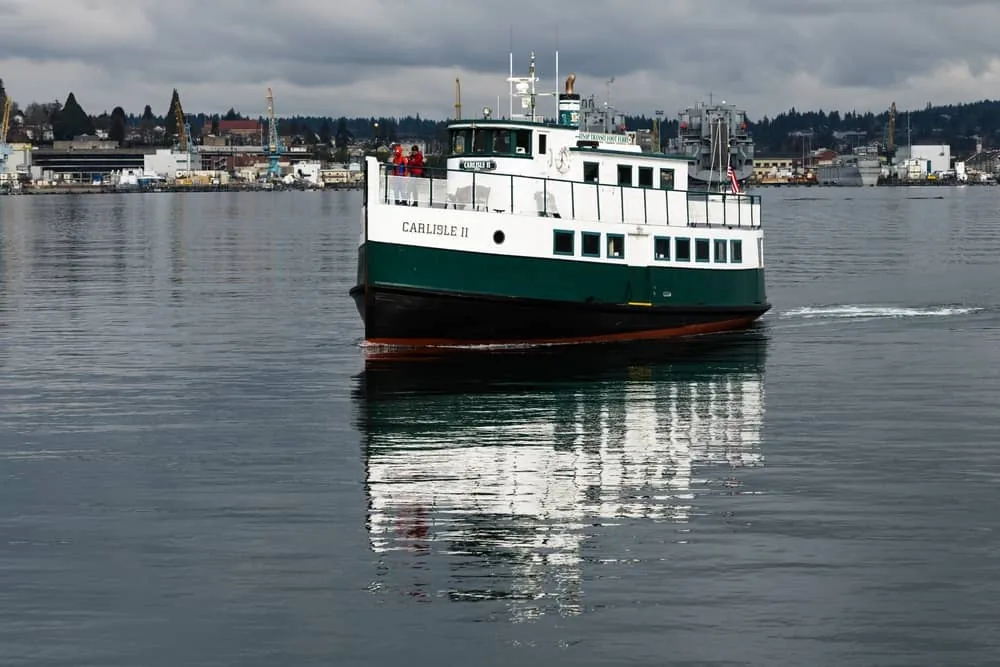
Kitsap Transit's passenger-only foot ferry between the Port Orchard waterfront and Bremerton is genuinely one of the best commuter tools in the Puget Sound region. The crossing takes 12–17 minutes and costs $2.00 each way. Weekday service departs Port Orchard as early as 4:30 AM — early enough to catch shift starts at the shipyard. From Bremerton, riders can connect directly to the Kitsap Transit fast ferry to Pier 50 in Seattle, threading a water commute to downtown Seattle that avoids the I-5 and SR-16 gridlock entirely.
The catch is that the foot ferry is foot-passenger only: no bikes except folding ones, no cars, and service suspends during low-visibility fog on Sinclair Inlet. For workers who need a vehicle at their destination, the ferry chain doesn't solve the problem.
The Road Network
| Destination | Route | Typical Drive Time | Notes |
|---|---|---|---|
| Puget Sound Naval Shipyard (Bremerton) | SR-16 N to Bremerton | ~20 minutes | Most direct for workers with vehicles at the shipyard |
| Gig Harbor | SR-16 S to Gig Harbor | ~15 minutes | Congestion builds southbound in PM peak |
| Tacoma / Tacoma Narrows Bridge | SR-16 S | ~25 minutes (normal conditions) | Bridge tolled; backups extend to Tremont interchange on bad days |
| Silverdale / Bremerton retail | SR-16 N, WA-3 N | ~25–30 minutes | Where most major retail is concentrated |
| Southworth Ferry Terminal | SR-160 E | ~15 minutes | Car ferry toward Vashon Island and West Seattle |
| Seattle (car + ferry) | SR-160 to Southworth, ferry to Fauntleroy | ~75–90 minutes total | Depends on ferry schedule and Seattle-side traffic |
| Seattle (foot ferry chain) | Port Orchard ferry → Bremerton → fast ferry to Pier 50 | ~60–75 minutes total | Best for downtown Seattle office commuters; schedule-dependent |
The Tremont Street interchange with SR-16 is the city's most reliable pressure point — northbound backups in the morning and southbound delays in the evening are the commute reality that buyers in the eastern neighborhoods feel most acutely.
Local Transit and Walkability
Kitsap Transit runs fixed bus routes through Port Orchard, connecting the city to Bremerton, Silverdale, and park-and-ride lots. For daily errands within Port Orchard itself, the walkability varies sharply by neighborhood: the Bay Street downtown core is navigable on foot, but Mile Hill Drive and the Bethel Corridor are built around cars, with sidewalk gaps that make walking to retail genuinely impractical for most residents.
The honest summary: if you work at Puget Sound Naval Shipyard or commute foot-ferry to Seattle, Port Orchard's transportation system can work beautifully. If you need to drive to Tacoma or beyond daily, you are accepting a commute with real variability — and the Tacoma Narrows Bridge toll is part of the ongoing math.
What Locals Know
The 4:30 AM ferry departure window rewards early risers on the shipyard schedule. Residents who've cracked the foot ferry and Bremerton fast ferry combination for Seattle commuting consistently cite it as the most underrated commute option in the entire Puget Sound region — less crowded than competing ferry routes, with parking that's easier to find at the Port Orchard terminal than at many of the other ferry landings.
Schools in Port Orchard
Families relocating to Port Orchard have public, private, and higher-education options nearby. Here’s a quick overview.
🎓 School District
South Kitsap School District serves K–12 students across Port Orchard and the surrounding area. Rated B- (source: Niche.com).
🏆 Graduation Rate
The 4-year high-school graduation rate here is approximately 84.8%.
📚 Higher Education
Washington’s public universities — the University of Washington, Washington State University, and Western Washington University — offer four-year degrees statewide, with a network of 34 community and technical colleges (SBCTC) providing two-year and workforce programs.
🌐 Online Learning
University of Washington Continuum College and Washington State University Online offer fully accredited online degrees for remote learners across the state.
Safety in Port Orchard
A quick look at how Port Orchard compares on the numbers that matter most when weighing a neighborhood or a move.
🛡 Violent Crime
Approximately 4 per 1,000 residents.
🔒 Property Crime
Approximately 28.6 per 1,000 residents.
Compared to the FBI’s most recent national data (2024), Port Orchard’s violent crime is above the national average (about 3.6 per 1,000), and property crime is above the national average (about 17.6 per 1,000).
Against Washington as a whole, Port Orchard’s violent crime is somewhat above the state average, and property crime is about the same as the state average (Bureau of Justice Statistics, Crime Known to Law Enforcement, 2024 (tables 2 and 3)).
Crime rates can vary a lot within a single city, so the citywide numbers above are only a starting point. Some neighborhoods in Port Orchard run well below these averages, while others run higher — the kind of block-by-block detail that matters most when you’re actually choosing where to live. The full guide below breaks it down neighborhood by neighborhood.
Working in Port Orchard
Port Orchard’s largest employers span several industries — here are some of the anchors of the local job market.
🎓 South Kitsap School District
Education
💼 Puget Sound Naval Shipyard
Shipbuilding/defense, nearby Bremerton
🏥 Harrison Medical Center
Healthcare
🏛 City of Port Orchard
Government
🛒 Fred Meyer
Retail
Retiring in Port Orchard
Port Orchard draws retirees for its balance of amenities, outdoor access, and cost. Here’s what to weigh.
🌤 Climate
Port Orchard sits in the rain shadow of the Olympic Mountains, which moderates rainfall compared to Seattle but still delivers the signature Pacific Northwest gray from October through March. Summers are the reward: mild temperatures, low humidity, and long daylight hours that stretch well past 9 PM in June and July. Hard freezes are rare, making year-round outdoor activity realistic for most retirees.
🍴 Lifestyle
The Saturday Farmers Market on the waterfront, Peninsula BevCo's taproom on Bay Street, and the Sidney Museum & Arts Center give downtown Port Orchard a cultural core that's compact but genuine. South Kitsap Regional Park and Manchester State Park a short drive east offer hiking, fishing, and forested trails without driving far. The Fathoms O' Fun festival each summer and the Night Market series keep the social calendar active through warm months.
🏚 55+ Communities
The Port Orchard and broader South Kitsap area has active-adult and senior-living options at multiple price points, including independent living communities within a short drive of Bay Street amenities. The McCormick Woods area attracts active retirees drawn to the golf course community setting and newer single-level construction. For a full overview of senior-living options and healthcare access, the retiring in Port Orchard page covers those details.
✈ Getting Around
Most retirees in Port Orchard rely on a personal vehicle — the city's layout outside of the Bay Street core is built around driving, and Kitsap Transit's fixed routes have limited reach. The foot ferry to Bremerton is a practical option for days when car-free travel to appointments or shopping across the inlet makes sense. Seattle-Tacoma International Airport is approximately 50–60 miles south via SR-16 and the Tacoma Narrows Bridge, typically a 60-to-90-minute drive depending on traffic.
🏛 Washington Taxes for Retirees — What to Know
- No state income tax — Washington does not tax personal income, so Social Security, pensions, and 401(k)/IRA withdrawals are all untaxed at the state level. There is no state return to file and no retirement exclusion to claim — the rate is simply zero.
- Military and public pensions — Because there is no income tax, military retirement pay and public-employee pensions are untaxed at the state level along with everything else.
- Sales tax is the tradeoff — The state sales tax is 6.5%, and local add-ons bring the combined rate in Port Orchard to 9.3% (Washington State Department of Revenue, Q3 2026 local sales & use tax rate table, July 2026). Groceries and prescription drugs are exempt.
- Property taxes, with senior relief — The effective property tax rate is roughly 0.9%. Homeowners 61+ (or unable to work due to disability, or a qualifying disabled veteran) who own and occupy their home may qualify for a reduction. Income limits are set against each county’s median household income, so the threshold differs by county — check with your county assessor. A separate deferral program is available for those who don’t qualify for the exemption.
- Capital gains tax — but not on retirement income — Washington taxes 7% on long-term capital gains above a $278,000 standard deduction for 2025, rising to 9.9% on gains above $1,000,000. Retirement accounts and real estate sales are both exempt. It therefore does not reach ordinary retirement income or the sale of a home.
- Estate tax — the one to plan for — Unlike most no-income-tax states, Washington has its own estate tax. For deaths on or after July 1, 2026, the exemption is $3 million with graduated rates topping out at 20%. Retirement accounts count toward the taxable estate, so long-time homeowners with sizable balances can cross the line without expecting to.
- No inheritance tax — Washington has no inheritance tax, and no gift tax.
- WA Cares payroll premium — Working Washingtonians pay 0.58% of gross wages into the WA Cares Fund, the state long-term care program, with no income cap. It applies to W-2 wages, so retirees who have stopped working do not pay it — but anyone relocating while still employed will see it. The private-insurance opt-out closed at the end of 2022 and is not available to new applicants; the remaining exemptions are narrow (living outside Washington, military spouses, certain visa holders, and veterans with a 70%+ service-connected rating).
- The Oregon border effect — Oregon has no sales tax, so Washington residents near the river — Vancouver, Camas, Washougal, Longview — often cross over for large purchases. Washington use tax technically applies to goods brought back for use in-state, though it is rarely enforced on ordinary personal purchases.
Tax laws change frequently and individual situations vary. This is general information, not tax advice — always consult a qualified Washington tax professional or CPA for personalized retirement tax planning.
Weekends & Local Favorites in Port Orchard
The Kitsap Peninsula gets long summer days and the kind of low-humidity July weather that makes residents forget why anyone lives east of the water. Weekends in Port Orchard tend to organize themselves around the waterfront, the trails, and a calendar of outdoor events that runs April through September.
The Waterfront Rhythm
Saturday morning starts at the Farmers Market at 933 Bay St — produce, local vendors, prepared food, and a general gathering-of-the-town energy that's been consistent here for nearly 50 years. The Port Orchard Marina draws boaters and spectators in equal measure. Peninsula BevCo on Bay Street is the waterfront taproom where afternoons tend to extend past intention, with Sinclair Inlet views that make the ferry math feel worth it.
Trails and State Parks
South Kitsap Regional Park's 209 acres of mountain biking and hiking trails sit within city limits — genuinely underused on weekday mornings, busier on weekend afternoons, and well-maintained enough that locals return to it week after week without feeling the need to drive elsewhere. Manchester State Park is the more distinctive destination: a 10-minute drive east of downtown on Rich Passage, it features a preserved 1901 torpedo warehouse, forested trails, and a fishing pier over saltwater. The combination of the two parks gives Port Orchard a recreational depth that surprises visitors expecting a suburban bedroom community.
The Event Calendar
The Port Orchard Night Market runs on four summer evenings in 2026 — June 20, July 11, August 22, and September 12 — bringing food trucks, live music, and artisan vendors to the waterfront in a format that works equally well for couples and families. Fathoms O' Fun in late June and early July is the signature event: a multi-day celebration with a parade down Bay Street, waterfront music stages, and fireworks over Sinclair Inlet. If you're visiting to scout the city as a potential move, timing a visit around Fathoms O' Fun gives you the clearest possible picture of how Port Orchard feels when it's fully itself.
Food Worth Knowing
Uncle Dave's Cafe on Harrison Avenue is the breakfast spot locals rely on for a quick, no-fuss start to the weekend. Royal Tandoor fills the gap for Indian cuisine in a dining scene that's still building diversity. Damn Fine Pizza earns repeat visits from residents who've learned not to overthink the weekend dinner question. For a broader dining range, most residents make the occasional trip across to Gig Harbor or Silverdale — a 15-to-25-minute drive that opens up considerably more options.
Day Trips From Port Orchard
The Kitsap Peninsula's geography makes Port Orchard a reasonable base for weekend exploration. The Olympic Peninsula and Olympic National Park are a ferry crossing and a scenic drive to the west. Tacoma's museum row — including one of the better art museums in the Pacific Northwest — is about 25 minutes south on SR-16. Seattle itself is a ferry ride away when the mood calls for it, accessible by car ferry through Southworth or by the foot ferry and fast ferry chain from the downtown waterfront.
Top Things Locals Say About Port Orchard
The best intel about a city comes from the people who actually live there. Here’s what Port Orchard residents say when newcomers ask the questions everyone’s thinking.
“I knew the commute would involve a ferry, but I didn't realize the foot ferry would become the part of my day I actually look forward to. Twelve minutes across the inlet in the morning — you get off the water and you're already somewhere different mentally.”
— Recent Port Orchard home buyer
“What's the most surprising thing about living in Port Orchard?”
How quickly the waterfront becomes your default. You think you'll drive out to Gig Harbor or Silverdale for most things, and you do — but on any given evening you somehow end up walking the Bay Street boardwalk or sitting at the marina without having planned it. The waterfront pulls people in a way that doesn't show up in any listing description.
“What do locals love most about Port Orchard?”
The combination of water access and elbow room. You can be on a forested mountain bike trail at South Kitsap Regional Park, then down at the marina watching ferries in under 15 minutes. And compared to what that waterfront lifestyle costs anywhere else on Puget Sound, Port Orchard still feels like a reasonable trade. The Fathoms O' Fun festival every July is genuinely beloved — it's when the whole city shows up and you understand why people stay.
“What should newcomers to Port Orchard know?”
Plan around the foot ferry schedule from day one — it's the best $2 you'll spend on any given workday. Also know that the Tremont Street interchange with SR-16 backs up predictably heading north in the morning and south in the evening; leaving 10 minutes earlier than you think you need to is the habit every commuter eventually develops. And check internet service at a specific address before you close — speeds vary enough between neighborhoods that it matters for remote workers.
“Can you live in Port Orchard without a car?”
If you live within a few blocks of Bay Street and work somewhere accessible by foot ferry, it's possible in a limited sense — the waterfront core is walkable and Kitsap Transit bus routes connect to Bremerton. But for most Port Orchard addresses, especially along Mile Hill Drive or out in McCormick Woods, a car isn't optional. Sidewalk gaps, strip-mall retail corridors, and the distance between neighborhoods make car-free living genuinely impractical for the vast majority of residents.
Cities Near Port Orchard
Other communities near Port Orchard worth a look — each with its own character and price point.
| City | Distance | Best For | Vibe | Median Rent | Median Buy |
|---|---|---|---|---|---|
| Bremerton | 8 mi | Defense workers & urban amenities | Gritty, revitalizing, walkable core | $1,650 | $454,986 |
| Silverdale | 12 mi | Retail access & newer suburbs | Suburban, car-dependent, family-oriented | $1,800 | $566,807 |
| Gig Harbor | 15 mi | Upscale waterfront living | Polished, expensive, marina-focused | $2,100 | $765,402 |
More Helpful Guides for Port Orchard
Going deeper on Port Orchard? Our blog series covers everything from first-time buying to retiring here — explore the guides below.
Local Expert Takeaway: Port Orchard's defining quality is the gap between how it looks on paper and how it functions in practice. The foot ferry to Bremerton for $2 each way — with 4:30 AM departures and a fast-ferry connection to downtown Seattle — is genuinely one of Puget Sound's most underrated commute options. The Farmers Market on Bay Street has run for nearly 50 years. South Kitsap Regional Park's 209 acres of trails are inside city limits. And a $10 million Bay Street reconstruction project, set for 2026, is about to make the waterfront core meaningfully better. Buyers who wait for that project to finish will pay for the improvement. Those who move before it wraps up get to buy into it.
Quick Takeaways & FAQs
✅ The Kitsap Transit foot ferry connects Port Orchard to Bremerton in 12–17 minutes for $2 each way, with fast-ferry access to Seattle Pier 50 from Bremerton — one of the most cost-effective commuter routes in the Puget Sound region.
⚠️ Car dependency is real outside of Bay Street's walkable core: Mile Hill Drive, the Bethel Corridor, and most residential areas require a vehicle for daily errands, and SR-16's Tremont interchange backs up reliably at peak hours.
📍 The $10 million Bay Street reconstruction project — including underground utilities, a landscaped median, and a new Kitsap Regional Library branch — is under construction in 2026, meaning downtown disruption now but a meaningfully upgraded waterfront by 2027.
How far is Port Orchard from Seattle?
Is Port Orchard a good place to live for military families?
What is the South Kitsap School District like?
Is Port Orchard growing, and will that affect traffic and services?
What is there to do in Port Orchard on weekends?
Helpful Links for Moving to Port Orchard
Moving to Washington?
Tell us what you need help with and we'll connect you with local resources.
