
Maybe you're coming off a 30-year career in the Pacific Northwest and you're not ready for a small town. Maybe you've been priced out of Seattle's retirement-community market and someone told you Tacoma has gotten interesting. Either way, you probably didn't expect a city of 222,000 people with a working waterfront, a free light-rail line, three competing hospital systems, and a Zillow Home Value Index of $496,203 — well below what comparable amenities cost closer to Seattle. That gap is real, and it's one of the main reasons retirees have been quietly rediscovering Tacoma over the past decade.
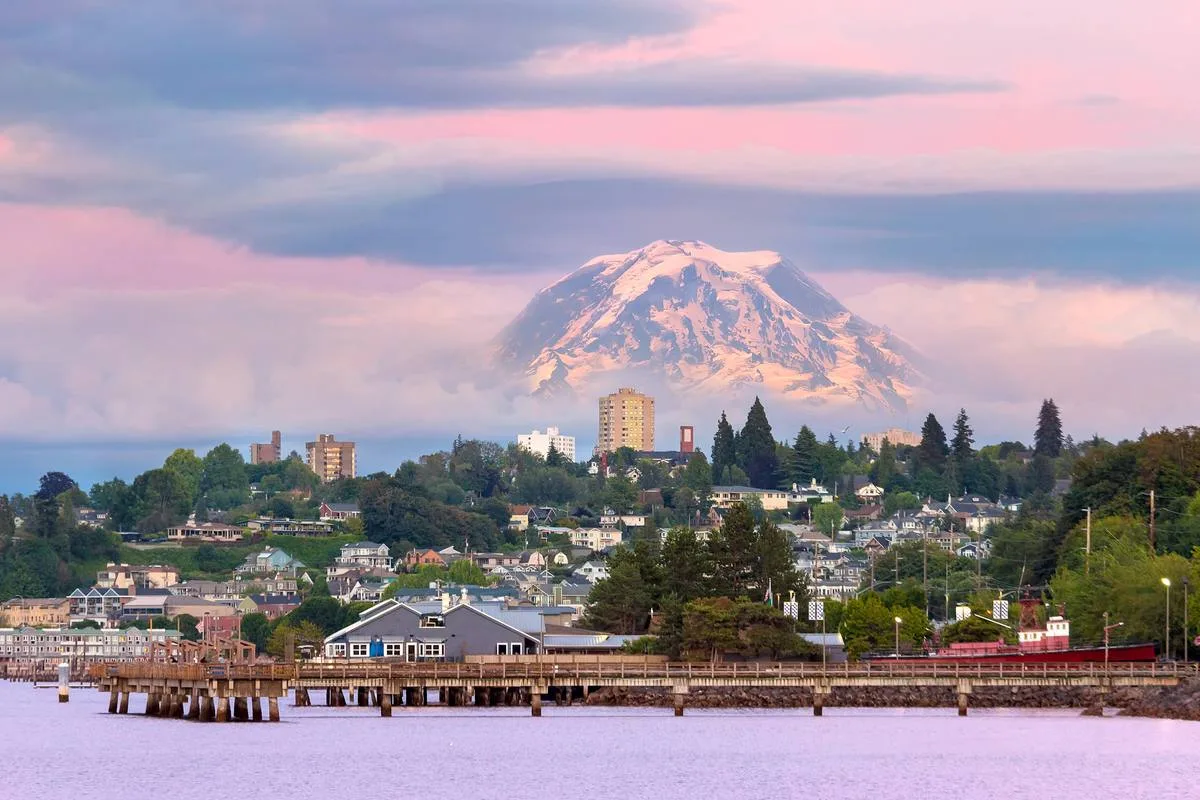
What anchors daily life here is a combination of genuine urban infrastructure and surprising green access. Point Defiance Park — one of the largest urban parks in the country — sits at the northwestern edge of the city. The Ruston Way waterfront stretches along Commencement Bay with unobstructed views of Mount Rainier on clear days. And downtown, the T Line light rail connects the Tacoma Dome to the Hilltop neighborhood across 12 free-fare stations. For retirees, that transit detail matters more than it might seem: it's the difference between a city that's technically walkable and one where you can genuinely reduce your car dependence over time.
The economic picture for retirees is genuinely favorable. Washington has no personal income tax, which means Social Security, pension income, IRA withdrawals, and 401(k) distributions all arrive untouched by the state. Pierce County adds a meaningful property tax exemption program for seniors aged 61 and older. The full cost-of-living breakdown lives on its own page, but the headline is that day-to-day expenses here track noticeably below Seattle while the quality of services — medical, cultural, recreational — remains genuinely metro-level.
Whether you're weighing Tacoma as a first retirement move or thinking about whether to stay as you age, the sections below cover the healthcare landscape, the retiree budget math, walkability and community life, downsizing options, and how Tacoma stacks up against nearby alternatives like University Place, Puyallup, and Lakewood.

Why Retirees Are Choosing Tacoma
Tacoma fits a specific kind of retiree: someone who wants real city infrastructure — museums, transit, medical depth, cultural events — without paying Seattle prices for it. The Zillow Home Value Index sat at $496,203 as of July 2026, which puts meaningful entry-level downsizing inventory within reach for buyers arriving from higher-cost markets. For retirees who want to sell a suburban home and either right-size into a condo or free up equity, that price point creates options that simply don't exist 45 minutes north.
The city also suits retirees with military ties. Joint Base Lewis-McChord sits immediately south, and the veterans' community in Tacoma is substantial and organized. If you or your spouse retired from the armed forces, the combination of Madigan Army Medical Center access, established veterans' organizations, and a city that has housed military families for generations gives Tacoma a social infrastructure that purely civilian retirement towns can't replicate.
Who should look elsewhere? Retirees who want a quiet, low-traffic small-town feel will find Tacoma's urban pace jarring — this is a working port city, not a retreat. Crime rates vary significantly by area, and parts of the city require the same situational awareness you'd apply in any mid-size urban environment. Retirees who want guaranteed flat terrain for daily walking will also need to be strategic: Tacoma's topography is uneven, and some of the most appealing neighborhoods involve real hills.
Healthcare & Medical Access in Tacoma
A Genuine Medical Hub
Tacoma punches well above its population size on healthcare depth. Most retirement destinations in the Pacific Northwest require a drive to reach a comprehensive hospital system. Tacoma has three competing systems within the city itself, which is rare outside Seattle and Portland.
MultiCare Health System is the anchor — the largest community-based, locally governed health system in Washington state. Its flagship Tacoma General Hospital and Allenmore Hospital both operate as full acute-care facilities within the city. Tacoma General holds DNV Comprehensive Stroke Center certification and received the American Heart Association's 2026 Get With The Guidelines® Gold Plus award for stroke care. For retirees, stroke response time and stroke-center quality are among the most consequential healthcare metrics, and Tacoma General's credentials here are legitimate, not marketing.
The Second and Third Systems
Virginia Mason Franciscan Health's St. Joseph Medical Center provides a second major hospital campus, with a system that extends across the broader Puget Sound region. Kaiser Permanente operates a full-service medical center in Tacoma offering cardiology, oncology, orthopedics, pulmonology, sleep medicine, and primary care — giving Kaiser members continuity of care without switching systems.
For military retirees, Madigan Army Medical Center on adjacent Joint Base Lewis-McChord is one of the largest military hospitals on the West Coast. It serves more than 100,000 beneficiaries, including military retirees, providing a fourth institutional option that most of Tacoma's civilian neighbors can't access.
What's Honest About the Limits
For highly specialized procedures — certain cancer surgeries, rare cardiac interventions, advanced neurology — the regional standard remains Seattle's major academic medical centers, roughly 45 minutes north. Tacoma's systems handle the vast majority of retiree healthcare needs exceptionally well, but if you're managing a complex chronic condition that requires subspecialty care, you'll want to confirm which Seattle-based specialists accept referrals from your chosen Tacoma system before you commit.

The Retiree Budget in Tacoma
Washington's Tax Posture for Retirees
Washington state collects no personal income tax. That means your Social Security benefits, pension distributions, IRA withdrawals, and 401(k) income all arrive without state-level withholding. For retirees moving from California, Oregon, or any state that taxes retirement income, the annual savings compound significantly over time.
The one meaningful wrinkle: Washington levies a 7% capital-gains tax on long-term gains above approximately $270,000 (2024 threshold, subject to annual adjustment). This applies only to taxable brokerage accounts — not retirement accounts — and excludes real estate sales entirely. Most retirees living on Social Security, pensions, and retirement-account withdrawals will never trigger it. If you're managing a large taxable investment portfolio alongside your retirement accounts, it's worth a conversation with a tax advisor before you establish residency.
Property Taxes and the Senior Exemption
Tacoma's effective property tax rate runs approximately 0.94%, paid in two installments each year — April 30 and October 31 — to the Pierce County Assessor-Treasurer. That rate is close to the Washington state average and significantly below what retirees pay in many other states.
The exemption program matters more than the base rate for many retirees. Pierce County seniors aged 61 or older with household income under $64,000 qualify for Washington's Senior Citizen/Disabled Person Property Tax Exemption, which freezes the home's assessed value for tax purposes and exempts qualifying households from excess levies. Beginning in 2027, the income ceiling rises to $85,000 — bringing a much larger share of Tacoma retirees into eligibility. If you're near that threshold now, the 2027 expansion is worth tracking before you finalize any purchase.
Fixed-Income Daily Life
Washington's Apple Health program covers long-term care services for eligible seniors, and the state offers at least 17 senior assistance programs — including free or reduced-cost transportation, utility bill assistance, and a lifetime state parks pass — that can materially reduce monthly expenses for qualifying retirees. The T Line light rail is completely free to ride within Tacoma, which is a genuine daily-budget item for retirees who shift toward reduced car use. Grocery, dining, and service costs in Tacoma track noticeably below Seattle without the significant trade-down in quality that smaller South Sound cities sometimes require.
Looking to buy in Tacoma? Estimate your payment.
Enter your numbers to see an estimated monthly mortgage payment.
Estimate only. Excludes HOA fees and mortgage insurance. The interest rate above is a starting point, not a quoted rate — replace it with your own to see real numbers. Insurance is a flat placeholder, not a Tacoma quote.
Walkability, Community & Staying Active in Tacoma
The Honest Walk Score Reality
Tacoma holds a Walk Score of 54 out of 100 — officially "Somewhat Walkable" — and ranks among the top three most walkable cities in Washington alongside Seattle and Lynnwood, well above the state's 79-city average of 33. That's genuinely encouraging context. The honest local caveat is that walkability is uneven across the city: downtown, the Stadium District, and the Proctor corridor offer the most practical on-foot access to errands, dining, and transit, while other areas require a car for most daily needs.
The T Line light rail — free to ride, running 4.0 miles across 12 stations from the Tacoma Dome through downtown and into the Hilltop — is the piece of infrastructure that makes partial car-freedom realistic for retirees who choose their address carefully. Nearly 987,000 passengers used it in 2025. For retirees who want to stop driving eventually but aren't ready to give up the car today, settling within a few blocks of a T Line stop is the move that pays off over years.
Where Retirees Actually Gather
Point Defiance Park remains the gravitational center of Tacoma's outdoor social life — walking groups, birdwatching clubs, and regular visitors who treat the 5-mile drive loop as a daily ritual. The Ruston Way waterfront attracts walkers and cyclists year-round, even in Tacoma's gray winters, because the bay views and relatively flat path make it accessible at nearly any fitness level.
Downtown's Brewery District clusters multiple craft taprooms — including E9 Brewing Co. on Fawcett Ave and Odd Otter Brewing Company on Pacific Ave — within roughly one mile of each other and within easy reach of T Line stops. For retirees, the practical benefit is a social scene that doesn't require driving. The Museum of Glass and LeMay — America's Car Museum draw consistent visitor traffic and both run volunteer and membership programs that retirees regularly describe as a genuine entry point into the community.
Senior Programming and Volunteering
Tacoma Metropolitan Park District operates senior programs through its community centers, and the city's arts and cultural institutions actively recruit older volunteers. The public library system runs programs specifically oriented toward older adults. For retirees arriving without an existing social network, the Museum of Glass volunteer corps and Point Defiance Zoo docent program are two of the more reliable ways locals describe finding community in the first year.
Right-Sizing: Downsizing in Tacoma
What the Market Offers
Tacoma's downsizing market is more varied than most South Sound cities, which is one of its underappreciated retirement advantages. You can find single-level bungalows in established neighborhoods, downtown condos above the waterfront, patio-home communities in quieter sections of the city, and full-service continuing-care communities — all within city limits. The trade-off is inventory: single-level detached homes in the most desirable walkable areas move quickly and rarely sit long enough to allow leisurely decision-making.
Condos and townhomes in downtown Tacoma and the Stadium District have attracted retirees who want urban proximity without yard maintenance. Prices in these categories vary considerably by building age, finishes, and proximity to transit, so buyers in this segment need to move with a clear sense of their priorities before touring.
Active-Adult and Continuum-of-Care Options
GenCare Lifestyle at Point Ruston — positioned adjacent to Tacoma's waterfront on Commencement Bay — is the most prominent purpose-built active-living option within city limits, offering 159 apartments across active-living and assisted-living configurations, with 24 residences dedicated to memory care. The location gives residents walkable access to the waterfront and a continuum-of-care structure that allows aging in place through significant health transitions. For retirees who want to make one housing decision rather than two or three over a decade, a continuum-of-care community like this changes the calculus considerably.
Nearby Lakewood and University Place both offer additional independent-living and assisted-living communities at generally lower price points than Tacoma's waterfront options, and both are close enough to Tacoma's medical infrastructure to be practically equivalent on healthcare access. Retirees who prioritize square footage and a quieter streetscape over urban walkability often find those adjacent communities a better fit — and the drive back into Tacoma for museums, dining, or medical appointments rarely exceeds 15 minutes.
What Surprises Buyers After Six Months
The thing downsizing retirees most consistently report not expecting: Tacoma's hills. The city's topography means that a condo listed as "walkable to downtown" can sit two steep blocks above the flat commercial core — manageable at 62, genuinely difficult at 75. If single-level living and flat walking routes are priorities rather than preferences, tour with that lens specifically, because it's not always obvious from a listing or a map.
Tacoma vs Nearby Retirement Destinations
| City | Cost vs Tacoma | Primary Hospital | Walkability | Senior Living Depth | Overall Retirement Fit |
|---|---|---|---|---|---|
| Tacoma | Anchor | MultiCare Tacoma General + St. Joseph Medical Center + Kaiser | Moderate; T Line free rail; some steep hills | Strong — multiple continuum-of-care and active-adult options | Transit Walkable Core Best for urban-leaning retirees who want medical depth |
| A harbor community to the west | Pricier | Community hospital within the Virginia Mason Franciscan system | Low — car-dependent outside a small village core | Moderate; growing but more limited than Tacoma | Views Quiet Best for retirees prioritizing scenery and a small-town feel |
| University Place | About the same | Served by Tacoma systems via short drive | Low to moderate; suburban layout | Moderate; several assisted-living campuses | Quiet Value Best for retirees wanting a calmer setting close to Tacoma services |
| Lakewood | Noticeably cheaper | St. Clare Hospital (St. Joseph/VMF system) | Low; primarily car-dependent | Moderate; several independent and assisted-living facilities | Value Good entry point for budget-conscious retirees; JBLM proximity benefits veterans |
| Puyallup | Noticeably cheaper | MultiCare Good Samaritan Hospital | Low; small walkable downtown core only | Moderate; growing retirement community options | Quiet Value Best for retirees who want lower costs and a small-city feel |
| Federal Way | Noticeably cheaper | St. Francis Hospital (VMF system) | Low; highway-commercial layout | Limited within city; relies on Tacoma or Seattle for depth | Commuter Tends to disappoint retirees seeking walkability or cultural amenities |
The harbor community to the west wins on scenery — the water views and boutique village core are genuinely hard to argue with — but its car dependence and premium pricing make it a tougher fit for retirees on fixed incomes who want to reduce driving over time. Lakewood and Puyallup offer the most meaningful cost advantage, and both sit close enough to Tacoma's medical systems that healthcare access is rarely a real concern. University Place is essentially a quieter version of Tacoma at similar prices — sensible for retirees who want Tacoma's infrastructure at arm's length without the urban noise. For retirees who want to walk to coffee, catch a free light rail to a museum, and have a Comprehensive Stroke Center ten minutes away — Tacoma is the most complete answer in the South Sound.
Local Expert Takeaway: Tacoma's retirement case rests on three things that rarely coincide in the same city: multiple full-service hospital systems within city limits, a free light-rail line that makes downtown genuinely accessible without a car, and home prices noticeably below Seattle's with no state income tax on your retirement distributions. The catch is that walkability is uneven — if flat terrain and car-free daily life are priorities, lock in an address near the T Line's downtown stations before anything else. GenCare Lifestyle at Point Ruston and the broader downtown condo market give retirees real options, but single-level detached homes in the best-positioned neighborhoods move fast. Visit in January, not July: Tacoma's gray winters are the part most people from sunnier climates underestimate, and knowing you're comfortable with 45 overcast days in a row matters more than any spreadsheet.
Quick Takeaways & FAQs
✅ Tacoma hosts three competing hospital systems — MultiCare, Virginia Mason Franciscan Health, and Kaiser Permanente — within city limits, giving retirees a level of medical access rare outside major metros.
⚠️ Walkability is real in the downtown and Proctor corridors but drops sharply in outer neighborhoods; Tacoma's hills catch many downsizing buyers off guard after they move in.
📍 The T Line light rail is completely free to ride within Tacoma, connecting the Tacoma Dome to Hilltop across 12 stations — a meaningful daily-budget and independence factor for retirees who want to reduce car use gradually.
Is Washington state tax-friendly for retirees?
What hospitals are in Tacoma for retirees?
Is there a senior property tax exemption in Pierce County?
How walkable is Tacoma for retirees who want to give up a car?
What active-adult and 55+ communities exist in or near Tacoma?
Moving to Washington?
Tell us what you need help with and we'll connect you with local resources.
