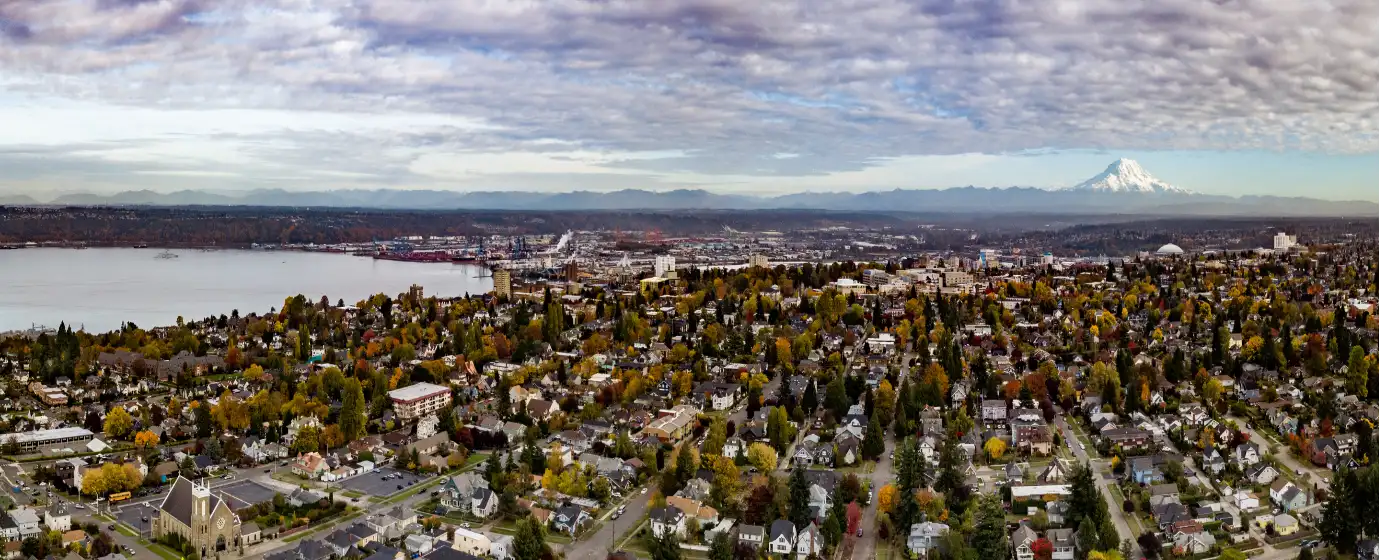
Maybe your company went remote and you finally ran the numbers. Maybe you've been watching Bay Area or Los Angeles home prices for a decade and decided enough is enough. Whatever brought you to this search, the case for Tacoma is not subtle: a waterfront city on the South Puget Sound with a genuine arts district, the Museum of Glass, Point Defiance Park stretching along the water, and a Zillow Home Value Index typical home value of $496,203 (July 2026) — a figure that lands well below California's statewide median. Tacoma sits about 45 minutes south of Seattle by car, close enough to access a major metro job market, distant enough to buy a house for under half a million dollars.
The economic backbone here is anchored by Joint Base Lewis-McChord, two large regional health systems, and Tacoma Public Schools — together they represent tens of thousands of stable, locally-rooted jobs. The port is one of the largest on the West Coast and supports a significant logistics and trade sector. Remote workers and hybrid commuters have discovered Tacoma in a big way over the past several years, particularly those priced out of Seattle's Eastside suburbs. For details on the neighborhood-by-neighborhood character — from the historic Proctor corridor to the working-class South Tacoma grid — a separate breakdown covers that geography thoroughly.
What Californians notice first is not just the home prices — it's the state income tax line on their first Washington pay stub showing $0 withheld. That structural shift reshapes a household budget in ways that compound year over year. The trade-off is a higher combined sales tax rate, a modestly higher effective property tax rate than California's, and, honestly, fewer sunny days than anywhere in Southern California. Tacoma runs about 16–22% above the U.S. national average on overall cost of living, which means it is not a cheap city in absolute terms — but compared to San Francisco or Los Angeles, the difference is substantial.
Whether you are deciding between Tacoma and staying in California, or trying to understand what your dollar actually buys here, the sections below walk through the home price gap, the full tax picture, what daily life costs look like, the lifestyle and cultural shift, and the honest reasons some California transplants eventually leave.

The Home Price Gap: What California Dollars Buy in Tacoma
California's statewide median home price sits at approximately $785,000. Tacoma's Zillow Home Value Index typical home value was $496,203 as of July 2026. That gap is not a rounding difference — it represents a fundamentally different entry point into homeownership.
In practical terms: a buyer who sells a modest Sacramento or Inland Empire home near the California median and moves to Tacoma can arrive with enough equity to put a substantial down payment on a Tacoma property and still have money left over. Buyers coming from the Bay Area or coastal Los Angeles, where prices routinely run well into seven figures, will find the shift even more pronounced. For a deeper look at Tacoma's full cost-of-living picture — including utilities, groceries, and transportation — that page covers the numbers in detail.
What the Market Feels Like on the Ground
The Tacoma market moves quickly. Homes priced well in the sub-$500,000 range can receive multiple offers within days, which surprises buyers expecting a slower-paced market than what they left behind in California. The pace is different from a Bay Area frenzy, but it is not the leisurely buyer's market some people imagine when they hear "Tacoma."
Entry-level properties tend toward older construction on smaller lots in areas that require careful due diligence on condition and location. As budgets climb toward and above the city-wide median, buyers gain access to Craftsman homes with water views, fully renovated properties in established corridors, and waterfront-adjacent streets where the Puget Sound is visible from the front porch. For neighborhood-by-neighborhood character and how geography shapes value, the neighborhoods page covers that in detail.
| Market | Approx. Home Price (2026) | Cost vs. Tacoma |
|---|---|---|
| San Francisco metro | ~$1,200,000+ | Substantially higher |
| Los Angeles metro | ~$900,000+ | Noticeably higher |
| San Diego metro | ~$875,000+ | Noticeably higher |
| Sacramento metro | ~$550,000+ | Moderately higher |
| Inland Empire | ~$520,000+ | Slightly higher |
| Washington state median | ~$560,000 | Modestly higher |
| Tacoma (ZHVI, July 2026) | $496,203 | — |
* ZHVI = Zillow Home Value Index. California and Washington figures are approximate 2026 statewide medians; Tacoma figure is city-specific.
Tacoma's price sits below even Washington's own statewide median, making it one of the more accessible entry points in the entire Pacific Northwest for a city of its size and waterfront access. The buying process page covers down payment expectations and loan programs for buyers new to the Washington market.
The Tax Shift: Income, Property, and Sales
The single biggest financial change for most Californians moving to Washington is the state income tax — or rather, the complete absence of one. Washington levies no individual income tax on wages or salaries. For a household earning $100,000, that difference is approximately $5,762 per year compared to what they were paying in California.
At higher income levels the savings scale significantly. California's top marginal rate reaches 13.3% (including the 1% Mental Health Services Tax on income above $1 million). High earners should know one important caveat: Washington enacted ESSB 6346 in March 2026, which imposes a 9.9% income tax on household income above $1 million, effective January 1, 2028. For income below that threshold, the state remains tax-free at the state level — but California founders and investors relocating with substantial capital gains should model their specific situation before assuming Washington is uniformly advantageous at every income level.
Where Tacoma Gives Some of It Back: Sales Tax
Tacoma's combined sales tax rate is 10.5% as of July 2026, reflecting the 6.5% Washington state base plus local additions — including a 0.1% increase approved by the Tacoma City Council that took effect April 1, 2026, earmarked for public safety programs. California's statewide base is 7.25%, though many California localities add their own increments, so the city-to-city comparison matters. A household buying furniture, appliances, and a car after a move will feel this difference immediately.
Property Tax: Modest but Real
Tacoma's effective property tax rate is approximately 0.94%, compared to California's effective rate of approximately 0.76%. On a $496,203 home, that difference is modest in dollar terms — but it is real, and it runs counter to what many Californians expect. California's Proposition 13 framework, which locks assessed value at purchase price and limits annual increases, often keeps long-term homeowners paying far below their home's market value. Washington has no equivalent — your assessed value tracks market value, and your tax bill follows.
| Tax Category | California | Tacoma / Washington | Net Effect for Most Movers |
|---|---|---|---|
| State income tax (under $1M income) | Up to 13.3% marginal | 0% | Major annual savings |
| State income tax (over $1M, from 2028) | 13.3% marginal | 9.9% marginal (ESSB 6346) | Still lower, but gap narrows |
| Retirement income (SS, 401k, IRA) | Taxed as ordinary income | Not taxed at state level | Advantage for retirees |
| Combined sales tax | 7.25% base + local | 10.5% (July 2026) | Higher in Tacoma |
| Effective property tax rate | ~0.76% | ~0.94% | Modestly higher in Tacoma |
| Prop 13-style assessment cap | Yes | No | Tacoma bills track market value |
For most households earning a typical income, the income tax elimination is the dominant factor — it outweighs the higher sales and property tax rates by a wide margin. Retirees drawing from 401(k) or IRA accounts get a particular benefit: Washington does not tax those distributions at all, because there is no individual income tax mechanism to do so. Full details on how these rates interact with overall household budgets are on the cost-of-living page.

What Daily Life Actually Costs After the Move
The home price and income tax headlines are real. The less-discussed reality is that Tacoma is still a Pacific Northwest city with Pacific Northwest prices on groceries, dining, and services — not a rural Idaho alternative. Tacoma runs about 16–22% above the U.S. national average on overall cost of living, so the adjustment from California is significant, but "cheap" is not the right frame.
Where You'll Notice the Difference
Californians moving from the Bay Area, Los Angeles, or San Diego will feel a meaningful drop in everyday expenses — dining out, dry cleaning, a weeknight beer at an independent brewery along Brewers Row on North 26th Street. The service sector and restaurant industry in Tacoma price differently than their San Francisco equivalents, and that gap shows up in weekly spending in a way that feels genuinely different after a few months.
Gasoline runs lower. Utilities — particularly electricity, where Washington's hydropower keeps rates well below California averages — come in noticeably cheaper for most households. Californians moving from Sacramento or the Inland Empire will feel a smaller shift in day-to-day expenses, though the income tax elimination still makes the overall math work in Tacoma's favor.
The Healthcare Cost Shift
Health insurance premiums in Washington tend to run noticeably below what most California residents were paying, which matters for self-employed transplants or those between employer plans. The honest trade-off: Tacoma is not a major medical center for complex specialty care, and some advanced specialist appointments mean a trip toward the Seattle corridor rather than a neighborhood drive. For more detail on healthcare access, see the retiring in Tacoma page.
What Six Months In Looks Like
Most California transplants describe the same surprise after half a year: they spend less than they projected on nearly every line item except sales tax, which hits harder than expected when buying a car, replacing appliances, or furnishing a new home. A $30,000 vehicle purchase carries $3,150 in sales tax at the 10.5% rate — that sticker shock is real and worth budgeting for before the move, not after.
Point Defiance Park, which runs along the Tacoma Narrows, is where many families settle into a weekly rhythm — Saturday mornings at the zoo, trails along the water, an unhurried pace that feels nothing like a weekend in Los Angeles. The outdoor access is genuine and close, not a two-hour drive away. For more on Tacoma's parks and outdoor recreation, that section covers the trail networks and waterfront amenities in detail.
Looking to buy in Tacoma? Estimate your payment.
Enter your numbers to see an estimated monthly mortgage payment.
Estimate only. Excludes HOA fees and mortgage insurance. The interest rate above is a starting point, not a quoted rate — replace it with your own to see real numbers. Insurance is a flat placeholder, not a Tacoma quote.
The Lifestyle Shift: What California Won't Prepare You For
Tacoma is not a suburb. It has a city grid, a port, a genuine downtown anchored by Union Station and the LeMay — America's Car Museum, an arts corridor tied to the Museum of Glass, and neighborhoods that each have a distinct identity. It is also a city with real urban challenges — and a public school district serving a wide socioeconomic range that warrants its own research before you commit to a block.
The Weather Reality
People relocating from Southern California consistently underestimate this. Tacoma sees roughly 150–160 days of measurable precipitation per year, most of it low-grade gray drizzle rather than dramatic storms. The period from November through March is overcast almost continuously. Seasonal affective disorder is a real conversation here — locals invest in light therapy lamps the way Angelenos invest in sunscreen. Summers, by contrast, are legitimately stunning: low humidity, long days, temperatures in the 70s, and views of Mount Rainier from half the city.
What the City Does Well That California Often Doesn't
Access without gridlock is real for most of Tacoma's daily geography. The Tacoma Dome anchors a transit hub with Sounder commuter rail to Seattle and intercity rail service that surprises people who assumed they were moving somewhere car-dependent. The living in Tacoma page covers commute patterns and the rail option in full.
The cultural scene is smaller than any major California metro but genuinely local in a way that resonates quickly. The Proctor District has the walkable street character that Pacific Northwest neighborhoods do well — independent bookshops, coffee roasters, weekend farmers markets. It is not downtown San Francisco, but it is also not a strip-mall exurb.
The Honest Reasons People Leave
Some California transplants move back within three to five years. The reasons are consistent: the weather wears on people who didn't fully account for eight months of gray. Extended family remains in California and the distance compounds over time. And a subset of people who moved primarily for cost reasons find that Tacoma's job market, outside of government, military, and healthcare, is narrower than what they left behind. Remote work helps, but it is not a permanent guarantee, and a forced return to office can reorient the whole relocation calculus. For a full read on crime and safety by area — which matters significantly for where you land in the city — that page has the detailed breakdown.
The California-to-Tacoma Decision Framework
If you're choosing between staying in California and making this move, the decision almost never comes down to a single number. It comes down to which trade-offs you can live with.
The Case For Making the Move
The income tax elimination is structural and immediate. On the day your first Washington paycheck clears, that money stays in your account. Compounded over a decade, the difference for a dual-income household earning in the $150,000–$250,000 range is substantial — easily enough to offset moving costs, furnishing a new home, and absorbing a few months of adjustment friction. The home price gap means you can realistically own in Tacoma what would be a decade-long savings project in coastal California. Washington also does not tax Social Security benefits, pension distributions, 401(k) withdrawals, or IRA income — a meaningful advantage for anyone within fifteen years of retirement.
Who Tends to Thrive Here
- Remote workers or hybrid Seattle-commuters who value waterfront access and urban character over suburban quiet
- Military families with Joint Base Lewis-McChord connections who want to stay in the region after service
- California homeowners with equity who want to convert that capital into a mortgage-free or nearly mortgage-free position
- Parents with school-age children who prioritize outdoor access and a more affordable overall cost base — the schools page covers Tacoma Public Schools and its programs in detail
Who Should Think Carefully
- High earners above $1 million in annual income, who need to model the ESSB 6346 tax that takes effect in 2028
- Anyone whose extended family and social network are deeply rooted in California — the distance is real and winter isolation can amplify it
- People moving primarily to escape a specific California city's housing prices without first spending time in Tacoma's different districts — the city's range of character and condition requires the same due diligence you applied back home
| Factor | Advantage | Notes |
|---|---|---|
| Home purchase price | Tacoma | $496,203 ZHVI vs. ~$785,000 CA median |
| State income tax (under $1M) | Tacoma / WA | 0% vs. up to 13.3% in CA |
| Retirement income taxation | Tacoma / WA | No state tax on SS, 401k, IRA distributions |
| Sales tax | California | 10.5% Tacoma vs. 7.25% CA base (local add-ons vary) |
| Property tax rate | California (long-term) | Prop 13 caps assessed value; WA tracks market |
| Weather / sunshine | California | Tacoma averages 150+ gray/rainy days per year |
| Access to outdoor recreation | Tacoma | Point Defiance Park, Puget Sound, Mount Rainier nearby |
| Overall cost vs. major CA metros | Tacoma | Noticeably below San Francisco and Los Angeles overall cost of living |
The numbers favor the move for most middle-income California households. The lifestyle variables are where the real decision lives — and those require an honest conversation before you sign a purchase agreement from 900 miles away.
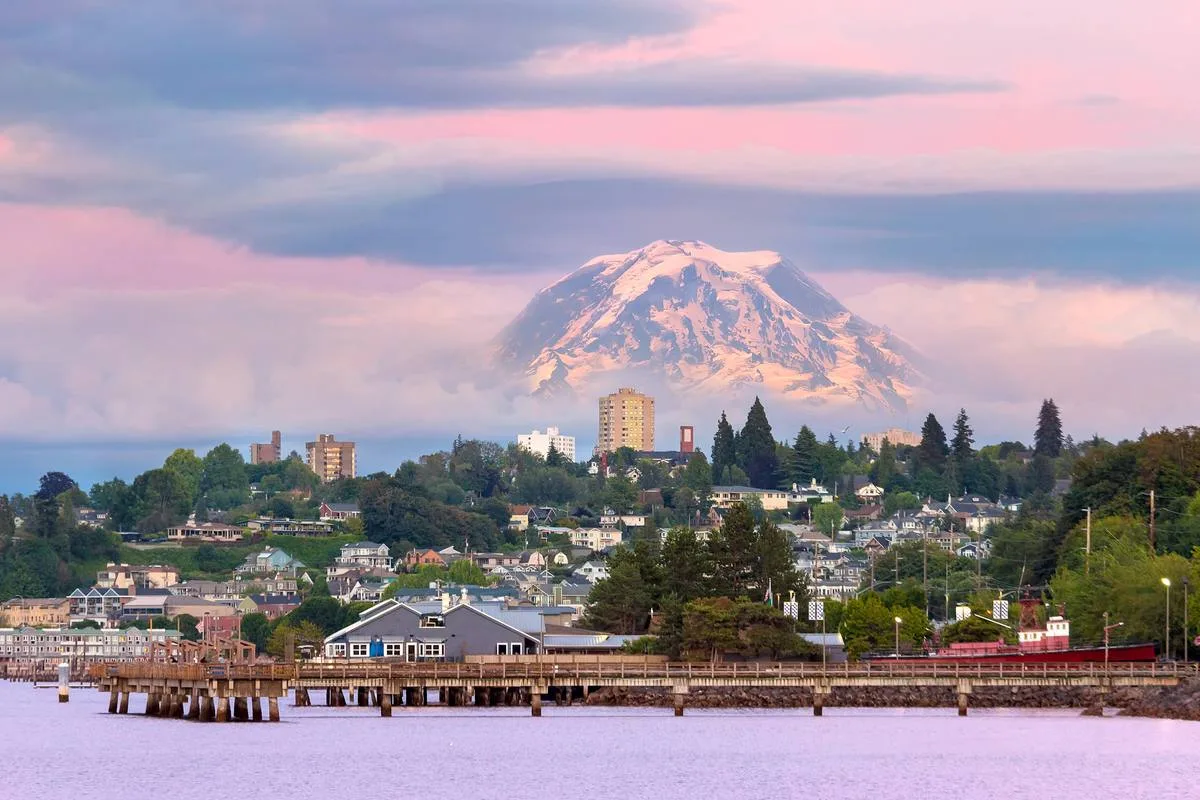
Local Expert Takeaway: Californians who move to Tacoma and stay tend to have one thing in common: they did a trial run first. Rent for six months before buying — find out whether the November-to-March gray is something you metabolize or something that grinds you down. Spend a Saturday morning walking the Proctor District down toward Old Town. Drive the Tacoma Narrows Bridge at dusk with Mount Rainier in the rearview. If that version of a weekend sounds like your life, the financial case is genuinely strong: no state income tax, a home price well below the California median, and a city that punches above its size on culture and outdoor access. If it sounds like exile from the sun, no spreadsheet will fix that.
Quick Takeaways & FAQs
✅ Washington's zero state income tax saves a household earning $100,000 approximately $5,762 per year compared to California — the most immediate financial impact of the move.
⚠️ Tacoma's combined sales tax of 10.5% (July 2026) is higher than California's base rate, and it hits hard on big purchases like cars and appliances — budget for it before you arrive, not after.
📍 Tacoma's Zillow Home Value Index typical home value was $496,203 as of July 2026, sitting below even Washington's own statewide median — one of the most accessible price points for waterfront-city living in the Pacific Northwest.
How much cheaper is Tacoma than California for buying a home?
Does moving from California to Washington really eliminate my state income tax?
Is Tacoma's sales tax higher than California's?
What is Tacoma's property tax rate compared to California's?
What do California transplants find hardest about living in Tacoma?
Moving to Washington?
Tell us what you need help with and we'll connect you with local resources.
