
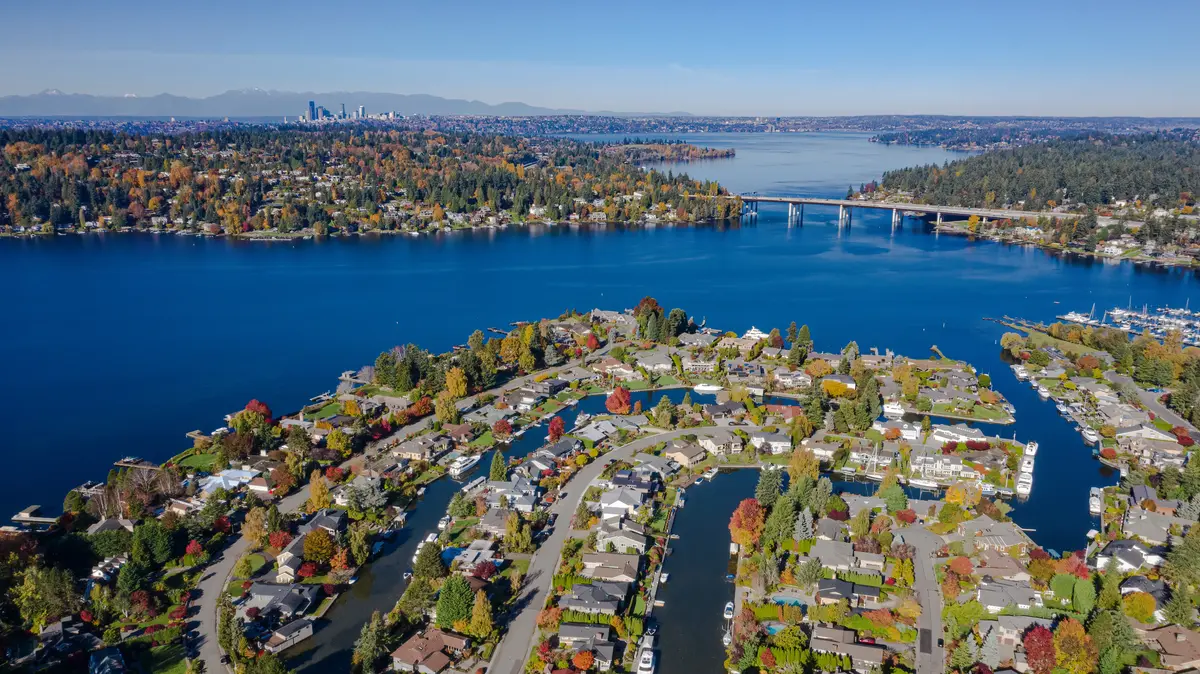
Maybe you've been renting in Kirkland or Redmond and watching Bellevue prices from a distance, telling yourself you'd jump in when the market softened. Or maybe your tech salary just crossed the threshold where homeownership feels within reach — and now the reality of what that actually buys here is setting in fast. Bellevue sits on the eastern shore of Lake Washington, anchored to Seattle by the 520 bridge and now by the 2 Line light rail, which opened its full cross-lake connection in late March 2026. It's a city where the median household income is $165,576 and the typical home price is $1,296,767 (Zillow Home Value Index, May 2026) — and bridging that gap is the central challenge every first-time buyer has to solve before writing an offer.
The economic engine here is unmistakable. Amazon, Microsoft, and T-Mobile US all have major presences in and around Bellevue, and OpenAI signed a lease for 296,000 square feet at City Center Plaza in 2026, adding more than 1,000 Eastside employees to an already competitive buyer pool. The schools are a significant draw that consistently pushes demand — see the schools page for the full breakdown. Washington also has no state income tax, a meaningful boost to purchasing power for anyone relocating from California or Oregon, where income tax can consume a significant share of the salary that would otherwise go toward a down payment.
The good news for first-timers is that Bellevue's market in mid-2026 is closer to balanced than it has been in years. With roughly 633 active residential listings and about 4.5 months of inventory (NWMLS data, August 2026), the frenzied multiple-offer environment of 2021–2022 has eased in most segments — though correctly priced single-family homes inside core school boundaries still routinely go pending in under 14 days. Condos and townhomes in areas like Crossroads and Factoria are sitting longer, sometimes 15–25 days, which gives first-time buyers more room to negotiate than the city's reputation suggests. The overall sale-to-list ratio sits at 97.5%, meaning most homes close modestly below asking — not at 110%.
Whether you're comparing Bellevue to Issaquah or Sammamish, or simply trying to figure out what your pre-approval letter needs to say before you tour a single property, the sections below walk through what your budget actually buys here, the step-by-step process specific to this market, a budget snapshot table with realistic cash-to-close figures, and the four mistakes that most reliably derail first-time buyers in Bellevue.

The Bellevue First-Time Buyer Reality
At a typical home price of $1,296,767 (Zillow Home Value Index, May 2026), Bellevue is not a market where a first-time buyer stretches slightly and lands a single-family home. For most first-timers, the realistic entry point is a condo or townhome — and the cost of living page has a fuller breakdown of how Bellevue's prices compare to surrounding Eastside cities.
That condo-first reality isn't a consolation prize. A townhome in Crossroads puts you inside the city, within a reasonable commute of downtown, and within walking distance of actual amenities — including the independently owned food and coffee spots that have made that neighborhood feel increasingly urban. Factoria offers a similar entry range with slightly easier parking and more square footage per dollar. Both areas give first-time buyers something they rarely find in Bellevue's more established residential pockets: a window to negotiate.
The market has cooled enough that buyers in these segments have leverage they didn't have two years ago. But "cooled" in Bellevue means homes sit for three weeks instead of three days — not that prices have fallen meaningfully. First-timers who approach this market expecting a negotiation like they'd have in Renton or Issaquah will be surprised by how little room sellers give on price, even when a home has been sitting. Your strongest move isn't waiting for a price drop — it's getting your financing tight enough that you can close confidently and quickly when the right unit appears.
The Homebuying Process in Bellevue, Step by Step
Step 1: Pre-Approval — The Non-Negotiable First Move
In Bellevue, listing agents routinely require a full pre-approval letter before they'll book a showing — not a pre-qualification, which is an informal estimate, but a verified pre-approval where the lender has reviewed your income documentation, tax returns, assets, and debts. If you show up to a Saturday open house with a pre-qualification letter, you may not be able to make an offer the same day. Get the real document first.
Because most Bellevue single-family home purchases involve financing above the King County high-cost loan limit for 2026, lenders will apply stricter qualification standards than they would for a smaller loan. That means your debt-to-income ratio, reserves, and credit profile need to be in strong shape before you start shopping, not after.
Step 2: Hire a Buyer's Agent and Define Your Search
A buyer's agent in this market isn't optional window dressing. Bellevue has micro-market dynamics — HOA structures that vary dramatically between condo buildings, listing timing that means a townhome in Factoria can appear and go pending before it ever hits Zillow, and pricing strategies that differ meaningfully by sub-area. An agent with active Eastside transaction history will know which buildings have deferred maintenance issues and which listings are priced to generate a bidding war versus genuinely priced to sell.
Step 3: Making an Offer
The full process from pre-approval to closing typically runs 60–90 days, with 30 days from accepted offer to closing being the most common timeline. When you make an offer, expect to negotiate earnest money in the range of 1–3% of the purchase price — in Bellevue, that's a meaningful dollar amount that signals seriousness. Sellers in the core single-family segment still see multiple offers on well-priced homes; in the condo segment, you may be the only offer.
Step 4: Inspection and Appraisal
In most 2026 Bellevue market segments — condos, townhomes, and homes outside the most competitive pockets — buyers are keeping the inspection contingency. This is the right call for a first-time buyer almost without exception. Waiving inspection to compete is a strategy for experienced buyers with cash reserves to absorb surprises; it's a significant financial risk for someone buying their first home. The escrow period covering inspection, appraisal, and final loan approval typically runs 30–45 days.
One step first-timers frequently underestimate: do not open new credit lines, make large purchases, or change employers between pre-approval and closing. A new car loan or a job change — even a lateral move to a higher salary — can trigger a full re-underwriting and delay or kill your closing.
Step 5: Closing
Washington uses escrow-based closings with a title company. You'll sign a significant stack of documents, wire your down payment and closing costs, and typically get keys the same day the deed records. Budget enough time in your schedule — closing appointments in Bellevue routinely run 60–90 minutes.

How Much Home Can You Afford in Bellevue
The table below shows five realistic first-time buyer scenarios in Bellevue, from entry-level condos to a near-median single-family home. Closing costs are estimated at approximately 2–3% of the purchase price, which covers title, escrow, lender fees, and prepaid items — the exact figure varies by lender and transaction. These are estimates for planning purposes; the interactive calculator below the table runs your specific numbers.
| Scenario | Purchase Price | Loan Type | Down Payment | Est. Closing Costs | Est. Cash Needed at Table |
|---|---|---|---|---|---|
| Entry condo / townhome — Crossroads or Factoria | $700,000 | Conventional 3% | $21,000 (3%) | ~$14,000–$21,000 | ~$35,000–$42,000 |
| Entry condo / townhome — Crossroads or Factoria | $700,000 | FHA 3.5% | $24,500 (3.5%) | ~$14,000–$21,000 | ~$38,500–$45,500 |
| Mid-range townhome | $900,000 | Conventional 10% | $90,000 (10%) | ~$18,000–$27,000 | ~$108,000–$117,000 |
| Upper-range condo / small single-family | $1,100,000 | Conventional 10% | $110,000 (10%) | ~$22,000–$33,000 | ~$132,000–$143,000 |
| Near-median single-family home | $1,300,000 | Conventional 20% | $260,000 (20%) | ~$26,000–$39,000 | ~$286,000–$299,000 |
| Above-median single-family home | $1,500,000 | Conventional 20% | $300,000 (20%) | ~$30,000–$45,000 | ~$330,000–$345,000 |
Washington's effective property tax rate in Bellevue runs approximately 0.88%, which factors into monthly carrying costs — the calculator below applies that rate to your specific purchase price.
A few things the table makes clear: even the entry-level condo scenario requires $35,000–$45,000 liquid before you close, and that figure doesn't include reserves most lenders want to see in your account after closing. First-time buyers who have saved aggressively for a down payment sometimes discover they've underestimated how much cash they need beyond it — more on that in the next section.
Looking to buy in Bellevue? Estimate your payment.
Enter your numbers to see an estimated monthly mortgage payment.
Estimate only. Excludes HOA fees and mortgage insurance. The interest rate above is a starting point, not a quoted rate — replace it with your own to see real numbers. Insurance is a flat placeholder, not a Bellevue quote.
Common First-Time Buyer Mistakes in Bellevue
Mistake 1: Starting With Showings Instead of Pre-Approval
This one costs buyers real opportunities. You find a townhome in Factoria that checks every box, you ask to see it on Sunday, and the listing agent asks for your pre-approval letter before confirming the showing. You don't have one yet. By the time you get it — even if it only takes two or three days — the property is under contract. In Bellevue's condo and townhome segment, 15–25 days on market sounds slow, but the right unit at the right price can still move in a long weekend.
Mistake 2: Waiving the Inspection Contingency Unnecessarily
Some buyers who've heard war stories from the 2021 market assume waiving inspection is still the only way to compete. In most 2026 Bellevue segments — particularly condos and homes in areas like Crossroads and Eastgate — it isn't. Sellers are accepting offers with inspection contingencies. A first-time buyer who waives inspection to win a condo that turns out to have significant deferred maintenance or HOA reserves issues has no recourse. Keep the contingency unless your agent gives you a specific, current-market reason not to — not a general story about how competitive Bellevue is.
Mistake 3: Underestimating Total Cash Needed
The down payment number is the one buyers fixate on. The cash-to-close number — which adds closing costs, prepaid homeowners insurance, initial escrow deposits, and lender fees — regularly surprises first-timers. On a $900,000 townhome, you might budget $90,000 for a 10% down payment and discover you need another $20,000–$27,000 on top of that to close. Then your lender wants to see two to three months of mortgage payments in reserves after closing. Build a cash cushion that is meaningfully larger than the down payment figure alone.
Mistake 4: Assuming All Addresses Carry the Same School Assignment
Schools are a significant driver of demand in Bellevue, but sub-boundary lines determine which elementary school a specific address feeds into — and those lines don't always follow the logic of the street grid. Two townhomes one block apart can feed into different schools. If the specific school assignment matters to you, verify the boundary for each address before making an offer, not after. The district's boundary lookup tool is the authoritative source; your agent's recollection is not. See the schools page for a full breakdown of how assignment works across the city.
A related friction: some first-time buyers assume that buying anywhere in Bellevue guarantees the most sought-after school assignments. It doesn't. The premium for certain assignments is already priced into the homes that carry it — you're paying for it whether you realize it or not.
Local Expert Takeaway: Bellevue in 2026 is more navigable for first-time buyers than its price tag suggests — but only if you enter the process in the right order. Get a verified pre-approval before you tour anything. Target condos and townhomes in Crossroads or Factoria as realistic entry points, where days on market give you actual negotiating room. Keep your inspection contingency. And build a cash reserve that is meaningfully larger than just your down payment — the gap between what buyers budget and what they actually need at the closing table is the most common reason first-time deals in Bellevue fall apart.
Quick Takeaways & FAQs
✅ Bellevue's 2026 market has roughly 4.5 months of inventory — the most balanced conditions first-time buyers have seen here in several years, especially in the condo and townhome segment.
⚠️ The typical Bellevue home price of $1,296,767 means most first-time buyers will start with a condo or townhome rather than a single-family home — and total cash needed at closing routinely exceeds the down payment by $20,000 or more.
📍 Listing agents in Bellevue frequently require a full verified pre-approval letter — not just a pre-qualification — before they will even book a showing, so get your financing documentation in order before you start browsing Zillow.
What credit score do I need to buy a home in Bellevue?
How long does it take to buy a home in Bellevue?
Can a first-time buyer actually find something affordable in Bellevue, or should I look at Issaquah or Renton instead?
Is the Bellevue housing market still competitive in 2026?
What's the biggest financial surprise first-time buyers face in Bellevue?
Moving to Washington?
Tell us what you need help with and we'll connect you with local resources.
