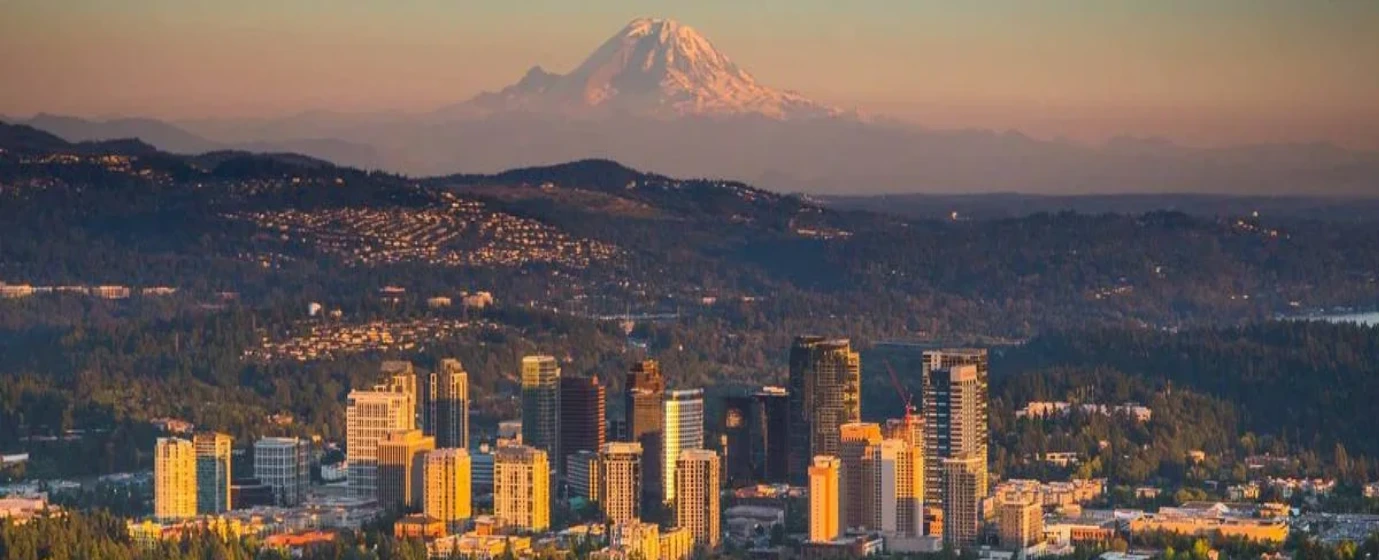
Maybe your company relocated you to work at Microsoft, T-Mobile, or one of the dozens of tech firms that have set up shop east of Lake Washington. Maybe you've been watching Seattle prices and decided Bellevue was the more logical base. Either way, you're now trying to make sense of a city where the median home price sits at $1,296,767 (Zillow Home Value Index, May 2026) — and where two neighborhoods three miles apart can feel like entirely different cities. That gap isn't just about price. It's about elevation, school assignment, freeway proximity, and whether you're looking at a view of the Olympic Mountains or a view of the I-405 sound wall.
Bellevue School District is the gravitational center of every buying decision here. It holds an A+ rating, according to Niche, and that standing is the reason families pay a significant premium to stay inside BSD boundaries rather than drift into neighboring Issaquah or Lake Washington districts. That reputation is reflected in the speed at which homes near top elementary feeders go under contract. If you have school-age children, your neighborhood decision is really a school-boundary decision first, and a lifestyle decision second. Learn more about specific schools on the Bellevue schools page.
Lifestyle-wise, Bellevue is genuinely less monolithic than its reputation suggests. You can buy a condo steps from the Spring District's brewpubs on NE District Way, or you can buy a house on a half-acre lot in Bridle Trails with 489 acres of state park as your backyard. The trade-off is that neither option is cheap, and the lower-priced pockets — Factoria, Crossroads — come with their own practical considerations. Sound Transit's 2 Line completed its cross-lake connection to Seattle in March 2026, which has already started to reshape which neighborhoods commuters prioritize. For a full breakdown of costs beyond housing, see the Bellevue cost of living page.
This guide covers all eight of Bellevue's key neighborhoods — their price bands, personalities, genuine trade-offs, and who each one actually suits. Whether you're choosing between a Downtown condo and a Somerset single-family home, or deciding whether Factoria's entry-level pricing is worth the compromises, the sections below will give you what a spreadsheet can't.
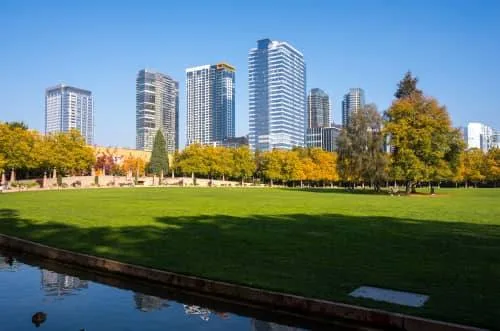
The Bellevue Reality
The single divide that shapes almost every buying decision in Bellevue is the one between the hilltop neighborhoods — Somerset, Newport Hills — and everything else. Sitting at just under 1,000 feet, Somerset overlooks Lake Washington, the Seattle skyline, Puget Sound, and the Olympic Mountains. That elevation isn't just scenery; it's a psychological and financial premium built into every comparable sale on the hill. Buyers who don't understand this geography sometimes compare Somerset prices to Eastgate prices and assume the difference is arbitrary. It isn't.
The second divide is the freeway corridor. I-405 runs north-south through the city's middle, and neighborhoods on its eastern flank — Crossroads, Factoria, Eastgate — have a fundamentally different feel from the western side. West Bellevue and Meydenbauer sit between the freeway and Lake Washington, which is where you find the most walkable streets, the densest concentration of boutique retail, and the highest detached-home prices in the city. East of the freeway, you get more square footage for the dollar, but you trade waterfront proximity and the kind of on-foot access that makes West Bellevue feel more like a city neighborhood.
The third factor — one that surprises buyers who move here from outside the region — is school boundary specificity. The Bellevue School District is a single district, but your assigned elementary school changes dramatically depending on which side of a given street you're on. Buyers targeting Medina Elementary or Enatai Elementary feeders, for instance, need to verify the exact parcel address before making an offer, not after. The southern neighborhoods — Somerset, Newport Hills, Eastgate, Factoria — all feed into Newport High School, which enrolled 1,844 students in the 2023–24 school year. That shared high school creates a loose community identity in the south end, but the elementary assignments within that zone still vary street by street.
Neighborhoods at a Glance
| Neighborhood | Best For | Price Range | Vibe |
|---|---|---|---|
| Downtown Bellevue | Walkable Transit | $700K–$1.5M (condos); $1.5M+ (townhomes) | Urban high-rise and mid-rise living next to The Bellevue Collection |
| Crossroads | First-Time Value | $850K–$1.1M | Diverse, international, community-park-anchored |
| Somerset | Views Luxury | $1.5M–$3M+ | Hilltop single-family homes with panoramic vistas |
| Newport Hills | Families School | $1.4M–$1.6M | Established suburban streets, mature trees, quiet cul-de-sacs |
| Bridle Trails | Nature Privacy | $1.6M–$2.5M+ | Large lots, equestrian culture, deep forest feel |
| Eastgate | Families Commuter | $1.4M–$1.6M | I-90 access, suburban ease, strong school feeders |
| West Bellevue/Meydenbauer | Luxury Walkable | $2M–$5M+ | Lakeside prestige, Old Bellevue dining, top-tier finishes |
| Factoria | First-Time Renter | $559K–$900K (condos/townhomes) | Most affordable entry point; dense, practical, freeway-adjacent |
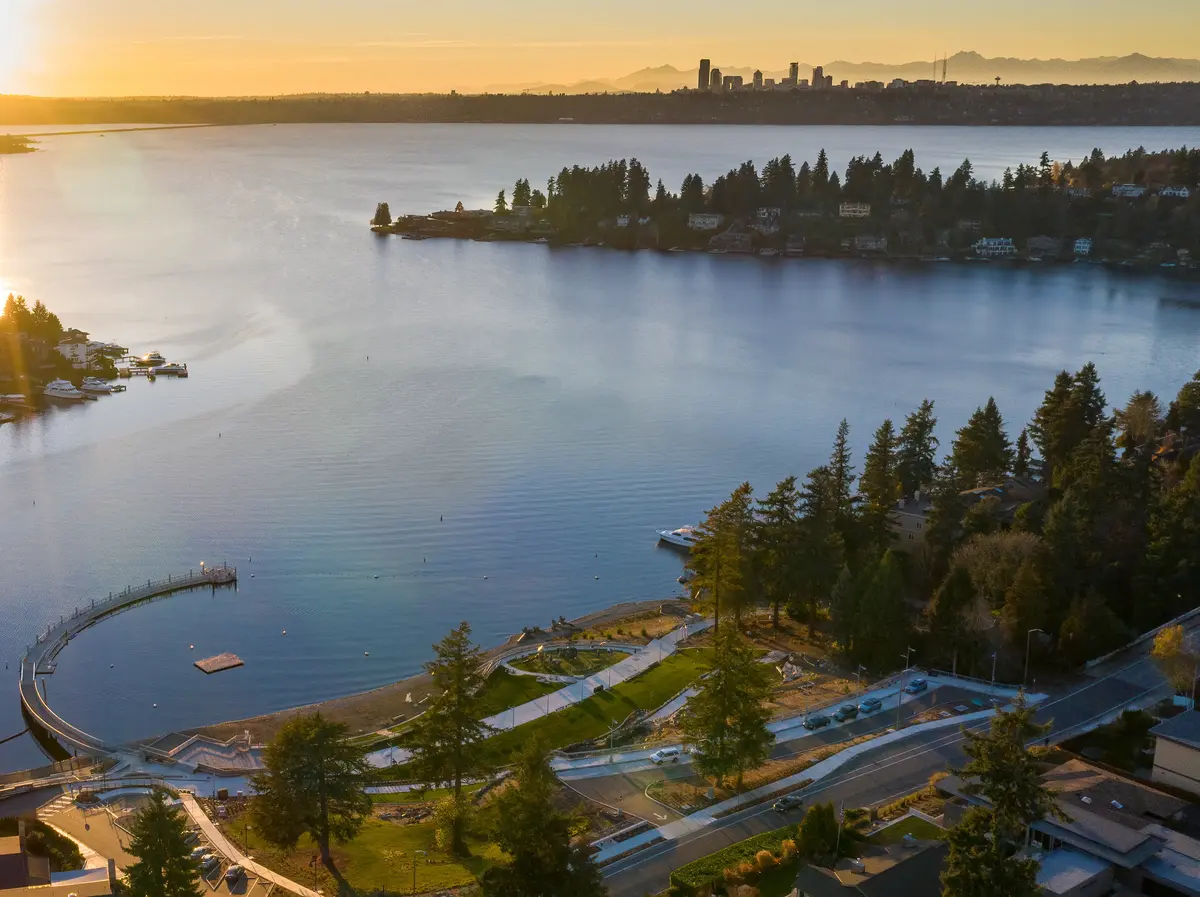
Best Neighborhood by Buyer Type
| Buyer Type | Best Neighborhood | Why |
|---|---|---|
| First-Time Buyer | Factoria | Entry-level condos starting around $559,000 make BSD access possible without a $1.4M budget. |
| Luxury Buyer | West Bellevue/Meydenbauer | Lakeside lots, walking distance to Old Bellevue, and detached homes that routinely exceed $3M set this apart from any other Bellevue zip. |
| Walkability Seeker | Downtown Bellevue | The Bellevue Collection, Bellevue Downtown Park, and the 2 Line station put daily errands and a one-seat ride to Seattle within a 10-minute walk. |
| Families with Kids | Newport Hills | Updated neighborhood area plans (adopted October 2025), quiet streets, and strong elementary feeders make this the south-end family benchmark. |
| Commuters | Eastgate | Direct I-90 on-ramp access and proximity to Issaquah and Renton corridors make this the rare Bellevue neighborhood that doesn't funnel every trip through downtown surface streets. |
| Large-Lot Buyers | Bridle Trails | Half-acre and larger lots bordered by 489 acres of state park trail are essentially unavailable anywhere else inside Bellevue city limits. |
| Renters | Downtown Bellevue | The highest concentration of purpose-built apartment inventory, plus 2 Line connectivity, makes downtown the only neighborhood where renting in Bellevue feels designed rather than accidental. |
Looking to buy in Bellevue? Estimate your payment.
Enter your numbers to see an estimated monthly mortgage payment.
Estimate only. Excludes HOA fees and mortgage insurance. The interest rate above is a starting point, not a quoted rate — replace it with your own to see real numbers. Insurance is a flat placeholder, not a Bellevue quote.
Most Popular Neighborhoods in Bellevue
1. Downtown Bellevue
Downtown Bellevue is the city's only genuinely walkable core — Bellevue Downtown Park, The Bellevue Collection, and the 2 Line light rail station are all within blocks of each other. The inventory skews heavily toward condos and mid-rise units, which is why the Downtown submarket Zillow Home Value Index came in at $1,117,537 (May 2026) — noticeably below the city-wide figure, reflecting the condo mix rather than a bargain on detached homes. The catch: downtown amenities come with downtown density, and if you need a yard or a garage larger than a single stall, the math rarely works here.
Best for: Tech workers commuting by rail, lock-and-leave condo buyers, anyone who wants urban convenience without crossing the bridge to Seattle. Price range: $700K–$1.5M (condos); $1.5M+ (townhomes).
2. Crossroads
Crossroads is the most culturally diverse neighborhood in Bellevue, anchored by a mall with roughly 30 international restaurants and a 34-acre park that includes a 9-hole golf course — an amenity combination you don't find at this price point anywhere else in the city. Updated neighborhood area plans were adopted in October 2025 after 15 months of community input, signaling that the city is actively investing in the area's future. The compromise is that Crossroads sits clearly east of I-405, which puts West Bellevue's lakeside energy a longer drive away than the map suggests.
Best for: First-time buyers, buyers who value international community and everyday conveniences over prestige addresses. Price range: $850K–$1.1M.
3. Somerset
Somerset's defining feature is its hilltop position — just under 1,000 feet of elevation — which delivers unobstructed views of Lake Washington, the Olympic Mountains, Puget Sound, and the Seattle skyline from many lots. Single-family homes dominate, and the price range reflects the view premium as much as the square footage. What newcomers don't expect: getting in and out of Somerset requires navigating steep, winding roads that become genuinely unpleasant in ice or heavy snow, and the neighborhood has no walkable retail of its own.
Best for: Buyers prioritizing views, privacy, and a quiet suburban feel with strong BSD school feeders. Price range: $1.5M–$3M+.
4. Newport Hills
Newport Hills sits in Bellevue's southeast quadrant with the kind of established street grid — mature Douglas firs, wide lots, mid-century and updated Craftsman homes — that takes decades to build and can't be replicated in newer developments. Median home prices in the $1.4M–$1.6M range put it slightly below Somerset but well above the city's condo-heavy entry tier. All five southern BSD neighborhoods, including Newport Hills, feed into Newport High School, which creates strong community continuity from elementary through graduation.
Best for: Families with school-age children who want a quiet, established neighborhood with good freeway access south toward Renton and Issaquah. Price range: $1.4M–$1.6M.
5. Bridle Trails
Bridle Trails is the only neighborhood in Bellevue where a horse trailer in the driveway is unremarkable — the 489-acre state park at its center includes four horse arenas and pull-through trailer parking, making equestrian culture a genuine part of daily life here. Lots run large, the tree canopy is dense, and the feel is closer to rural Woodinville than to downtown Bellevue despite being inside city limits. The downside is real: Bridle Trails has almost no walkable retail, and the Redmond and Kirkland border proximity means some residents feel more connected to those cities than to Bellevue proper.
Best for: Buyers wanting large lots, true privacy, equestrian access, and a forest-neighborhood feel that doesn't require leaving the city. Price range: $1.6M–$2.5M+.
6. Eastgate
Eastgate's selling point is I-90 access — this is the neighborhood where commuters heading to Issaquah, Renton, or Mercer Island can get on the freeway without threading through downtown Bellevue surface streets first. Home prices land in the $1.4M–$1.6M range, making it comparable to Newport Hills in cost but with a slightly more suburban-commercial character near the Eastgate Park and Ride. The city's 2025–2026 Great Neighborhoods planning cycle is currently focused on Eastgate and Factoria, with draft area plans available for public review, which suggests meaningful infrastructure attention is coming.
Best for: Commuters, families who want the southern BSD school cluster, and buyers who prioritize freeway convenience over walkability. Price range: $1.4M–$1.6M.
7. West Bellevue/Meydenbauer
West Bellevue and the Meydenbauer Bay area represent Bellevue at its most expensive and most walkable — Meydenbauer Bay Park, Bellevue Square, and Old Bellevue's row of boutique shops and restaurants are all reachable on foot. Detached homes in this corridor routinely start above $2M and climb well past $5M on waterfront lots. The honest caveat: at these price points, buyers are often competing against all-cash offers, and the inventory is thin enough that waiting for the right property in this zip code is a genuinely long game.
Best for: Luxury buyers, lakeview seekers, and anyone who wants to walk to Old Bellevue for dinner without getting in a car. Price range: $2M–$5M+.
8. Factoria
Factoria is the closest thing Bellevue has to an affordable entry point, with condo inventory starting around $559,000 in 2026 — a figure that would be unremarkable in Renton but stands out sharply against the city's overall median. The neighborhood is dominated by condos and townhomes, and the character is dense and practical rather than residential-quiet; I-405 and the Factoria commercial corridor are both close. Like Eastgate, Factoria is currently part of Bellevue's active Great Neighborhoods planning cycle, with a draft area plan open for public input — a signal that the city views this area as one of its growth priorities.
Best for: First-time buyers willing to trade space and quiet for BSD school access at a price point well below the city median. Price range: $559K–$900K (condos/townhomes).
Common Mistakes Buyers Make in Bellevue
Assuming All BSD Addresses Are Equal
Every address in Bellevue sits inside the Bellevue School District, which leads buyers to assume their school situation is settled once they've found a BSD zip code. It isn't. Elementary school assignments shift street by street — a home on one side of SE 24th Street may feed a different school than one three houses down. Verify your specific parcel's assignment through the BSD boundary tool before writing an offer, not during inspection.
Underestimating the I-405 Effect
Buyers moving from outside the region often look at a map and decide that Crossroads or Factoria is "close to everything." In practice, getting from the east side of I-405 to Meydenbauer Bay Park or Old Bellevue during evening drive time takes meaningfully longer than the distance implies. If walkable access to the lake or the downtown core is a priority, the freeway divide matters — and it's not something you fully feel until you've lived it through a few weeks of commuting.
Chasing Square Footage in the South End Without Checking School Feeders
Newport Hills and Eastgate offer among the best dollars-per-square-foot ratios for detached homes in Bellevue, which attracts buyers who are stretching their budget. The mistake is optimizing for lot size without mapping out which elementary school a given property feeds — some buyers discover post-offer that the school they assumed came with the address is actually one boundary over. In a district this competitive, that's a meaningful difference.
Overlooking Somerset's Access Trade-Off
Somerset's hilltop views sell themselves in listing photos. What the photos don't show is the reality of navigating Newport Way or SE Newport Drive in January when the roads ice over — a seasonal quirk that catches transplants from flat-terrain cities off guard. Buyers who commit to Somerset based on summer visits sometimes find the winter access situation more limiting than expected, particularly if they're used to relying on rideshare or transit for daily movement. The hill has no light rail stop and no walkable retail to fall back on when driving feels risky.
Best Areas to Rent in Bellevue
| Area | Ideal For | Typical Rent Range | Trade-off |
|---|---|---|---|
| Downtown Bellevue | Transit riders, young professionals | $2,200–$3,800/mo (studio–2BR) | Highest rents in the city; parking adds cost; dense and loud near NE 8th St corridors |
| Spring District (East Downtown) | Tech workers, brewpub crowd | $2,100–$3,400/mo (1–2BR) | Newer inventory but limited neighborhood retail outside NE District Way |
| Crossroads | Budget-conscious renters, international community | $1,700–$2,600/mo (1–2BR) | East of I-405; longer drive to waterfront amenities |
| Factoria | First-time renters, commuters to Renton or Issaquah | $1,600–$2,400/mo (studio–2BR) | Commercial-heavy surroundings; less residential quiet than Somerset or Bridle Trails |
| Eastgate | Families renting before buying, I-90 commuters | $1,900–$2,900/mo (2–3BR) | Limited apartment inventory; most rentals are townhomes or SFR, fewer amenities included |
Rental inventory in Bellevue is genuinely thin outside the Downtown and Spring District corridors — purpose-built apartment buildings are concentrated where the density is, and in the southern and eastern neighborhoods, available rentals tend to be individual units in townhome complexes or SFR leases rather than large managed communities. If you're renting while shopping to buy, Downtown or Spring District gives you the most options and the easiest month-to-month flexibility, even if the monthly cost is the steepest in the city.
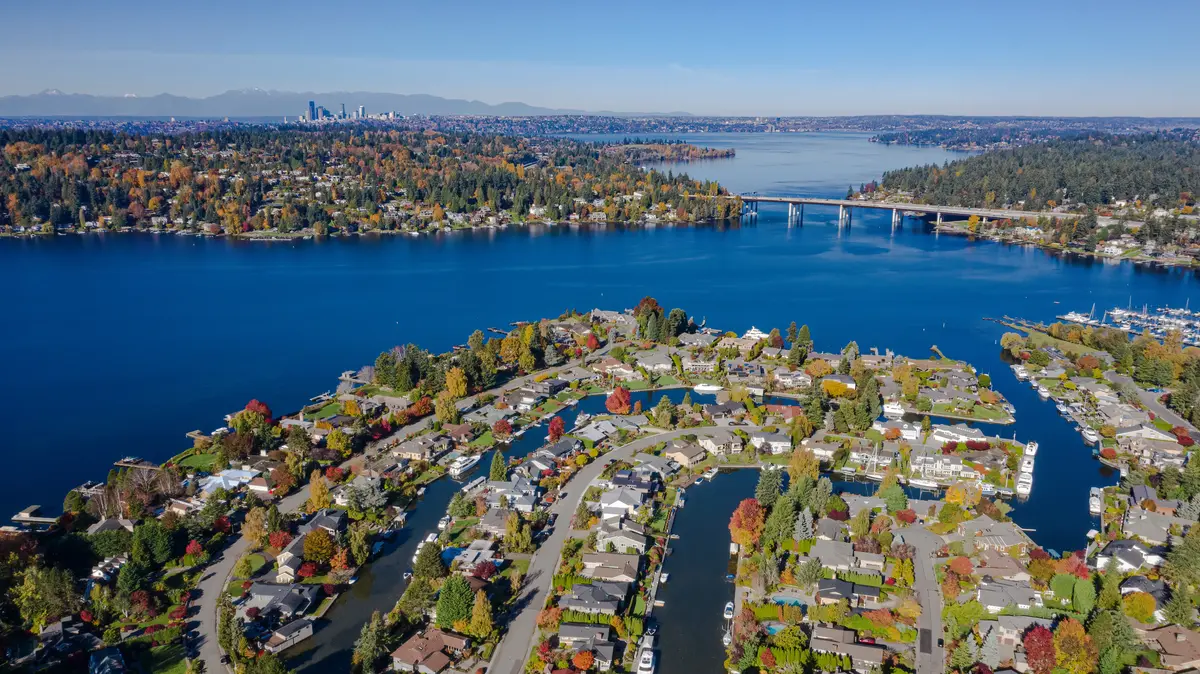
Local Expert Takeaway: The buyers who get Bellevue right are the ones who start with a school-boundary map, not a Zillow filter. Once you've confirmed which elementary your target addresses feed, layer in the I-405 divide: west of the freeway means on-foot access to Old Bellevue and Meydenbauer Bay Park but prices that start at $2M for detached homes; east of it means more square footage, real entry points at Crossroads and Factoria, and a longer drive to the lake. The 2 Line's March 2026 cross-lake connection has made Downtown and the Spring District — where brewpubs and independent restaurants anchor NE District Way — more relevant for Seattle commuters than they've ever been. If you can tolerate a condo and a shorter commute, that corridor is worth a serious look before defaulting to a hilltop bidding war in Somerset.
Quick Takeaways & FAQs
✅ Bellevue School District holds an A+ rating, according to Niche — BSD boundary maps should be your first filter, before price or square footage.
⚠️ The I-405 corridor creates a real divide: west-side neighborhoods like Meydenbauer offer walkability and lakeside access, while east-side areas like Crossroads and Factoria trade that for lower prices and more square footage.
📍 Sound Transit's 2 Line completed its cross-lake connection in March 2026, making the Spring District and Downtown Bellevue the most transit-connected rental zones in the city.
What is the most affordable neighborhood in Bellevue to buy a home?
Which Bellevue neighborhoods are best for families with school-age children?
Is West Bellevue really worth the price premium over other Bellevue neighborhoods?
How has the new light rail line affected Bellevue neighborhood values?
What surprises people about living in Bellevue after the first six months?
Moving to Washington?
Tell us what you need help with and we'll connect you with local resources.
