
Maybe your company is relocating you here — Amazon, Microsoft, T-Mobile, or one of the dozens of firms orbiting them. Maybe you've been priced out of Seattle proper and Bellevue keeps coming up as the alternative. Whatever brought you to this page, the first thing to understand is that Bellevue is not a cheaper version of Seattle. It is a fully matured, high-demand city in its own right, sitting on the eastern shore of Lake Washington along I-405 and SR-520, and it prices like one. The median household income here runs $165,576 — roughly double the national figure — and the housing market reflects who that income attracts.
The economic engine is concentrated and powerful. Amazon, Microsoft, and T-Mobile US all have significant operations or headquarters here, drawing a highly compensated workforce that keeps demand for housing persistently strong. That demand doesn't disappear in slow markets — it compresses. When rates rise, inventory stays thin because existing homeowners with sub-3% mortgages don't sell. When rates ease, buyers flood back. The result is a market where entry-level is genuinely difficult to find within city limits, and where even modest condos command prices that would be luxury in most of the country.
Beyond housing, the cost picture has some genuine bright spots. Washington's hydropower grid keeps electricity rates noticeably below the national average. Groceries are taxed at zero percent under state law. And the Link Light Rail 2 Line — connecting Downtown Bellevue to Seattle in roughly 20–25 minutes — gives car-free commuters a real alternative to the SR-520 bridge toll and I-90 traffic. The catch: everything else, from Bellevue having a combined state and local sales tax rate of 10.3% to water and sewer bills set by the city, runs above what you'd pay in most peer metros.
Whether you're deciding between Bellevue and Kirkland, trying to figure out whether your tech salary actually stretches here, or just benchmarking before your first offer, the sections below break down Bellevue's housing costs, rent vs. buy math, everyday expenses, how the city stacks up against nearby alternatives, and how Washington's tax structure shapes your real take-home picture.

What It Really Costs to Live in Bellevue
Bellevue's overall cost of living runs an estimated 43% above the U.S. national average in 2026, with housing doing the heaviest lifting. That's not a rounding error — it's the structural reality of a city where strong employer gravity, a 25-minute rail connection to Seattle, and high household incomes all compete for the same finite supply of housing.
The Zillow Home Value Index for Bellevue stood at $1,296,767 in May 2026 — a figure that encompasses the full range of the market, from older townhomes to newer construction. Compared to Sammamish and some of the lake-front enclaves nearby, Bellevue lands in a similar tier. Compared to Renton or Issaquah, it runs noticeably higher. And compared to most of Washington state outside the Puget Sound metro, it is in a different category entirely.
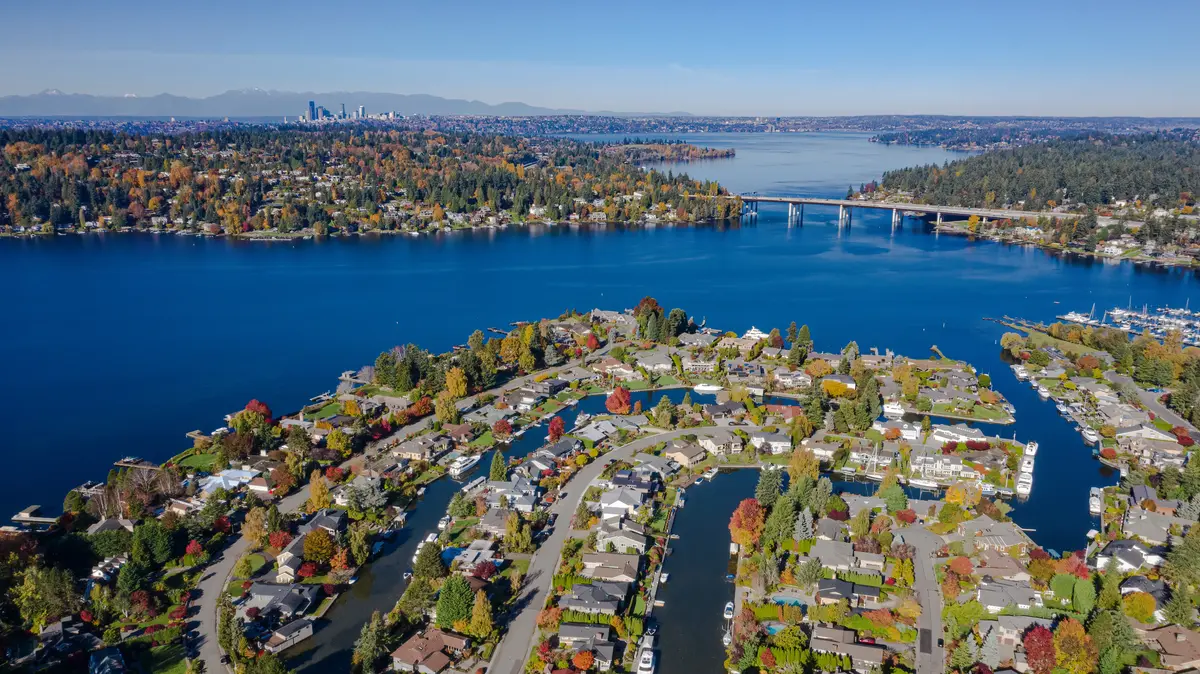
What drives the number isn't mystery — it's supply constraint meeting employer gravity. Bellevue is geographically bounded by Lake Washington to the west, Lake Sammamish to the east, and established suburbs on all sides. There is no cheap edge of town that's about to get discovered. The premium is baked in, and the buyers absorbing it are largely dual-income households in technology and finance who can.
Housing: Rent vs Buy in Bellevue
The Buying Side
Entry-level ownership in Bellevue — typically an older condo or a smaller townhome — starts around $600,000–$750,000 on the lower end of what's available, though supply at that price point is thin and competition is real. The city-wide Zillow Home Value Index of $1,296,767 (May 2026) is the honest anchor for the broader market. If you want a single-family home with a yard, plan for well above that figure in most parts of the city. For neighborhood-level price breakdowns, the Best Neighborhoods guide has the specifics.
The effective property tax rate in Bellevue is approximately 0.88% — one of the lower rates among King County cities, and meaningfully below what buyers pay in many comparable metros on the East Coast. That relative restraint helps at the margin, but on a home priced at the city-wide index level, the annual tax bill is still substantial. Use the mortgage calculator below this section for a full monthly ownership estimate; this page won't quote a specific payment figure because your down payment, rate, and insurance will move that number considerably.
The Renting Side
Renting in Bellevue is expensive, but it gives you flexibility in a market where timing matters. The average apartment rent citywide ran $2,722/month as of June 2026, per RentCafe/Yardi Matrix data. A two-bedroom unit averages $3,147/month; a three-bedroom averages $4,117/month. Renting makes the most sense here if you're new to the area and haven't yet decided which part of the Eastside fits your commute pattern and lifestyle, or if you're waiting to accumulate a larger down payment in a market where that represents a significant cash requirement.
Buying makes more sense if you have a long time horizon, a stable employer situation, and enough liquidity to absorb the transaction costs — because appreciation here has historically rewarded those who stayed.

Everyday Costs Beyond Housing in Bellevue
The good news on utilities is real: electricity in Bellevue runs approximately 14¢/kWh as of May 2026, which is roughly 31% below the national average. That's a direct result of the Pacific Northwest's hydropower-heavy grid — not a promotional figure. The less cheerful line item is water, sewer, and storm service, which the City of Bellevue bills as a combined charge: $255.71/month in 2026 after a rate increase approved by City Council. That's a meaningful line item most relocating households underestimate when building their first budget here.
Groceries run approximately 8–12% above the national average, which stings less than it sounds once you factor in that Washington exempts groceries from sales tax entirely. Several major grocery chains operate in or near Bellevue across price points, so comparison shopping is feasible. Transportation costs are shaped by two competing forces: Washington's gas tax of 59.04 cents per gallon (among the highest in the country) hits drivers hard, while the ORCA regional pass at $6/day for unlimited rides across King County Metro, Sound Transit, and the Link Light Rail 2 Line gives transit users a genuinely competitive alternative to car ownership.
| Category | Typical Monthly Cost | Notes |
|---|---|---|
| Housing (2BR Rent) | $3,000–$3,300 | Citywide average per RentCafe June 2026; owners: use the mortgage calculator above for a purchase estimate |
| Electricity | $80–$130 | ~14¢/kWh; lower than most major metros due to regional hydropower |
| Water / Sewer / Storm | ~$256 | City of Bellevue combined residential rate, 2026 |
| Groceries | $500–$650 | 8–12% above national average; groceries are sales-tax exempt in Washington |
| Transportation & Gas | $200–$500 | Wide range: car-free ORCA pass users on the low end; daily drivers absorb WA's 59¢/gal gas tax |
| Phone & Internet | $150–$250 | Competitive providers in the market; gigabit fiber available in many neighborhoods |
| Misc / Discretionary | $400–$800 | Dining, entertainment, personal care; a combined state and local sales tax rate of 10.3% applies to most purchases |
Bellevue has a combined state and local sales tax rate of 10.3%, which is impossible to ignore when budgeting discretionary spending — it adds up fast on restaurant tabs, electronics, and clothing.
Looking to buy in Bellevue? Estimate your payment.
Enter your numbers to see an estimated monthly mortgage payment.
Estimate only. Excludes HOA fees and mortgage insurance. The interest rate above is a starting point, not a quoted rate — replace it with your own to see real numbers. Insurance is a flat placeholder, not a Bellevue quote.
Bellevue vs Nearby Cities: Cost Comparison
| City | Median Home Price | Typical 2BR Rent | Cost vs Bellevue |
|---|---|---|---|
| Bellevue | $1,296,767 (ZHVI, May 2026) | ~$3,147/mo | — baseline — |
| Kirkland | ~$1.1M–$1.3M (approx. range) | ~$2,800–$3,100/mo | About the same; slightly lower on the edges |
| Sammamish | ~$1.2M–$1.5M (approx. range) | ~$2,600–$3,000/mo | Comparable; newer construction, less transit |
| Redmond | ~$1.0M–$1.2M (approx. range) | ~$2,400–$2,800/mo | Somewhat cheaper; trade-off is less urban amenity |
| Issaquah | ~$850K–$1.0M (approx. range) | ~$2,200–$2,600/mo | Noticeably cheaper; longer commute to Seattle core |
| Renton | ~$650K–$800K (approx. range) | ~$1,900–$2,300/mo | Meaningfully cheaper; different character, improving rapidly |
* ZHVI = Zillow Home Value Index. Nearby-city figures are approximate ranges based on available market data; Bellevue's figure is the authoritative ZHVI input.
Renton and Issaquah represent the clearest value alternatives for buyers who are willing to trade some commute convenience or urban density for a lower entry price. Kirkland and Redmond land close enough to Bellevue that buyers often shop all three simultaneously — the decision usually hinges on which employer campus is closer.
Taxes & the Bottom Line for Bellevue
Washington's Income Tax Advantage
Washington levies no broad-based personal income tax on wages or salaries — a genuine financial advantage for the high earners Bellevue attracts. A household earning $165,000 here keeps more of each paycheck than an equivalent earner in Oregon, California, or most Eastern seaboard states. That advantage is one reason why tech employees who could theoretically live anywhere in the country often choose the Puget Sound region specifically.
There is one important exception. Washington taxes 7% on long-term capital gains above a $278,000 standard deduction for 2025, rising to 9.9% on gains above $1,000,000. For most wage earners this is irrelevant. For anyone selling a large stock position, a business, or investment real estate, it's a material consideration worth discussing with a tax advisor before you establish residency.
Sales Tax and Property Tax
Bellevue has a combined state and local sales tax rate of 10.3%, which applies to restaurant meals, retail purchases, and services, but not to groceries or prescription drugs. On a $150 restaurant tab for two, you're paying an extra $15.45 before the tip. Over a year of normal spending, that adds up to a real number.
The effective property tax rate of approximately 0.88% is one of the lower rates among King County's high-value cities, which softens the blow of prices at the level described above. It is still a substantial annual obligation on a home priced in the range the market commands here — but compared to the 1.5–2%+ rates common in Texas or New York metro markets, it's a relative advantage.
Who This Budget Fits
The honest bottom line: Bellevue works financially for dual-income households in technology, finance, or similar high-compensation fields — people whose combined income supports a housing cost that would disqualify most single-earner budgets. Single professionals making strong salaries can rent here comfortably, but ownership in the range that the market's index figure describes requires either significant household income, substantial equity from a prior home sale, or both. Buyers who find the numbers genuinely tight often settle in Renton or Issaquah and commute — a reasonable compromise if it means financial breathing room. Those who stretch for Bellevue tend to stay, because the light rail access and the employer proximity make it hard to give back once you're in.
Local Expert Takeaway: Bellevue's cost of living rewards households who planned for it and stings those who didn't. The electricity bill surprises people on the low side — hydropower keeps rates well below the national average. The water and sewer bill surprises people on the high side — $255/month combined is a real line item most transplants from the Midwest or South don't see coming. And the 10.3% sales tax hits hardest in the first year, before you've adjusted your spending habits. If you're commuting to Microsoft or Amazon and weighing Bellevue against Redmond or Kirkland, the price difference between those cities is real but not enormous — your commute direction and preferred neighborhood character will likely matter more than the marginal cost difference.
Quick Takeaways & FAQs
✅ Washington's no-income-tax structure is a genuine financial advantage for Bellevue's high earners — a household at $165K keeps more of each paycheck than it would in most comparable metros.
⚠️ Bellevue has a combined state and local sales tax rate of 10.3%, and a $255.71/month water-sewer-storm bill makes Bellevue's non-housing costs meaningfully higher than most buyers expect before they move in.
📍 The Link Light Rail 2 Line's $6 ORCA day pass covers unlimited rides from Downtown Bellevue to Seattle in roughly 20–25 minutes — a real alternative to I-90 and SR-520 tolls for daily commuters.
What is the typical home price in Bellevue, WA in 2026?
What is the average rent for a two-bedroom apartment in Bellevue?
Does Washington state have an income tax? How does that affect living in Bellevue?
How much should I budget for utilities in Bellevue?
Is Bellevue cheaper than Seattle or the surrounding Eastside cities?
Moving to Washington?
Tell us what you need help with and we'll connect you with local resources.
