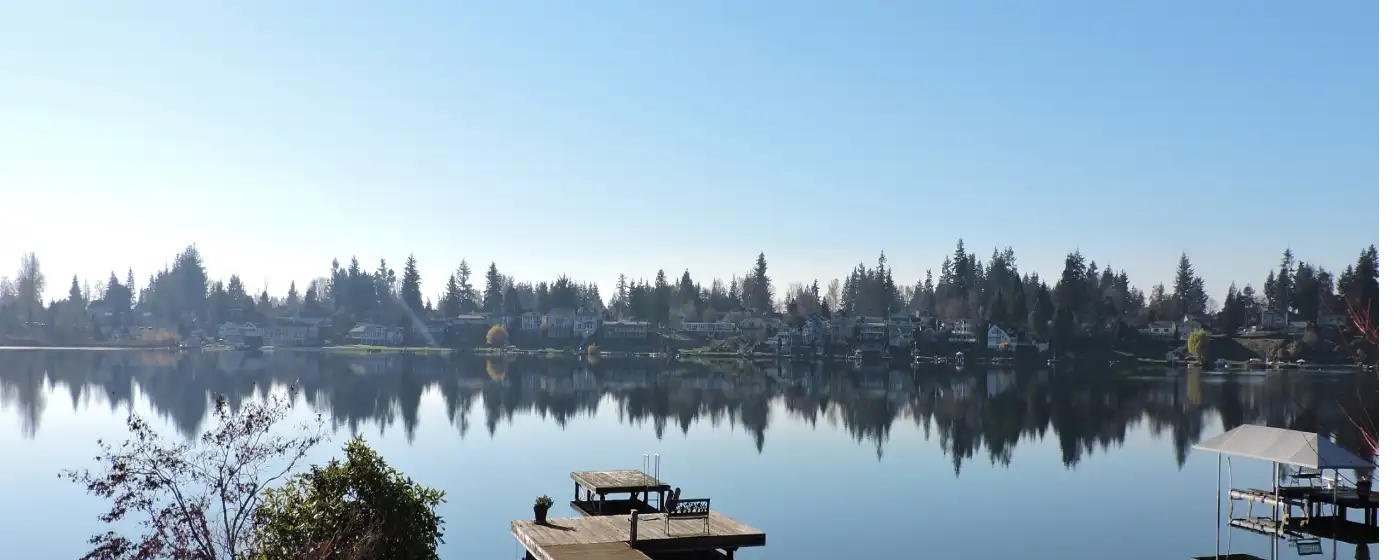
What Is Living in Kent, Washington Like?
Most people who land on Kent, Washington as a relocation option get here the same way: they ran the numbers on Seattle and the Eastside, realized those numbers didn't work, and started looking south. What they find is a city that doesn't look like much from the I-5 on-ramp — industrial yards, warehouse rooftops, a valley floor that was farmland a generation ago — but holds together far better than the drive-through impression suggests. Kent sits in the Green River Valley, roughly 20 miles south of Seattle and 20 miles north of Tacoma, flanked by SR-167 and I-5. It's the sixth-most-populous city in Washington state, and the thing that actually shapes daily life here is the same thing that built it: the valley floor is an economic engine, and the hillside neighborhoods above it are where most residents actually live.
The economy here is unusually diverse for a city this size. Boeing's aerospace manufacturing operations have been part of Kent's identity for decades. Blue Origin's advanced manufacturing presence sits alongside Amazon logistics facilities and REI's distribution center — all concentrated on the valley floor between the hills. Oberto Sausage Company, a Pacific Northwest name since 1918, still manufactures here. The Kent School District serves more than 26,000 students across the city and holds a B rating, according to Niche, with enough school options that the boundary you land in matters more than the district label. The workforce skews toward logistics, aerospace, and tech-adjacent roles, and the median household income of $92,497 reflects it — a figure noticeably above the national median.
Housing costs run approximately 25% above the national average, driven mainly by prices that are well above the U.S. median — but still meaningfully below Seattle proper and the Eastside suburbs. The Zillow Home Value Index put the city-wide figure at $611,760 as of June 2026. For daily life beyond the commute, Kent has the Green River Trail threading through the valley, Lake Meridian Park anchoring the east side, and a downtown corridor around Kent Station that functions as the city's transit and social hub. The food scene is more international than first-time visitors expect — the demographic mix here is genuinely diverse, and the restaurants reflect that. Taste of Yemen on Central Ave N made The Infatuation Seattle's Best New Restaurants of 2025 list, which tells you something about the level of ambition showing up in Kent's dining scene.
Whether you're weighing a move from Seattle, relocating for a job at one of the valley employers, or just starting your research, the sections below break down Kent's neighborhoods, housing market, commute reality, economy, and what weekends actually look like here.

Kent at a Glance
Looking to buy in Kent? Estimate your payment.
Enter your numbers to see an estimated monthly mortgage payment.
Estimate only. Excludes HOA fees and mortgage insurance. The interest rate above is a starting point, not a quoted rate — replace it with your own to see real numbers. Insurance is a flat placeholder, not a Kent quote.
Why Are People Moving to Kent?
The short version: Kent offers Seattle-metro access at a price point that Seattle itself stopped offering years ago. But the longer version is more interesting, because Kent isn't just a consolation prize — it has its own economic gravity.
The Valley Floor as an Employer
The Green River Valley's flat terrain made it ideal for large-scale industrial and logistics operations, and that geography is now one of the strongest arguments for living here. Boeing's aerospace manufacturing facilities have anchored the local economy for generations. Blue Origin — a major aerospace company — runs advanced manufacturing out of Kent, making it one of very few cities in the country with two significant aerospace employers within city limits.
Amazon's logistics network has multiple facilities in the valley. REI's distribution center employs a significant local workforce. Oberto Sausage Company, a name Pacific Northwest residents have known since 1918, still manufactures here. If you're relocating for work at any of these operations, you're looking at a commute measured in minutes, not miles.
Who Actually Moves Here
| Buyer Type | Why Kent Works | Best Fit |
|---|---|---|
| Valley-floor employees | Boeing, Blue Origin, Amazon, REI all within city limits | Commuter |
| Seattle commuters priced out | City-wide median well below Seattle proper; Sounder rail in 24 min | Value Commuter |
| Families with school-age children | Kent School District holds a B rating, according to Niche; established East Hill and Meridian neighborhoods | Families School |
| First-time buyers | Entry-level condos and townhomes from the $400,000s; more inventory than inner-ring suburbs | First-Time Value |
| Renters transitioning to ownership | Median rent around $1,991/mo; purchasing can pencil out in comparison | First-Time Renter |
| Nature-focused buyers | Green River Trail, Lake Meridian Park, Soos Creek Trail system all accessible | Nature Families |
What surprises many newcomers after six months is how self-contained Kent feels. You don't have to drive to Seattle for most daily needs — the city has its own retail, dining, transit, and event infrastructure.
The SeaTac Proximity No One Talks About
Seattle–Tacoma International Airport is less than 10 miles from Kent. If your job involves travel, or if you have family across the country, that proximity is worth real money over time. Residents in Bellevue or Kirkland drive past Kent to get there.
What Daily Life Feels Like in Kent
Kent's geography creates two distinct lived experiences: the valley floor, which is industrial and functional, and the hillside neighborhoods above it — East Hill, West Hill, Meridian — where most residents actually spend their time. Understanding which one you're buying into matters more than the city name on your address.
The Divide That Shapes Everything
The valley bottom along SR-167 is warehouses, manufacturing plants, and freight corridors. It's not where people linger. The residential quality of life happens on the slopes above — quieter streets, more established tree cover, and the kind of suburban texture that reads as ordinary in the best sense. East Hill in particular has a density of parks, schools, and everyday retail that makes it feel complete.
A More Diverse City Than the Reputation Suggests
Kent is one of the most ethnically diverse cities in Washington state. The schools reflect it, the restaurants reflect it, and the cultural events at accesso ShoWare Center reflect it. The International District along Central Avenue has been growing for years — you'll find Somali, Yemeni, Vietnamese, Mexican, and other international restaurants within a few blocks of each other. Taste of Yemen on Central Ave N landed on The Infatuation Seattle's Best New Restaurants of 2025 list, which tells you the quality ceiling is higher than the strip-mall storefronts might suggest.
Where Locals Actually Gather
Kent Station — the transit hub downtown — doubles as a gathering point, with a mix of national retail, a movie theater, and transit connections. Lake Meridian Park is where families with kids spend summer weekends: swimming beach, boat launch, and a loop trail around the lake. The Green River Trail is a genuine amenity — a paved multi-use path that connects through the valley and draws cyclists commuting between cities.
What People Don't Expect
The train noise surprises renters who move into apartments near the valley floor. BNSF freight rail runs through the Green River corridor, and at night the horns carry further than you'd think. It's not a dealbreaker, but it's worth a nighttime visit before signing a lease near the lower elevations.
The school boundary system also trips up newcomers. The Kent School District serves a large geographic area, and the school you're assigned to depends heavily on your specific address — not just the general neighborhood name. Check the district's boundary tool before you make an offer, not after.
The Kent Housing Market Right Now
The Zillow Home Value Index for Kent stood at $611,760 as of June 2026 — down about 2.7% from the prior year, which is actually useful context: the market has softened from its 2022 peak, and buyers have more room to negotiate than they did two years ago.
What the Numbers Show
April 2026 data showed 418 active listings with a median sold price of $649,950 — conditions tilted toward buyers due to supply outpacing active demand. The most competitive homes were still going pending in around seven days; average homes were sitting closer to 36 days and selling slightly below list price. That gap between hot and average is wide right now, and it rewards buyers who know exactly which pockets they want.
Entry-level ownership starts in the $400,000s for condos, townhomes, and smaller single-family homes. Neighborhood-level price breakdowns belong on the best neighborhoods page, where you can compare specific areas side by side. For full context on costs of ownership and what the monthly payment looks like, the cost-of-living page covers property tax rates, rent benchmarks, and the full expense picture.
The Relative Value Argument
Kent's prices sit meaningfully below Seattle proper and the Eastside suburbs — Bellevue, Kirkland, Redmond. That gap has narrowed since the pandemic but hasn't closed. For buyers who've been priced out of those markets, Kent represents access to the same metro economy at a lower entry point.
The effective property tax rate is approximately 0.82% — close to the state average and lower than many comparable metro markets nationally. Washington has no state income tax, which factors into total cost of ownership in a way that out-of-state buyers sometimes underweight.
One Honest Caution
The valley floor has a concentration of industrial zoning that occasionally bumps up against residential areas. Some buyers discover only after closing that their backyard view is a warehouse roof. This isn't universal, but it's specific enough to Kent's geography that it's worth checking satellite imagery for any property near the valley bottom before you get attached to it.
Kent Neighborhoods
Kent has several distinct areas — each with its own character and appeal. Here’s a breakdown to help you narrow down where to focus your home search.
🏡 East Hill
The largest residential area in Kent, East Hill sits on the plateau above the valley with established schools, a dense network of parks, and the everyday retail that makes it feel self-sufficient. It suits families with school-age children who want suburban stability without sacrificing convenience.
🏠 Panther Lake
Panther Lake occupies the western edge of Kent near the Federal Way border, with a quieter, more residential character than the busier East Hill corridors. The housing stock runs toward single-family homes with larger lots, and the area appeals to buyers who want distance from the valley-floor activity.
🌳 The Lakes
Anchored by Lake Meridian and its park, beach, and perimeter trail, this is the most recreation-oriented residential pocket in Kent. The combination of water access and a calmer pace makes it popular with buyers who prioritize outdoor proximity over nightlife or transit.
🏘 Downtown Kent/Kent Station
Kent Station is the city's transit and commercial hub — Sounder rail, King County Metro buses, a movie theater, and the Central Avenue restaurant corridor all converge here. It suits renters transitioning to ownership and commuters who want to minimize driving.
🏔 West Hill
West Hill sits above the valley on the opposite side from East Hill, with elevated terrain that offers views across the Green River corridor and a closer proximity to Renton and Tukwila. It tends to attract buyers who want a shorter hop to the Eastside without paying Renton prices.
🌆 Meridian
The Meridian area runs along the eastern plateau between East Hill and the Lake Meridian waterfront, with a family-oriented residential character and solid access to Kent School District schools. It's a steady, established part of the city without much flash — which is exactly what many buyers are looking for.
Pros & Cons of Living in Kent
The Pros
- Large local job base in aerospace
- logistics and manufacturing reduces reliance on Seattle commutes
- more affordable housing than Seattle or the Eastside
- one of the most ethnically and culturally diverse cities in Washington
- Sounder commuter rail offers a fast alternative to I-5/SR-167 traffic
The Cons
- Property crime rates are notably higher than national and state averages
- peak-hour driving commutes to Seattle can stretch well beyond 45-75 minutes
- Kent School District test scores trail the state average
Getting Around & Commuting in Kent
Kent's commute story changed significantly on December 6, 2025, when Sound Transit's Federal Way Link Extension opened and added two light rail stations inside city limits to the 1 Line network. This is the single biggest transit development Kent has seen in a generation.
The New Light Rail Reality
The Kent/Des Moines Station and the Star Lake Station both sit within Kent and connect directly to Seattle via the 1 Line. During peak hours, trains run every eight minutes. The trip from Kent/Des Moines Station to Seattle takes approximately 42–46 minutes — longer than the Sounder, but available all day and on weekends, not just weekday peaks.
The Sounder commuter rail at Kent Station remains the fastest rail option to Seattle: approximately 24 minutes to King Street Station on weekday service. For anyone commuting to downtown Seattle, it's hard to beat on a cost-per-hour basis. The catch is that Sounder runs on a limited weekday schedule — it doesn't replace a car for evenings and weekends.
Driving: The Real Picture
| Destination | Typical Commute | Primary Route |
|---|---|---|
| Seattle (downtown) | 30–50 min off-peak; 60–90 min peak | I-5 N or SR-167 to I-405 N |
| Tacoma (downtown) | 25–40 min | I-5 S |
| Seattle–Tacoma Airport | 10–15 min | SR-516 to SR-99 or I-5 N |
| Bellevue / Eastside | 30–50 min off-peak | SR-167 N to I-405 N |
| Renton | 15–25 min | SR-167 N |
| Auburn | 10–15 min | SR-167 S or SR-18 |
SR-167 northbound through the valley is the pressure point that shapes mornings here. The merge from the valley surface streets onto 167 near the Willis Street interchange backs up reliably between 7 and 9 a.m. Residents who've lived here long enough simply shift their departure time to beat it.
Bus and Car-Free Options
King County Metro and Sound Transit bus routes connect Kent to surrounding cities, and the Kent/Des Moines light rail station makes a car-free Seattle commute genuinely feasible for the first time. That said, within Kent itself, on-foot access is limited outside of the downtown core and East Hill shopping corridors — most errands still require a car or a transit connection. The Green River Trail handles recreational cycling well; daily errands by bike are possible but require route planning.
Schools in Kent
Families relocating to Kent have public, private, and higher-education options nearby. Here’s a quick overview.
🎓 School District
Kent School District serves K–12 students across Kent and the surrounding area. Rated B (source: Niche.com).
🏆 Graduation Rate
The 4-year high-school graduation rate here is approximately 86.6%.
📚 Higher Education
Washington’s public universities — the University of Washington, Washington State University, and Western Washington University — offer four-year degrees statewide, with a network of 34 community and technical colleges (SBCTC) providing two-year and workforce programs.
🌐 Online Learning
University of Washington Continuum College and Washington State University Online offer fully accredited online degrees for remote learners across the state.
Safety in Kent
A quick look at how Kent compares on the numbers that matter most when weighing a neighborhood or a move.
🛡 Violent Crime
Approximately 4.9 per 1,000 residents.
🔒 Property Crime
Approximately 37.7 per 1,000 residents.
Compared to the FBI’s most recent national data (2024), Kent’s violent crime is above the national average (about 3.6 per 1,000), and property crime is above the national average (about 17.6 per 1,000).
Against Washington as a whole, Kent’s violent crime is about one and a half times the state average, and property crime is about one and a half times the state average (Bureau of Justice Statistics, Crime Known to Law Enforcement, 2024 (tables 2 and 3)).
Crime rates can vary a lot within a single city, so the citywide numbers above are only a starting point. Some neighborhoods in Kent run well below these averages, while others run higher — the kind of block-by-block detail that matters most when you’re actually choosing where to live. The full guide below breaks it down neighborhood by neighborhood.
Working in Kent
Kent’s largest employers span several industries — here are some of the anchors of the local job market.
🏭 Boeing
Aerospace manufacturing
💼 Blue Origin
Aerospace/space
💼 Amazon
E-commerce/logistics
🛒 REI
Retail distribution
🛒 Oberto Sausage Company
Food manufacturing
Parks & Recreation in Kent
Some of the outdoor spaces that shape everyday life in Kent.
🌱 Green River Trail
🌱 Lake Meridian Park
Kent residents don’t have to go far for green space — spots like Green River Trail and Lake Meridian Park are part of everyday life here, whether that’s a morning walk, a weekend hike, or just somewhere to unwind outside. The full guide below covers more of what Kent has to offer for parks and outdoor recreation.

Retiring in Kent
Kent draws retirees for its balance of amenities, outdoor access, and cost. Here’s what to weigh.
🌤 Climate
Kent's Green River Valley position means it sees slightly more sun than Seattle proper — the marine layer that parks over the coast often burns off faster here. Winters are mild and wet rather than cold, with rain from October through March and comfortable, dry summers that rarely push above 85°F. Snow is uncommon enough that a half-inch shuts down the valley roads, so retirees coming from eastern states will find the winters manageable.
🍴 Lifestyle
Lake Meridian Park offers year-round walking trails and summer swimming within the city. The Green River Trail is flat enough for all fitness levels and connects to a regional network. Downtown Kent's accesso ShoWare Center brings concerts and entertainment without a Seattle trip, and the Central Avenue dining corridor covers everything from Yemeni to Vietnamese without leaving the city.
🏚 55+ Communities
Kent has independent-living and assisted-living facilities serving the greater King County south area, with options ranging from active-adult communities to full-service senior care. The city's central location means specialized medical services in both Seattle and Tacoma are reachable within 30–45 minutes, and SeaTac's proximity simplifies travel for retirees with family elsewhere.
✈ Getting Around
Most of Kent is car-dependent, but the transit infrastructure is better than most South King County cities: Sounder rail, new 1 Line light rail, and King County Metro bus coverage all operate from Kent Station. SeaTac Airport is under 10 miles away — a consistent advantage for retirees who travel frequently. For medical appointments and errands, a car remains practical for most areas of the city.
🏛 Washington Taxes for Retirees — What to Know
- No state income tax — Washington does not tax personal income, so Social Security, pensions, and 401(k)/IRA withdrawals are all untaxed at the state level. There is no state return to file and no retirement exclusion to claim — the rate is simply zero.
- Military and public pensions — Because there is no income tax, military retirement pay and public-employee pensions are untaxed at the state level along with everything else.
- Sales tax is the tradeoff — The state sales tax is 6.5%, and local add-ons bring the combined rate in Kent to 10.4% (Washington State Department of Revenue, Q3 2026 local sales & use tax rate table, July 2026). Groceries and prescription drugs are exempt.
- Property taxes, with senior relief — The effective property tax rate is roughly 0.9%. Homeowners 61+ (or unable to work due to disability, or a qualifying disabled veteran) who own and occupy their home may qualify for a reduction. Income limits are set against each county’s median household income, so the threshold differs by county — check with your county assessor. A separate deferral program is available for those who don’t qualify for the exemption.
- Capital gains tax — but not on retirement income — Washington taxes 7% on long-term capital gains above a $278,000 standard deduction for 2025, rising to 9.9% on gains above $1,000,000. Retirement accounts and real estate sales are both exempt. It therefore does not reach ordinary retirement income or the sale of a home.
- Estate tax — the one to plan for — Unlike most no-income-tax states, Washington has its own estate tax. For deaths on or after July 1, 2026, the exemption is $3 million with graduated rates topping out at 20%. Retirement accounts count toward the taxable estate, so long-time homeowners with sizable balances can cross the line without expecting to.
- No inheritance tax — Washington has no inheritance tax, and no gift tax.
- WA Cares payroll premium — Working Washingtonians pay 0.58% of gross wages into the WA Cares Fund, the state long-term care program, with no income cap. It applies to W-2 wages, so retirees who have stopped working do not pay it — but anyone relocating while still employed will see it. The private-insurance opt-out closed at the end of 2022 and is not available to new applicants; the remaining exemptions are narrow (living outside Washington, military spouses, certain visa holders, and veterans with a 70%+ service-connected rating).
- The Oregon border effect — Oregon has no sales tax, so Washington residents near the river — Vancouver, Camas, Washougal, Longview — often cross over for large purchases. Washington use tax technically applies to goods brought back for use in-state, though it is rarely enforced on ordinary personal purchases.
Tax laws change frequently and individual situations vary. This is general information, not tax advice — always consult a qualified Washington tax professional or CPA for personalized retirement tax planning.
Weekends & Local Favorites in Kent
Kent doesn't compete with Seattle for weekend entertainment — and it doesn't need to. The city has enough going on locally that many residents go entire weekends without leaving, and the ones who do leave are usually heading for a trail or a mountain, not a bar district.
The Outdoors Backbone
The Green River Trail is the centerpiece: a paved, multi-use path that follows the river through the valley and connects to trail networks in Auburn and Tukwila. It draws cyclists, joggers, and families on weekend mornings in numbers that would surprise anyone who only sees Kent from the freeway. Lake Meridian Park anchors the east side with a swimming beach, a boat launch, and a perimeter trail that's genuinely pleasant on a clear Pacific Northwest morning. Soos Creek Trail threads through the southeastern part of the city for anyone who wants more natural surface and tree cover.
Food, Coffee, and the Local Scene
The stretch of Central Avenue through downtown Kent is where the food diversity shows up most clearly. Taste of Yemen at 124 Central Ave N — included in The Infatuation Seattle's Best New Restaurants of 2025 — is the highest-profile recent addition, but it sits in a corridor that already had depth in Somali, Vietnamese, and Mexican spots. Independent neighborhood cafés along the East Valley Highway corridor give the area a local anchor that regulars return to by habit.
For events, accesso ShoWare Center — a 6,000-seat arena on Railroad Avenue — hosts the Seattle Thunderbirds WHL hockey team and brings in concerts and touring acts that would otherwise require a Seattle trip. It's an underrated civic asset for a city this size.
A Seasonal Quirk Worth Knowing
Kent's summers are legitimately good — the Green River Valley gets more sun than Seattle proper, sitting east of the marine layer that tends to park over the coastline. But fall brings flooding risk to the valley floor. The Green River, managed upstream by a flood-control dam, has a history of high-water events, and valley-floor properties near the river corridor have seen flood warnings in high-precipitation winters. Hillside properties are unaffected, but if you're considering anything near the river, check the flood zone designation before you fall in love with the address.
Why do people leave Kent? The ones who go tend to cite either the valley-floor industrial feel wearing on them over time, or a job change that makes the location less strategic. The city isn't going to win anyone over on aesthetics — the appeal here is practical. If practical is what you need, it delivers.
Top Things Locals Say About Kent
The best intel about a city comes from the people who actually live there. Here’s what Kent residents say when newcomers ask the questions everyone’s thinking.
“I knew the commute numbers before we moved, but I didn't know how much the Green River Trail would become part of our routine. We're out there most Saturday mornings before 9 a.m. — and so is half the neighborhood.”
— Recent Kent home buyer
“What's the most surprising thing about living in Kent?”
How international the food corridor along Central Avenue has become. People picture warehouse districts and fast food, and then they discover Taste of Yemen a few blocks from Kent Station and realize the city has been quietly building a real dining scene. The demographic mix here is genuinely diverse, and that shows up in the restaurants, the schools, and the community events in ways that catch a lot of newcomers off guard in the best way.
“What do locals love most about Kent?”
The Green River Trail and Lake Meridian Park are the answers you'll hear most. The trail connects through the valley and is genuinely usable for commuter cycling and weekend rides. Lake Meridian has a real swimming beach, which matters more than it sounds in a Pacific Northwest summer. And the proximity to SeaTac — under 10 miles — comes up constantly among people who travel for work. It's one of those location advantages that compounds over years.
“What should newcomers to Kent know?”
Check your specific address against the Kent School District boundary map before you commit — the district covers a large area and school assignments vary significantly by block, not just by neighborhood name. Also: SR-167 northbound at Willis Street is the morning pressure point. Residents who leave before 7 a.m. or after 9 a.m. have a meaningfully different commute experience than those who don't. The freight rail noise near the valley floor is also real — take a nighttime drive near any property close to the river corridor before you decide.
“Can you live in Kent without a car?”
It's more realistic now than it was two years ago. The December 2025 opening of the Kent/Des Moines light rail station means a car-free commute to Seattle is genuinely feasible for residents in the southwestern part of the city. The Sounder at Kent Station handles weekday peak commutes well. Within Kent itself, though, most errands still require a car or a bus connection — the city's walkable on-foot access is limited to the downtown core and parts of East Hill. If you live near Kent Station and work in downtown Seattle, you can manage without a car. Most other residents drive.
Cities Near Kent
Other communities near Kent worth a look — each with its own character and price point.
| City | Distance | Best For | Vibe | Median Rent | Median Buy |
|---|---|---|---|---|---|
| Federal Way | 7 mi | families seeking newer construction & space | suburban, sprawling, value-oriented | $1,750 | $564,681 |
| Renton | 8 mi | Boeing workers & Eastside commuters | hillside views, transit-connected, active | $1,900 | $650,000 |
| Auburn | 10 mi | buyers wanting lower entry prices | small-town feel, growing, quiet | $1,750 | $550,000 |
More Helpful Guides for Kent
Going deeper on Kent? Our blog series covers everything from first-time buying to retiring here — explore the guides below.
Local Expert Takeaway: Kent rewards buyers who look past the valley floor. The residential neighborhoods on East Hill and the Meridian corridor are genuinely livable — established trees, real parks, walkable school access — and the December 2025 opening of the Kent/Des Moines light rail station means a car-free Seattle commute is now a real option, not a planning document. The food scene along Central Avenue is better than the city's reputation gives it credit for, and the Green River Trail is the kind of daily amenity that quietly improves quality of life for years. The catch: don't buy near the valley bottom without checking the flood zone designation and taking a nighttime drive to hear the freight rail.
Quick Takeaways & FAQs
✅ Kent is home to Boeing, Blue Origin, Amazon, and REI — four major employers within city limits, making it one of the few Seattle-area cities where you can live and work without a highway commute.
⚠️ The valley floor is industrial, and some residential streets sit closer to warehouse operations and freight rail than photos reveal — a nighttime visit before signing anything is worth the trip.
📍 The Kent/Des Moines light rail station opened in December 2025, adding a direct 1 Line connection to Seattle that runs seven days a week, not just weekday peaks like the Sounder.
Is Kent, WA a good place to live?
How far is Kent from Seattle and how long does the commute take?
What is the average home price in Kent, WA?
What are the major employers in Kent, WA?
What neighborhoods are in Kent, WA?
Helpful Links for Moving to Kent
Moving to Washington?
Tell us what you need help with and we'll connect you with local resources.
