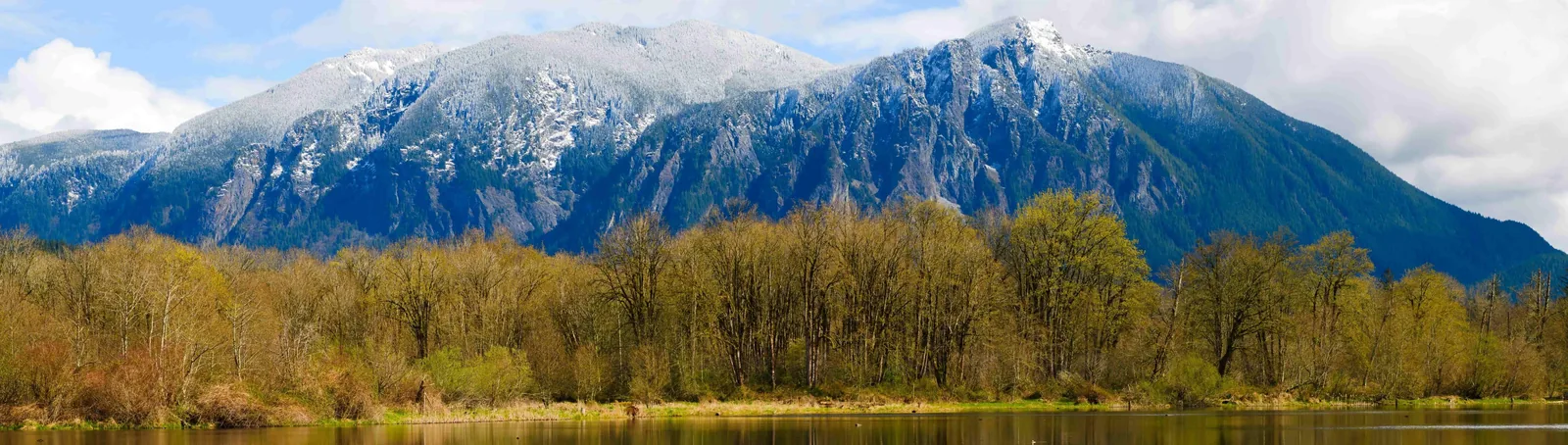
Retiring here looks different depending on what you're selling and what you're buying. If you're arriving with equity from a bigger city — or unlocking a longtime home's value after the kids leave — Snoqualmie's setting is genuinely hard to argue with: a 268-foot waterfall a short walk from downtown, trails threading the Cascade foothills in every direction, and a small-city feel that the I-90 corridor delivers without the congestion of the suburbs closer to Seattle. The city sits about 30 miles east of downtown Seattle, with North Bend immediately to its east and Issaquah roughly 15 miles west — close enough to access major medical centers, far enough that the pace of daily life is its own thing.
The city's economy runs on aerospace, tech, gaming, and hospitality — Boeing and Microsoft employees have driven much of the residential growth on Snoqualmie Ridge, and that workforce has shaped what retail, dining, and services exist here. That matters in retirement because it means the town skews younger and family-oriented. There are active seniors here and the infrastructure to support them is real, but Snoqualmie is not, by design, a retirement community. The median household income of $214,107 tells you something about the neighbors you'd have — and about what the local cost baseline looks like on a fixed income.
Washington's complete absence of a state income tax is a meaningful advantage for anyone living on Social Security, pension distributions, or retirement-account withdrawals. The Zillow Home Value Index put the typical Snoqualmie home at $1,129,059 in April 2026 — a figure that makes this a serious financial decision, but also one that reflects the equity position many long-term homeowners here already hold. Day-to-day, you'll need a car for most errands; the town is scenic and walkable in spirit, but practical walkability for groceries and medical appointments requires some planning. For full cost-of-living detail, see the Snoqualmie cost-of-living page.
Whether you're weighing a move here from somewhere pricier, thinking about right-sizing after decades in a larger home, or just mapping out what Pacific Northwest retirement actually looks like on the ground, the sections below cover healthcare access, the retiree tax picture, what daily life costs on a fixed income, walkability and community, downsizing options, and how Snoqualmie stacks up against the towns nearby.

Why Retirees Are Choosing Snoqualmie
The retirees who thrive here share a few things: they want natural beauty as a daily backdrop, they're comfortable driving to access services, and they're not looking for a golf-cart retirement village. Snoqualmie delivers a genuine small-town feel inside the Seattle metro — the kind of place where you recognize faces at the farmers market and can walk to Snoqualmie Falls on a Tuesday morning with almost no one around.
Safety is a real and specific draw. The violent crime rate here is among the lowest you'll find in the broader metro, and the community atmosphere on Snoqualmie Ridge in particular feels more like a planned neighborhood than a suburb — quiet streets, maintained common spaces, and a pace that slows down noticeably once you leave SE North Bend Way. For retirees coming from denser, louder urban environments, that shift registers quickly and positively.
Who should look elsewhere? If you're on a tight fixed income and need to stretch every dollar, the Zillow Home Value Index median of $1,129,059 (April 2026) signals that even right-sizing here carries a premium — and that the supporting retail and services reflect a high-income base. If you need walkable access to multiple specialists, a senior center with robust daily programming, or a strong transit network that replaces the car entirely, Snoqualmie will frustrate you. The honest read: this is a strong retirement destination for equity-rich buyers who want beauty, safety, and proximity to Seattle without living in it — not for retirees who need the city's infrastructure density to support them.
Healthcare & Medical Access in Snoqualmie
What's Right Here
Snoqualmie Valley Hospital sits at 9575 Ethan Wade Way SE — inside city limits, not a drive away. It operates as a critical-access public hospital district with 24/7 emergency care, a Level 5 Trauma Center designation, Level 2 Cardiac services, Level 3 Stroke capabilities, and seven-days-a-week urgent care. For the routine and the urgent, you're covered without leaving the valley.
Specialty services on-site include Cardiology, Gastroenterology, and rehabilitative therapy — the trifecta that matters most as joint replacements, cardiac monitoring, and post-surgical recovery become part of the calendar. Snoqualmie Valley Health also operates the Snoqualmie Ridge Medical Clinic, a primary-care location on the Ridge itself, one block from the Snoqualmie Valley YMCA. Having two distinct in-city Snoqualmie Valley Health locations means primary care is genuinely local for most residents.
The Honest Distance Reality
Where Snoqualmie asks more of you is advanced specialty care — oncology, complex cardiac interventions, neurosurgery, major orthopedics. For those, you're looking at Issaquah, Bellevue, or Seattle, which can run 35 to 60 minutes depending on I-90 conditions. That's not unusual for a community this size, but retirees managing chronic or complex conditions should factor in the drive as a recurring reality, not a rare inconvenience.
The valley's transportation infrastructure helps. Snoqualmie Valley Transportation (SVT), run as a project of Mt. Si Senior Center, provides door-to-door rides for $1 per trip, Monday through Friday from 6 a.m. to 9 p.m., covering Snoqualmie, North Bend, Fall City, Carnation, Duvall, and as far as Monroe. A separate volunteer-driver program offers free or reduced-cost rides specifically to medical appointments, including outside the valley. If driving to a specialist is eventually off the table, this infrastructure matters — and it already exists.
Navigating Options
The city's official transportation page directs residents to FindARide.org, which filters by wheelchair accessibility and medical-trip type. A live Transportation Resources Line (425-943-6760) runs Monday through Friday, 9 a.m. to 4 p.m., for one-on-one help. The Snoqualmie Valley Mobility Coalition, formed in 2017, continues to expand coordination between transit providers and human-services organizations across the valley — a meaningful long-term investment in aging-in-place infrastructure.
The Retiree Budget in Snoqualmie
Washington's No-Income-Tax Advantage
Washington State collects no personal income tax — full stop. Your Social Security benefits, pension distributions, IRA withdrawals, and 401(k) income are all exempt from state taxation. For retirees moving from Oregon, California, or any state with income tax, this is a structural financial shift, not a marginal one.
Washington does levy a 7% capital gains tax on long-term gains above a $278,000 annual standard deduction (2025 threshold, inflation-adjusted). But the law specifically exempts retirement account transactions — 401(k)s, IRAs, Roth IRAs, defined-benefit plans — and real estate sales. A retiree living on Social Security plus retirement-account withdrawals, or one selling a longtime home to downsize, typically won't owe it. The nuance matters: check with a tax advisor if you're realizing investment gains outside retirement accounts, but for the typical retirement income picture, Washington's tax posture is genuinely favorable.
Property Taxes and Senior Relief
Snoqualmie's effective property tax rate is approximately 0.84% — moderate for King County, where rates in closer-in suburbs can run noticeably higher. Washington State offers income-based senior property-tax exemption and deferral programs that can reduce that burden meaningfully for qualifying homeowners; current income thresholds and tiers are published at the Washington State Department of Revenue's website (dor.wa.gov) and updated annually.
The engine below can help you model specific monthly carrying costs based on purchase price and down payment. What matters for budgeting context: the property tax rate here is not a hidden shock, and the state-level relief programs are real and worth applying for if your retirement income falls within the qualifying ranges.
Fixed-Income Daily Life
Grocery options in Snoqualmie skew toward the practical — a standard supermarket on SE North Bend Way handles the weekly shop without a major drive. Dining on Railroad Avenue SE and at the casino complex offers range, but options at the lower price tier are thinner than you'd find in a larger town. Costco and a broader retail corridor are roughly 15 minutes west in Issaquah. If your retirement budget is on the leaner side, the daily cost baseline here reflects the high-income community it serves — and that gap can add up over a month. For full cost-of-living detail, the Snoqualmie cost-of-living page breaks down groceries, utilities, and comparable rent ranges.
Looking to buy in Snoqualmie? Estimate your payment.
Enter your numbers to see an estimated monthly mortgage payment.
Estimate only. Excludes HOA fees and mortgage insurance. The interest rate above is a starting point, not a quoted rate — replace it with your own to see real numbers. Insurance is a flat placeholder, not a Snoqualmie quote.
Walkability, Community & Staying Active in Snoqualmie
The Walkability Reality
Snoqualmie is not a walk-to-the-pharmacy town. The Ridge development, where much of the newer housing sits, is car-designed — wide residential streets, setbacks, and dispersed commercial. Downtown Snoqualmie along Railroad Avenue SE is genuinely walkable within its footprint: a few blocks of independent shops, Chickadee Bakeshop, Sigillo Cellars, and the Northwest Railway Museum are all reachable on foot from the historic district. But that footprint is small, and a car is necessary for groceries, medical appointments, and anything outside that core.
The terrain is another honest consideration. The Snoqualmie Ridge neighborhoods sit on elevated ground, and the streets connecting the Ridge to downtown involve real elevation change. Flat, accessible walking is available — the paved paths around Snoqualmie Falls offer one of the best accessible viewpoints in the state — but the city overall is not flat in the way that makes car-free daily life practical for someone with limited mobility.
Where Community Happens
Mt. Si Senior Center, just a short drive from Snoqualmie in North Bend, is the valley's primary senior hub — it runs the SVT transit program, hosts fitness classes, arts programming, and social events, and serves as the connective tissue for older adults across the valley. Retirees in Snoqualmie who make the short trip to North Bend find a meaningfully more robust set of senior-specific programming than the city itself provides on its own.
Within Snoqualmie, The Club at Snoqualmie Ridge offers an 18-hole golf course and social membership options — a genuine gathering point for retirees who play. The Snoqualmie Valley YMCA serves as a practical fitness anchor, and the proximity of the Snoqualmie Ridge Medical Clinic to the Y on the same block makes a workout-plus-appointment morning realistic without a second drive. Saturday mornings in the warmer months, the downtown farmers market draws a cross-generational crowd; it's the kind of recurring social ritual that makes a small town feel like a community rather than just a zip code.
Snoqualmie Casino's five dining venues and 11,000-square-foot entertainment space — currently expanding with a new hotel and convention center — serve as an additional local entertainment anchor, especially in the evening. It's close enough for a regular dinner out without committing to the drive to Issaquah or beyond.
Right-Sizing: Downsizing in Snoqualmie
The Equity Decision
If you've owned in Snoqualmie for a decade or more, you're likely sitting on substantial equity given where the Zillow Home Value Index placed the typical home in April 2026. Downsizing within the city unlocks that equity — but it requires understanding what the right-sized options actually look like here, because Snoqualmie is overwhelmingly a single-family-home market.
What's Available
Snoqualmie Ridge is where most of the townhome and attached-product inventory concentrates. The Ridge was developed with a mix of larger single-family homes and smaller attached units — some of which are genuinely single-level or close to it — making it the most realistic hunting ground for retirees who want less square footage without leaving Snoqualmie. The Reserve at Snoqualmie Ridge, one of the named neighborhoods in the area, represents a higher-finish tier of the Ridge product and is worth examining for buyers prioritizing lower-maintenance exteriors.
Downtown Snoqualmie Historic District offers a small number of older homes closer to Railroad Avenue, some of which are single-story and on flatter lots than the Ridge — a meaningful accessibility consideration. Inventory here turns slowly, and when it does, it attracts buyers who prioritize the walkable-to-downtown character over the newer finishes of the Ridge.
What Snoqualmie Doesn't Have
A purpose-built 55+ or active-adult community inside Snoqualmie city limits does not currently exist in the way you'd find in larger retirement markets. There is no on-site amenity complex with a clubhouse, pickleball courts, and a pool designed specifically for that demographic — that product type simply hasn't been built here at scale. Retirees whose priority is an age-restricted community with deep social programming typically find that Issaquah, Sammamish, or points further south offer more options.
The practical workaround many retirees use: buy a newer single-level or step-in-at-grade townhome on the Ridge, join The Club at Snoqualmie Ridge for social and golf programming, and use Mt. Si Senior Center in North Bend for the structured senior-community experience. It's not one roof over everything, but assembled together it replicates much of what a formal active-adult community would provide — with the added advantage of a genuinely beautiful setting.
Snoqualmie vs Nearby Retirement Destinations
| City | Cost vs Snoqualmie | Primary Hospital | Walkability | Senior Living Depth | Overall Retirement Fit |
|---|---|---|---|---|---|
| Snoqualmie | Anchor | Snoqualmie Valley Hospital — in-city, Level 2 Cardiac, Level 3 Stroke | Limited; car needed for most errands; accessible Falls paths | Thin in-city; Mt. Si Senior Center nearby in North Bend | Nature Quiet Strong for active, equity-rich retirees |
| North Bend | Noticeably cheaper | Shares Snoqualmie Valley Hospital system; same access | Small-town walkable core; flat downtown streets | Home to Mt. Si Senior Center — strongest senior hub in the valley | Value Nature Best for retirees who want senior programming and lower entry cost |
| Issaquah | About the same to slightly pricier | Major regional medical center with broader specialty depth | Good — Gilman Village area walkable; flatter than Snoqualmie Ridge | Stronger 55+ product; more senior-specific communities | Walkable Services Better for retirees who want specialty care closer and more retail options |
| Carnation | Noticeably cheaper | No in-town hospital; drives to Snoqualmie Valley or Duvall | Very limited; rural pace | Minimal; small community | Nature Privacy Best for retirees who truly want rural life and don't need nearby services |
| Duvall | Cheaper | No in-town hospital; nearest is a regional medical center in Monroe or Kirkland | Small walkable downtown core; manageable on foot within a few blocks | Limited; growing but still thin | Value Quiet Good for retirees who want small-town character at a lower price point |
| Fall City | Cheaper | Unincorporated; relies on Snoqualmie Valley Hospital system | Rural; minimal walkability | Very limited | Nature Privacy Fits retirees prioritizing acreage, quiet, and a low-key Snoqualmie River setting |
On pure cost, North Bend is the most compelling nearby alternative — it's noticeably more affordable, shares the same hospital system, and is home to the valley's strongest senior center. Retirees who want robust specialist access and more walkable daily errands will find Issaquah a better fit, even if prices are comparable.
Carnation, Duvall, and Fall City all trade lower price points for thinner services and real distances to hospital care — worth considering only if rural pace and land are the primary draw. For retirees whose priority is natural beauty, a safe and quiet community, and Washington's favorable tax structure without giving up in-city hospital access, Snoqualmie is the strongest answer in this immediate cluster — but North Bend comes close at a meaningfully lower cost of entry.
Local Expert Takeaway: Snoqualmie retirement works best when you arrive with equity, a car, and a clear plan for how you'll build social life. The Snoqualmie Valley Hospital on Ethan Wade Way handles the day-to-day medical calendar well, and Washington's zero income tax on Social Security and retirement-account income is a genuine structural advantage. But the social infrastructure — senior programming, community, the kind of daily rhythm that makes retirement feel full — is something you assemble here rather than find pre-built. Mt. Si Senior Center in North Bend, The Club at Snoqualmie Ridge, the YMCA, and Railroad Avenue's small-town character on a Saturday morning are all real anchors. Stop into Chickadee Bakeshop on Railroad Avenue SE and then walk toward the Falls on a weekday and you'll understand exactly why equity-rich retirees keep choosing this valley.
Quick Takeaways & FAQs
✅ Washington State's no-income-tax structure means Social Security, pension income, and retirement-account withdrawals are all state-tax-free — a rare and meaningful advantage for retirees on fixed income.
⚠️ Snoqualmie has no purpose-built 55+ or active-adult community, and practical walkability for errands requires a car — retirees who need either of those things should weight Issaquah or North Bend more heavily.
📍 Snoqualmie Valley Hospital at 9575 Ethan Wade Way SE is an in-city facility with 24/7 ER, Level 2 Cardiac, and Level 3 Stroke services — rare depth for a town this size, and a major factor in the retirement calculus here.
Is Social Security taxed in Washington State?
Is there a hospital in Snoqualmie itself?
Are there 55+ or active-adult communities in Snoqualmie?
Can I get around Snoqualmie without a car as a retiree?
What is the property tax rate in Snoqualmie, and is there senior relief?
Moving to Washington?
Tell us what you need help with and we'll connect you with local resources.
