
About Elizabeth
Who Buys in Wilsonville — and Why
The buyer I see most often in Wilsonville is someone who has already been priced out of West Linn or Lake Oswego, or who works in the tech corridor along I-5 and wants to cut the commute without giving up the suburban quality of life. Siemens EDA, Rockwell Collins, and Sysco all anchor employment here, and I work with engineers, logistics professionals, and administrators who either work locally or commute about 25 minutes to Portland and want the return trip to be predictable.
The second category is households relocating from out of state — usually from the Bay Area, Seattle, or Phoenix — who have done their research and arrive with Villebois already on their list. That master-planned community reads well in photos: the row homes, the plazas, the walkable village center. What I help them understand before they write an offer is how Villebois actually functions day to day, and what the rest of the city looks like in comparison.
A smaller but real cohort is buyers drawn to Charbonneau specifically — the golf course, the Willamette River views, the sense of a self-contained community. That buyer is usually retired or semi-retired, is not commuting daily, and genuinely values having the 27-hole course and the walking paths right outside the door. But they need to go in with eyes open about the trade-offs that come with the geography.
What the Citywide Price Hides
The typical home price of $630,814 (Zillow Home Value Index, July 2026) is a real figure, but it flattens enormous variation. A Villebois row home and a gated Charbonneau waterfront property are not the same conversation. Knowing which part of the city a buyer is actually shopping — and which school district that puts them in — is the first decision that has to be made, not the last.
Neighborhoods: What I Tell Every Buyer First
Villebois
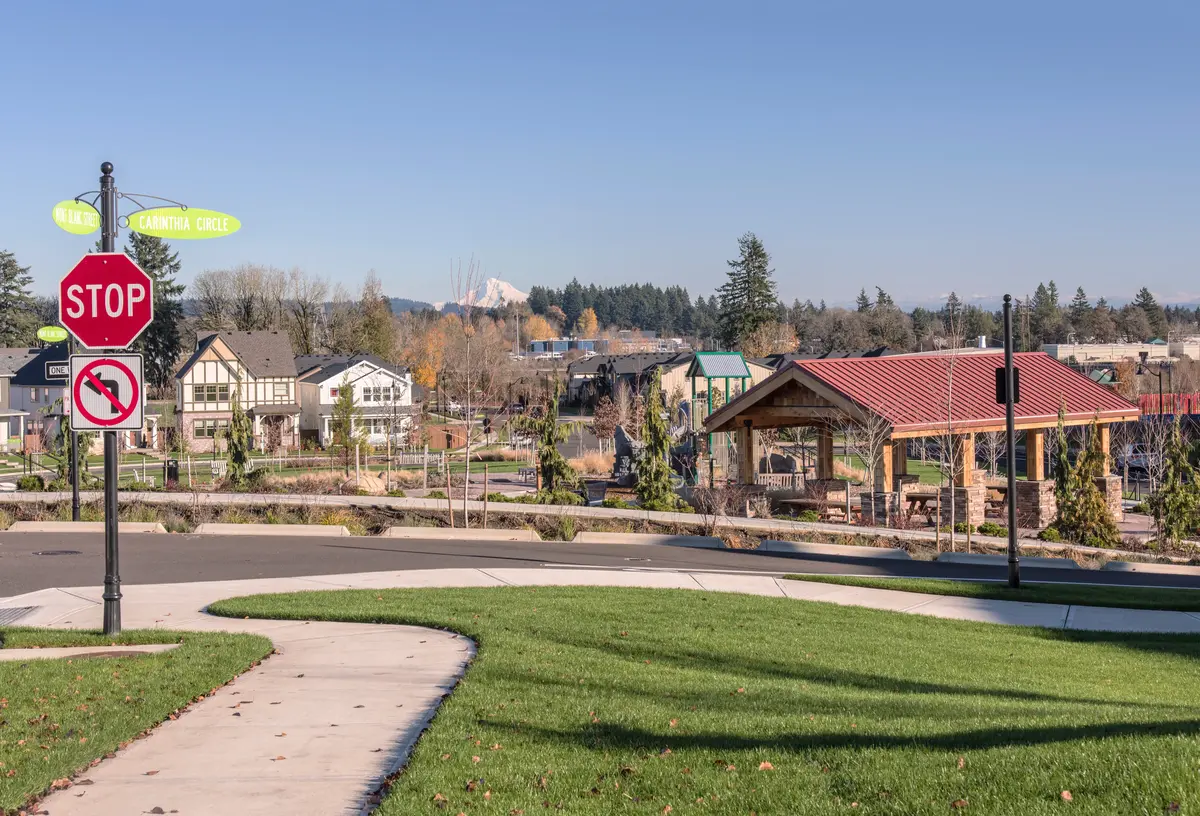
Villebois is the most talked-about neighborhood in Wilsonville, and for good reason — it is genuinely different from anything else in the southern Portland Metro. The design is intentionally walkable, organized around a village center with plazas and parks woven between single-family homes, condominiums, and row homes. For buyers coming from denser, urban markets, it can feel like the right compromise: suburban scale, but with on-foot access built in.
The catch is that Villebois is still a suburb. The commercial district at the village center is small, and a car is still required for most grocery runs and errands. Buyers who expect European-village density in terms of shops and restaurants usually recalibrate after the first few weeks. That said, for families with school-age children who want sidewalks, parks within walking distance, and a strong sense of neighborhood identity, Villebois delivers.
Charbonneau
Charbonneau is where I have the most important conversation I have with any buyer in Wilsonville. This community south of the Willamette River dates to 1972 — one of Oregon's first planned communities — and it wraps about 1,500 homes around a 27-hole golf course with river access, a marina, walking paths, tennis, and pickleball. The housing range is extraordinary: condominiums, golf-course homes, waterfront properties, gated executive estates. For the right buyer, there is nothing else like it at this price point in the Metro.
But Charbonneau falls within the Canby School District, not the West Linn-Wilsonville district. And there is no gas station, grocery store, or pharmacy on that side of the river — every errand means getting back on I-5. If neither of those facts changes your thinking, Charbonneau is a serious option. If either one matters, I'll tell you clearly before you fall in love with a listing.
The Rest of the City
Canyon Creek, Frog Pond, Wilsonville Meadows, and Hazelwood are the quieter residential chapters of this city — established subdivisions with more conventional lot sizes, more mature trees, and generally more entry-level inventory relative to Villebois. Old Town and Town Center sit closer to I-5 and the city's civic core, with older housing stock and faster access to the main commercial corridor. These neighborhoods suit buyers who prioritize value and commute convenience over neighborhood character. They are where first-time buyers and downsizers often land after Villebois prices them out or Charbonneau's isolation doesn't fit.
Best for: Villebois — Families Walkable; Charbonneau — Luxury Views; Canyon Creek / Frog Pond — First-Time Value

Schools: What the Data Says and What I Tell My Clients
The West Linn-Wilsonville School District serves the vast majority of Wilsonville — every neighborhood except Charbonneau, which falls under the Canby School District. With 8,617 students enrolled in 2025-26, it is a mid-sized district by Oregon standards, drawing from both Wilsonville and West Linn. According to figures the Oregon Department of Education publishes, on 2024-25 state assessments, 49.3% of students reached math proficiency and 59.8% reached reading proficiency across the district. Those numbers are worth putting in context: statewide proficiency rates in Oregon have been recovering from pandemic-era lows, and the district's figures sit above many comparable districts in the Metro.
The active OSAA athletics programs are well-supported here, and the community follows the Wildcats closely — Friday night football at Wilsonville High School draws the kind of crowd that tells you something about how connected this city feels around its schools.
My standing advice: do not take my word for it, and do not take anyone else's word for it either. If schools are a material factor in your decision — and for most families moving to Wilsonville, they are — confirm the assigned school for the specific address you are considering directly with the district, and review the data the Oregon Department of Education publishes themselves. The Charbonneau boundary situation is the reason I say this so plainly: a Wilsonville address is not the same as a West Linn-Wilsonville district address, and I have seen that assumption cause real heartbreak in a transaction.
Oregon Tech, Clackamas Community College, and Pioneer Pacific College all have campuses in Wilsonville, which matters to buyers thinking about continuing education or workforce training for themselves or for kids who stay local after high school.
Looking to buy in Wilsonville? Estimate your payment.
Enter your numbers to see an estimated monthly mortgage payment.
Estimate only. Excludes HOA fees and mortgage insurance. The interest rate above is a starting point, not a quoted rate — replace it with your own to see real numbers. Insurance is a flat placeholder, not a Wilsonville quote.
Commute and Getting Around
The commute story in Wilsonville is genuinely good, which is one of the reasons the city keeps attracting buyers from closer-in Portland neighborhoods. The typical Wilsonville resident is about 25 minutes to Portland, and I-5 is the primary corridor. For workers commuting to Beaverton or Hillsboro, the WES Commuter Rail is a real option — the southern terminus sits in Wilsonville, connecting north to Beaverton where it meets MAX light rail into downtown Portland and out to Portland International Airport (PDX), about 26 miles away. That rail connection is underused by newcomers and worth understanding if one member of a household works in the Washington County tech corridor.
Within the city itself, a local transit service runs free for trips entirely within Wilsonville. It is a genuinely useful city bus system for a community this size, connecting neighborhoods to employers and the commercial core without requiring a car for every errand. Routes extending beyond the city carry a fare.
The honest caveat: Wilsonville is not a walkable city in the way that inner Southeast Portland or downtown Lake Oswego are. Most grocery runs, school pickups, and weekend errands happen by car. Villebois is the exception in degree, not in kind — it is more walkable than anywhere else in the city, but the full range of daily needs still requires driving. Buyers moving from genuinely walkable urban neighborhoods sometimes find the adjustment larger than they expected.
For commuters going south toward Salem, the I-5 positioning is straightforwardly convenient. The city's location roughly midpoint between the two metros is one of its genuine structural advantages, and for households with one person working in each direction, it is a meaningful selling point.
Wilsonville vs Nearby Cities
| City | Typical Home Price | Typical Rent | Cost vs Wilsonville |
|---|---|---|---|
| Wilsonville (this city) | $630,814 | $1,750/mo | — |
| Tualatin | $635,314 | $1,890/mo | About the same |
| Sherwood | $629,598 | $2,555/mo | About the same |
| Canby | $598,201 | $1,744/mo | 5% lower |
Source — home prices: Zillow ZHVI, July 2026; rent: Zillow ZORI, July 2026. Nearby-city figures are the same series, refreshed together.
I work with a lot of buyers who are simultaneously looking at Wilsonville, Tualatin, Sherwood, Canby, West Linn, and sometimes Tigard, and the comparison almost always comes down to the same few variables: price, commute direction, school district, and lifestyle character.
Tualatin is Wilsonville's most direct competition. The home prices are roughly comparable, the I-5 access is similar, and both cities have made real investments in parks and quality of life. The difference I hear from buyers who have spent time in both: Wilsonville has more internal cohesion as a city, with Villebois and the summer event calendar giving it a stronger sense of place. Tualatin is a bit more centrally located for Washington County commuters.
Sherwood sits to the northwest and runs at a similar price level. Buyers choosing between Sherwood and Wilsonville are usually choosing between the Sherwood School District and the West Linn-Wilsonville district, and between Sherwood's more compact, historic downtown and Wilsonville's newer commercial character. Neither city feels like a compromise, but they attract slightly different buyers.
Canby, to the southeast, prices noticeably lower. For buyers who need to stretch their budget and can work with a longer I-5 commute, Canby is worth a serious look. The lifestyle is more agricultural and small-town than Wilsonville, which is a feature for some buyers and a friction point for others.
West Linn is in a different category. The Willamette River bluffs, the older-money character of the established neighborhoods, and the school reputation all push prices well above Wilsonville's typical range. Buyers who come to me asking about West Linn and find they need to adjust their budget usually land in Villebois or Canyon Creek as the closest equivalent in feel, at a more workable price point.
Tigard tends to come up for buyers who want more retail density and MAX access closer to home. It trades some of Wilsonville's park-and-nature character for urban convenience, and it prices in a range that overlaps Wilsonville's. I tell buyers to drive both cities on a Saturday afternoon and see which one they want to come home to.
Weekends and What Daily Life Actually Looks Like
One thing I tell buyers before they move here: Wilsonville has a stronger civic and outdoor identity than its position on I-5 suggests. Graham Oaks Nature Park — 250 acres of restored oak savanna, conifer forest, and wetland trails owned by Metro — is the kind of resource that takes buyers by surprise. Three miles of trails through genuinely restored habitat, and on a weekday morning you can walk it with almost no one else around. The planned Tonquin Trail connection to Tualatin and Sherwood will make this even more useful once complete.
Memorial Park along the Willamette River and Boones Ferry Park fill out the outdoor picture. The summer event calendar — outdoor movies, a concert series, a beer festival, an arts festival, a cycling race — is bigger than what most cities this size can sustain, and it does real work in building the community texture that keeps residents here after the first couple of years.
For food and drink, the local scene is modest but genuine. Oswego Grill Wilsonville and Ram Restaurant & Brewery anchor the more polished end of the dining options. Wankers Corner Saloon & Cafe has a devoted following and a character entirely its own. Bullwinkle's and Boston's Pub & Grill are well-regarded locals. For coffee and morning pastries, Lux Sucre Bakery + Cafe and Elka Bee's Coffee Haus are the spots residents return to, with Mr. Maple Donuts and Royal Scot Sips & Eats rounding out the casual morning options. McMenamins Old Church & Pub — a converted historic church in the classic McMenamins style — is the kind of place that anchors a neighborhood's identity and draws people from across the Metro.
The Willamette Valley opens up immediately to the south: nurseries, vineyards, and farmland are accessible within a short drive, and that agricultural gateway is a genuine quality-of-life asset for buyers who moved here partly to get out of the city. Wilsonville gets 141 sunny days a year — not the number the Pacific Northwest markets itself on, but enough to fill the summer calendar, and the outdoor infrastructure here makes those days count.

Final Advice From Elizabeth
Quick Takeaways & FAQs
✅ Wilsonville's WES Commuter Rail connection to Beaverton and MAX is one of the most underused assets in the city — worth building your housing search around if one of you works in Washington County.
⚠️ Charbonneau carries a mailing address in Wilsonville but falls under the Canby School District — a boundary detail that changes the calculation for families who moved here specifically for the West Linn-Wilsonville district.
📍 Graham Oaks Nature Park puts 250 acres of restored oak savanna and three miles of Metro-maintained trails inside the city limits — a level of preserved open space most Portland-area cities this size simply don't have.
What is the commute from Wilsonville to Portland really like?
Which neighborhoods in Wilsonville are best for families with kids?
How do Wilsonville schools actually perform?
What does the typical home price in Wilsonville actually buy?
What surprises people after they move to Wilsonville?
How fast do homes move in Wilsonville, and is there much room to negotiate?
How does Wilsonville compare with West Linn or Tualatin for a family deciding where to buy?
Is Wilsonville a good choice for someone who wants a low-maintenance lifestyle or is thinking about retiring here?
Moving to Oregon?
Tell us what you need help with and we'll connect you with local resources.
