What Is Living in Salem, Oregon Like?
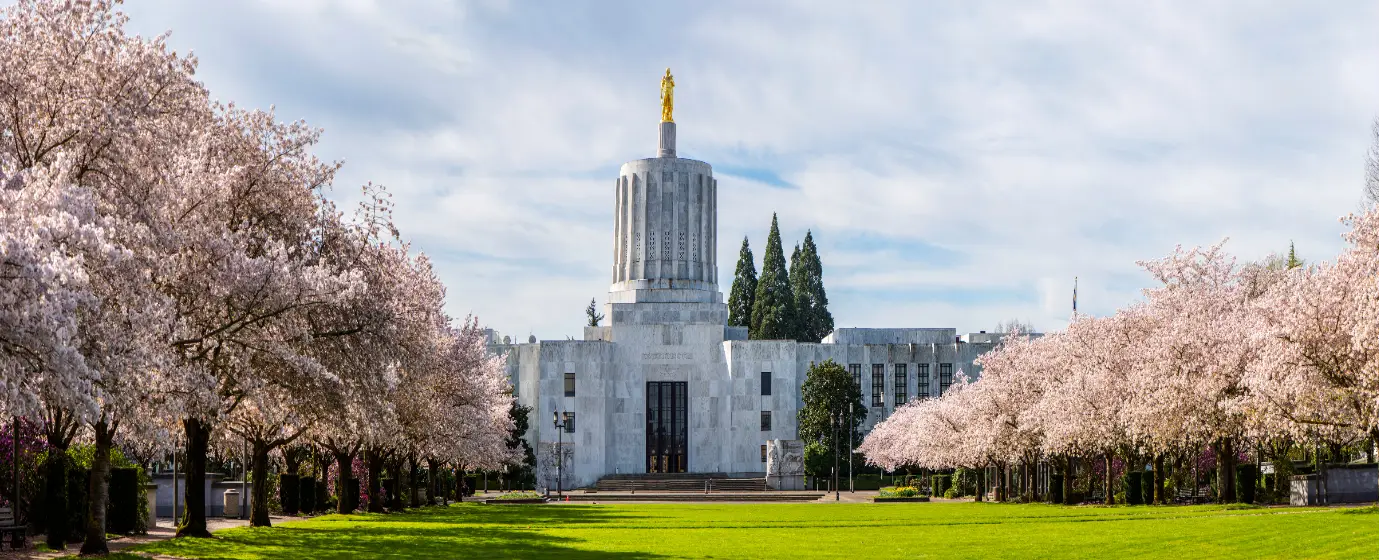
You've probably seen Salem on a list of affordable Oregon cities and thought: how does Oregon's own state capital still fly this far under the radar? The honest answer is that Portland pulls the attention and most of the migration press, and Salem — sitting about 50 minutes south on I-5 — ends up as an afterthought for people who would genuinely love it here. It is the 2nd-largest incorporated city in Oregon, with a population of 178,865, and it straddles Marion and Polk counties with the Willamette River forming its western edge. The Capitol dome is visible from downtown intersections, cherry trees bloom across the Capitol grounds each spring, and the whole city operates at a pace that Portland transplants almost universally describe as the biggest surprise of their first six months.
Salem's economic backbone is the kind that weathers recessions better than most. State of Oregon government, Salem-Keizer Public Schools, a major regional health system, and Marion County collectively anchor the job market in a way that insulates the city from private-sector swings. In 2025, while much of Oregon saw sector-level job losses, Salem added transportation, healthcare, and government and education jobs — bucking the statewide trend in a meaningful way. Salem-Keizer School District 24J serves the region's families with 36,837 students enrolled in 2025-26 and holds a B- rating, according to Niche. Willamette University — said to be the oldest university in the Western United States — sits directly adjacent to the Capitol, giving downtown an academic energy that most mid-sized cities don't carry.
For buyers priced out of Portland or Bend, Salem's typical home price of $440,726 (Zillow Home Value Index, July 2026) reads as a genuine opportunity rather than a consolation prize. The typical two-bedroom rent runs $1,460–$1,770, and the effective property tax rate sits at approximately 0.79% — both noticeably below what those two markets ask. Daily life here means easy access to the Willamette Valley wine country, Silver Falls State Park about 20 miles east, two major in-city parks in Minto-Brown Island and Bush's Pasture, and a farmers market scene anchored by Salem Community Markets and Schlechter Farms. The tradeoff is real: 154 sunny days a year means nine months of grey, and anyone moving from a sunnier climate should factor that honestly into the decision.
Whether you're weighing a move from Portland, relocating for a state government job, or simply researching the area, the sections below break down Salem's neighborhoods, housing market, commute patterns, local employers, and what daily life here is really like.
Salem at a Glance
Looking to buy in Salem? Estimate your payment.
Enter your numbers to see an estimated monthly mortgage payment.
Estimate only. Excludes HOA fees and mortgage insurance. The interest rate above is a starting point, not a quoted rate — replace it with your own to see real numbers. Insurance is a flat placeholder, not a Salem quote.
Why Are People Moving to Salem?
The case for Salem starts with affordability and ends with something harder to quantify: the feeling that you can actually build a life here without being financially stretched every month. People moving from Portland arrive and immediately notice that the same dollar goes further — on housing, on rent, on a Saturday at the farmers market.
A Government Town with Private-Sector Depth
Salem's role as the state capital means the State of Oregon is the single largest employment anchor, and that stability shapes the whole local economy. Marion County, the City of Salem, and Salem-Keizer Public Schools round out the public-sector core. What surprises many newcomers is that the private sector has genuine depth too — healthcare, transportation, manufacturing, and finance all added jobs in 2025 while those same sectors contracted elsewhere in Oregon.
That jobs picture matters for buyers: a diversified employer base means the city doesn't boom and crash with any single industry. Families with school-age children often come specifically for the combination of affordable housing and a school district large enough to offer real program variety across its 36,837 enrolled students.
The Portland Pressure Valve
Real estate agents in Salem will tell you that a meaningful share of their buyers are arriving from the Portland metro — people who want access to Oregon's cultural and outdoor assets but can no longer justify what Portland-area prices ask. Salem gives them a commute-viable alternative: the drive is about 50 minutes to Portland on I-5, which puts most of the metro's employers within reach for hybrid schedules, even if a daily commute would wear thin quickly.
Retirees and people approaching retirement are another steady cohort, drawn by the lower cost of living, the walkable downtown, and proximity to outdoor recreation without the mountain-town price premium that Bend commands. Population growth here is projected to run slightly above the statewide average — not a boom, but a steady, sustained influx that keeps the housing market active without making it frantic.
What Salem Is Honest About
Salem carries a property crime rate of 27.8 per 1,000 residents, which runs above both the state average and the national figure. A violent crime rate of 5.4 per 1,000 residents is above the state rate, though it tracks closer to the national figure. These numbers are not evenly distributed across the city — the Salem safety page breaks down what those figures mean neighborhood by neighborhood and what buyers typically prioritize when choosing where to land.
What Daily Life Feels Like in Salem
Salem is not a city that performs busyness. The pace is genuinely slower than Portland, and most people who have been here a few years say that's the feature, not the bug. Traffic jams exist, but they resolve. The Capitol grounds fill up at lunch. The Willamette River Greenway draws walkers and cyclists on weekday mornings when you'd expect the trail to be empty.
The Calendar Year
Spring is Salem's best season without argument — cherry trees on the Capitol grounds bloom in March, the farmers markets open, and the Willamette Valley wine country fills with visitors who often stop in Salem on the way. Summer brings the Oregon State Fair, held here every August since 1862, which for longtime residents is less a tourist event and more an annual neighborhood reunion that happens to have carnival rides.
Then there's the rain. Salem gets 154 sunny days a year — a figure that catches people moving from California or the Midwest completely off guard. The grey sets in around November and doesn't fully lift until May. Newcomers who haven't lived through a Willamette Valley winter often underestimate how much that affects daily mood and how long it lasts. People who thrive here make peace with it early: they buy good rain gear, they find an indoor hobby, and they stop treating grey skies as a weather event worth remarking on.
Where Families Actually Gather
Bush's Pasture Park anchors the South Salem social calendar in a way that a single park rarely does — weekend mornings bring out families with kids, dog walkers, and joggers in numbers that feel outsized for a 90-acre city park. Minto-Brown Island Park, a short drive from downtown, offers the kind of trail system where you can genuinely lose yourself in wetlands and woods without leaving city limits. The Riverfront Park hosts the annual World Beat Festival and functions as Salem's civic front porch along the Willamette.
The downtown core — bounded by the Capitol to the north and Willamette University's campus running through the middle — has the Hallie Ford Museum of Art, the Willamette Heritage Center, and the historic Elsinore Theatre for live performances. It's a walkable district once you're in it, though most of Salem's daily errands still require a car. The full picture on trails, parks, and outdoor access is on the Salem parks and recreation page.
Schools in Practice
Salem-Keizer School District 24J is large enough to have real program diversity — magnet options, dual-language programs, career-technical pathways — but large also means variable. On 2024-25 state assessments, 20.9% of students reached math proficiency and 32.2% reached reading proficiency, figures that tell a story of a district working through persistent achievement gaps. Parents with school-age children who are doing their homework on specific schools should dig into the Salem schools page for the detail that matters at the individual building level.
The Salem Housing Market Right Now
Salem's typical home price of $440,726 (Zillow Home Value Index, July 2026) sits noticeably below comparable Oregon markets — well under Portland metro prices, and a fraction of what Bend asks. For buyers coming from out of state, it often registers as one of the more accessible entry points into the Pacific Northwest.
What the Affordability Picture Actually Means
The median household income in Salem is $79,638, and the gap between that figure and what's actually needed to carry the typical home here is real — roughly $37,000 short, by current estimates. That's not unusual for Oregon's larger cities, but it means many first-time buyers are stretching, leaning on dual incomes, or targeting the lower end of the price spectrum. The first-time homebuyer page covers the practical steps and financing options in detail.
The rental market runs $1,460–$1,770 for a two-bedroom, with a city-wide typical rent of $1,584 per month (Zillow, July 2026). That's approachable compared to Portland, which makes Salem an attractive landing spot for people who want to rent while they learn the city before buying.
The Geographic Reality
Salem's housing stock varies more by geography than many buyers expect. West Salem — across the Willamette River via the bridges on OR-22 — runs above the city-wide median and offers newer construction with river and valley views. South Salem and the Faye Wright area are at the median, with established neighborhoods and access to the city's best parks. Grant and Southeast Mill Creek offer entry points below the city median, which is where most first-time buyers and investors tend to look first.
Some areas cost more than others, and the character differences between east and west, north and south are significant enough that buying without touring multiple neighborhoods is a common mistake. The Salem neighborhoods page covers the geographic divides, the school boundaries that cut through them, and what each pocket of the city actually feels like to live in.
Market Conditions
Well-priced homes in desirable neighborhoods don't sit for long, but buyers are not consistently in frenzied multiple-offer situations either. It's a market where preparation matters more than panic — and where understanding which neighborhoods are genuinely in demand separates good decisions from expensive ones.
Salem Neighborhoods
Salem has several distinct areas — each with its own character and appeal. Here’s a breakdown to help you narrow down where to focus your home search.
🏡 South Salem
South Salem is the go-to for families who want established neighborhoods with direct access to Bush's Pasture Park and a quieter residential feel — tree-lined streets, older homes with mature yards, and a strong sense of neighborhood identity that newcomers notice quickly.
🏠 West Salem
West Salem sits across the Willamette River and draws buyers with newer construction, valley views, and a slightly more suburban character — just know that the OR-22 bridge crossing is a real daily variable that looks different on a weekday morning than a weekend afternoon.
🌳 Faye Wright
Faye Wright is one of South Salem's most established pockets, with mid-century homes, proximity to good schools, and the kind of neighborhood cohesion that parents with school-age children tend to seek out specifically.
🏘 Morningside
Morningside occupies a comfortable middle ground in the city — established housing stock, accessible location, and a residential character that suits buyers looking for a settled neighborhood without the premium of the city's most sought-after corridors.
🏔 Downtown Salem
Downtown Salem is the city's walkable core — the Oregon State Capitol, Willamette University, Riverfront Park, and the Elsinore Theatre are all within a few blocks, making it the best option for buyers who genuinely want to live without driving for most of their daily life.
🌆 Grant
Grant sits below the city-wide median price point, making it one of the more accessible entry points into Salem's market — a straightforward choice for first-time buyers and investors who want to be in the city proper without stretching to the higher-demand south and west corridors.
Pros & Cons of Living in Salem
The Pros
- Stable, recession-resistant job base anchored by state government and healthcare
- Noticeably more affordable housing than Portland or the coast
- Easy access to Willamette Valley wine country, rivers, and Silver Falls State Park
- Walkable historic downtown with a growing food and arts scene
The Cons
- Property crime rates run above national and state averages
- Hot, dry, smoke-prone summers paired with long gray, rainy winters
- I-5 and bridge-crossing traffic can bottleneck commutes during peak hours
Getting Around & Commuting in Salem
I-5 bisects Salem north to south, and OR-22 (the North Santiam Highway) runs east-west through the city — these two routes define most of how Salem connects to the rest of Oregon. The commercial arterials that run through the city's core carry the bulk of local trips, and the layout means most errands in Salem require a car.
The Portland Commute: Honest Math
Salem to Portland is about 50 minutes in normal conditions — and considerably more during peak commute hours when I-5 between Salem and the south Portland metro backs up. A daily round-trip commute to Portland is something most residents try once and then reconsider. Hybrid schedules — two or three days in the office — are what make this corridor work for most people, and that's precisely the arrangement that drove a lot of Salem's recent in-migration from the metro.
For people who need to get to Portland regularly without driving, options exist. Amtrak serves Salem's station with northbound trains to Portland and southbound service toward Eugene. Cherriots Regional bus service runs to Wilsonville, where riders connect to TriMet for Portland. FlixBus makes the run to Portland, Corvallis, and Eugene from downtown Salem. None of these fully replicate driving convenience, but they're real alternatives for people who want to reduce their car dependence on the corridor.
Getting Around Salem Itself
Cherriots — the Salem Area Mass Transit District — runs a network of bus routes across Salem and Keizer, with youth riders 18 and under riding free. For daily errands, however, most Salem residents drive. The city's layout is spread out enough that a car is effectively required for most households.
The Willamette River Greenway and the path network connecting Minto-Brown Island Park to Riverfront Park give cyclists and pedestrians a genuine north-south corridor through the city. It's not a substitute for a car, but it's a legitimate commute route for people who live and work within the central core — and the kind of infrastructure that makes Salem noticeably more bikeable than most Oregon cities its size.
Driving Within the City
Salem's internal traffic is manageable by the standards of any city approaching 180,000 people, but the bottlenecks are predictable. The bridges over the Willamette connecting West Salem to the rest of the city compress traffic during morning and evening peaks, and the commercial corridors through the city slow considerably at rush hour. Buyers who choose West Salem specifically for its views and newer housing should road-test the bridge crossing at 8 a.m. before finalizing that decision — the daily reality doesn't match the weekend test drive.
Portland International Airport (PDX) is about 58 miles north, and Eugene (EUG) is about 62 miles south — both roughly comparable in drive time, which gives Salem residents a genuine choice of airport depending on the destination.
Schools in Salem
Families relocating to Salem have public, private, and higher-education options nearby. Here’s a quick overview.
🎓 School District
Salem-Keizer Public Schools (Salem-Keizer School District 24J) serves K–12 students across Salem and the surrounding area. Rated B- (source: Niche.com).
🏆 Graduation Rate
The 4-year high-school graduation rate here is approximately 79.7%.
📚 Higher Education
Oregon’s public universities — the University of Oregon, Oregon State University, and Portland State University — offer four-year degrees statewide, with a network of 17 community colleges providing two-year and workforce programs.
🌐 Online Learning
Oregon State University Ecampus and Portland State University Online offer fully accredited online degrees for remote learners across the state.
Safety in Salem
A quick look at how Salem compares on the numbers that matter most when weighing a neighborhood or a move.
🛡 Violent Crime
Approximately 5.4 per 1,000 residents.
🔒 Property Crime
Approximately 27.8 per 1,000 residents.
Compared to the most recent national figures from the Bureau of Justice Statistics (2024), Salem’s violent crime is above the national average (about 3.7 per 1,000), and property crime is above the national average (about 18.4 per 1,000).
Against Oregon as a whole, Salem’s violent crime is about one and a half times the state average, and property crime is somewhat above the state average (Bureau of Justice Statistics, Crime Known to Law Enforcement, 2024 (tables 2 and 3)).
Crime rates can vary a lot within a single city, so the citywide numbers above are only a starting point. Some neighborhoods in Salem run well below these averages, while others run higher — the kind of block-by-block detail that matters most when you’re actually choosing where to live. The full guide below breaks it down neighborhood by neighborhood.
Working in Salem
Salem’s largest employers span several industries — here are some of the anchors of the local job market.
🏛 State of Oregon
Government
🎓 Salem-Keizer Public Schools
Education
🏥 Salem Health
Healthcare
🏛 Marion County
Municipal government
🏛 City of Salem
Municipal government
Parks & Recreation in Salem
Some of the outdoor spaces that shape everyday life in Salem.
🌱 Bush's Pasture Park
🌱 Riverfront Park & Salem Riverfront Carousel
🌱 Minto-Brown Island Park
Salem residents don’t have to go far for green space — spots like Bush's Pasture Park and Riverfront Park & Salem Riverfront Carousel are part of everyday life here, whether that’s a morning walk, a weekend hike, or just somewhere to unwind outside. The full guide below covers more of what Salem has to offer for parks and outdoor recreation.
Retiring in Salem
Salem draws retirees for its balance of amenities, outdoor access, and cost. Here’s what to weigh.
🌤 Climate
Salem's Willamette Valley climate means mild, wet winters and warm, dry summers — but the grey season runs long, from roughly November through April, with 154 sunny days a year. Summers are genuinely pleasant, with low humidity and temperatures that rarely reach extreme heat for extended periods. Retirees who struggle with seasonal grey should weigh that honestly before the move.
🍴 Lifestyle
Downtown Salem puts the Oregon State Capitol grounds, Willamette University's campus, the Hallie Ford Museum of Art, and the Elsinore Theatre within walking distance of each other. The Willamette Valley wine country is effectively in Salem's backyard, and Silver Falls State Park is a short drive east for hikers. The farmers market season, the World Beat Festival at Riverfront Park, and the Oregon State Fair each August give the city a calendar that keeps most retirees genuinely busy.
🏚 55+ Communities
Salemtowne is the established 55+ community in Salem — a long-running community with an active social calendar that fits the pace many retirees are looking for. For the fuller picture on retiring in Salem, including healthcare access and neighborhood fit, the Salem retiring page covers the specifics.
✈ Getting Around
Most errands in Salem require a car, though the downtown core is walkable once you're in it. Cherriots bus service covers Salem and Keizer with a network of routes, and paratransit options serve those who need them. Portland International Airport (PDX) is about 58 miles north, and Eugene (EUG) is about 62 miles south — both roughly equal in drive time, which gives Salem retirees a real choice depending on their travel patterns.
🏛 Oregon Taxes for Retirees — What to Know
- Social Security is not taxed — Oregon does not tax Social Security or Railroad Retirement benefits. Any amount included in your federal adjusted gross income is subtracted back out on the Oregon return.
- But other retirement income IS taxed — This is the trade-off that surprises people moving from Washington or Texas. Pension distributions and 401(k)/IRA withdrawals are taxed as ordinary income at Oregon’s regular rates — there is no blanket retirement-income exclusion.
- Graduated income tax — Oregon has four brackets — 4.75%, 6.75%, 8.75% and 9.9%. The 4.75% rate covers the first $10,000 of taxable income for a single filer ($20,000 filing jointly); the 8.75% rate starts at $125,000 ($250,000 jointly); and the top 9.9% rate applies above $250,000 ($500,000 jointly).
- No sales tax — Oregon levies no general sales tax.
- Property taxes, with senior deferral — Oregon’s Senior and Disabled Property Tax Deferral lets qualifying homeowners have the state pay their county property taxes, with a lien recorded against the home. The 2026 household income limit is $70,000, and deferred balances accrue 6% simple interest — it defers the bill rather than forgiving it.
- Estate tax — the one to plan for — Oregon has its own estate tax with a $1 million filing threshold — far below the federal exemption, and NOT indexed for inflation, so it reaches more estates every year in real terms. Retirement accounts and a long-held home count toward the taxable estate, so estates that feel modest can cross the line without the owner expecting it.
- No inheritance tax — Oregon has no separate inheritance tax and no gift tax.
Tax laws change frequently and individual situations vary. This is general information, not tax advice — always consult a qualified Oregon tax professional or CPA for personalized retirement tax planning.
Weekends & Local Favorites in Salem
Salem's weekend identity is built around its parks, its proximity to the Willamette Valley wine country, and a food and coffee scene that punches well above its size. The city doesn't have Portland's density of options, but what's here is specific and good — and the lack of crowds at the places worth going to is itself part of the appeal.
Parks and Outdoor Life
Minto-Brown Island Park is where Salem shows off its best self — hundreds of acres of wetlands, forested trails, and river access that feel genuinely wild for a park inside city limits. Bush's Pasture Park, 90 acres of trails, picnic areas, and Oregon's oldest greenhouse conservatory in the heart of South Salem, is where the neighborhood gathers on a warm Saturday with the kind of regularity that makes it feel like a public living room. Riverfront Park along the Willamette River is the city's civic anchor — the World Beat Festival draws the whole city here each summer, and the Salem Riverfront Carousel is the kind of detail that parents of small children discover and immediately tell other parents about.
Silver Falls State Park is the signature day trip — about 20 miles east of the city, with the Trail of Ten Falls looping 7.2 miles past ten waterfalls, including the 177-foot South Falls that you can walk directly behind. Longtime residents stop thinking of it as special because it's so close; newcomers consistently report it as one of the best things about living here.
Food, Coffee, and the Farmers Market
The food scene rewards the curious. Word Of Mouth Neighborhood Bistro is the kind of breakfast spot that builds real loyalty — expect a line on weekend mornings and don't fight it. Ritter's Housemade Foods is a local staple for housemade sausages and provisions that reflects the agricultural richness of the Willamette Valley. Best Little Roadhouse handles the comfort food end of the dial with no pretension. The Cozy Taberna brings a warmth to the dining scene that longer-term residents mention first when asked for a recommendation. The Yard Food Park gathers multiple independent food vendors in one outdoor space, making it the kind of stop where a group with different appetites can all find something.
For coffee, French Press Coffee and Crepes combines two things Salem does well in one spot. Broadway Coffeehouse, IKE Box Café, The Governor's Cup Coffee Roasters, and Bentley's Coffee round out an independent coffee scene that's genuinely strong for a city this size — none of them chains, all of them with real regulars.
The farmers market side of life is anchored by Salem Community Markets through the growing season, with Schlechter Farms connecting residents to the valley's agricultural output directly. This is the Willamette Valley — the produce, berries, hazelnuts, and local wine access aren't an amenity, they're the backdrop.
Culture and Institutions
Willamette University's campus running through downtown gives the city an academic energy and a calendar of lectures, performances, and events that most mid-sized cities have to drive to a university town to find. The Hallie Ford Museum of Art is legitimate — not a regional curiosity, but a real collection worth spending an afternoon in. The Willamette Heritage Center tells the city's specific history in a way that newcomers find genuinely useful for understanding why Salem is laid out and governed the way it is. The Oregon State Capitol grounds, with their cherry trees and public art, function as a neighborhood park for downtown residents and state workers alike.
Local favorites in Salem
Restaurants
- The Yard Food Park
- Best Little Roadhouse
- Word Of Mouth Neighborhood Bistro
- Ritter's Housemade Foods
- The Cozy Taberna
Outdoors
- Minto-Brown Island Park
- Bush's Pasture Park
- Riverfront Park
- Willamette River Greenway
- Silver Falls State Park (day trip)
Coffee
- French Press Coffee and Crepes
- Broadway Coffeehouse
- IKE Box Café
- The Governor's Cup Coffee Roasters
- Bentley's Coffee
Farmers Markets
- Salem Community Markets
- Schlechter Farms
Top Things Locals Say About Salem
The best intel about a city comes from the people who actually live there. Here’s what Salem residents say when newcomers ask the questions everyone’s thinking.
“I expected Salem to feel like a smaller Portland, but it's really its own thing. The pace genuinely surprised me — I thought I'd miss the city energy, but six months in I was hiking at Silver Falls on a Tuesday and wondering why I waited so long to move here.”
— Recent Salem home buyer
“What's the most surprising thing about living in Salem?”
How much is actually here. People from outside Oregon assume the state capital is a small government town and nothing else, but then they discover Willamette University, the Hallie Ford Museum, a serious independent coffee scene, and Silver Falls twenty minutes out the door. The other surprise is the rain — not that it rains, everyone knows that, but how long the grey actually lasts. From November to May is not an exaggeration, and that's the part the Instagram photos of Oregon never show you.
“What do locals love most about Salem?”
The access. Minto-Brown Island Park is essentially a wilderness preserve inside city limits, Bush's Pasture Park is where the whole neighborhood shows up on a Saturday morning, and the Willamette Valley wine country starts practically at the city's edge. Downtown has a real walkable core around the Capitol and the university that most cities this size don't have. And the housing costs relative to Portland mean people here can actually afford to own a home and still have money left for a life — that combination is rarer than it should be in Oregon.
“What should newcomers to Salem know?”
Test-drive the West Salem bridge crossing on a weekday morning before you commit to buying there — the views are real, the new construction is appealing, but the OR-22 bridge backs up at peak hours in a way that a Saturday visit won't reveal. Also: get a rain jacket you'll actually wear, not one that lives in your car. The grey season rewards people who lean into it rather than waiting it out. And the Oregon State Fair in August is not just a tourist event — it's legitimately the social event of the Salem summer.
“How much do you need a car in Salem?”
For most errands, you need a car. Salem's layout is spread out, and even with Cherriots running routes across the city, the majority of residents drive for grocery runs, appointments, and anything outside the central core. The exception is the downtown area near Willamette University and the Capitol, where on-foot access to coffee, lunch, and the riverfront is genuinely good. The Willamette River Greenway and the trail connecting Riverfront Park to Minto-Brown Island make the city more bikeable than it looks on a map, but biking replaces driving for a slice of trips, not most of them.
Cities Near Salem
Other communities near Salem worth a look — each with its own character and price point.
| City | Distance | Best For | Vibe | Median Rent | Median Buy |
|---|---|---|---|---|---|
| Keizer | 5 mi | Families, value, newer builds | Quiet, suburban, Salem-adjacent | $1,563 | $453,552 |
| Independence | 12 mi | Small-town feel, affordability | Walkable, historic, riverside | $1,945 | $430,520 |
| Silverton | 16 mi | Buyers wanting a true small town | Artsy, tight-knit, pricier | $1,775 | $557,308 |
More Helpful Guides for Salem
Going deeper on Salem? Our blog series covers everything from first-time buying to retiring here — explore the guides below.
Local Expert Takeaway: Salem is Oregon's state capital and its most underestimated city. The combination of stable government employment, a housing market noticeably below Portland prices, Silver Falls State Park twenty miles out the door, and a food and coffee scene built around real independents makes this a city that rewards people who actually move here over people who just research it. The catch is honest: the rain is relentless from November through April, the property crime figures run above state averages, and the daily commute to Portland is a grind that works much better on a hybrid schedule than five days a week. Buyers who do their homework on specific neighborhoods — particularly the divide between West Salem across the river and the east-side neighborhoods — tend to land well. Those who don't sometimes find themselves in the wrong part of town for their actual daily life.
Quick Takeaways & FAQs
✅ Salem's typical home price of $440,726 (July 2026) is noticeably below Portland and Eugene, making it one of the more accessible entry points into the Willamette Valley for buyers who still want a genuine city.
⚠️ The drive to Portland is about 50 minutes in good conditions — workable for hybrid schedules, but a real grind as a daily commute, and bridge bottlenecks into West Salem add time that weekend test-drives don't reveal.
📍 Silver Falls State Park — with its 7.2-mile Trail of Ten Falls — is about 20 miles east of downtown Salem, a proximity that locals take for granted and newcomers consistently name as one of the best things about living here.
Is Salem, Oregon a good place to live?
How far is Salem from Portland?
What is the cost of living like in Salem, Oregon?
What are the best neighborhoods in Salem, Oregon?
What is the Salem-Keizer School District like?
Helpful Links for Moving to Salem
Moving to Oregon?
Tell us what you need help with and we'll connect you with local resources.
