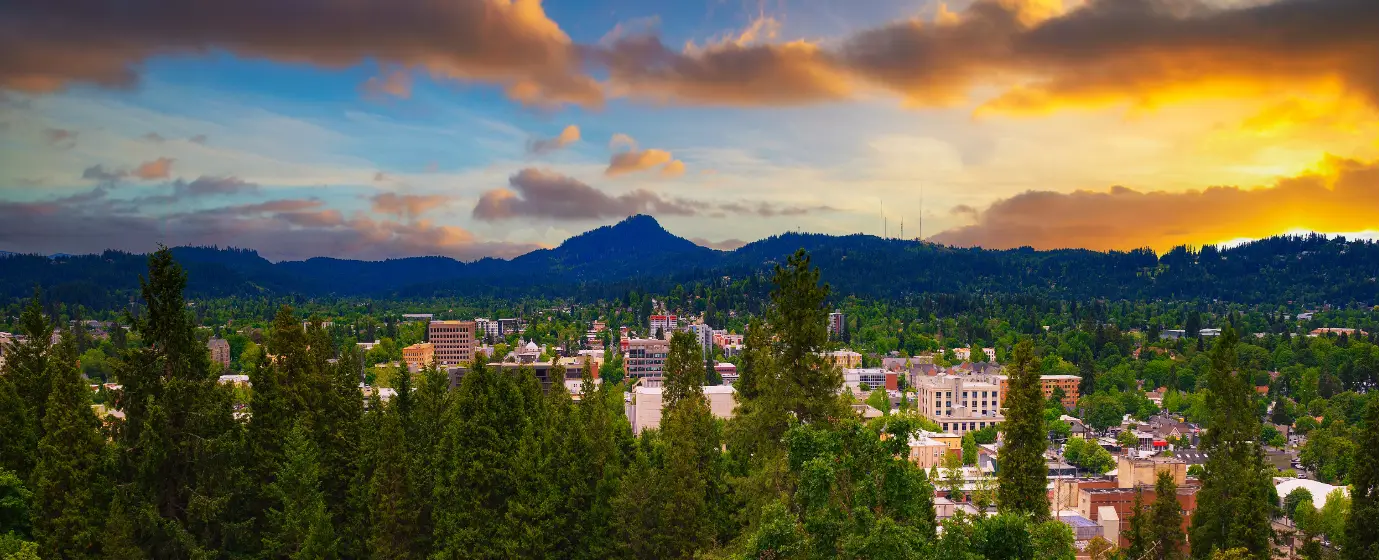
What Is Living in Eugene, Oregon Like?
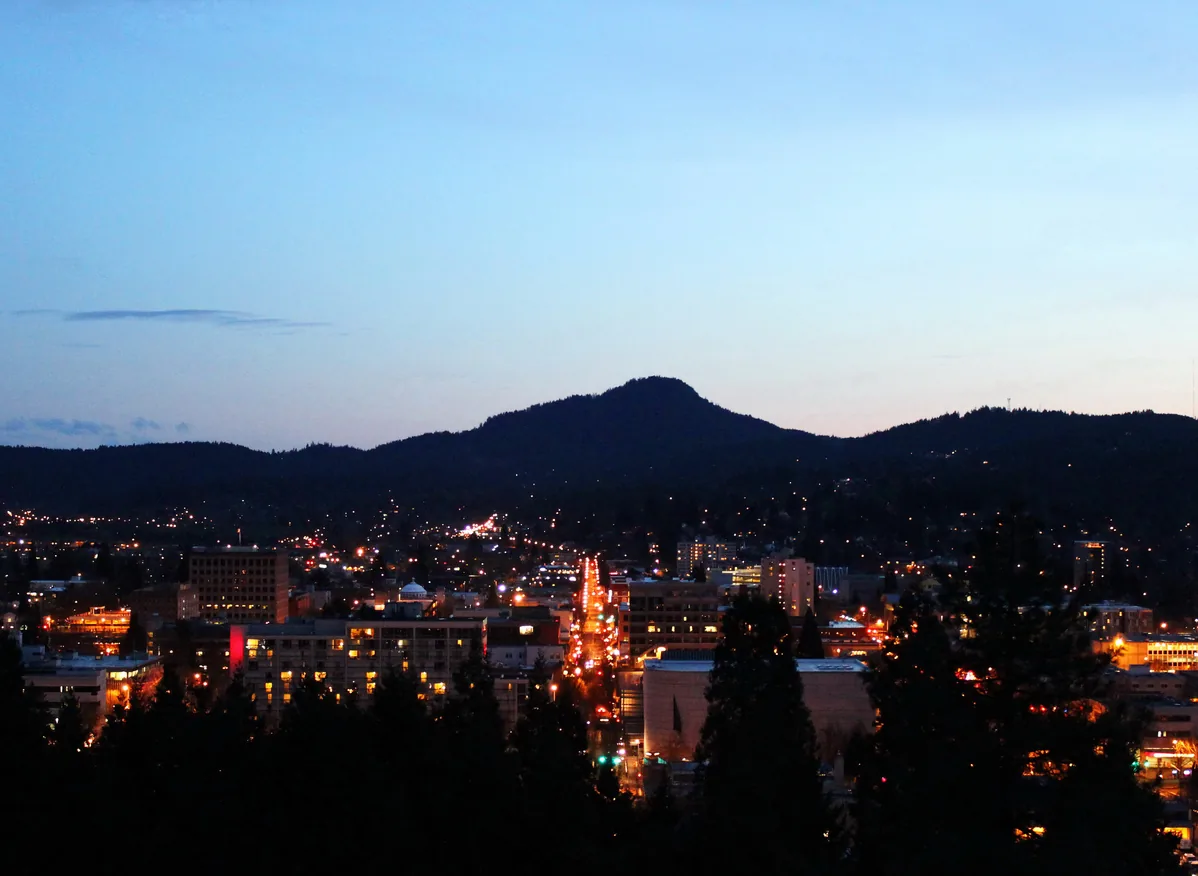
Maybe you've been priced out of Portland and someone mentioned Eugene. Maybe the University of Oregon is pulling you here for work or school. Maybe you drove through on I-5 and the Willamette Valley looked different than you expected — greener, flatter at the bottom, with mountains stacking up on both sides. Eugene is Oregon's third-largest incorporated city, with a population of 178,618 spread across 44.7 square miles, but it operates with the sensibility of a place half that size. The river, the university, and the hills define everything: where people live, how they get around, and what they do on a Saturday.
The University of Oregon is the undeniable center of gravity here — the city's largest employer and the source of the arts venues, the running culture, the track-and-field pedigree, and a good share of the rental demand. Lane County government and the Eugene School District 4J round out the civic employment base, and a regional health system anchors healthcare jobs for the broader area. The city draws teachers, researchers, healthcare workers, and remote workers who want walkable streets and outdoor access without paying Portland prices.
The housing picture is meaningful. The typical home here is $482,062 (Zillow Home Value Index, July 2026) — noticeably below what you'd pay in Portland or Bend, though still a stretch: the median household income of $66,562 sits below what's needed to comfortably carry a home at that price. A typical two-bedroom rental runs $1,660–$2,020 per month. On the lifestyle side, Eugene delivers: the Ridgeline Trail System traces the southern hills, Alton Baker Park sits at the edge of downtown along the Willamette, and the lane miles of dedicated bike infrastructure make the city one of the most genuinely bikeable in the Pacific Northwest. With 155 sunny days a year, the gray winters are real — but the shoulder seasons, when the valley turns green and the farmers markets open back up, are hard to argue with.
Whether you're weighing a move or deep in the research phase, the sections below break down Eugene's neighborhoods, housing market, daily life, commute patterns, local employers, and what weekends actually look like for people who live here.
Eugene at a Glance
Looking to buy in Eugene? Estimate your payment.
Enter your numbers to see an estimated monthly mortgage payment.
Estimate only. Excludes HOA fees and mortgage insurance. The interest rate above is a starting point, not a quoted rate — replace it with your own to see real numbers. Insurance is a flat placeholder, not a Eugene quote.
Why Are People Moving to Eugene?
The University of Oregon pulls the first wave — faculty, researchers, and staff who want to live close to campus rather than commute from Portland. The second wave is harder to pin down: remote workers from the Bay Area and Seattle who want Pacific Northwest livability at a lower entry point, healthcare workers tied to the regional medical system, and longtime Oregonians who got priced out of the Willamette Valley's northern cities and landed here instead.
The employer base rewards people with specific backgrounds. Education and healthcare are the most durable sectors — Lane County government, the City of Eugene, and Eugene School District 4J all hire steadily. A growing tech cluster exists, but it's thin compared to what you'd find in Bend or the Portland metro. The metro-area average hourly wage runs below the national average, and anyone relocating for a private-sector career should research their specific field before assuming local salaries will match what they earned elsewhere.
What Actually Draws People
Hayward Field is a genuine differentiator. Eugene has built a national running identity over decades — the Prefontaine Classic, the USA Outdoor Track & Field Championships, and the NCAA championship meet have all been held at Hayward Field in recent years, and that culture permeates the city's parks and trail network. Autzen Stadium seats 54,000 for Oregon Duck football, and on game weekends the entire city reorganizes around it.
Beyond sports, the arts infrastructure surprises newcomers. The Hult Center for the Performing Arts books national touring productions and serves as the home of the Oregon Symphony's Eugene residency. The Whiteaker neighborhood runs one of the most active arts-and-music scenes between Portland and San Francisco. The Lane County Farmers Market operates through the growing season and draws producers from across the valley.
The honest tradeoff: Eugene's wages lag the national average, housing costs are rising faster than incomes, and the city's affordability gap — the distance between median household income and what it takes to buy a typical home — is wide and growing. People who move here usually do so for reasons that go beyond the spreadsheet.
What Daily Life Feels Like in Eugene
Eugene runs on bikes and on foot in a way that most Oregon cities don't. Between 2017 and 2024, roughly 42% of commuters used something other than a solo car trip — carpooling, transit, biking, walking, or working from home. Working from home has more than doubled since 2017. In the Friendly Area and the Whiteaker, running an errand on a bicycle isn't aspirational — it's just Tuesday.
The Rhythm of the Week
Mornings in Eugene tend to start outdoors. Spencer Butte draws hikers before 8 a.m. on weekdays; the Ridgeline Trail System connects the southern neighborhoods to views of the valley. Along the river, Alton Baker Park and the adjacent path system carry a constant stream of runners and cyclists through every season except the worst of February.
The downtown core is genuinely walkable once you're in it, though the blocks between the university and downtown have a scrappier character than newcomers sometimes expect. The Whiteaker sits just northwest of downtown and operates on its own frequency — independent music venues, a rotating cast of food carts, and a community ethos that has resisted homogenization for decades.
What Surprises People After Six Months
The rain is relentless from November through March in a way that weather apps don't fully convey. Eugene averages 155 sunny days a year — less than half the year — and the gray stretches between November and April can wear on people who moved from sunnier climates. Longtime residents own good rain gear and treat outdoor plans as weather-optional; newcomers who wait for a dry day to go outside end up staying inside from October to May.
The university calendar also shapes daily life in ways that aren't obvious until you're here. Every fall, thousands of students return to the city; rental competition tightens, traffic patterns shift, and the downtown energy changes noticeably. Game days at Autzen Stadium — particularly Duck football home games — effectively close off parts of the city for a Saturday afternoon. If you're buying near campus, understanding the rhythm of the academic year is practical, not just interesting.
For families with kids, the schools page covers the district's performance data and boundary details in full. For the outdoor side of daily life, the parks and recreation page maps Eugene's trail network and park system.
The Eugene Housing Market Right Now
The typical home in Eugene is $482,062 (Zillow Home Value Index, July 2026). That number sits well below Portland and dramatically below Bend, but the affordability gap here is real: the median household income falls short of what's needed to comfortably buy at that price by a meaningful margin. Eugene is more affordable than Oregon's pricier markets in absolute terms — but it is not an inexpensive housing market relative to the wages it pays.
The rental market is equally tight. A typical two-bedroom runs $1,660–$2,020 per month city-wide. University proximity and limited new supply keep downward pressure on vacancy rates through most of the year, with the sharpest competition in the fall when students arrive. A state housing analysis has estimated the city needs to add more than 26,000 units over the next two decades — more than half of them affordable — which tells you something about where supply and demand currently stand.
The Geographic Reality
Not every part of Eugene prices the same. South Eugene and Fairmount — the hillside neighborhoods with mature tree canopies and proximity to the Ridgeline trails — run above the city median. Cal Young, the quieter family-oriented area north of the river, also sits above median. Bethel, River Road, and Whiteaker represent the city's more accessible entry points. Santa Clara and the Friendly Area trade close to the city-wide typical price. The neighborhoods page covers the character of each area in detail, and the cost of living page breaks down taxes, utilities, and what your dollar actually buys here.
The city's effective property tax rate is approximately 0.95% — close to the Oregon average and meaningfully below what buyers from California often expect. Oregon also has no sales tax, which shows up in everyday spending in ways that feel noticeable in the first few months after a move.
New affordable housing is being added steadily, but the pace of new construction hasn't kept up with demand, particularly for mid-range ownership product. People looking for recently built single-family homes sometimes find more options in neighboring Springfield, where prices run somewhat lower than Eugene's city-wide typical.
Eugene Neighborhoods
Eugene has several distinct areas — each with its own character and appeal. Here’s a breakdown to help you narrow down where to focus your home search.
🏡 South Eugene
South Eugene is the city's most established residential area — hilly terrain, mature tree canopies, and immediate access to the Ridgeline Trail System. It draws families and long-term homeowners who want the feel of the hills without leaving city limits.
🏠 Bethel / Danebo
Bethel and Danebo sit on the western side of the city with more affordable housing stock and a quieter residential character. It's a practical choice for buyers looking for space at a price point below the city median.
🌳 Santa Clara
Santa Clara occupies the northern part of the city with a mix of single-family homes and a suburban feel that sets it apart from the more urban central neighborhoods. Prices track close to the city-wide typical, and the area tends to attract families looking for quieter streets.
🏘 River Road
River Road runs north of downtown along the Willamette, with a mix of older housing stock and a neighborhood feel that's more grounded and less trend-driven than the university-adjacent areas. Prices here sit below the city median.
🏔 Cal Young
Cal Young is the quieter, family-oriented neighborhood north of the river — larger lots, less foot traffic, and a residential pace that suits parents with school-age children. It runs above the city median, reflecting its stability and housing quality.
🌆 Fairmount
Fairmount sits within the South Eugene hills and is known for tree-lined streets and well-maintained character homes. It's one of Eugene's more upscale residential pockets, priced above the city median and popular with professionals and longtime residents who want walkable access to the university area.
Pros & Cons of Living in Eugene
The Pros
- Home to the University of Oregon with a lively, youthful college-town energy
- Unmatched access to rivers, forests, and mountain trails right in the city
- Strong arts, music, and craft-beer culture
- Relatively short, traffic-light commutes citywide
The Cons
- Overall crime rate, especially property crime, runs notably above state and national averages
- Median household income lags both the state and national medians
- Long, gray, rainy winters with limited sunshine
Getting Around & Commuting in Eugene
Eugene is the most bikeable city of its size in Oregon, and that's not a marketing claim — it's the infrastructure. Dedicated bike lanes, a river path system, and the PeaceHealth Rides bike-share program make cycling a genuine daily option in the central neighborhoods, with ridership well into the hundreds of thousands of trips annually. If you live in the Friendly Area, Whiteaker, or close to campus, a car is optional for routine errands.
Transit
Lane Transit District (LTD) operates a network of bus routes and the Emerald Express (EmX) — Oregon's first bus rapid transit line — connecting downtown Eugene to downtown Springfield and the Gateway area. LTD draws well over a million riders annually and runs frequent service across the central corridors. In fall 2025, the city launched a two-year Downtown Loop pilot, expanding coverage and running more frequent service into the evening hours.
Amtrak's Cascades and Coast Starlight service connects Eugene to Portland by rail — a practical option for occasional trips north, though the schedule doesn't serve daily commuters.
Driving and Regional Access
I-5 runs through the eastern edge of the city and is the main artery for regional movement. I-105, which connects Eugene to Springfield, and the Beltline Highway handle crosstown traffic and give access to the wider highway network. OR-99 and OR-126 carry traffic west toward the coast and east toward the Cascades respectively.
The drive to Portland is about 110 minutes under normal conditions — manageable for occasional trips but not a daily commute most people choose voluntarily. Rush hour congestion on the Beltline and near the I-5 interchange is Eugene's real chokepoint; if you're working at the university or downtown, the time-of-day difference between 7:30 a.m. and 9:00 a.m. is significant enough that locals notice it.
Eugene Airport (EUG) sits about 10 miles from the city center and offers direct service to major West Coast hubs, making air travel for business practical without a drive to Portland.
What Locals Know About Commuting
The university calendar is a commute variable most people outside Eugene don't account for. Fall move-in, graduation weekend, and major track meets at Hayward Field all create traffic patterns that don't exist on a typical Tuesday. Buying near campus and assuming you'll always have an easy drive out is one of the more common mistakes incoming residents make. The bike network is the practical workaround — on a game-day Saturday, two wheels are genuinely faster than four in the central neighborhoods.
Schools in Eugene
Families relocating to Eugene have public, private, and higher-education options nearby. Here’s a quick overview.
🎓 School District
Eugene School District 4J serves K–12 students across Eugene and the surrounding area. Rated B (source: SchoolDigger (4-star district rating, ranked 20th of 140 Oregon districts)).
🏆 Graduation Rate
The 4-year high-school graduation rate here is approximately 78.2%.
📚 Higher Education
Oregon’s public universities — the University of Oregon, Oregon State University, and Portland State University — offer four-year degrees statewide, with a network of 17 community colleges providing two-year and workforce programs.
🌐 Online Learning
Oregon State University Ecampus and Portland State University Online offer fully accredited online degrees for remote learners across the state.
Safety in Eugene
A quick look at how Eugene compares on the numbers that matter most when weighing a neighborhood or a move.
🛡 Violent Crime
Approximately 3 per 1,000 residents.
🔒 Property Crime
Approximately 33 per 1,000 residents.
Compared to the most recent national figures from the Bureau of Justice Statistics (2024), Eugene’s violent crime is below the national average (about 3.7 per 1,000), and property crime is above the national average (about 18.4 per 1,000).
Against Oregon as a whole, Eugene’s violent crime is about the same as the state average, and property crime is somewhat above the state average (Bureau of Justice Statistics, Crime Known to Law Enforcement, 2024 (tables 2 and 3)).
Crime rates can vary a lot within a single city, so the citywide numbers above are only a starting point. Some neighborhoods in Eugene run well below these averages, while others run higher — the kind of block-by-block detail that matters most when you’re actually choosing where to live. The full guide below breaks it down neighborhood by neighborhood.
Working in Eugene
Eugene’s largest employers span several industries — here are some of the anchors of the local job market.
🎓 University of Oregon
Education
🏛 Lane County
Municipal government
🏥 PeaceHealth Sacred Heart Medical Center
Healthcare, located in Springfield
🏛 City of Eugene
Municipal government
🎓 Eugene School District 4J
Education
Parks & Recreation in Eugene
Some of the outdoor spaces that shape everyday life in Eugene.
🌱 Skinner Butte Park
🌱 Owen Rose Garden
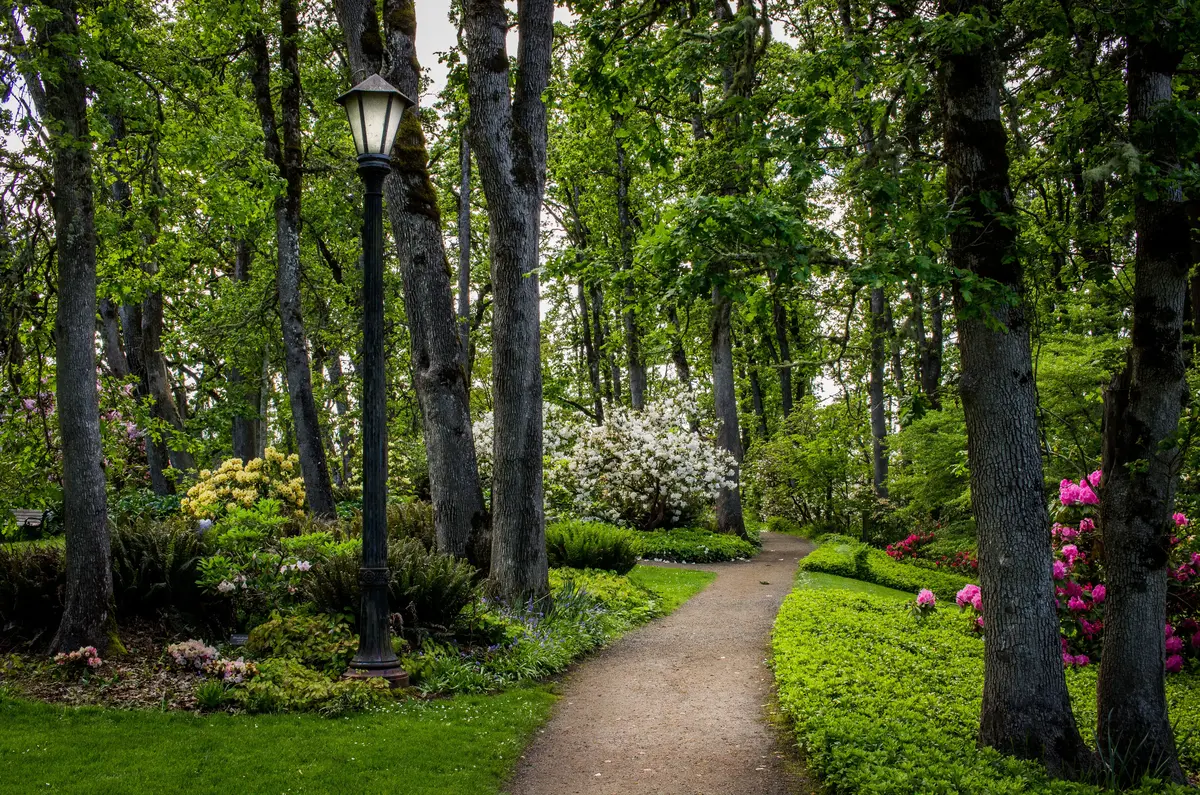
Eugene residents don’t have to go far for green space — spots like Skinner Butte Park and Owen Rose Garden are part of everyday life here, whether that’s a morning walk, a weekend hike, or just somewhere to unwind outside. The full guide below covers more of what Eugene has to offer for parks and outdoor recreation.
Retiring in Eugene
Eugene draws retirees for its balance of amenities, outdoor access, and cost. Here’s what to weigh.
🌤 Climate
Eugene sits in the Willamette Valley with mild, rainy winters and warm, dry summers. The city averages 155 sunny days a year, with the gray season running hard from November through March. Summers are genuinely pleasant — low humidity, long evenings, and temperatures that rarely reach the extremes of inland Oregon.
🍴 Lifestyle
The Owen Rose Garden, Mount Pisgah Arboretum, and the river path system give retirees access to nature without serious exertion. The Hult Center for the Performing Arts anchors a strong performing arts calendar, and the Lane County Farmers Market draws a multi-generational crowd through the growing season. The independent dining and coffee scene is well developed for a city this size.
🏚 55+ Communities
No 55+ communities were found in Eugene. Retirees considering the area typically look at single-family homes in South Eugene, Fairmount, or Cal Young, or explore whether neighboring Springfield offers more options at a somewhat lower price point.
✈ Getting Around
Eugene Airport (EUG) is about 10 miles from the city center, with direct service to major West Coast hubs. Lane Transit District's bus network and the EmX rapid transit line make car-free living workable in the central neighborhoods. For retirees who prefer to drive, the city's grid is straightforward and the Beltline gives quick access to regional destinations.
🏛 Oregon Taxes for Retirees — What to Know
- Social Security is not taxed — Oregon does not tax Social Security or Railroad Retirement benefits. Any amount included in your federal adjusted gross income is subtracted back out on the Oregon return.
- But other retirement income IS taxed — This is the trade-off that surprises people moving from Washington or Texas. Pension distributions and 401(k)/IRA withdrawals are taxed as ordinary income at Oregon’s regular rates — there is no blanket retirement-income exclusion.
- Graduated income tax — Oregon has four brackets — 4.75%, 6.75%, 8.75% and 9.9%. The 4.75% rate covers the first $10,000 of taxable income for a single filer ($20,000 filing jointly); the 8.75% rate starts at $125,000 ($250,000 jointly); and the top 9.9% rate applies above $250,000 ($500,000 jointly).
- No sales tax — Oregon levies no general sales tax.
- Property taxes, with senior deferral — Oregon’s Senior and Disabled Property Tax Deferral lets qualifying homeowners have the state pay their county property taxes, with a lien recorded against the home. The 2026 household income limit is $70,000, and deferred balances accrue 6% simple interest — it defers the bill rather than forgiving it.
- Estate tax — the one to plan for — Oregon has its own estate tax with a $1 million filing threshold — far below the federal exemption, and NOT indexed for inflation, so it reaches more estates every year in real terms. Retirement accounts and a long-held home count toward the taxable estate, so estates that feel modest can cross the line without the owner expecting it.
- No inheritance tax — Oregon has no separate inheritance tax and no gift tax.
Tax laws change frequently and individual situations vary. This is general information, not tax advice — always consult a qualified Oregon tax professional or CPA for personalized retirement tax planning.
Weekends & Local Favorites in Eugene
Eugene's weekends organize themselves around the outdoors, the university's event calendar, and a food-and-coffee culture that punches well above the city's size. The combination of a large student and faculty population with a long-standing independent-business ethos means the options are real.
Outdoors
Spencer Butte is the anchor of the southern trail network — a 2,055-foot summit with views across the valley that becomes a weekend pilgrimage for anyone who's lived here more than a month. The Ridgeline Trail System connects the hilltop parks that ring South Eugene, and Alton Baker Park along the Willamette delivers riverside paths and open green space a short bike ride from downtown. Mount Pisgah Arboretum, in the city's southeast, is one of those places that longtime residents describe to newcomers and newcomers immediately add to their regular rotation. The Cascades Raptor Center, also in the south part of the city, gives residents close-up access to birds of prey in a working wildlife rehabilitation setting.
Skinner Butte Park rises at the northern edge of downtown and offers a quick hike with city views — the kind of place you take visiting family when you want to show off Eugene in forty-five minutes. The Owen Rose Garden sits at its base along the river.
Coffee, Food, and Markets
The coffee scene is genuine and locally rooted. Wandering Goat Coffee Co. is one of the city's most well-established roasters, with a following that extends across the Pacific Northwest. Vero Espresso, Coffee Plant Roaster, Meraki Coffee Co., and Dark Pine Coffee fill out a cafe landscape that gives residents real options across neighborhoods.
For food, Fisherman's Market has been the go-to for fresh seafood in Eugene for decades — a counter-service institution with lines that tell you everything you need to know about its reputation. Beppe & Gianni's Trattoria represents the more formal end of Italian dining in the city. Sweet Waters on the River, Agate Alley Bistro, and rye each bring a distinct sensibility to a dining scene that rewards exploration.
The Lane County Farmers Market runs through the growing season and draws producers from across the Willamette Valley, drawing regulars from nearly every neighborhood. The Whiteaker Community Market offers a smaller, neighborhood-scale version of the same idea with its own distinct character.
Arts and Events
Hayward Field hosts world-class track and field most summers — the Prefontaine Classic, the USA Championships, and NCAA championship meets have all been held there in recent years. On non-event days it's still one of the most impressive athletic facilities in the country. The Hult Center for the Performing Arts anchors the city's performing arts calendar with touring productions, the Oregon Bach Festival, and local company performances through the year. The Whiteaker neighborhood's live music venues carry the city's independent music scene into most evenings of the week.
Local favorites in Eugene
Restaurants
- Fisherman's Market
- Beppe & Gianni's Trattoria
- Sweet Waters on the River
- Agate Alley Bistro
- rye
Outdoors
- Spencer Butte
- Skinner Butte Park
- Mount Pisgah Arboretum
- Alton Baker Park
- Ridgeline Trail System
Coffee
- Vero Espresso
- Wandering Goat Coffee Co.
- Coffee Plant Roaster
- Meraki Coffee Co.
- Dark Pine Coffee
Farmers Markets
- Lane County Farmers Market
- Whiteaker Community Market
Top Things Locals Say About Eugene
The best intel about a city comes from the people who actually live there. Here’s what Eugene residents say when newcomers ask the questions everyone’s thinking.
“I expected to miss Portland, but what I didn't expect was how quickly the Ridgeline trails and the Saturday market became just... the routine. What caught me off guard was how much the university shapes everything — the rental market in September, the traffic on game weekends, even which coffee shops are slammed at 8 a.m.”
— Recent Eugene home buyer
“What's the most surprising thing about living in Eugene?”
How much the University of Oregon shapes the texture of the city even if you have nothing to do with it. The fall rental crunch, the Hayward Field weekends when parking evaporates, the way Autzen game days reorganize the entire Saturday — you learn to plan around the academic calendar whether you want to or not. The Whiteaker is the one neighborhood that mostly operates on its own schedule regardless of what's happening on campus.
“What do locals love most about Eugene?”
The trail access without the tourist infrastructure. Spencer Butte and the Ridgeline System are right there, and on a weekday morning you're sharing them with people who live here, not a parking lot full of day-trippers. The farmers market culture is genuine — the Lane County Farmers Market draws producers from across the valley, and regulars have their routes and their vendors. The Hult Center brings touring productions that you'd otherwise have to drive to Portland for.
“What should newcomers to Eugene know?”
The rain isn't just frequent — it's persistent. November through March can go two or three weeks with barely a break. Locals don't wait for a dry window; they gear up and go anyway. Also: the Beltline near I-5 backs up in the morning rush in a way that doesn't look bad on a map but adds real time. If your job is downtown or at the university, figuring out your bike or bus option early makes a noticeable difference in your daily quality of life.
“How much do you need a car in Eugene?”
It depends almost entirely on where you live. In the Friendly Area, Whiteaker, or close to campus, many residents go days without driving — the bike lanes are real, the bus rapid transit line connects Eugene to Springfield reliably, and the PeaceHealth Rides bike-share fills the gaps. In the outer neighborhoods like Santa Clara or Bethel, a car is a practical necessity for most errands. The city is genuinely bikeable at its center and car-dependent at its edges, with not much in between.
Cities Near Eugene
Other communities near Eugene worth a look — each with its own character and price point.
| City | Distance | Best For | Vibe | Median Rent | Median Buy |
|---|---|---|---|---|---|
| Springfield | 3 mi | Value seekers & growing families | Practical, working-class, unpretentious | $1,678 | $421,652 |
| Coburg | 8 mi | Rural feel, small-town pace | Quiet, historic, agricultural edge | $1,600 | $480,000 |
| Junction City | 14 mi | Space, land, lower density | Small-town, farmland surroundings | $1,450 | $489,162 |
More Helpful Guides for Eugene
Going deeper on Eugene? Our blog series covers everything from first-time buying to retiring here — explore the guides below.
Local Expert Takeaway: Eugene rewards people who move here for the right reasons and frustrates people who move here expecting Portland wages and Portland amenities in a smaller package. The trail network, the bike infrastructure, and the Farmers Market are as good as advertised. The rain, the income gap, and the university's outsizing effect on housing and traffic are real and worth understanding before you commit. If you work at the University of Oregon, in healthcare, or remotely, and you want genuine outdoor access and a food-and-coffee culture without paying Bend prices, Eugene makes a strong case.
Quick Takeaways & FAQs
✅ Eugene's Ridgeline Trail System, Alton Baker Park, and Spencer Butte put serious outdoor recreation within a short bike ride of most central neighborhoods.
⚠️ The median household income falls well short of what's needed to buy the typical home here — affordability is real compared to Portland, but the local wage-to-price gap is a genuine constraint.
📍 The University of Oregon's academic calendar — fall move-in, game days at Autzen, and major track meets at Hayward Field — reshapes traffic and rental competition in ways that newcomers rarely anticipate.
Is Eugene, Oregon a good place to live?
What is the cost of living like in Eugene, Oregon?
What are the best neighborhoods in Eugene, Oregon?
What are the major employers in Eugene, Oregon?
How far is Eugene from Portland?
Helpful Links for Moving to Eugene
Moving to Oregon?
Tell us what you need help with and we'll connect you with local resources.
