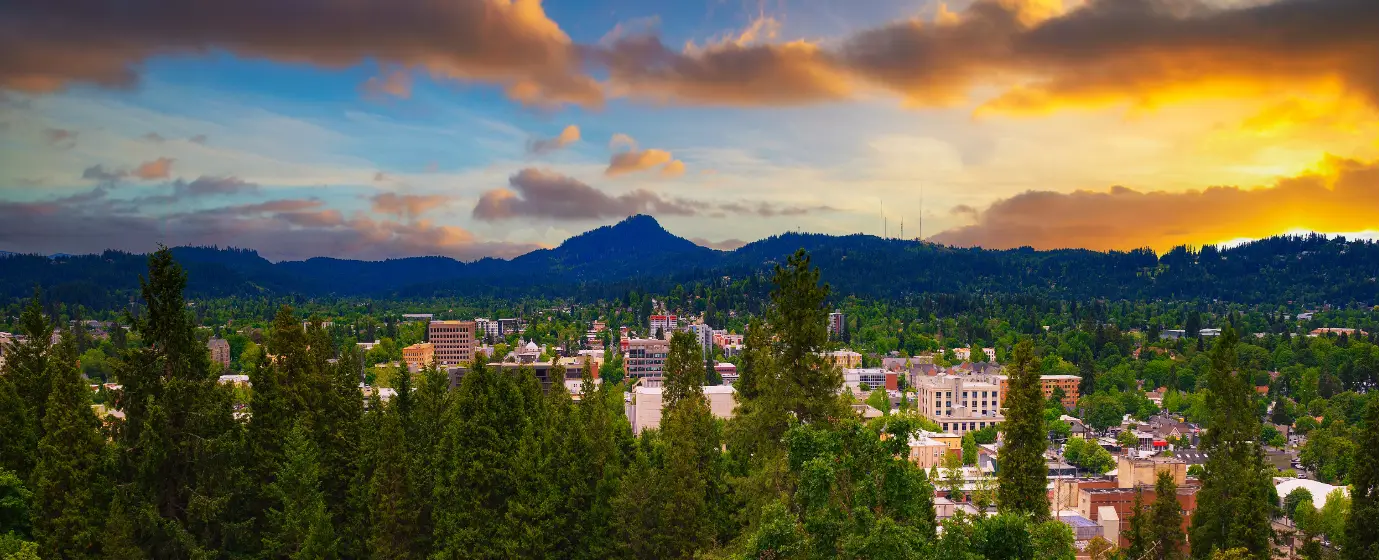
Eugene doesn't market itself as a retirement destination the way Bend or Ashland do, and that's part of what makes it worth a serious look. It's a mid-sized university city — the 3rd-largest incorporated city in Oregon — with 178,618 residents, a genuine arts scene anchored by the Hult Center for the Performing Arts, and an outdoor infrastructure built for people who plan to stay active. The Willamette River runs through it, Spencer Butte rises at its southern edge, and the flat valley floor means a bicycle is a realistic tool, not just weekend recreation. What drives daily life here is the University of Oregon's cultural gravity: world-class running events at Hayward Field, live music, farmers markets, and a population that skews intellectually engaged at every age.
The economic backbone is education and healthcare, with the University of Oregon and Lane County among the largest employers, and a regional health system that anchors both Eugene and neighboring Springfield. The school district — Eugene School District 4J — matters less to most retirees directly, but it shapes the community's age mix and civic investment in ways you'll notice. Who moves here in retirement tends to fall into two groups: transplants from California or coastal cities who want a smaller, walkable city without small-town isolation, and Oregonians from the coast or rural areas who want reliable medical access and more cultural programming. Both groups are choosing Eugene deliberately, not settling for it.
On cost of living, Eugene sits at a middle register for Oregon — meaningfully below Portland while carrying real university-city pricing on services and housing. The typical home price was $482,062 as of July 2026. Rainfall is the honest friction point: Eugene averages 155 sunny days a year, which means overcast winters that genuinely surprise people who didn't do their homework. The outdoor scene — Alton Baker Park, the Ridgeline Trail System, Mount Pisgah Arboretum — is excellent, but it's a green-and-grey kind of excellent, not a Southwest-sunshine kind.
Whether you're seriously considering the move or still comparing options, the sections below break down Eugene's healthcare access, retiree tax picture, daily budget reality, walkability and community life, downsizing options, and how it stacks up against nearby retirement alternatives.
Why Retirees Are Choosing Eugene
Eugene earns serious consideration from retirees who want a real city — performing arts, a research university, a food scene, multiple hospital systems nearby — but can't stomach Portland's scale or price. At a typical home price of $482,062 (July 2026 Zillow Home Value Index), it's not cheap by Oregon small-town standards, but the value proposition sharpens once you factor in what's actually here: a legitimate transit system, a hospital complex minutes away in Springfield, and cultural programming most cities twice Eugene's size can't match.
The fit is strongest for active retirees who plan to walk, bike, or use transit as their primary mode. Eugene's relatively flat terrain and extensive trail network reward people who want to stay physically engaged without needing a car for every errand. The Lane County Farmers Market is a weekly anchor for the kind of community that forms around food and local agriculture, and the Hult Center calendar gives winters a reason to leave the house.
The honest counterargument: Eugene is not a mellow, slow-paced retirement town. The university brings noise, density, and a rental market that competes with retirees looking to downsize into a manageable rental. The grey winters are long — 155 sunny days a year means roughly seven months of cloud cover. And if you're moving from a sunnier climate expecting Oregon to deliver the outdoor lifestyle you imagined, month three will recalibrate you. Retirees who thrive here tend to embrace the rain rather than fight it, and they come with enough social infrastructure — interests, hobbies, reasons to be out — to use what Eugene offers rather than wait for the weather to cooperate.
Healthcare & Medical Access in Eugene
The Regional Hospital Picture
The nearest hospital to Eugene is McKenzie-Willamette Medical Center in Springfield, about 6 miles from central Eugene. It handles acute care and routine hospital needs for a significant portion of the metro area.
For serious or specialized care, the dominant regional hub is PeaceHealth Sacred Heart Medical Center at RiverBend, also in Springfield. It's a 388-bed medical center with a 24-hour Level II trauma center — the highest-level trauma designation available in the Eugene-Springfield metro. It houses the Oregon Heart and Vascular Institute and the Oregon Neurosciences Institute, which means cardiac and neurological care that would otherwise require a drive to Portland are available within the metro.
One change retirees should know: PeaceHealth's former University District campus in Eugene closed in 2024, with demolition beginning in March 2026. That campus is no longer an active hospital. PeaceHealth continues to operate outpatient services in Eugene, including a Senior Health and Wellness clinic, urgent care, primary care, and hospice services — so the in-city footprint for day-to-day medical access remains meaningful, even if inpatient hospital care sits across the Springfield line.
Specialty Depth and Distance Reality
For most retiree health needs — orthopedics, cardiology, oncology, outpatient surgery — the Eugene-Springfield metro is well-equipped relative to Oregon cities its size. The presence of specialty institutes within PeaceHealth RiverBend matters: it means you're not reflexively routed to Portland for cardiac work or neurology consultations the way you might be from a smaller city.
Where the distance reality bites is for procedures or subspecialties that remain concentrated at Oregon Health & Science University (OHSU) in Portland — complex oncology, pediatric specialty care (less relevant for retirees), and certain surgical subspecialties. Eugene is about 110 minutes to Portland, OR, which is manageable for a scheduled procedure but a real consideration if you're planning for a health trajectory that might involve frequent Portland trips. For most retirees in reasonably good health, the local and Springfield options are sufficient. For those managing complex chronic conditions from day one, the drive to OHSU deserves an honest spot in the planning.
The Retiree Budget in Eugene
Oregon's Tax Posture for Retirees
Oregon does not tax Social Security or Railroad Retirement benefits — they're fully subtracted from Oregon taxable income regardless of income level. That's a meaningful structural advantage over states that tax Social Security at full rates. The relief stops there, though: pensions, 401(k) distributions, and IRA withdrawals are taxed at Oregon's regular graduated income tax rates, which run from 4.75% to 9.9%. Single filers hit the top 9.9% bracket above $125,000 of taxable income; married joint filers above $250,000. A retiree drawing primarily from a pension or IRA in the $60,000–$90,000 range will likely land in the 8.75% bracket — not punishing, but not the tax-friendly picture some assume Oregon offers. Consult a tax professional for your specific situation.
Oregon has no statewide or local sales tax, which produces real savings for retirees on fixed budgets who are buying goods and services regularly. For someone spending $30,000–$40,000 a year on taxable goods, the absence of sales tax adds up to several hundred dollars annually compared with most states.
Oregon also has an estate tax worth knowing: the exemption is $1 million — not indexed to inflation and unchanged since 2012 — with graduated rates from 10% to 16% on the taxable amount above that threshold. There is no Oregon inheritance tax. For retirees with meaningful assets, this deserves attention in estate planning.
Property Taxes and the Deferral Option
Eugene's effective property tax rate is approximately 0.95%, which sits below Oregon's state average and well below most California counties — a genuine affordability factor for retirees who own. Oregon also offers a property tax deferral program for homeowners aged 62 or older: the state pays county property taxes directly, recording a lien at 6% simple interest, repaid on sale or death. To qualify in 2025, household income must be no more than $60,000, and the home must have been owned and occupied for at least five years. For retirees who are asset-rich and income-constrained, this program can meaningfully improve monthly cash flow.
Day-to-Day Budget Reality
Groceries, dining, and services in Eugene reflect the university-city cost structure — not Portland prices, but not rural Oregon either. Independent coffee shops and casual restaurants are plentiful. The full cost-of-living breakdown covers utilities, groceries, and transportation in detail. The practical takeaway for a fixed-income retiree: Eugene is livable without feeling like you're constantly squeezing, especially if you own and have eliminated housing debt.
Looking to buy in Eugene? Estimate your payment.
Enter your numbers to see an estimated monthly mortgage payment.
Estimate only. Excludes HOA fees and mortgage insurance. The interest rate above is a starting point, not a quoted rate — replace it with your own to see real numbers. Insurance is a flat placeholder, not a Eugene quote.
Walkability, Community & Staying Active in Eugene
Getting Around Without a Car
Eugene's flat valley floor is genuinely useful for aging in place. The Willamette River path, Alton Baker Park, and the greenway system are flat, paved, and accessible — not just for weekend recreation but for daily movement. Eugene's bike-friendliness is well-documented: the city's bike infrastructure, with over 20 trails and extensive on-street lanes, puts it among the most bikeable cities in the country.
Lane Transit District (LTD) operates multiple bus routes plus the Emerald Express (EmX), Oregon's first bus rapid transit line. EmX connects West Eugene, downtown Eugene, the University of Oregon, and downtown Springfield with frequent weekday service. All buses are wheelchair accessible. For retirees or people with disabilities who can't use fixed-route service, LTD's RideSource paratransit program is a safety net that matters as mobility changes over time. This is a transit system that actually gets used — ridership is substantial for a metro this size — not a nominal one.
The honest caveat: Eugene is not a pedestrian city in the way that a dense urban grid is. Downtown and the neighborhoods around the University are walkable for daily errands. The outer neighborhoods — Bethel, Santa Clara, parts of River Road — require a car or a bus for most errands. Where you buy matters enormously to your non-driving future.
Community, Culture & Staying Engaged
The Hult Center for the Performing Arts anchors Eugene's cultural calendar in a way that genuinely distinguishes it from other Oregon cities at this population. The Eugene Symphony, visiting performances, and the Oregon Bach Festival draw an older, engaged audience, and the programming is consistent enough to structure a month around.
Hayward Field brings world-class track and field to the city in a way that draws an athletic community at every age. The parks and trail system — the Ridgeline Trail System, Mount Pisgah Arboretum, Skinner Butte Park, and the Owen Rose Garden — give active retirees a genuinely varied outdoor life across the seasons. The Lane County Farmers Market and the Whiteaker Community Market create regular social rhythm for those who want informal community rather than organized programming.
For retirees who want structured engagement, the University of Oregon runs a lifelong learning institute offering courses, lectures, and travel programs specifically designed for adults 50 and older. It's one of the concrete benefits of retiring in a university city that doesn't get enough attention in retirement planning conversations.
Right-Sizing: Downsizing in Eugene
What the Inventory Actually Looks Like
Eugene's housing stock skews toward older single-family homes — many of them ranch-style or bungalow construction from the 1950s through 1980s — which means single-level living is genuinely available, particularly in the flatter neighborhoods of Santa Clara, River Road, and parts of Bethel. The catch is that many of these homes haven't been updated for accessibility: thresholds, bathroom layouts, and kitchen configurations often require renovation for aging-in-place use. Budget for that work if you're buying in older stock.
Condos and patio homes exist in Eugene but represent a thin slice of the overall market. Downtown and the South University area have the highest concentration of low-maintenance attached housing, but that also means more competition and pricing that runs above the city-wide typical figure. The neighborhood breakdown covers which areas run above and below the city median.
55+ Communities and Senior Living
No 55+ communities were found in Eugene. Retirees looking for that specific structure — age-restricted ownership communities with shared amenities — will need to look at the broader metro or neighboring cities.
What Eugene does have is a meaningful independent and assisted living landscape. The Springs at Greer Gardens is set on 14 acres of a former rhododendron nursery and was the first senior community nationwide to receive Fitwel Certification using the senior living scorecard — a distinction that signals genuine attention to wellness design rather than marketing language. Ya-Po-Ah Terrace is a 222-unit senior apartment community for adults aged 62 and older in downtown Eugene, offering HUD rental assistance for income-qualified residents. For retirees whose budget requires subsidized housing, the existence of Ya-Po-Ah Terrace in a well-located downtown setting is worth knowing.
Eugene's senior living sector has continued to invest: 2025 brought expansion of a non-profit continuing care retirement community, a downtown permanent supportive housing initiative for older adults, and a change in ownership at an existing senior community. The direction of investment is toward density and accessibility, which tracks with where the population is heading.
The practical right-sizing reality: if you're buying and downsizing, single-level inventory exists and is findable without heroic effort, but competition is real and the well-updated options move. If you're considering renting, the typical rent figures apply here — the university rental market keeps vacancy low and pushes rents in ways that affect retirees as much as students.
Eugene vs Nearby Retirement Destinations
| City | Cost vs Eugene | Primary Hospital | Walkability | Senior Living Depth | Overall Retirement Fit |
|---|---|---|---|---|---|
| Eugene | Anchor | McKenzie-Willamette (6 mi); PeaceHealth RiverBend (Springfield) — Level II trauma, cardiac & neuro institutes | Strong for a city this size; flat terrain, robust transit & bike network | Independent, assisted, memory care options; no 55+ ownership communities | Best for active, culturally engaged retirees who want city amenities without Portland scale |
| Springfield | Somewhat lower | PeaceHealth Sacred Heart RiverBend on-site — Level II trauma center, specialty institutes | More car-dependent than Eugene; less pedestrian infrastructure | Growing; some senior housing options near the hospital corridor | Better for budget-focused retirees who prioritize proximity to the regional hospital |
| Coburg | About the same | Relies on Springfield hospitals; no acute care in town | Very limited; small-town walkability only within the historic core | Minimal; primarily a residential community | Appeals to retirees wanting quiet, small-town character close to Eugene's amenities |
| Junction City | About the same | Relies on Eugene-Springfield hospitals; no local acute care | Limited; a car is essential for most errands | Limited options; smaller senior services footprint | Suits retirees comfortable driving to Eugene for medical care and services |
| Veneta | Noticeably cheaper | No local hospital; Eugene-Springfield is the care hub | Minimal; rural setting requires a car for virtually everything | Very limited | Best for retirees who strongly prioritize rural quiet and lower land costs over access |
| Creswell | Noticeably cheaper | No local hospital; I-5 corridor puts Eugene hospitals within reach | Limited; small-town core only, car-dependent otherwise | Very limited | Works for retirees who want a quieter setting and can drive to Eugene for services |
Springfield is the clearest value play for retirees who want the Eugene metro's healthcare depth — specifically, being literally adjacent to PeaceHealth's RiverBend campus — while spending less on housing. The trade-off is a more car-dependent daily environment and less of the cultural programming that makes Eugene worth the premium.
Veneta and Creswell offer meaningfully lower land costs, but both require a car for everything and have negligible local senior services. They work for retirees who genuinely want rural quiet and are comfortable driving into Eugene-Springfield for medical care — but they are not a substitute for the city's infrastructure.
Coburg and Junction City sit at similar price levels to Eugene with notably fewer amenities; the value proposition there is primarily peace and elbow room, not savings. For most retirees weighing this region, the honest comparison is Eugene versus Springfield — and if proximity to PeaceHealth RiverBend matters and budget is tight, Springfield deserves a serious look before Eugene.

Local Expert Takeaway: Eugene rewards retirees who move here with a plan — not those hoping the city will provide the structure retirement needs. The Hult Center, the University of Oregon's lifelong learning programs, the Lane County Farmers Market, Alton Baker Park, and the EmX bus line are all real, reliable infrastructure for an engaged retirement. The gaps are equally real: no 55+ ownership communities, long grey winters, and a rental market shaped by the university rather than by retirees. Buy in the flatter neighborhoods — Santa Clara, River Road, Friendly Area — if single-level living and walkability both matter. And factor the McKenzie-Willamette and PeaceHealth RiverBend campuses in Springfield into your healthcare calculus before you pick a neighborhood: six miles is nothing in good health and very much something during a cardiac event.
Quick Takeaways & FAQs
✅ Oregon fully exempts Social Security from state income tax, and the effective property tax rate of approximately 0.95% keeps annual ownership costs genuinely manageable for retirees on fixed incomes.
⚠️ Eugene has 155 sunny days a year — grey winters are long, and retirees who underestimate the cloud cover are consistently the ones who leave within two years.
📍 PeaceHealth's former University District hospital in Eugene closed in 2024 and is being demolished; the nearest inpatient hospital is McKenzie-Willamette Medical Center in Springfield, about 6 miles away, with PeaceHealth RiverBend's Level II trauma center also in Springfield.
Is Oregon a tax-friendly state for retirees?
What is the closest hospital to Eugene for retirees?
Are there 55+ communities in Eugene, Oregon?
Can you get around Eugene without a car as a retiree?
Does Oregon's property tax deferral program apply to Eugene homeowners?
Moving to Oregon?
Tell us what you need help with and we'll connect you with local resources.
