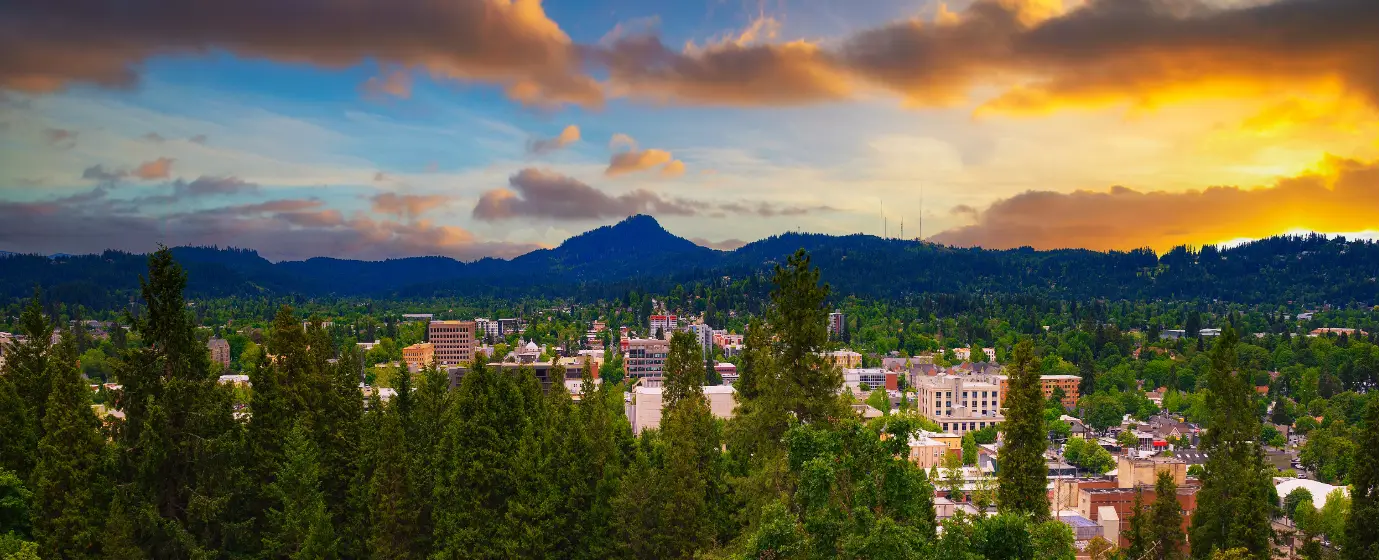
Eugene gets compared to Portland constantly, and the comparison usually misses the point. This is a city of 178,618 people anchored by the University of Oregon, threaded with river trails, and spread across a valley floor that pushes up into hills on the south and east. The Willamette River is not incidental — it splits the city in ways that shape commutes, flood risk, school boundaries, and the general feel of daily life. Where you land relative to the river, the university, and the interstate corridors determines more about your day-to-day experience than almost any other factor.
The University of Oregon and Eugene School District 4J are the two institutional forces most buyers should understand before choosing a neighborhood. The UO enrolls tens of thousands of students, sustains a research economy, and drives a steady rental market — but it also concentrates noise and transient turnover in the neighborhoods immediately around it. District 4J is the dominant public school system for most of the city, but Bethel and Danebo on the west side fall under the separate Bethel School District — a distinction that catches relocating families off guard. Major employers include the University of Oregon, Lane County, and the City of Eugene, with a regional health system anchoring the Springfield side of the metro.
The typical home in Eugene sits at $482,062 (Zillow Home Value Index, July 2026), which puts it well below Portland but above many smaller Oregon cities — and the median household income of $66,562 is below what it takes to comfortably carry that price at current rates. That gap shapes the rental market too: the typical two-bedroom runs $1,660–$2,020 per month, and renters make up a significant share of residents in several neighborhoods. For outdoor access, Eugene is genuinely hard to beat: the Ridgeline Trail System, Alton Baker Park, Spencer Butte, and the Willamette River path system all reach into residential neighborhoods rather than sitting at the edge of town.
Whether you're weighing a move or already under contract, the sections below break down Eugene's eight core neighborhoods by character, buyer type, and the honest trade-offs that most guides skip over — plus where to rent, what mistakes buyers commonly make, and which parts of the city suit which kind of life.
The Eugene Reality
The North-South Divide That Decides Everything
The single most important geographic fact in Eugene is the elevation change from north to south. The valley floor north of the Willamette River is flat, suburban, and highway-adjacent — easy to commute from and largely built out in the postwar decades. South Eugene climbs into the hills, where the Ridgeline Trail System begins practically at the back fence and the neighborhood's established tree canopy and school access drive consistent buyer demand. That character premium is real, and it reflects school quality, lot size, and general calm as much as it reflects views.
School Boundaries Are Not What You Assume
Most buyers assume Eugene equals Eugene School District 4J — and for most of the city, that is correct. But Bethel and Danebo on the west side operate under the separate Bethel School District, which has its own schools, its own performance profile, and its own boundary lines. Families buying in west Eugene without checking which district serves a specific address make this mistake regularly. A house one street over from another can land your child in an entirely different system.
The Corridor Reality
I-5, OR-569 (Randy Papé Beltline), and OR-99 define the arterial skeleton of the city, and the neighborhoods that sit against or between those corridors feel noticeably different from the ones insulated from them. Cal Young gets beltline noise on its northern edge; Bethel runs along OR-99. The university corridor through Fairmount and the Friendly Area creates a different kind of pressure — foot traffic, rental density, and parking competition — that is hard to appreciate until you have lived with it for six months.
Neighborhoods at a Glance
| Neighborhood | Best For | Vibe |
|---|---|---|
| South Eugene | Families Nature Schools | Established, tree-lined, hilly — the aspirational address in Eugene |
| Bethel / Danebo | Value First-Time | West-side working neighborhood with a rural edge and its own school district |
| Santa Clara | Families Quiet | Suburban northern fringe — spacious, calm, and close to the beltline |
| River Road | Nature Value | Outdoorsy and community-oriented along the Willamette's west bank |
| Cal Young | Commuters Families | Full-service suburban north Eugene — the most amenity-dense neighborhood outside downtown |
| Fairmount | Luxury Views Walkable | Hillside campus-adjacent elegance with architectural character and rhododendron gardens |
| Friendly Area | Walkable Renters | Laid-back, locally rooted southwest neighborhood anchored by Friendly Street's corridor |
| Whiteaker | Renters Walkable | Eugene's arts and counter-culture heart — murals, food carts, monthly art walks |
Eugene typical home price: $482,062 (Zillow ZHVI, July 2026). Typical rent: $1,808/mo (Zillow ZORI, July 2026). Neighborhood tiers on this page are relative to these figures.
Best Neighborhood by Buyer Type
| Buyer Type | Best Neighborhood | Why |
|---|---|---|
| First-Time Buyer | Bethel / Danebo | Prices run below the city median and the entry-level inventory is more accessible than anywhere else in Eugene. |
| Luxury Buyer | Fairmount | Above-median pricing, hillside views, architectural variety, and walking distance to both Hendricks Park and the UO campus. |
| Walkability Seeker | Friendly Area | Friendly Street's corridor of independent grocers, food carts, and cafes puts everyday errands within a short walk of most homes. |
| Families with Kids | South Eugene | Strong District 4J schools, mature residential streets, and trailhead access to the Ridgeline Trail System from within the neighborhood. |
| Commuters | Cal Young | Positioned between I-105 and OR-569 (Randy Papé Beltline), Cal Young offers the cleanest freeway access to both downtown Eugene and Springfield. |
| Large-Lot Buyers | Santa Clara | Santa Clara's suburban development patterns and northern fringe location yield larger lots than the denser, hillside neighborhoods farther south. |
| Renters | Whiteaker | Below-median home prices produce more accessible rental stock, and the neighborhood's density of small businesses and parks makes car-free living plausible. |
Looking to buy in Eugene? Estimate your payment.
Enter your numbers to see an estimated monthly mortgage payment.
Estimate only. Excludes HOA fees and mortgage insurance. The interest rate above is a starting point, not a quoted rate — replace it with your own to see real numbers. Insurance is a flat placeholder, not a Eugene quote.
Most Popular Neighborhoods in Eugene
1. South Eugene
South Eugene is where long-term residents tend to plant roots and stay. The hilly terrain gives walkers direct access to the Ridgeline Trail System and Amazon Park without getting in a car, and the mature tree canopy makes summer more livable than the open valley floor. The honest trade-off: the steep streets aren't friendly to anyone with mobility concerns or a reluctance to drive winding roads in ice, and consistent buyer demand means well-priced listings here move quickly.
Best for: Families prioritizing District 4J schools, professionals who want established neighbors and trail access, long-term owners.
2. Bethel / Danebo
Bethel and Danebo were two separate communities that grew together on the west side of Eugene, bounded by OR-99 on the east. Homes run below the city median, making this the most accessible entry point for buyers who want a detached house with a yard. The critical detail most buyers miss: this area falls under the Bethel School District, not Eugene 4J — research specific school assignments before making an offer. Fern Ridge Reservoir is about 12 miles west and draws residents for fishing and summer water recreation.
Best for: Budget-conscious buyers, first-time homeowners, anyone willing to trade school-district prestige for price.
3. Santa Clara
Santa Clara started as farmland on Eugene's northern edge and filled in between 1960 and 1975 — which means the housing stock is largely postwar ranch and split-level, with generous lots by city standards. The OR-569 (Randy Papé Beltline) gives quick access to the rest of the metro, and OR-126 connects toward the coast and central Oregon. About half of Santa Clara's acreage is still outside city limits, which creates an unusual mix of municipal and county services that can affect permitting and infrastructure.
Best for: Families wanting a quieter, suburban pace with good beltline access and larger lots at roughly the city median price.
4. River Road
River Road runs along the Willamette's west bank, and the neighborhood's identity is built around the water — residents kayak, fish, and bike the riverfront paths at a rate that makes the outdoor lifestyle feel built-in rather than aspirational. The housing stock skews older, mostly mid-century construction, which means character and space but also deferred maintenance to budget for on inspection. Homes sit below the city median, but the neighborhood's desirability has risen steadily as buyers discovered what they were pricing themselves out of farther south.
Best for: Outdoor-focused buyers, buyers seeking below-median pricing with genuine community texture, anyone who wants the river in their daily routine.
5. Cal Young
Cal Young is north Eugene's most complete neighborhood: two golf courses, a branch library, major shopping, and freeway access from both I-105 and OR-132 (Delta Highway) without the noise of living directly on a highway corridor. Homes run above the city median, and the suburban feel is deliberate — this is not a neighborhood for buyers seeking walkable streets or an arts scene. The northern boundary along OR-569 (Randy Papé Beltline) does create some edge-of-neighborhood noise and traffic that buyers near that corridor should factor in.
Best for: Commuters, families who want suburban amenities, buyers who prioritize full-service infrastructure over urban energy.
6. Fairmount
Fairmount sits on the hillside directly above the University of Oregon campus, and the views across the valley are among the best you will find within Eugene's city limits. The neighborhood's winding streets hold a range of architectural styles — craftsman bungalows, mid-century moderns, and larger Victorians — that attract buyers who find subdivisions uninspiring. Homes run above the city median, and the hillside location means that proximity to campus cuts both ways: walking to the UO and Hendricks Park is easy; dealing with football-game congestion is the seasonal price you pay.
Best for: Above-median buyers, architecture enthusiasts, UO faculty and professionals who want walkable access to campus without living in student-heavy density.
7. Friendly Area (South University / Amazon)
The Friendly Area earns its name through its commercial corridor on Friendly Street — locally owned grocers, food carts, and the kind of independently operated businesses that define Eugene's character at its most neighborhood-scale. Homes are priced at roughly the city median, a mix of older bungalows and some newer infill, and the area draws buyers who put community feel and on-foot access ahead of square footage. The proximity to the university means rental density is higher than it looks from the street, and parking can be genuinely competitive on event days.
Best for: Buyers who prioritize walkable streets and local commerce, households without cars or with one car between two adults, renters seeking a neighborhood with genuine community identity.
8. Whiteaker
The Whit is Eugene's most visually distinct neighborhood — murals cover building faces, food carts cluster along side streets, and the monthly art walk draws people from across the city. The neighborhood runs northwest of downtown along the Willamette and holds a dense mix of residential homes, small businesses, and parks across its footprint. Homes run below the city median, and the Whiteaker Community Market brings local farmers, artisans, and food vendors together regularly. The counter-culture energy is real and valued by residents, but buyers expecting a quiet residential street should be clear-eyed: this is an active, dense, occasionally loud neighborhood by design.
Best for: Renters and buyers who want below-median pricing, arts-and-culture seekers, households who thrive in high-energy, community-oriented environments.
Common Mistakes Buyers Make in Eugene
Assuming All of Eugene Means District 4J
The most consequential mistake families make is buying in Bethel or Danebo without realizing those addresses fall under the Bethel School District, not Eugene School District 4J. The two systems are entirely separate — different schools, different performance profiles, different boundaries. Pull the district map for any specific address before you make an offer, not after.
Chasing Square Footage Over School Boundary
South Eugene consistently draws persistent buyer demand because of its District 4J school access and trail proximity. Buyers who trade those qualities for a larger house in a less-demand neighborhood often find that the school boundary they gave up was a larger driver of long-term value than the extra bedroom they gained. This is especially true for families who plan to stay through middle and high school.
Underestimating the University's Footprint
Fairmount and the Friendly Area both sit close enough to the University of Oregon that football weekends, graduation, and the academic calendar affect parking, traffic, and noise in ways that don't show up during a Tuesday morning showing. Buyers who visit on a quiet weekday and then move in during fall term regularly describe the first October as a surprise. Time a second visit for a home football game weekend before closing.
Treating the Beltline as Just Another Road
OR-569 (Randy Papé Beltline) is the defining arterial boundary for both Cal Young to the south and Santa Clara to the north. Homes adjacent to it carry beltline noise that varies significantly by distance and orientation. Buyers who don't specifically ask about proximity to the beltline and don't visit at rush hour sometimes discover the noise level only after moving in — and it is not subtle at the nearest streets.
Best Areas to Rent in Eugene
| Area | Ideal For | Trade-off |
|---|---|---|
| Friendly Area / South University | Renters who want walkable streets, independent shops, and community character without full student-housing density | Parking competition is real on event days; older rental stock means variable unit quality |
| Whiteaker | Renters drawn to arts culture, food carts, and a below-median price point with high walkability | The neighborhood's energy level is not for everyone; noise and density are part of the deal |
| Cal Young | Renters who commute to Springfield or downtown and want suburban-style apartments with parking and amenities | Above-median area means higher rents; limited character relative to more urban neighborhoods |
| Santa Clara | Renters wanting quiet, space, and easy beltline access — often families or remote workers | Most errands require a car; the northern fringe location adds distance to downtown destinations |
| River Road | Outdoorsy renters who want riverfront access and below-median pricing in a community-oriented setting | Much of the rental stock is older mid-century construction; some units carry deferred maintenance |
Eugene's rental market reflects the same income-to-price gap that affects buyers, and the university's enrollment drives persistent demand in the neighborhoods closest to campus. Renters willing to look north to Santa Clara or west to River Road typically find more space for the same monthly cost, though both require a car for most daily needs.
Local Expert Takeaway: Eugene's neighborhood map rewards specificity. The distance between a home in South Eugene and one in Bethel / Danebo can be measured in miles, but in practice the school district, the trail access, and the daily feel are entirely different cities. If you're a family, confirm the District 4J boundary before anything else. If you're a renter or first-time buyer working with a tighter budget, Whiteaker and River Road offer genuine neighborhood character well below the city median — the Whiteaker Community Market and the Willamette riverfront trails are the kinds of amenities that make a neighborhood feel like home, and both are built into the daily fabric of those areas rather than added on as selling points.
Quick Takeaways & FAQs
✅ South Eugene's Ridgeline Trail System and District 4J school access make it the most consistently in-demand residential area in the city for families.
⚠️ The Bethel School District boundary in west Eugene catches relocating families off guard — always verify which district serves a specific address before making an offer.
📍 Whiteaker is the only neighborhood in Eugene where a monthly art walk, a farmers market, and below-median home prices all coexist in the same walkable footprint.
What is the most family-friendly neighborhood in Eugene?
Which Eugene neighborhoods are most affordable for first-time buyers?
Is the Whiteaker neighborhood safe?
What are the best neighborhoods in Eugene for commuters?
Does the Bethel School District cover all of west Eugene?
Moving to Oregon?
Tell us what you need help with and we'll connect you with local resources.
