
The United Van Lines 2025 National Movers Study ranked Eugene-Springfield as the number one inbound metro in the country — not just in Oregon, the entire nation. That finding surprised almost no one who has lived through the last few years in California. Eugene sits in the southern Willamette Valley, roughly two hours south of Portland along I-5, and it draws Californians for a recognizable set of reasons: meaningfully lower home prices, no sales tax, a genuine downtown, and a pace of life that does not require two hours of commuting to access a park. The move is a single-day drive from the Bay Area, which makes logistics far simpler than a cross-country relocation.
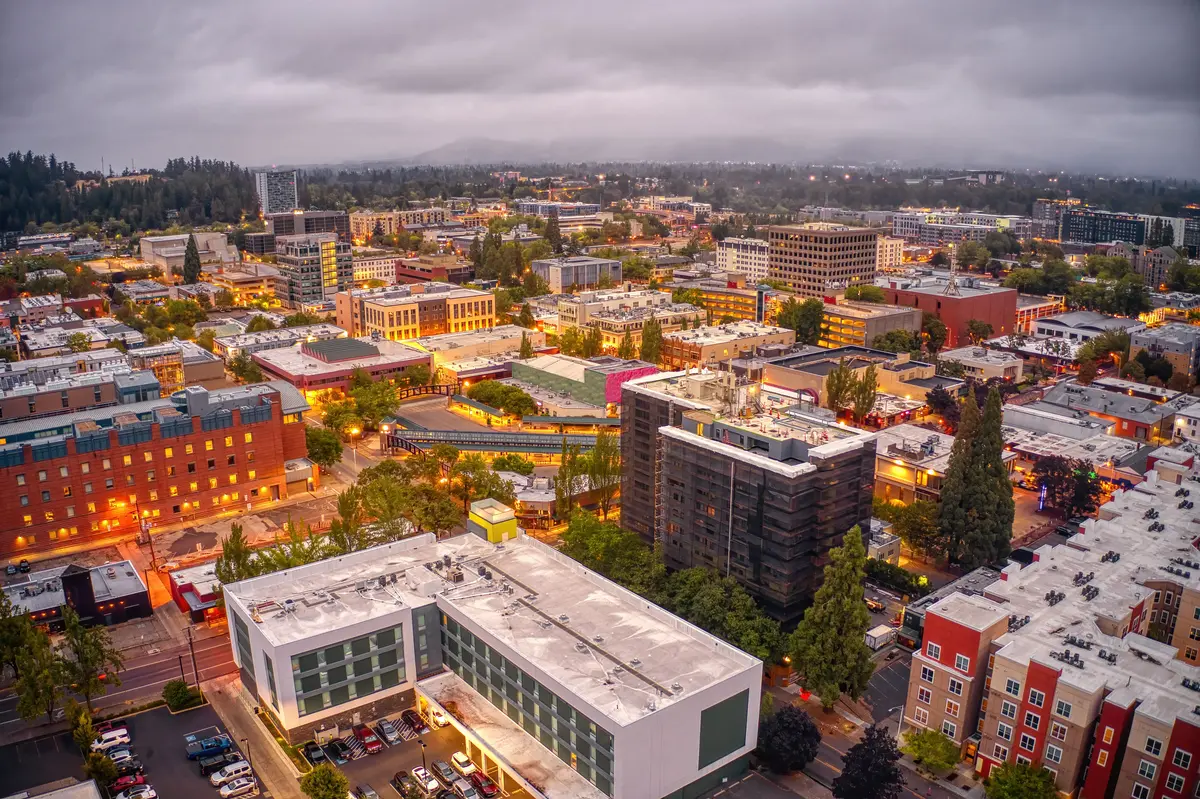
Eugene is a city of 178,618 — the 3rd-largest incorporated city in Oregon — anchored by the University of Oregon, Lane County government, and the City of Eugene itself. The university shapes a great deal of daily life here: the energy around Hayward Field and Autzen Stadium, the concentration of independent coffee roasters and food options, the arts programming at the Hult Center for the Performing Arts. The Eugene School District 4J is consistently regarded as one of Oregon's stronger urban districts, and families arriving from California's coastal metros find both school quality and housing access more straightforward than what they left behind.
The cost picture is the most immediate difference. Eugene's typical home value sits at $482,062 (July 2026) — see the full breakdown on the cost of living page — well below California's statewide typical home value of $773,735. Oregon collects no sales tax at all, which is an immediate, daily savings Californians feel from the moment they arrive. The honest counterweight is income tax: Oregon's system is more nuanced than the headline comparison suggests, and the savings do not flow automatically to most earners. That comparison gets its own section below.
Whether you are weighing a specific offer, trying to understand the tax picture before you list your California home, or just figuring out whether Eugene's lifestyle matches what you are looking for, the sections below break down the home price comparison, the tax realities, what daily life in Eugene looks like for California transplants, and what tends to surprise people after six months here.

Home Price Reality: What Your California Equity Buys Here
The single most common reaction California buyers have when they see Eugene's market is that they can finally buy without stretching. Eugene's typical home value stands at $482,062 (July 2026, Zillow Home Value Index). California's statewide typical home value of $773,735 puts that gap in perspective — Eugene comes in substantially below the statewide California figure, and that is before accounting for the Bay Area or Los Angeles metro premiums that many relocating buyers are actually leaving behind.
What that equity unlocks varies by neighborhood. Areas like Fairmount and Cal Young tend to run above the city median — older craftsman homes on larger lots near the university, or mid-century properties with established tree cover. Bethel, River Road, and Whiteaker offer entry points below the median, where California transplants who cashed out of appreciated coastal markets often find themselves buying outright or carrying a relatively modest loan. Santa Clara and the Friendly Area (also known as the South University and Amazon neighborhood) tend to land right at the city median. See the full neighborhood breakdown on the neighborhoods page.
One thing Californians who were long-term homeowners do not always anticipate: Proposition 13 had been artificially suppressing their property tax bill for years. That structural advantage disappears when you sell. Eugene's effective property tax rate is 0.95%, which is modestly above California's Prop-13-compressed effective rate — meaning you may pay more in annual property taxes here even on a less expensive home than you owned in California. The math still favors most buyers overall, but it is a real line item to include in your planning.
Homeowners 62 and older have one tool available that California does not offer in the same form: Oregon's property tax deferral program lets qualifying seniors defer payments until the property is sold, which can meaningfully ease cash-flow pressure for retirees living on fixed income. The affordability reality underneath all of this is that Eugene's median household income of $66,562 does not comfortably carry the typical home price here — so if you are arriving without California equity, the picture is tighter than the headline numbers suggest. If you are arriving with equity, it can change your options substantially.
The Tax Comparison Californians Actually Need to Read
Oregon's income tax story is more complicated than the headline — and it is the one area where Californians consistently make assumptions that turn out to be wrong.
The Sales Tax Difference Is Simple
Oregon has no state or local sales tax, full stop. California's statewide base sales tax rate of 7.25% — the highest in the country — climbs higher once local additions are included. On a household spending $40,000 a year on taxable goods, that difference adds up to a meaningful annual sum in Oregon. You feel this on every purchase, every day, without doing any math.
Income Tax: Not What You Expect
California's top state income tax rate of 13.3% applies only to the highest earners. Oregon's top rate is 9.9%, which sounds like an automatic win. It is not, for most people. Oregon's tax brackets compress steeply, meaning moderate earners hit higher marginal rates faster. The income-tax savings favor high earners; many middle-income households pay about the same as they would in California, or more. Do not count on income-tax savings as a given — run the actual numbers with a CPA who handles multi-state returns.
There is one meaningful offset available at lower and moderate income levels: Oregon allows taxpayers to subtract a portion of their federal income taxes paid from Oregon taxable income. This subtraction phases out at higher incomes and drops to zero for joint filers with federal adjusted gross income of $290,000 or more. For earners below that threshold, it reduces the effective Oregon tax burden meaningfully.
Remote Workers and Multi-State Situations
If you work remotely from Eugene for a California-based employer, you generally pay Oregon income tax, not California income tax. At the highest income levels, where Oregon's 9.9% top rate compares against California's top state income tax rate of 13.3%, that difference is real. Part-time California workers — people who travel to California for work regularly — may still owe California tax on income earned there. The multi-state picture is genuinely complex enough that a tax professional is not optional here; it is a necessary step before you finalize your move.
| Tax Category | Oregon (Eugene) | California (Statewide) |
|---|---|---|
| State sales tax | None | 7.25% base rate (higher with local additions) |
| Top income tax rate | 9.9% (above ~$125K single) | 13.3% top rate |
| Who actually saves on income tax | High earners benefit most; middle-income households often pay similar or more | Moderate earners generally pay less than they would in Oregon |
| Federal tax subtraction | Yes, up to income limits | No |
| Effective property tax rate | 0.95% (Eugene) | 0.71% (Prop-13-capped) |
| Senior property tax deferral | Yes, age 62+ (Oregon program) | Limited programs vary by county |
The table above is where the summary lives. The income tax line is the one that trips up most California arrivals, so read it carefully before building your relocation budget.
Daily Life Cost Differences: What Changes and What Doesn't
Day-to-day spending in Eugene — groceries, restaurants, utilities, services — runs noticeably below what Californians from major metros were spending. The gap is real across most spending categories, though it is not uniform. Arriving from Los Angeles or the Bay Area, most transplants notice the difference within their first few weeks of receipts.
What Gets Cheaper Immediately
Rent is the most dramatic shift. Eugene's typical two-bedroom apartment rent falls well below Bay Area and Los Angeles levels — see the full rental picture at the cost of living page. The absence of sales tax on every retail purchase adds up over a year in a way most Californians underestimate until they see their first few months of receipts. Gasoline, dining out, and everyday services all run below the Los Angeles and Bay Area baseline.
What Stays Roughly Similar
Utilities in Eugene track close to Oregon averages, which are broadly comparable to California. Groceries are noticeably cheaper on a like-for-like basis, though some California specialty items require more effort to source. A serious shopping run for certain specialty retail means driving out of town or ordering online for anything the local shops do not carry.
Healthcare Costs
Health insurance premiums in Oregon run noticeably below what most Californians were paying at comparable coverage levels, and routine care costs less here. The honest trade-off is access to specialist care — for complex or specialized treatment, you will drive farther than you did from a major California metro. For a full look at healthcare access in Eugene, see the retiring page.
The overall picture is a meaningful improvement in purchasing power for most Californians who move here, particularly those arriving from Los Angeles or the Bay Area. The improvements are not uniform across every spending category, but they are real and durable. Eugene is not cheap in an absolute sense — but it is substantially more affordable than where most of its California arrivals are coming from.
Looking to buy in Eugene? Estimate your payment.
Enter your numbers to see an estimated monthly mortgage payment.
Estimate only. Excludes HOA fees and mortgage insurance. The interest rate above is a starting point, not a quoted rate — replace it with your own to see real numbers. Insurance is a flat placeholder, not a Eugene quote.
What Eugene Is Actually Like: The Lifestyle Shift
Eugene's population of 178,618 makes it a real city with real city infrastructure — not a suburb you have been relocated to. There is a functioning downtown, genuine independent culture, and the University of Oregon's presence means arts, live music, and food options that would be unremarkable in San Francisco but stand out clearly against most Oregon cities of comparable size.
Outdoors as Daily Infrastructure
The outdoor access here is not background scenery — it functions as actual daily infrastructure. Alton Baker Park runs along the Willamette River and connects to a network of paths that commuters and runners use on weekdays without irony. Spencer Butte sits at the southern end of the city and offers a genuine summit hike within the city limits. The Ridgeline Trail System links several of the city's south hills parks into a continuous natural corridor. Mount Pisgah Arboretum sits just outside the city and draws serious birders and casual walkers in equal measure. The Cascades Raptor Center is a working wildlife rehabilitation facility and an educational landmark unlike anything most Californians had access to locally.
The Seasonal Reality
Eugene averages 155 sunny days a year. That figure lands hard on Californians who arrive expecting a Pacific Northwest version of what they left. The grey stretches from November through March are real, persistent, and worth taking seriously as a quality-of-life variable before you commit. Many California transplants sail through the first winter and struggle with the second, once the novelty of a new city has settled and the rain is just the rain. This is the thing most people admit nobody warned them about. The summers, by contrast, are long, dry, and genuinely spectacular — warm days, cool nights, and the kind of outdoor access that justifies the previous eight months.
Culture and Community Texture
Hayward Field — rebuilt and now widely considered among the premier track and field venues in the world — sits on the University of Oregon campus and hosts competitions that draw international athletes. Autzen Stadium fills for football in a way that reshapes the city's traffic and energy on game weekends. The Hult Center for the Performing Arts anchors the downtown performing arts calendar with a programming depth that surprises most arrivals. The Owen Rose Garden along the Willamette is the kind of place that becomes part of your weekly rhythm within a few months of living here. Skinner Butte Park overlooks downtown from the north bank and is where families, runners, and anyone who needs five minutes of perspective tends to end up.
Eugene School District 4J is consistently regarded as one of Oregon's stronger urban districts — for a full breakdown of individual schools and current ratings, see the schools page. Families arriving from California's coastal metros generally find the transition manageable, though performance varies meaningfully by school level and by neighborhood.
What Californians Get Wrong About Eugene (and What to Do Instead)
Most California arrivals make the same set of assumptions, and most of them are at least partially wrong. A few are wrong in ways that cost real money or real happiness.
Assuming Income Tax Savings Are Automatic
The headline — Oregon's 9.9% top rate versus California's 13.3% — is real. The implication that most California earners will automatically pay less income tax in Oregon is not. The income-tax advantage flows most clearly to high earners; households at moderate income levels often pay about the same in Oregon as they would in California, or more. The sales tax elimination is real and immediate; the income tax math requires a professional. Run your actual return numbers before you structure a financial plan around assumed savings.
Underestimating the Property Tax Shift
If you have owned your California home for more than a few years, Proposition 13 has been compressing your assessed value the entire time. Selling means losing that cap. Eugene's effective property tax rate of 0.95% is modest in absolute terms, but California's effective property tax rate of 0.71% — held artificially low by Prop 13 for long-term owners — may have made your tax bill feel lower than it reflects market-rate ownership. Budget for a higher annual property tax line in Eugene than you were paying in California, even on a less expensive home.
Not Checking Neighborhood Fit First
Eugene's neighborhoods have genuinely distinct characters, and the variation matters more than the city-wide numbers suggest. The neighborhoods page walks through what separates South Eugene, the Whiteaker, Fairmount, and the other major areas. Buying without understanding the geographic and cultural divide between these areas is the most common mistake relocating buyers make. A neighborhood that looks similar on paper — school proximity, commute access — can feel very different on a daily basis depending on which part of the city you land in.
Why People Leave Eugene
The exits are real and worth naming honestly. The most common reasons: the grey season is longer and heavier than people prepared for, the job market outside the university and public sector is genuinely thinner than in California's major metros, and Eugene lacks the specialist amenities — certain retail categories, certain professional services — that people from larger California cities had built into their daily routines. Remote workers and retirees arriving with California equity tend to thrive here. People who need Eugene to have a San Francisco-caliber job market, or who underestimated the winters, tend to struggle.
The Lane County Farmers Market and the Whiteaker Community Market are where you get a fast read on what Eugene actually values — local agriculture, independent vendors, a general preference for making things rather than buying them. That is the culture you are entering. If that resonates, the move tends to stick. If it does not, that is useful information to have before you close on a house. For a look at how Eugene's safety picture compares to Oregon and national benchmarks, see the safety page.

Local Expert Takeaway: The California-to-Eugene move works best when buyers arrive with equity and a clear-eyed understanding of the income tax picture. The home price gap is real — Eugene's typical value sits well below California's statewide typical home value of $773,735 — and the absence of sales tax is an immediate, daily savings. The catch is income tax: the advantage flows most clearly to high earners, and many middle-income households find they pay about the same in Oregon as they did in California. Long-term California homeowners will also likely pay a higher property tax rate here even on a less expensive home. Go to the Lane County Farmers Market your first weekend. Walk the Ridgeline Trail System. Take 155 sunny days a year at face value rather than assuming California sun. Eugene rewards arrivals who let the city be what it is.
Quick Takeaways & FAQs
✅ Eugene's typical home value is substantially below California's statewide typical home value of $773,735, and Oregon's zero sales tax delivers immediate, year-round savings on every purchase.
⚠️ Oregon's income tax does not automatically favor California earners — the advantage flows most clearly to high earners, while many middle-income households pay about the same or more than they would in California, so verify your specific situation with a CPA before assuming savings.
📍 Eugene-Springfield ranked as the number one inbound metro in the United Van Lines 2025 National Movers Study, meaning you will not be the first Californian your new neighbors have met — the transplant community here is large, established, and generally ready to compare notes on the winter.
Is Eugene cheaper than California to live in overall?
Will I pay less income tax in Oregon than in California?
How does property tax in Eugene compare to what I was paying in California?
What is the biggest thing that surprises California movers after six months in Eugene?
What kind of jobs are available in Eugene if I am not working remotely?
Moving to Oregon?
Tell us what you need help with and we'll connect you with local resources.
