What Is Living in Portland, Oregon Like?
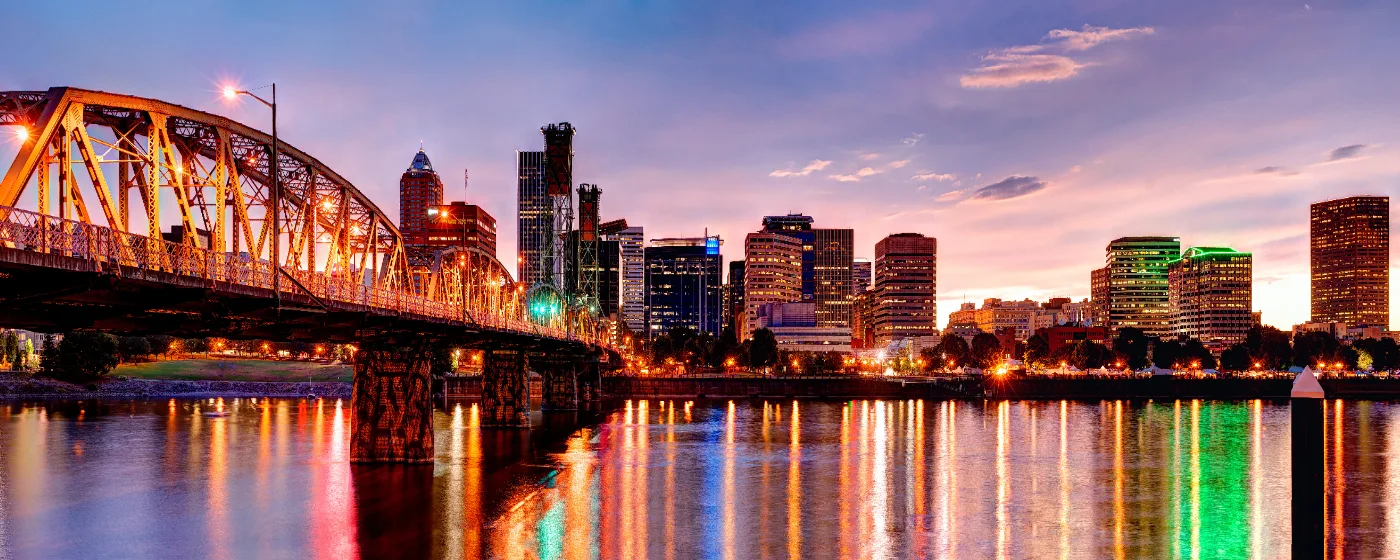
Maybe your company is relocating you here. Maybe you've been priced out of Seattle and someone mentioned Portland as the sensible alternative. Either way, Portland has a way of not being what people expected — in both directions. It is the largest incorporated city in Oregon, sitting at the confluence of the Willamette and Columbia rivers with I-5 running its spine and I-84 peeling east toward the Gorge. The freeways shape more than just traffic: they define which neighborhoods feel urban and walkable, which feel suburban and quiet, and which feel like a different city entirely. Getting that geography right before you make an offer is the single most useful thing this guide can do for you.
Portland's economic backbone is public-sector and healthcare. The State of Oregon, OHSU, Legacy Health, Portland Public Schools, and the City of Portland itself are the city's anchor employers. Healthcare remains the city's largest active hiring sector. That said, the Portland Metro Chamber's 2026 State of the Economy report flagged a real divergence: metro-area employment contracted in 2025 even as national employment grew, driven partly by trade-policy headwinds along the Pacific Rim. Portland is a genuine city with a genuine economy, but it is not a one-industry boomtown, and anyone moving here for private-sector work should go in clear-eyed about the current job market. Portland Public Schools is a large urban district with a B rating according to Niche — a solid, mid-tier district with meaningful variation across its schools.
Housing costs are noticeably below comparable Bay Area and Seattle markets, though the metro's cost of living overall runs roughly 30% above the national average, driven mainly by housing. Oregon's tax structure is a genuine quirk worth understanding: there is no state sales tax, which means the price on any Portland price tag is what you actually pay — but the state income tax is progressive and tops out at 9.9%, with Multnomah County and Metro-level surcharges adding roughly another 2.5% for many residents. The trade-off is real and it cuts both ways depending on your income and spending habits. Day-to-day life in Portland is defined by cycling infrastructure, food cart pods, dense independent coffee culture, and a neighborhood system that rewards people who pick the right part of the city for how they actually want to live. Forest Park's 5,200 acres of trails sit inside the city limits. The Willamette River Greenway runs for miles. The MAX light rail system covers nearly 60 miles of track — though service changes announced in 2025 are worth understanding before you assume the transit map you see online still reflects current service.
Whether you're considering a move or deep in the research phase, the sections below break down why people are choosing Portland right now, what daily life here actually feels like, the housing market as it stands, how people get around, and where locals spend their weekends.
Portland at a Glance
Looking to buy in Portland? Estimate your payment.
Enter your numbers to see an estimated monthly mortgage payment.
Estimate only. Excludes HOA fees and mortgage insurance. The interest rate above is a starting point, not a quoted rate — replace it with your own to see real numbers. Insurance is a flat placeholder, not a Portland quote.
Why Are People Moving to Portland?
The case for Portland is easier to make than the case against it — but both are worth reading. Start with what draws people in: Portland is one of a small handful of American cities where you can live without a car, work downtown, walk to a farmers market, and reach genuine wilderness within 30 minutes. That combination is genuinely rare at this population scale.
No Sales Tax, and What That Actually Means
Oregon is one of only five states with no state sales tax. Every purchase you make in Portland — groceries, furniture, a car — is priced at what the tag says. For households spending heavily on goods, this is a meaningful daily offset against the city's higher housing costs. The catch, and it is a real one: Oregon's income tax tops out at 9.9%, and Multnomah County and Metro-level surcharges can add roughly another 2.5% for many Portland residents. The tax structure rewards retirees and light earners; it is less friendly to high-income professionals. For a full picture of Portland's cost of living, including property and income taxes, that page breaks it down by category.
The Job Market — Honest Assessment
Healthcare is the dominant hiring engine right now. A major regional health system and a large academic medical center together account for hundreds of active job openings tracked in the Portland market. The State of Oregon and City of Portland government jobs provide stable employment that doesn't swing with private-sector cycles. What the market is not, in 2025 and into 2026, is an obvious tech-sector draw: the Portland Metro Chamber's 2026 State of the Economy report documented employment contraction even as national hiring grew — a genuine break from Portland's historical pattern. Anyone moving here for a private-sector role should research their specific sector carefully rather than assuming the rising-tide conditions of earlier years still apply.
Parks, Culture, and the Lifestyle Argument
Washington Park alone contains the Portland Japanese Garden, the International Rose Test Garden, Hoyt Arboretum, the World Forestry Center, and the Oregon Zoo — all within one connected green space that residents treat as a neighborhood amenity rather than a tourist destination. Forest Park covers 5,200 acres within city limits, making it one of the largest urban forested parks in the country. The annual Rose Festival, which has run every June since 1907, brings a Grand Floral Parade, dragon boat races on the Willamette, and waterfront activity that makes the city feel like itself in a way that's hard to replicate. These are not selling points layered on top of a city — they are what the city is organized around.
Portland's 2022 charter reform produced a new 12-member city council elected by ranked-choice voting, which began its term in January 2025 under Mayor Keith Wilson. The city government is genuinely in transition, and how that plays out over the next few years is part of what you are buying into.
What Daily Life Feels Like in Portland
Six months in, most newcomers say the same thing: they underestimated how much the neighborhood they chose would define their entire experience. Portland is not one city — it is a collection of distinct districts that each operate at a different register, and picking the wrong one for your lifestyle is the most common mistake people make.
The East–West Divide
The Willamette River is the first divide. The west side — Pearl District, Northwest District, the hills above — tends toward older money, denser housing, and more immediate access to Washington Park and Forest Park. The east side — Alberta, Division, Hawthorne, Foster-Powell, St. Johns — is where Portland's food cart pods, independent coffee culture, and cycling-first street design are most concentrated. Most people who move here from other cities picture the west side; most people who stay here long-term end up preferring the east.
Food Carts, Coffee, and 'Beervana'
Portland's food cart pods are not food trucks in the conventional sense. They are permanent lots — often with covered seating and dozens of vendors — serving serious gourmet food at accessible prices. The city's density of microbreweries has earned it the nickname 'Beervana' among people who track that kind of thing, and it is a fair one. Independent coffee runs deep here; this is not a city where the chain options are the best options, and most neighborhoods have their own local anchors that regulars treat with genuine loyalty.
What Surprises People After Six Months
The rain is not what visitors experience. Portland's precipitation is consistent and grey for months at a stretch, but it is rarely heavy — it is more mist and drizzle than downpour. The city gets 144 sunny days a year, which is lower than most newcomers from California or the Southwest expect, and the psychological adjustment to a grey November through February is real. Locals adapt by building routines around covered farmers markets, neighborhood coffee shops, and the indoor/outdoor flexibility of covered cycling lanes. The people who leave say the grey got to them. The people who stay say they stopped noticing it by year two.
Downtown's Recovery
Downtown Portland took a visible hit in 2020–2023. The honest picture in 2026 is one of slow but real improvement: new restaurant and retail openings have returned street-level activity, and longtime observers note it feels more alive than it did at the bottom. It is not the frenzied market of 2018, but it is not the emptied-out downtown of 2022 either. Buyers considering close-in neighborhoods should see downtown for themselves rather than relying on older accounts in either direction.
The Portland Housing Market Right Now
Portland's typical home price sits at $534,270 (Zillow Home Value Index, July 2026) — noticeably below comparable Seattle and Bay Area markets, and one of the main reasons the city keeps drawing buyers priced out of those metros. It is not inexpensive by any absolute measure: the median household income of $90,919 falls meaningfully short of what it takes to carry a typical home here at current rates, which means many buyers are stretching, relying on dual incomes, or bringing equity from a previous sale.
What the Market Actually Looks Like
Portland's housing stock is genuinely varied — from 1920s bungalows in Irvington and Sellwood to newer construction in the Pearl District. Some neighborhoods run well above the city-wide typical price; others give first-time buyers a realistic entry point. For a full breakdown of which areas sit where relative to that citywide figure, the best neighborhoods page covers that in detail.
Typical rent in Portland varies meaningfully by neighborhood and unit size. Renters considering Portland will find the range competitive with Seattle but still a real line item. For a side-by-side look at renting versus owning costs, the cost of living page breaks both down.
The Affordability Gap
The median household income in Portland is below — by a meaningful margin — the income typically needed to buy at the city-wide price point. That gap is what drives the pattern you'll see among buyers here: dual-income households, buyers bringing equity from previous homes, and people making conscious trade-offs on neighborhood or house size to close the affordability distance. It is honest to say that Portland requires financial stretching for a significant share of the people who want to own here.
The effective property tax rate is approximately 1.02% — moderate relative to many western metros, and a figure worth factoring into monthly budget conversations alongside the no-sales-tax offset.
Portland Neighborhoods
Portland has several distinct areas — each with its own character and appeal. Here’s a breakdown to help you narrow down where to focus your home search.
🏡 Pearl District
The Pearl is Portland's most urban neighborhood — converted warehouses and newer condominiums alongside galleries and independent restaurants, with pocket parks as the connective green tissue. It suits buyers who want density and walkability and are comfortable with a price point that runs above the city-wide typical for a downtown-adjacent address.
🏠 Northwest District (Nob Hill)
The Northwest District's walkable commercial corridors are lined with independent shops and restaurants, backed by Victorian-era housing stock that climbs toward the West Hills. It sits near the city-wide typical price level and draws buyers who want urban convenience with a more residential, tree-lined character than the Pearl.
🌳 Irvington
Irvington is one of Portland's most sought-after historic neighborhoods — wide tree-lined streets, substantial early-20th-century homes, and a quiet that feels deliberately protected. It runs above the city-wide typical price, and the demand for that housing stock is consistent enough that well-priced homes here rarely sit long.
🏘 Sellwood-Moreland
Sellwood-Moreland sits at the southern end of the city along the Willamette, with an antique district, local restaurants, and a park system that backs up to the river. It also runs above the city-wide typical price and draws parents with school-age children who want a walkable neighborhood feel without giving up access to the broader city.
🏔 Alberta Arts District
Alberta Arts District is the east side at its most expressive — a concentrated stretch of murals, independent galleries, and restaurants that reflects Portland's creative culture more visibly than almost any other neighborhood. It suits buyers who want to be in the cultural life of the city and are comfortable with a neighborhood still in the middle of its own evolution.
🌆 Hawthorne / Richmond
Hawthorne is the east side's most established walkable corridor — bookshops, cafés, and neighborhood restaurants lining SE Hawthorne Boulevard through a residential fabric of bungalows and craftsman homes. Richmond, the neighborhood behind it, is where many families with school-age children land when they want that walkable street life at a price that remains reachable.
Pros & Cons of Living in Portland
The Pros
- Unmatched access to outdoor recreation with mountains, coast, and rivers nearby
- No state sales tax
- Strong food, coffee, and craft beer culture
- Robust public transit and bike infrastructure
The Cons
- High property crime rates relative to similarly sized cities
- Steep home prices relative to local wages
- Persistent gray, rainy winters with limited sunshine
Getting Around & Commuting in Portland
Portland's transit infrastructure is one of the most extensive in the American West — and also, right now, one of the most in flux. Understanding both sides of that is essential before you make a decision about where to live relative to where you work.
The MAX System — What It Covers, and the Current Caveat
The MAX light rail runs five color-coded lines covering nearly 60 miles of track and close to 100 stations. The system connects downtown Portland to Portland International Airport (PDX), Hillsboro to the west, Gresham to the east, and Milwaukie to the south — making it one of the few regional transit networks in the country that legitimately serves an airport, a tech employment corridor, and multiple suburb centers on a single unified system.
The important caveat: service changes announced in 2025 have reduced coverage on some corridors, and the Green Line was shortened in 2026 so that it no longer serves downtown Portland. Anyone making a housing decision based on MAX proximity should verify current line service — the system that exists today is not the same as what maps published before mid-2025 showed.
Driving Portland
I-5 is the city's north-south spine, and I-84 is the primary east-west corridor. I-205 runs along the east side and is often the faster alternative to I-5 for trips to the airport or to Vancouver, WA. US-26 (the Sunset Highway) connects the west side to Beaverton and beyond. OR-99W and OR-99E carry the surface-street arterial load on the southwest and southeast sides respectively.
The I-5 corridor through downtown is the most reliable chokepoint in the metro — weekday morning and afternoon rush periods on the river crossing can add 20 minutes to what looks like a five-mile trip. Buyers who work in Beaverton or the Hillsboro tech corridor should think carefully about which side of the river they want to live on, because the Sunset Highway (US-26) is a fundamentally different commute experience than I-5.
Cycling as a Real Mode of Transport
Portland has more dedicated bike infrastructure than nearly any American city its size. On the east side especially, protected lanes and low-traffic neighborhood greenways make cycling a genuine daily commute option — not just a recreational one. This is not window dressing: a meaningful share of Portland residents commute by bike year-round, rain included, and the neighborhood system is built around it.
Portland International Airport
PDX is approximately 10 miles from downtown and is among the most consistently well-regarded airports in the country for its size. The MAX airport line connects downtown directly to PDX — check current service before relying on that connection, given the service changes underway.
| Destination | Typical Route | Approx. Drive Time |
|---|---|---|
| Downtown Portland | I-5 | varies by origin |
| Portland International Airport (PDX) | I-205 / I-84 | ~20 min (off-peak) |
| Beaverton / Hillsboro | US-26 | ~20–30 min |
| Lake Oswego | OR-43 | ~20 min |
| Gresham | I-84 / OR-99E | ~25 min |
| Vancouver, WA | I-5 north | ~20–30 min |
Schools in Portland
Families relocating to Portland have public, private, and higher-education options nearby. Here’s a quick overview.
🎓 School District
Portland Public Schools serves K–12 students across Portland and the surrounding area. Rated B (source: Niche.com).
🏆 Graduation Rate
The 4-year high-school graduation rate here is approximately 82.5%.
📚 Higher Education
Oregon’s public universities — the University of Oregon, Oregon State University, and Portland State University — offer four-year degrees statewide, with a network of 17 community colleges providing two-year and workforce programs.
🌐 Online Learning
Oregon State University Ecampus and Portland State University Online offer fully accredited online degrees for remote learners across the state.
Safety in Portland
A quick look at how Portland compares on the numbers that matter most when weighing a neighborhood or a move.
🛡 Violent Crime
Approximately 8.5 per 1,000 residents.
🔒 Property Crime
Approximately 59.8 per 1,000 residents.
Compared to the most recent national figures from the Bureau of Justice Statistics (2024), Portland’s violent crime is above the national average (about 3.7 per 1,000), and property crime is above the national average (about 18.4 per 1,000).
Against Oregon as a whole, Portland’s violent crime is about three times the state average, and property crime is about three times the state average (Bureau of Justice Statistics, Crime Known to Law Enforcement, 2024 (tables 2 and 3)).
Crime rates can vary a lot within a single city, so the citywide numbers above are only a starting point. Some neighborhoods in Portland run well below these averages, while others run higher — the kind of block-by-block detail that matters most when you’re actually choosing where to live. The full guide below breaks it down neighborhood by neighborhood.
Working in Portland
Portland’s largest employers span several industries — here are some of the anchors of the local job market.
🏛 State of Oregon
Government
🏥 Legacy Health
Healthcare
🏥 OHSU
Healthcare
🎓 Portland Public Schools
Education
🏛 City of Portland
Municipal government
Parks & Recreation in Portland
Some of the outdoor spaces that shape everyday life in Portland.
🌱 Washington Park & International Rose Test Garden
🌱 Portland Japanese Garden
Portland residents don’t have to go far for green space — spots like Washington Park & International Rose Test Garden and Portland Japanese Garden are part of everyday life here, whether that’s a morning walk, a weekend hike, or just somewhere to unwind outside. The full guide below covers more of what Portland has to offer for parks and outdoor recreation.
Retiring in Portland
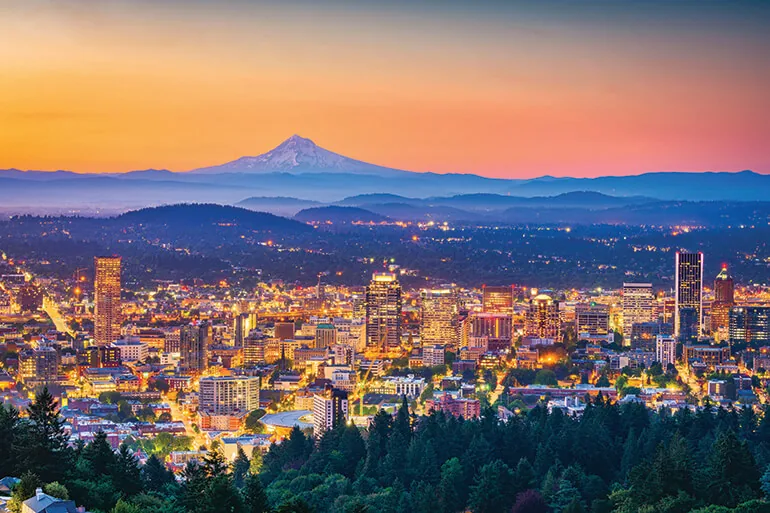
Portland draws retirees for its balance of amenities, outdoor access, and cost. Here’s what to weigh.
🌤 Climate
Portland's climate is mild year-round by most measures — winters rarely freeze and summers are warm and dry. The trade-off is a long grey season: from roughly November through March, overcast skies and persistent drizzle are the norm, with 144 sunny days a year in total. Retirees from the Southwest tend to find the adjustment to the grey the biggest lifestyle shift; those coming from the Midwest often find it a relief.
🍴 Lifestyle
Portland's cultural and culinary infrastructure is genuine. The Portland Saturday Market, Washington Park, the Japanese Garden, and a dense independent restaurant and coffee scene give retirees a genuinely active daily life without needing a car in many neighborhoods. Downtown has seen noticeable recovery since its low point in 2023–24, and the waterfront along the Willamette is an accessible, walkable corridor for regular use.
🏚 55+ Communities
Summerplace is Portland's established 55+ community for buyers seeking a neighborhood specifically designed around that life stage. Portland's broader housing stock also includes a range of condominiums in the Pearl District that attract active retirees looking for walkable, low-maintenance living. The retiring page covers the full picture of what Portland offers for buyers in this phase of life.
✈ Getting Around
The MAX light rail connects key parts of the city, though service changes announced in 2025 have reduced coverage on some lines — verifying current routes before choosing a neighborhood is advisable. Portland International Airport (PDX) is approximately 10 miles from downtown and is straightforward to reach by car or the airport rail line. Most close-in neighborhoods support a walkable daily routine, while outer neighborhoods remain car-dependent.
🏛 Oregon Taxes for Retirees — What to Know
- Social Security is not taxed — Oregon does not tax Social Security or Railroad Retirement benefits. Any amount included in your federal adjusted gross income is subtracted back out on the Oregon return.
- But other retirement income IS taxed — This is the trade-off that surprises people moving from Washington or Texas. Pension distributions and 401(k)/IRA withdrawals are taxed as ordinary income at Oregon’s regular rates — there is no blanket retirement-income exclusion.
- Graduated income tax — Oregon has four brackets — 4.75%, 6.75%, 8.75% and 9.9%. The 4.75% rate covers the first $10,000 of taxable income for a single filer ($20,000 filing jointly); the 8.75% rate starts at $125,000 ($250,000 jointly); and the top 9.9% rate applies above $250,000 ($500,000 jointly).
- No sales tax — Oregon levies no general sales tax.
- Property taxes, with senior deferral — Oregon’s Senior and Disabled Property Tax Deferral lets qualifying homeowners have the state pay their county property taxes, with a lien recorded against the home. The 2026 household income limit is $70,000, and deferred balances accrue 6% simple interest — it defers the bill rather than forgiving it.
- Estate tax — the one to plan for — Oregon has its own estate tax with a $1 million filing threshold — far below the federal exemption, and NOT indexed for inflation, so it reaches more estates every year in real terms. Retirement accounts and a long-held home count toward the taxable estate, so estates that feel modest can cross the line without the owner expecting it.
- No inheritance tax — Oregon has no separate inheritance tax and no gift tax.
Tax laws change frequently and individual situations vary. This is general information, not tax advice — always consult a qualified Oregon tax professional or CPA for personalized retirement tax planning.
Weekends & Local Favorites in Portland
Portland's weekend culture is built around markets, parks, and neighborhoods that reward walking. The city has a density of independent restaurants, coffee roasters, and outdoor spaces that makes a Saturday here feel genuinely different from a Saturday in most American cities — not because someone planned it that way, but because the infrastructure for it accumulated over decades.
The Markets
The Portland Saturday Market along Tom McCall Waterfront Park has run continuously since 1974, making it the largest continuously operating open-air crafts market in the United States. It runs through the warm months and into the holiday season — local makers, artisans, food vendors, and live music in a stretch that doubles as a good reason to walk the waterfront. The Portland Farmers Market at PSU anchors the South Park Blocks and is the city's premier produce and food-producer market; the Montavilla Farmers Market on the east side gives that neighborhood its own version of the same ritual.
Parks That Actually Get Used
Forest Park is 5,200 acres of ridge trails inside city limits — Wildwood Trail alone runs over 30 miles. Washington Park packages the Portland Japanese Garden, the International Rose Test Garden, Hoyt Arboretum, the World Forestry Center, and the Oregon Zoo into one connected green space that families treat as a standing weekend option rather than a once-a-year destination. Mt. Tabor Park sits on an extinct volcanic butte in the middle of the east side and gives that part of the city a landmark that doubles as a neighborhood gathering point. The Willamette River Greenway and Sauvie Island round out the outdoor options for anyone who wants water and open space without leaving the metro.
Coffee and Food
Portland's independent coffee culture is not a marketing position — it is genuinely the dominant form. Coava Coffee Roasters, Rose City Coffee Co., Keeper Coffee Co, Heretic Coffee Co., and Good Coffee are among the verified local roasters and cafés that longtime residents actually use. The dining end of the weekend runs from Farmhouse Kitchen Thai Cuisine Pearl District and Andina to Screen Door Eastside (expect a line for weekend brunch), Luc Lac Vietnamese Kitchen, and Portland City Grill for a high-rise view of the city. Food cart pods add a layer that no other comparably-sized American city replicates — permanent clusters of serious gourmet vendors that regulars treat as a neighborhood dining room.
The Rose Festival
The Rose Festival has anchored the city's June calendar since 1907. The Grand Floral Parade, dragon boat races on the Willamette, and waterfront carnival rides make it a week that newcomers tend to stumble into and then show up to intentionally for the rest of their lives. It is the single best introduction to the city as a place with a civic identity — and a useful counterweight to the greyness that preceded it all spring.
Local favorites in Portland
Restaurants
- Farmhouse Kitchen Thai Cuisine Pearl District
- Portland City Grill
- Screen Door Eastside
- Luc Lac Vietnamese Kitchen
- Andina
Outdoors
- Forest Park
- Washington Park
- Mt. Tabor Park
- Willamette River Greenway
- Sauvie Island
Coffee
- Coava Coffee Roasters
- Rose City Coffee Co.
- Keeper Coffee Co
- Heretic Coffee Co.
- Good Coffee
Farmers Markets
- Portland Farmers Market at PSU
- Montavilla Farmers Market
Top Things Locals Say About Portland
The best intel about a city comes from the people who actually live there. Here’s what Portland residents say when newcomers ask the questions everyone’s thinking.
“I thought I understood Portland from visiting twice, but living here taught me that the east side and the west side are genuinely different cities. I bought near Division and didn't realize until month two that my husband's commute to the west side was going to be the thing we talked about every single evening.”
— Recent Portland home buyer
“What's the most surprising thing about living in Portland?”
How much the neighborhood defines everything. Irvington and Alberta feel like small towns embedded in a big city; the Pearl feels like a downtown high-rise neighborhood. People in Portland don't really say they live 'in Portland' — they say they live in Hawthorne, or St. Johns, or Sellwood. That identity is real and it affects who you run into, how you commute, and what your weekend looks like.
“What do locals love most about Portland?”
The combination of access. You can walk to a farmers market, bike to work, and be standing in genuine wilderness at Forest Park or out on Sauvie Island on the same Saturday. The food cart pods are something people genuinely miss when they leave — not just the food, but the ritual of standing at a picnic table in the rain eating something great. And Powell's City of Books is one of those places that still surprises you no matter how many times you go in.
“What should newcomers to Portland know?”
Verify the MAX service before you commit to a neighborhood based on the light rail map. The Green Line was cut back in 2026, and service on several corridors is not what it was two years ago. Also: OR-99W is the surface-street alternative to I-5 on the southwest side, and knowing when to use it versus the freeway is one of those things locals figure out by trial and error. Don't wait for someone to tell you — just try both.
“How much do you need a car in Portland?”
It depends almost entirely on where you live and where you work. In the Pearl District, Northwest, Alberta, or Hawthorne, many daily errands are walkable or bikeable, and the MAX handles longer trips. If you're in a hillside neighborhood west of the river, or anywhere in the outer southeast, most routine errands mean a drive. A lot of Portland households own one car rather than two — transit and cycling cover enough of the week that the second car doesn't pencil out. But saying you can live here car-free is really only accurate for the close-in neighborhoods.
Cities Near Portland
Other communities near Portland worth a look — each with its own character and price point.
| City | Distance | Best For | Vibe | Median Rent | Median Buy |
|---|---|---|---|---|---|
| Beaverton | 8 mi | Tech workers & suburban families | Suburban, diverse, well-served | $1,880 | $527,947 |
| Gresham | 15 mi | Value-focused buyers & commuters | Working-class, unpretentious, eastside | $1,611 | $470,730 |
| Lake Oswego | 8 mi | Upscale buyers & established professionals | Affluent, quiet, waterfront | $2,209 | $889,944 |
More Helpful Guides for Portland
Going deeper on Portland? Our blog series covers everything from first-time buying to retiring here — explore the guides below.
Local Expert Takeaway: Portland rewards buyers who spend time in the city before they buy — specifically, who spend time on both the east and west sides before deciding which one fits them. The Pearl District and Northwest neighborhoods offer walkability and proximity to Washington Park but at above-median prices and with a different energy than the eastside districts. Alberta, Hawthorne, Division, and Foster-Powell are where Portland's food cart pods, independent coffee, and cycling culture are densest. The commute math changes significantly depending on where you land relative to I-5 versus US-26 — and with MAX service changes ongoing, verifying current light rail coverage before buying near a station is genuinely important right now.
Quick Takeaways & FAQs
✅ Forest Park's 5,200 acres of trail and Washington Park's five major attractions sit inside city limits — Portland's outdoor access is a genuine lifestyle asset, not a marketing claim.
⚠️ The city's typical home price of $534,270 (July 2026) sits below Seattle and Bay Area levels, but the median household income falls meaningfully short of what's needed to buy at that price — stretching is the norm, not the exception.
📍 The MAX light rail covers nearly 60 miles of track, but service changes announced in 2025 are ongoing — verify current line coverage before choosing a neighborhood based on transit access.
What is the typical home price in Portland, Oregon right now?
Is Portland, Oregon a good place to raise a family?
How does Oregon's no-sales-tax rule affect living in Portland?
How is the MAX light rail in Portland — is it reliable for commuting?
What are the main reasons people leave Portland after moving there?
Helpful Links for Moving to Portland
Moving to Oregon?
Tell us what you need help with and we'll connect you with local resources.
