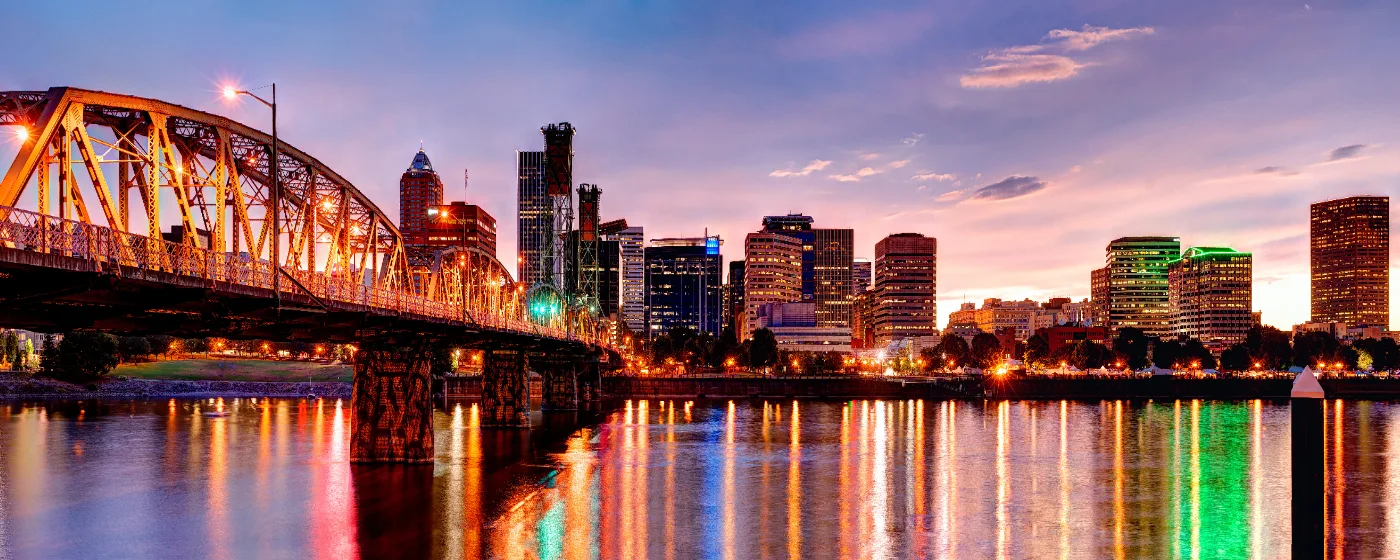
If you're deciding where in Portland to plant roots, the city's sheer size is the first thing that catches people off guard. With a population of 640,623, Portland is the largest incorporated city in Oregon — and that scale means neighborhoods can feel like entirely separate towns with distinct economies, housing stocks, and daily rhythms. The Willamette River cuts the city into West and East sides, and that divide carries real weight: most of the walkable, historically dense neighborhoods sit east of the river, while the West Hills hold quieter, more wooded terrain. Buying without understanding this east-west split, and the further divide between neighborhoods closer to the river versus those further out, is the most common mistake relocating buyers make.
Portland's economy is anchored by the State of Oregon, Legacy Health, OHSU, Portland Public Schools, and the City of Portland — a mix that skews heavily toward government, healthcare, and education. That employer base gives the city a somewhat insulated job market, but it also means the highest-paying private-sector work often sits in neighboring suburbs. Portland Public Schools serves a large and diverse student population and holds a B rating, according to Niche — a solid starting point, though school quality varies significantly by building and neighborhood boundary. Many buyers moving from other metros are surprised to find that school assignment can meaningfully shift based on which side of an arterial they buy on.
The typical home price in Portland sits at $534,270 (Zillow Home Value Index, July 2026), which puts it noticeably below Lake Oswego and roughly in line with Beaverton, with Gresham offering a somewhat lower entry point. The city's typical 2BR rent runs $1,590–$1,930, and the effective property tax rate is approximately 1.02%. Day-to-day life here is defined by Forest Park, the Saturday Market along the Willamette, Powell's City of Books, the Portland Farmers Market at PSU, and a network of MAX light rail and Portland Streetcar lines that make car-free living genuinely practical in the neighborhoods closest to the river — though outer neighborhoods are firmly car-dependent. Portland averages 144 sunny days a year, and newcomers from sunnier states consistently underestimate how much the nine months of overcast sky shape the city's indoor culture, its coffee scene, and its residents' outdoor urgency when the sun does appear.
Whether you're comparing neighborhoods on paper or trying to understand what daily life actually looks like from block to block, the sections below break down Portland's eight key neighborhoods, the buyer types each suits best, common mistakes to avoid, and where renters tend to land first.
The Portland Reality
The Divide That Decides Everything
Portland is functionally two cities joined at the river. The West Side — the Pearl District, Northwest District — offers the most walkable streets, the Portland Streetcar, and immediate access to Forest Park. The East Side holds everything else: Irvington's historic homes, Hawthorne's counterculture corridor, the affordability of St. Johns, and the family-friendly density of Division Street and Foster-Powell. Buyers who don't spend time on both sides before making an offer routinely end up in the wrong half.
The bigger trap is assuming that neighborhoods close to the river and those further east are interchangeable once you've settled on a side. The neighborhoods nearest the Willamette — Hawthorne, Sellwood — have mature trees, walkable commercial strips, and a decades-deep sense of community. Further east, beyond the reach of the Streetcar lines, most errands require a car and the buyer profile shifts accordingly. That boundary moves street by street, and it doesn't show up on a zip code map.
Portland Public Schools adds another layer of complexity. The district's attendance boundaries don't follow neighborhood lines cleanly, and two homes on the same block can feed into different elementary schools depending on a minor jog in the zone map. Parents buying in Irvington or Richmond specifically for a school should pull the current boundary map before making an offer — not after. For a full breakdown of school performance and boundary patterns, see the Portland schools guide.
Neighborhoods at a Glance
| Neighborhood | Best For | Vibe |
|---|---|---|
| Pearl District | Walkable Renter | Dense, gallery-lined, condo-heavy; the city's most urban block-by-block experience |
| Northwest District (Nob Hill) | Walkable Nature | Victorian streetcar suburb with Forest Park at the back door; sophisticated and unhurried |
| Irvington | Families Luxury | Oregon's largest historic district; wide lots, preserved Craftsman homes, tree-canopied streets |
| Sellwood-Moreland | Families Quiet | River-adjacent, antique-shop friendly, small-town feel with genuine urban access |
| Alberta Arts District | First-Time Walkable | Mural-lined corridor with monthly street fairs; creative and community-oriented |
| Hawthorne / Richmond | First-Time Nature | Portland's most countercultural stretch; bookstores, independent cafés, Mt. Tabor at the edge |
| St. Johns | Value Privacy | North Portland small-town pocket; creative community under an iconic Gothic bridge |
| Division Street / Foster-Powell | Families Value | Bike-friendly, diagonally-gridded; the most actively reinventing neighborhood in the city |
Portland typical home price: $534,270 (Zillow ZHVI, July 2026). Typical rent: $1,723/mo (Zillow ZORI, July 2026). Neighborhood tiers on this page are relative to these figures.
Best Neighborhood by Buyer Type
| Buyer Type | Best Neighborhood | Why |
|---|---|---|
| First-Time Buyer | Alberta Arts District | Prices sit closer to reach for entry-level buyers than the Pearl or Irvington, and the community infrastructure — farmers markets, street fairs, walkable coffee shops — means you don't need a big renovation budget to feel at home immediately. |
| Luxury Buyer | Irvington | Prices run above the city median and the historic district designation keeps the streetscape stable, making this the most defensible premium purchase in the city for buyers who want character alongside price appreciation. |
| Walkability Seeker | Pearl District | The Portland Streetcar, Powell's City of Books, and a grid designed for pedestrians make car-free daily life more achievable here than anywhere else in Oregon. |
| Families with Kids | Sellwood-Moreland | Oaks Bottom Wildlife Refuge, tree-lined residential streets, and a genuinely small-town commercial strip give families the outdoor access and community texture that matter most once kids arrive. |
| Commuters | Northwest District (Nob Hill) | The Portland Streetcar connects directly to downtown, and proximity to US-26 (Sunset Highway) puts the Hillsboro Silicon Forest corridor within reach without crossing the full metro. |
| Large-Lot Buyers | Irvington | The neighborhood's historic platting produces some of Portland's largest in-city lots, with homes that sit on genuine parcels rather than the tight infill footprints common in the city's outer rings. |
| Renters | Division Street / Foster-Powell | Relative affordability, active civic investment through the FPNA's Better Center project, and a bike-friendly street network make this the city's best value for renters who want a real neighborhood feel without Pearl District pricing. |
Looking to buy in Portland? Estimate your payment.
Enter your numbers to see an estimated monthly mortgage payment.
Estimate only. Excludes HOA fees and mortgage insurance. The interest rate above is a starting point, not a quoted rate — replace it with your own to see real numbers. Insurance is a flat placeholder, not a Portland quote.
Most Popular Neighborhoods
Pearl District
The Pearl transformed from a railroad freight yard into Portland's most fully realized urban neighborhood over roughly three decades, and it shows: the mixed-use grid is tight, the streetcar runs frequently, and monthly First Thursday gallery openings give the calendar a cultural rhythm that other neighborhoods only approximate. The trade-off is density — this is condo living, not Craftsman bungalows, and the street-level energy that makes weekends electric can make weekday mornings feel crowded. Prices sit below the city median, which surprises buyers who assume the prestige address commands a premium; what you're actually paying for is the lifestyle, not the square footage.
Best for: buyers who want urban density, car-free on-foot access, and a walkable cultural scene over yard space or architectural history.
Northwest District (Nob Hill)
NW 23rd Avenue — locally called "Trendy-third" — anchors a Victorian streetcar suburb that manages to feel both historic and genuinely livable, with boutiques and independent restaurants filling restored buildings and Forest Park beginning practically at the neighborhood's western edge. The Portland Streetcar's NS line connects residents to the Pearl and downtown without a car, making this one of the two most walkable neighborhoods in the city. The neighborhood's older Victorian housing stock carries real character along with maintenance costs that add up over time.
Best for: buyers who want on-foot access to daily needs, immediate proximity to more than 5,200 acres of Forest Park, and a neighborhood with genuine architectural character.
Irvington
Oregon's largest National Register Historic District has been listed since 2010, and the designation means roughly 85% of properties are classified as contributing structures — exterior renovations require a Historic Resource Review, which slows down flip projects but also protects the neighborhood's Queen Anne, Craftsman, and Colonial Revival streetscape from being erased. Prices run above the city median, and the trade-off is that renovation ambitions face real constraints: replacing windows, altering facades, or adding dormers can trigger a review process that surprises buyers used to permitting in less-regulated markets. What you get in return is arguably the most intact early-twentieth-century residential landscape in the Pacific Northwest.
Best for: buyers drawn to architectural history, wide residential lots, and a northeast Portland location that keeps downtown commutes short — who are also prepared to work within historic preservation guidelines.
Sellwood-Moreland
Sellwood began as its own city in 1882, was annexed by Portland in 1893, and has spent the century-plus since then quietly being one of the better places to live in the metro — antique shops, Craftsman homes, the Sellwood-Moreland Improvement League (SMILE) keeping the community organized, and Oaks Bottom Wildlife Refuge providing genuine wetland habitat a short walk from residential streets. Prices run above the city median, and the honest catch is geography: Sellwood sits at the southern tip of the inner city, which means commutes to the west side or the Hillsboro corridor are longer than the neighborhood's pleasant character might suggest. Buyers who work downtown or in the inner eastside will find the drive manageable; those heading to Beaverton daily should map the route first.
Best for: families with kids and anyone who values a walkable, small-town commercial strip with riverfront access — and who commute east or downtown rather than west.
Alberta Arts District
Alberta Street runs northeast through a corridor of colorful murals, independent galleries, and the monthly Last Thursday street fair, which brings live music, food trucks, and locally made artwork to the sidewalk in a format that feels genuinely grassroots rather than curated. The neighborhood has a real creative community with historical depth — markers along Alberta Street document the area's cultural heritage — and the commercial strip rewards walking in a way that suburban neighborhoods simply don't. The honest trade-off is that Alberta has gentrified significantly, meaning long-term affordability for buyers is not guaranteed, and the neighborhood's transitional blocks are unevenly maintained.
Best for: buyers who want an artsy, walkable northeast Portland address with a strong community identity and monthly cultural programming built into the calendar.
Hawthorne / Richmond
SE Hawthorne Boulevard is Portland's most reliably countercultural commercial corridor — independent bookstores, coffee shops where the staff knows regulars by order, and a density of restaurants that punches well above what the neighborhood's residential footprint would suggest. Mt. Tabor Park, an extinct volcano converted into one of the city's most beloved green spaces, sits on the Richmond side and draws residents for morning runs, reservoir walks, and the kind of quiet that's hard to find this close to a commercial strip. The trade-off is that Hawthorne's popularity has pushed prices above what buyers often expect once they fall in love with the vibe, and parking on the main corridor has been contentious for years.
Best for: buyers who want Portland's most established bohemian address, within walking distance of Mt. Tabor Park and the city's best concentration of independent retail.
St. Johns
St. Johns is the neighborhood that Portland people mean when they say the city still has unhurried corners — anchored by the Gothic-style St. Johns Bridge spanning the Willamette, it operates at a slower pace than the neighborhoods closer to the river, with independent shops, a creative community, and a genuine small-town feel that persists even as the rest of North Portland grows more expensive. Prices sit below the city median, making it one of the most accessible entry points into Portland homeownership. The honest catch: it's a meaningful drive from downtown, and the commute to the inner eastside or the Pearl feels longer than the miles suggest because of the bridge crossing.
Best for: buyers who want below-median pricing, a tight-knit creative community, and a North Portland address with access to the Willamette River Greenway — and who don't need to cross the river to work every day.
Division Street / Foster-Powell
Foster Road's diagonal path cuts across Portland's otherwise rigid grid, giving this pocket of inner southeast a distinctive map shape and a street-level energy that feels different from the more orderly corridors nearby — the neighborhood is dense with young families, immigrants, and the kind of civic engagement that produces real results, like the FPNA's Better Center project launched in early 2026 to make the main corridor safer and more accessible. The Portland Mercado, a Latin American food and retail hub, was damaged by fire in January 2024 and began reconstruction in summer 2025, with plans to reopen in fall 2026 featuring indoor retail, outdoor food carts, and a rooftop terrace. The trade-off is that Foster-Powell is still mid-transformation — buyers who want a finished neighborhood will find it feels more like a work-in-progress than Hawthorne or Sellwood, even if the trajectory is clearly upward.
Best for: buyers who want relative affordability, a bike-friendly street network, and a neighborhood with genuine community investment and a multicultural food scene — who are comfortable buying into a place that's still finding its full form.
Common Mistakes Buyers Make in Portland
Assuming the East Side Is Uniform
The neighborhoods closest to the Willamette on the east side and those further out are not the same market. Buyers drawn by the Hawthorne or Sellwood reputation sometimes widen their search radius to stay in budget and end up well east of the neighborhoods they fell in love with, in a part of the city that is car-dependent and less connected to the MAX or Streetcar network. Always map the commute from the actual address, not the neighborhood name.
Ignoring the School Boundary Before Signing
Portland Public Schools enrollment boundaries don't follow neighborhood edges, and a home in Irvington or Richmond that looks like a clear win for a particular elementary school may sit on the wrong side of the line. The district's boundary map is updated periodically, and the version on a real estate listing site may be a cycle behind. Families who care about a specific building need to verify the address against the current Portland Public Schools boundary map — not the one embedded in the listing.
Buying in the Pearl for the Lifestyle and Getting Surprised by HOA Fees
The Pearl's condo density means that most purchases come with a homeowners association, and monthly fees for high-rise or mid-rise buildings in that corridor can be substantial enough to shift the effective cost of ownership well past what the purchase price alone implies. Buyers who move from single-family markets and aren't used to factoring HOA dues into their budget sometimes discover this after they've fallen in love with the unit. Run the full monthly cost — not just principal and interest — before comparing the Pearl to a Sellwood bungalow. For a broader look at Portland cost of living, see the cost of living page.
Underestimating the Bridge-Crossing Tax in St. Johns
St. Johns is below the city median in price and genuinely has the small-town community feel that buyers are promised — but the St. Johns Bridge is the primary crossing, and on mornings when it backs up or when a driver needs to reach the inner eastside, the commute adds meaningful time. Buyers who work at OHSU or anywhere on the southwest side should drive the route at commute hour before committing. The distance in miles looks short; the experience in traffic often isn't.
Best Areas to Rent in Portland
| Area | Ideal For | Trade-off |
|---|---|---|
| Pearl District | Urban professionals, new arrivals who want walkable access from day one | The city's most expensive rental zone; studio and one-bedroom apartments command a premium that's hard to justify without maximizing the car-free lifestyle |
| Northwest District (Nob Hill) | Renters who want Victorian character and Forest Park access without buying | Parking is limited and competitive; older buildings can mean charm at the cost of modern insulation and soundproofing |
| Hawthorne / Richmond | Renters who want a walkable, culturally rich east-side address at a step below Pearl pricing | Demand is high and unit turnover is low; finding a vacancy often requires patience or flexibility on move-in timing |
| Alberta Arts District | Creative renters who want a Northeast Portland address with community programming | The corridor's gentrification has pushed rents higher than the neighborhood's historical reputation suggests; value varies block by block |
| Division Street / Foster-Powell | Renters looking for the most accessible entry point into the close-in eastside without committing to a purchase | The neighborhood is still in active transition — amenities, safety, and street quality are uneven depending on which block you land on |
Portland's citywide typical rent runs $1,590–$1,930 for a two-bedroom, but those figures average across a wide range of building types, vintages, and locations. New apartment construction in the Pearl and close-in Northeast has added supply, which has softened asking rents on older units in transitional corridors like Foster-Powell — renters willing to look at slightly older stock a few blocks off the main commercial strips often find meaningfully better value than the headline range implies.

Local Expert Takeaway: The neighborhoods that hold their value best in Portland share one trait: they're genuinely walkable to something — a farmers market, a park, a commercial strip with independent businesses that belong to the neighborhood rather than to a franchise strip mall. The Pearl District, Irvington, and Sellwood-Moreland have all outperformed the city median over time precisely because residents can walk to the Portland Farmers Market at PSU, to the Willamette River Greenway, or to a real neighborhood coffee shop without getting in a car. Buyers who prioritize square footage over location and end up in a larger home far from the Streetcar and MAX network often look back three years later and wish they'd taken less house in a neighborhood that kept them more connected to the city they moved here for.
Quick Takeaways & FAQs
✅ Portland's Pearl District and Northwest District offer some of the most genuinely car-free urban living in the Pacific Northwest, with the Portland Streetcar connecting both to downtown.
⚠️ The school boundary issue is real and specific: two homes on the same Irvington block can feed different elementary schools, and listing sites don't always carry the current map.
📍 St. Johns runs below the city median and has the small-town community feel its reputation promises — but the commute to the west side of the city is longer than the map distance suggests.
What is the most walkable neighborhood in Portland?
Which Portland neighborhood is best for families with kids?
Where do first-time buyers typically start in Portland?
Is St. Johns a good place to buy in Portland?
How do Portland's neighborhoods compare in price?
Moving to Oregon?
Tell us what you need help with and we'll connect you with local resources.
