
Portland surprises a lot of people who come here expecting a rainy, expensive Pacific Northwest city and instead find one of the most genuinely walkable urban environments in the country, a healthcare system anchored by an academic medical center with deep specialty capabilities, and a cultural life dense enough that you could fill every week without driving anywhere. What you give up is equally real: Oregon taxes most retirement income at rates that reach 9.9%, the property crime picture is well above national norms, and the typical home price — $534,270 as of July 2026 — sits above what the median household income can comfortably carry. Portland is a city where the retirement math can work beautifully if your income and assets are structured the right way, and work poorly if they are not.
Portland is the largest incorporated city in Oregon, with a population of 640,623 spread across a compact, transit-connected geography defined by the Willamette River to its west, the West Hills above it, and a grid of eastside neighborhoods stretching toward the Cascades. The major employers that shape the local economy — State of Oregon, Legacy Health, OHSU, Portland Public Schools, and the City of Portland — also define who lives here: a disproportionate share of working-age residents are in government, healthcare, and education, which means Portland has a strong institutional civic culture and, for retirees, a community that takes public life seriously. The Powell's City of Books, the Portland Japanese Garden, the Saturday Market, and the International Rose Test Garden at Washington Park are not tourist attractions bolted onto a city that doesn't otherwise have culture — they are expressions of the way Portland actually functions day to day.
Cost of living on a fixed income deserves an honest read before you commit. Portland has no state sales tax, which helps. Social Security is fully exempt from Oregon income tax. But pension income, IRA withdrawals, and 401(k) distributions are taxed at Oregon's regular graduated rates, and the effective property tax rate in Multnomah County runs approximately 1.02%. Portland's walkability — the city ranks as the most walkable in Oregon — means transportation costs can be lower than in comparable cities, but groceries, utilities, and housing all run noticeably above the national average. For more on the full cost of living in Portland, the breakdown by category is worth reviewing before you finalize a budget.
Whether you are weighing a move from California, downsizing from a larger home elsewhere in the metro, or comparing Portland against quieter Oregon alternatives, the sections below cover what retirees actually need to know: healthcare depth, the tax picture for retirement income, walkability and senior community life, downsizing inventory, and how Portland stacks up against nearby retirement destinations.

Why Retirees Are Choosing Portland
Portland makes the most sense for retirees who want a city — not a suburb dressed up as one. The Pearl District is genuinely walkable to medical appointments, independent cafés, arts venues, and the Portland Farmers Market at PSU. Irvington offers tree-lined streets with a neighborhood rhythm that suits people who want a front porch and a MAX light-rail stop within walking distance. These are not abstractions: the city's design, shaped partly by Oregon's Urban Growth Boundary since 1973, keeps density high enough that daily life without a car is realistic in a way it simply is not in Beaverton or Gresham.
The healthcare argument is equally concrete. Having OHSU Hospital — a Level I Trauma Center and the only NCI-designated cancer center in Oregon — inside the city limits is not a minor amenity. For retirees managing age-related conditions, proximity to that level of specialty care carries real weight. Legacy Health's network of hospitals and clinics adds a second major system covering the metro, so the depth here is closer to what you would find in a larger city than what most Oregon communities can offer.
Portland is a harder fit for retirees on a tight fixed income, those who dislike gray winters with 144 sunny days a year, or anyone hoping to escape urban friction — the property crime rate runs well above state and national norms, and the city's politics and visible homelessness have pushed some longtime residents toward Lake Oswego or Milwaukie. If you want a quiet small town with low overhead, Portland will cost you more in taxes, housing, and patience than you expect. But if you want world-class healthcare, genuine walkability, and a cultural calendar that doesn't require a car to reach, the trade-off tips the other way. The typical home price of $534,270 (July 2026, Zillow Home Value Index) is the entry point into that life — for more on what neighborhoods cost at different price points, see the Portland neighborhoods guide.
Healthcare & Medical Access in Portland
The Anchor: OHSU Hospital
OHSU Hospital is the closest major hospital to most of Portland proper, and it is not a typical community facility. As a 576-bed academic medical center and Level I Trauma Center, and the only NCI-designated cancer center in Oregon, it offers a depth of specialty care that retirees moving from large metro areas are used to — and that most Oregon cities cannot provide at all. Its cardiac, oncology, and surgical programs reflect the kind of subspecialty depth that becomes most relevant in the years between 65 and 85, and that typically requires a drive to a major academic center in smaller markets.
The Second System: Legacy Health
Legacy Health operates six hospitals and over 70 clinics across the Portland metro area, with locations covering Northwest Portland, North Portland, and East County. The May 2025 mutual termination of a planned merger between OHSU and Legacy Health means both systems continue operating independently — which, for retirees, actually means more options rather than fewer. The two systems are not interchangeable, and having a second major network alongside OHSU gives Portland a level of redundancy and competition in specialist access that smaller Oregon markets lack entirely.
What Retirees Should Know
For specialized procedures, Portland keeps most retirees within the city rather than requiring a drive to Seattle or San Francisco. The reality for someone managing multiple age-related conditions — cardiology, oncology, orthopedics — is that a single city with two major health systems and an academic medical center is meaningfully different from a mid-sized market with one community hospital. That difference becomes most relevant exactly when it matters most: an unexpected diagnosis, a surgical referral, or a specialist who does not practice outside the major academic centers.
One honest caveat: insurance network coverage varies between the two systems, and Medicare Advantage plan compatibility with specific OHSU and Legacy physicians changes year to year. Verifying that your plan covers your preferred providers before you move — or before you select a plan in open enrollment — is not optional here.
The Retiree Budget in Portland
Oregon's Tax Treatment of Retirement Income
Oregon fully exempts Social Security and Railroad Retirement benefits from state income tax — even the portion that is federally taxable gets subtracted from Oregon taxable income. That is a genuine advantage and one of the few bright spots in Oregon's retirement tax picture.
The rest of the picture is less favorable. Pension income, 401(k) distributions, and IRA withdrawals are taxed at Oregon's regular graduated rates, which run from 4.75% up to 9.9%. A retiree drawing primarily from a 401(k) or pension — rather than Social Security — will feel that top rate if their income is above the threshold where it kicks in. Oregon's small Retirement Income Credit, which provided limited relief on eligible pension income for lower-income seniors, is no longer available for tax year 2026 or later, having sunset after 2025.
One tax issue that catches higher-asset retirees off guard: Oregon levies its own estate tax with a $1 million exemption — well below the federal threshold. An estate that owes nothing to the IRS may still owe Oregon estate tax. For retirees with significant real property, investment accounts, or business interests, this warrants early estate planning with an Oregon-licensed attorney.
Property Taxes and the Deferral Option
Multnomah County carries an effective property tax rate of approximately 1.02% — the highest of any county in Oregon. Oregon's Measure 50 caps annual growth in assessed value at 3% for owner-occupied homesteads, which provides meaningful protection for long-term homeowners whose market value is rising faster than that. The longer you own, the more your assessed value can diverge from market value in your favor.
For income-qualified senior homeowners, Oregon's Senior and Disabled Homeowner Property Tax Deferral Program is worth understanding. The state pays your property taxes annually; the deferred amount accrues 6% simple interest and is repaid via lien when the home is sold or the estate settles. Qualifying requires owning and occupying the home as a primary residence for at least five years and meeting the program's income threshold — check current Oregon Department of Revenue guidance for the figure in force when you apply, as the limit adjusts periodically. It is not free money, but it is a cash-flow tool that can meaningfully ease a tight fixed-income budget.
Daily Cost of Living
Oregon has no state sales tax, which helps on everyday purchases. For a full breakdown of Portland's cost of living — groceries, utilities, transportation, and how it compares to nearby metros — that page has the detail. The short version for a retiree budgeting on a fixed income: Portland runs above the national average in housing and services, but noticeably below Seattle and San Francisco, and the absence of a sales tax is genuinely felt on a day-to-day basis.
Looking to buy in Portland? Estimate your payment.
Enter your numbers to see an estimated monthly mortgage payment.
Estimate only. Excludes HOA fees and mortgage insurance. The interest rate above is a starting point, not a quoted rate — replace it with your own to see real numbers. Insurance is a flat placeholder, not a Portland quote.
Walkability, Community & Staying Active in Portland
The Walkability Reality
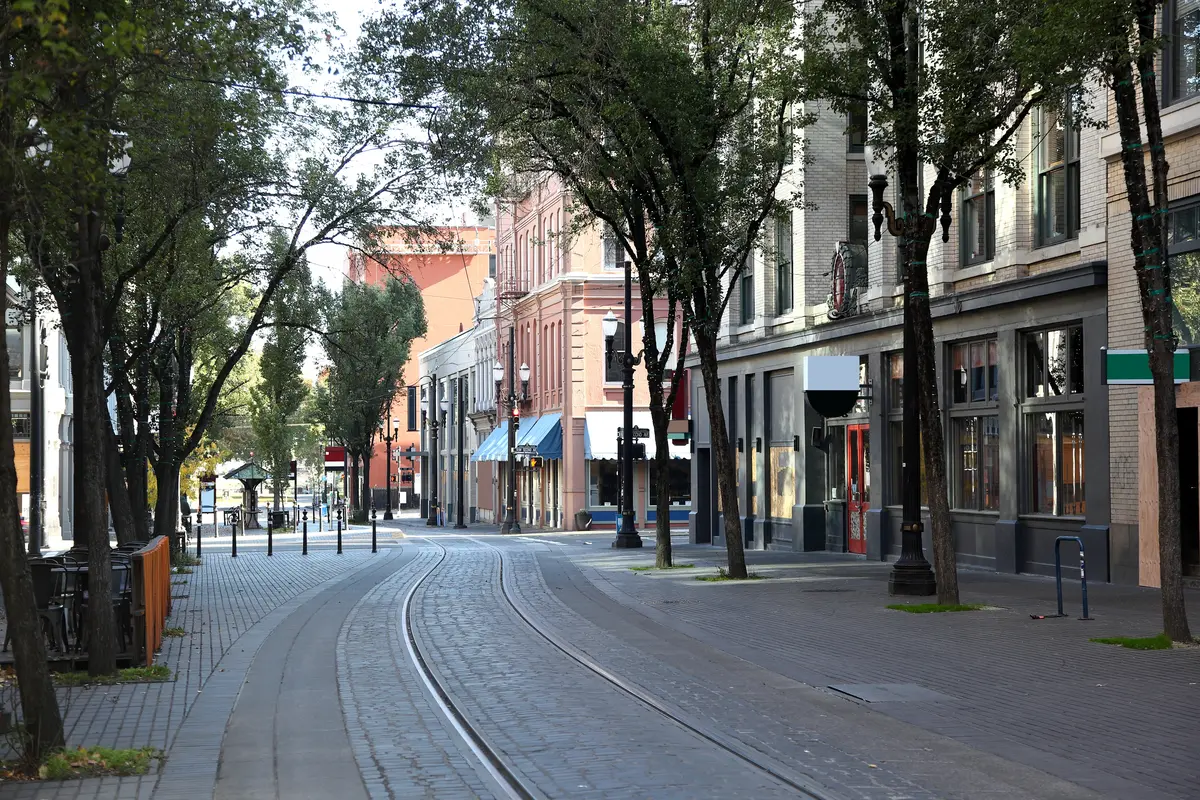
Portland is the most walkable city in Oregon, and in the inner neighborhoods, that is not a marketing claim — it is a functional description of daily life. The Pearl District is essentially car-optional for someone who lives there: groceries, medical appointments, the Portland Farmers Market at PSU, and a dense restaurant and café scene are all reachable on foot or by MAX light rail. Irvington, on the east side, offers a similar dynamic on a more residential scale, with walkable access to the Broadway corridor and a MAX station nearby.
The terrain matters more than most people expect. The West Hills neighborhoods — and anything climbing toward the Pittock Mansion — involve real grade changes that make walking less practical as mobility shifts. The inner eastside and the Pearl District are largely flat. If staying mobile without a car is a retirement priority, the neighborhood choice inside Portland is as important as the city choice itself.
Portland's TriMet system covers the metro with MAX light rail, streetcar, and bus lines, meaning a car-free or car-light retirement is genuinely achievable for someone based in the inner city. That has a real effect on the retirement budget. For a deeper look at transit and commute patterns, see the Living in Portland guide.
Senior Community and Active Life
Portland has an active senior center network through Multnomah County's aging and disability services division, with multiple sites across the city offering fitness programs, social events, and support services. The city's parks — Forest Park for the hikers, Mt. Tabor Park for the neighborhood walkers, and the Willamette River Greenway for anyone who wants a flat multi-mile path — give retirees who are still physically active a genuinely excellent outdoor life. The International Rose Test Garden at Washington Park draws regulars year-round, not just tourists in June.
The cultural texture of Portland retirement is worth naming plainly. Powell's City of Books hosts regular readings and events. The Portland Japanese Garden is the kind of place that sustains regular visits across years. The Montavilla Farmers Market and the Portland Farmers Market at PSU give a weekly social rhythm to neighborhoods that might otherwise feel quiet. For retirees who found their working years short on time for exactly this kind of life, Portland delivers it in concentrated form.
What surprises many retirees after six months is how much Portland rewards people who show up for it. The arts scene, the volunteer culture, the neighborhood associations — none of it comes to you. The people who feel most at home here are the ones who walked into something and stayed. The people who find it isolating are often the ones who expected the city to be more self-delivering.
Right-Sizing: Downsizing in Portland
The Inventory Picture for Single-Level Living
Downsizing in Portland is easier in some neighborhoods than others, and the terrain is the underlying reason. The inner eastside — Sellwood-Moreland, Division Street, Hawthorne — has a mix of bungalows and ranch-style homes where single-level living is possible without going to a condo. The Pearl District and Northwest District (Nob Hill) lean heavily toward condos and multi-story buildings, which suit some retirees perfectly and frustrate others who want a yard.
Single-level detached homes in walkable locations are not abundant, and when they come to market in neighborhoods like Irvington or Sellwood-Moreland, they tend not to sit long. For retirees whose priority is a single floor with no stairs and a manageable lot, the honest answer is that the supply is tighter than in suburban markets, and patience is required. The Portland neighborhoods guide has the character breakdown that helps narrow which part of the city matches your priorities.
The Condo Path: Vertical Retirement
A real and growing pattern among Portland retirees is choosing condo or high-rise living in walkable inner neighborhoods to stay close to arts, healthcare, and restaurants — trading square footage for proximity. The Pearl District is the most prominent example: condos here sit below the city-wide median price tier, which makes them accessible relative to what the neighborhood offers in walkability and cultural density. A one-level condo in a building with an elevator removes the mobility concern that makes multi-story houses complicated to age in place.
The honest downside of the condo path in Portland is homeowners association fees, which vary widely and can add meaningfully to monthly costs. The engine's calculator on this page gives you a starting point for how those stack into the overall picture, but getting the specific HOA disclosure for any building you are seriously considering is not optional.
Summerplace: Portland's 55+ Community
The one dedicated 55+ active adult community the fact sheet identifies in Portland is Summerplace, a 135-acre development in Northeast Portland offering a mix of homes and condos with an active lifestyle focus and easy access to the rest of the city. For retirees who want the social structure of a purpose-built community — shared amenities, neighbors in the same life stage — without leaving Portland's urban reach, Summerplace is the option. It is not a manufactured-home or assisted-living community; it is an owner-occupied active adult development within the city limits.
Beyond Summerplace, retirees seeking a broader range of 55+ options typically look at communities in Lake Oswego, Beaverton, or the wider metro rather than within Portland proper. The city's housing stock is large but not heavily built for dedicated senior communities — which is part of why the vertical-retirement condo trend has taken hold among those who want to stay inside the city.
Portland vs Nearby Retirement Destinations
| City | Cost vs Portland | Primary Hospital | Walkability | Senior Living Depth | Overall Retirement Fit |
|---|---|---|---|---|---|
| Portland | Baseline | OHSU Hospital — Level I Trauma, NCI cancer center; Legacy Health network | Highest in Oregon; car-optional in inner neighborhoods | Summerplace (55+); broad condo inventory; two major health systems | Best for retirees who want urban amenities, walkability, and deep healthcare access |
| Lake Oswego | Noticeably higher | Served by regional health facilities; close to OHSU and Legacy via the freeway | Moderate; car still useful for most errands | Multiple senior communities; stronger single-level detached inventory | Best for retirees who want quieter suburban feel with proximity to Portland's medical corridor |
| Beaverton | About the same | Regional hospital within city; Portland systems accessible by highway | Moderate; improving with recent development | Several 55+ and active-adult options; good single-level inventory | Best for retirees prioritizing flat terrain, newer housing stock, and lower property tax burden |
| Milwaukie | Noticeably lower | Close to OHSU and Legacy Health facilities via nearby arterials | Lower than Portland; car needed for most errands | Limited dedicated senior communities; mostly standard residential inventory | Best for retirees who want proximity to Portland at a lower price point with a quieter feel |
| Gresham | Somewhat lower | Regional hospital access; farther from OHSU than west-side options | Lower; auto-dependent for most daily needs | Some senior housing; fewer purpose-built active-adult options | Best for retirees on a tighter budget who are comfortable with a car-dependent lifestyle |
| Vancouver WA | About the same on housing; Washington state income tax structure differs | Regional medical center; Portland's systems reachable via the interstate | Lower than Portland; suburban layout | Growing senior community inventory; more new construction than Portland proper | Best for retirees who want to avoid Oregon income tax; Washington does not tax retirement income |
The Vancouver, Washington comparison deserves a direct sentence: Washington state does not tax income, including pension and 401(k) distributions. For a retiree whose income comes primarily from sources other than Social Security, living in Vancouver while using Portland's healthcare and cultural amenities — a short drive across the Columbia River — is a legitimate financial strategy that some Portland-area retirees explicitly choose.
Lake Oswego beats Portland on suburban quiet and single-level home inventory, but the price premium is real and the healthcare access is effectively borrowed from Portland's systems rather than homegrown. Milwaukie and Gresham offer lower price points and genuine proximity to Portland's medical corridor, but neither delivers the walkability or cultural density that makes Portland's retirement case compelling in the first place. For retirees who need — or want — the depth that OHSU and Legacy Health together represent, Portland itself is the clearest answer; for those whose income tax situation makes Washington state more attractive, Vancouver with a Portland commute is the move worth modeling before you decide.

Local Expert Takeaway: Portland's retirement case rests on three things that compound: the best walkability in Oregon (which reduces transportation costs and keeps you active), OHSU Hospital inside the city limits (which matters most exactly when you need it), and a cultural life in the Pearl District, around Washington Park, and along the Willamette River Greenway that requires no car and no planning — it is simply there. The catch is Oregon's income tax on pension and 401(k) income, the 1.02% property tax rate, and a property crime picture that is well above national norms. Retirees who arrive with eyes open to both sides tend to stay; the ones who get there expecting something else often start looking at Lake Oswego or Vancouver within two years.
Quick Takeaways & FAQs
✅ OHSU Hospital — the only NCI-designated cancer center in Oregon — is inside Portland's city limits, giving retirees specialist access that no other Oregon city can match.
⚠️ Oregon does not tax Social Security, but pension income, IRA withdrawals, and 401(k) distributions are taxed at graduated rates reaching 9.9% — making Portland's tax picture genuinely unfavorable for retirees drawing heavily from retirement accounts.
📍 Summerplace is Portland's only dedicated 55+ active adult community; retirees seeking a wider range of purpose-built senior options typically look to Lake Oswego, Beaverton, or Vancouver, WA rather than within Portland proper.
Is Oregon a good state for retirees from a tax perspective?
What is the best Portland neighborhood for retirees who want to walk to everything?
What 55+ communities are available in Portland?
How does Portland compare to Vancouver, Washington for retirement?
Does Oregon offer any property tax relief for senior homeowners in Portland?
Moving to Oregon?
Tell us what you need help with and we'll connect you with local resources.
