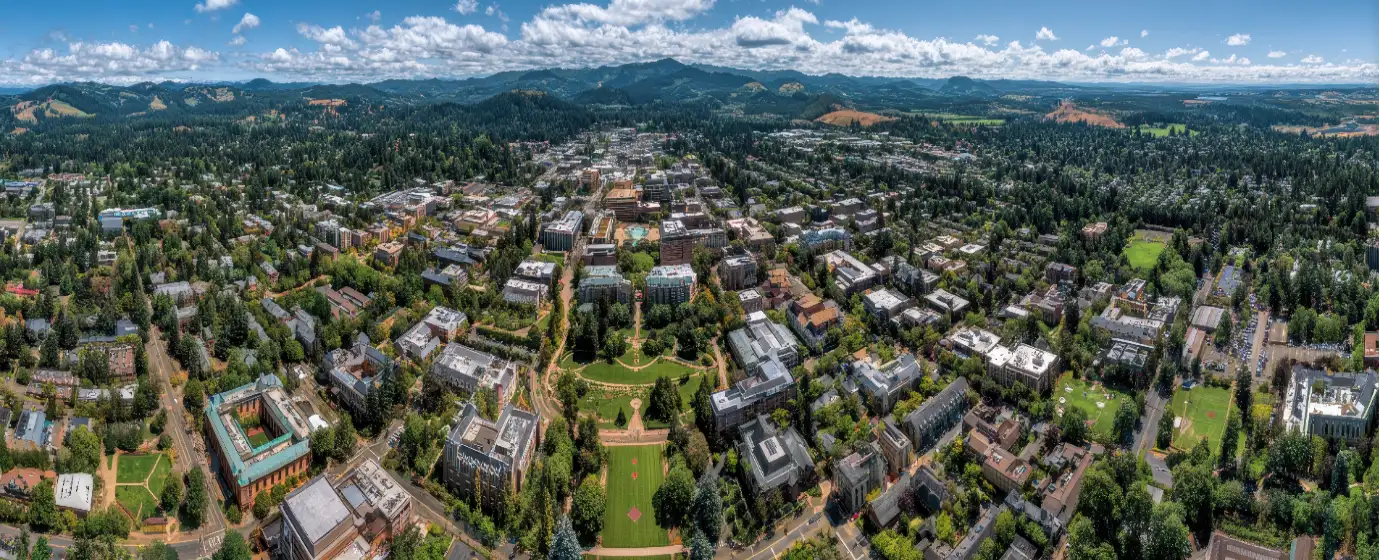
What Is Living in Corvallis, Oregon Like?
You've probably heard Corvallis described as a college town, but that framing undersells what makes it genuinely unusual. Oregon State University doesn't just sit inside the city — it is the city's economic engine, cultural calendar, and commuter magnet all at once. OSU shapes everything from the rental market to the farmers' market. What surprises people who move here from larger metros is the scale: at 61,247 residents spread across roughly 14.3 square miles, Corvallis is the 9th-largest incorporated city in Oregon — substantial enough to have real amenities, compact enough that you can genuinely bike anywhere in about 15 minutes. US-20 ties the city east to Albany; OR-99W runs the north-south corridor; and OR-34 connects east toward Interstate 5. The Willamette Valley's farm fields frame the view in every direction.
Oregon State is the backbone employer, drawing faculty, researchers, administrators, and support staff from across the region. A major regional health system anchors healthcare employment. HP maintains a significant technology presence here — a legacy of the company's long history in the valley — and Benton County government rounds out the public-sector base. The Corvallis School District 509J, with 5,858 students enrolled in 2025-26, holds a B+ rating, according to Niche, and draws families who want a smaller district without sacrificing academic culture. The combination of a major research university, a regional medical center, and a technology employer in a city this size is genuinely rare in Oregon, and it's the reason the housing market behaves differently here than in comparably sized towns: workers commute into Corvallis every day for jobs they can't fill from within city limits.
Housing is where the reality check comes in. The typical home price in Corvallis is $565,289 (Zillow Home Value Index, July 2026), which sits meaningfully above the median household income of $65,012 — the gap between what homes cost and what a median-income household can carry is real, and worth planning around before you start touring. Neighboring Albany and Lebanon come in noticeably lower; Philomath runs somewhat lower. Oregon's lack of a state sales tax softens the everyday cost of living, and the effective property tax rate of approximately 0.95% is relatively modest by Pacific Northwest standards — see the full cost of living breakdown for the complete picture. The city's tightly managed urban growth boundary means new supply stays constrained, and the large student population keeps rental demand high year-round.
Whether you're considering a move or just researching the area, the sections below break down Corvallis's neighborhoods, the housing market, commute patterns, local employers, and what daily life here is really like.
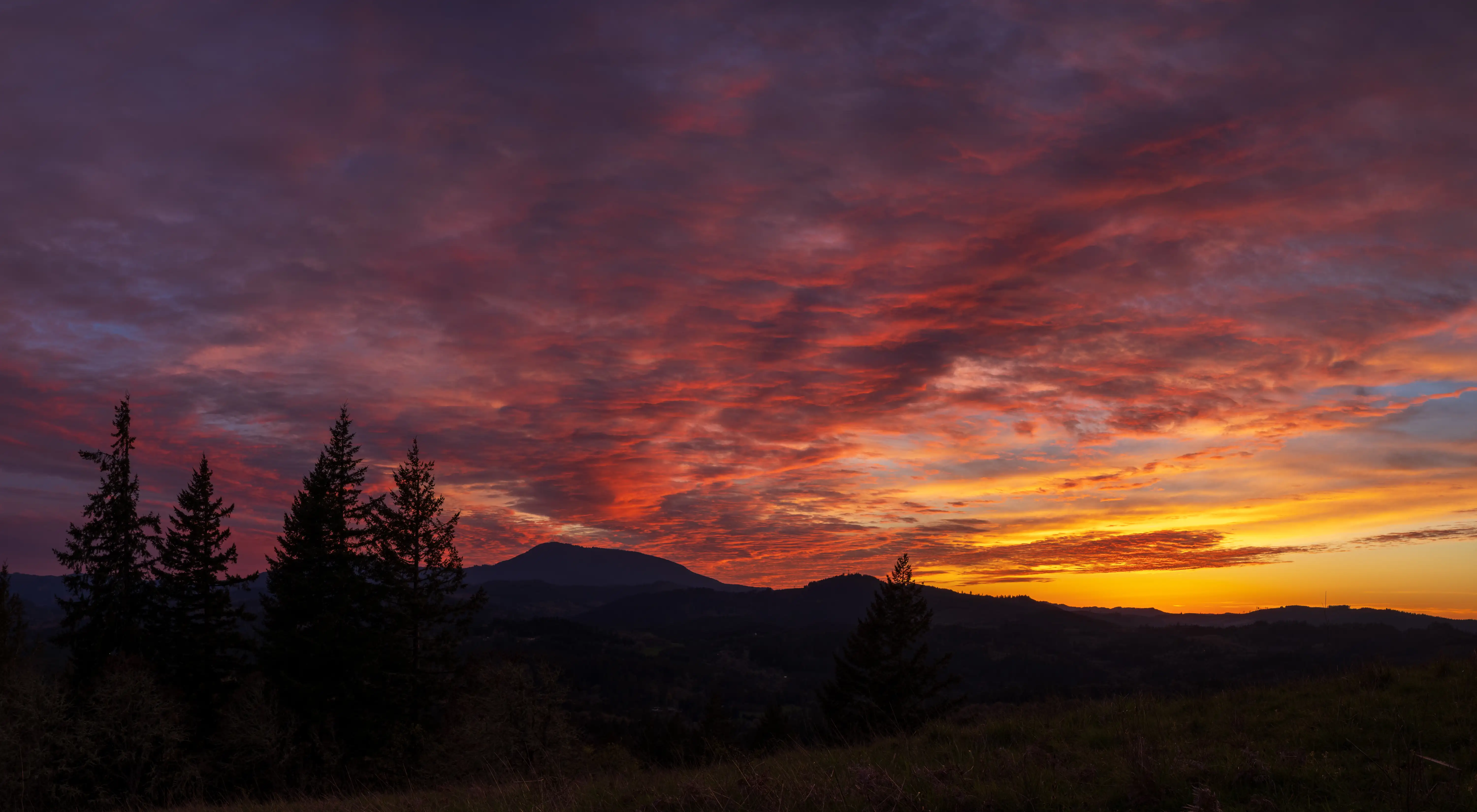
Corvallis at a Glance
Looking to buy in Corvallis? Estimate your payment.
Enter your numbers to see an estimated monthly mortgage payment.
Estimate only. Excludes HOA fees and mortgage insurance. The interest rate above is a starting point, not a quoted rate — replace it with your own to see real numbers. Insurance is a flat placeholder, not a Corvallis quote.
Why Are People Moving to Corvallis?
The case for Corvallis is easy to make: stable institutional employers, a Gold-level cycling city, a walkable downtown, and a Willamette Valley location that puts you within reach of the coast, the Cascades, and the wine country. The case against it is shorter but worth reading — the housing cost-to-income gap is substantial, and if your job doesn't tie you to OSU, HP, or the medical center, you may be looking at a commute to Albany or beyond.
The Institutional Anchor
Oregon State University's presence is the single biggest reason people land here rather than in a comparable Oregon city. OSU draws students from all 50 states and over 100 countries, and the ripple effect on local hiring, culture, and services is felt in every corner of the city. Faculty and staff relocations account for a significant slice of the buyer pool in any given year. If OSU recruited you, or if you're joining one of the university's research operations, Corvallis is not a compromise — it's the destination.
What the Job Market Actually Looks Like
Oregon State University is the dominant employer, followed by a major regional health system in the healthcare sector. HP's Corvallis operation represents the technology side of the economy — the company has maintained a presence here for decades, making it a genuine anchor rather than a satellite outpost. Benton County government and the school district complete the picture for public-sector workers.
A commissioned study found that a significant share of the workers who commute into Corvallis daily would prefer to live here if they could find housing that met their needs. That finding tells you two things simultaneously: the city generates more jobs than its housing supply can absorb, and demand for homes here has structural support that doesn't depend on speculation.
Who Actually Moves Here
| Buyer Type | Why Corvallis Works | The Catch |
|---|---|---|
| Tech | HP campus, OSU research partnerships | Limited inventory; expect competition |
| Families | B+ rated school district, compact city, low traffic | Home prices outpace local incomes |
| Walkable | Gold-level cycling city; fare-free transit | Car still needed for bigger shopping trips |
| Faculty & Staff | OSU employment anchor; academic community | Rental vacancy is tight near campus |
| Outdoor Enthusiasts | Marys Peak, McDonald-Dunn Forest, Bald Hill Natural Area | 159 sunny days a year — gray winters are real |
| First-Time Renters | Fare-free Corvallis Transit System; walkable streets | Student demand keeps rents elevated |
Remote workers have also discovered Corvallis as a livable alternative to Portland-area prices — the trade-off is that a serious shopping trip or a flight usually means driving to Eugene Airport (EUG), about 35 miles south. See the first-time homebuyer page if you're working through financing for the first time in this market.
What Daily Life Feels Like in Corvallis
The first thing people notice after moving here is how unhurried the pace is — not because nothing is happening, but because the city's 14.3-square-mile footprint means you're almost never stuck. The Oregon State campus and the downtown core sit close enough together that the two blend into one walkable zone on weekday mornings.
Getting Around on Two Wheels
Corvallis has held Gold-level Bicycle Friendly Community status from the League of American Bicyclists continuously since 2003, renewed most recently in February 2024. Only 34 communities in the country have ever reached that level. Bike lanes cover 98% of collector and arterial roadways, and the city has 18 miles of shared-use paths. About 11% of residents commute by bike and 12% commute on foot — figures that would be remarkable in any American city and are extraordinary for one with a Willamette Valley climate.
The Corvallis Transit System operates a fare-free bus network, with multiple routes connecting Oregon State University to surrounding neighborhoods. For most errands inside city limits, a car is optional. For anything bigger — a Costco run, IKEA, a night out in Portland — you'll drive.
The OSU Effect on Daily Life
Living in Corvallis means sharing the city with a university that enrolls more people than most Oregon towns have residents. That cuts both ways. It brings a consistently active arts and lecture calendar, a diverse food scene anchored by cuisines that would surprise you in a city this size, and a level of civic investment in parks and trails that a town of 61,247 couldn't sustain on its own. It also means August move-in weekend is a parking situation, and rental prices near campus never really dip.
The Weather Honest Assessment
Corvallis gets 159 sunny days a year. That's the number to plan around, not the rosier figure that sometimes gets quoted for the broader Willamette Valley. Gray, drizzly winters run from November through March, and newcomers from sunnier climates — particularly those arriving from California — are often caught off guard by how persistent the overcast is. The upside is genuine: summers here are dry, warm, and spectacular, with the kind of weather that makes the outdoor scene feel like a payoff for enduring the rest of the year.
The schools page covers youth programs and extracurriculars in more depth if you're moving with kids.
The Corvallis Housing Market Right Now
The typical home in Corvallis is priced at $565,289 (Zillow Home Value Index, July 2026). That figure matters not just as a number but as a signal: it sits well above what the median household income of $65,012 can comfortably carry, meaning many buyers here are either dual-income households, arriving with equity from a previous home sale, or employed at income levels above the local median — think OSU faculty, HP engineers, and medical professionals.
Why Inventory Stays Tight
Corvallis operates inside a tightly managed urban growth boundary. The city doesn't sprawl — it can't, by design — so new supply inside city limits is genuinely constrained. Combined with persistent rental demand from a large OSU student body, the result is a housing market that rewards preparation. Well-priced homes here rarely wait long for buyers.
Some areas of the city run above the typical price, particularly close to campus. The best way to understand the full neighborhood picture is on the best neighborhoods page, which maps out the character and price positioning of each area in detail.
Renting Before Buying
The typical rent in Corvallis runs $1,731 per month (Zillow ZORI, July 2026), with two-bedroom units generally ranging between $1,590 and $1,940. Renting first is a reasonable approach in a market this size: it lets you learn which neighborhoods actually suit your commute and lifestyle before committing. The full rent and cost-of-living picture is on the cost of living page.
The Effective Property Tax Rate
Oregon's effective property tax rate in Corvallis runs approximately 0.95% — below the national average and a meaningful factor when you're comparing monthly costs against renting. Oregon also has no state sales tax, which partially offsets everyday spending costs relative to what many transplants from other states are used to paying.
The affordability gap is the honest reality here: the income needed to buy comfortably at the typical price exceeds the median household income by a significant margin. That doesn't make the market impossible — it makes preparation more important. If you're buying for the first time in this market, the first-time homebuyer guide covers what to expect from the process.
Corvallis Neighborhoods
Corvallis has several distinct areas — each with its own character and appeal. Here’s a breakdown to help you narrow down where to focus your home search.
🏡 Northwest Corvallis
Northwest Corvallis is a mix of established single-family homes and newer construction that suits families and professionals looking for a quieter residential feel while staying close to the university corridor. The area has good access to the McDonald-Dunn Research Forest trails without requiring a drive out of the city.
🏠 Timberhill
Timberhill sits in the northwest quadrant and draws buyers looking for larger lots and a more suburban character within city limits. It's a solid choice for families with school-age children who want to be within biking distance of the rest of the city without living directly adjacent to the OSU campus buzz.
🌳 South Corvallis
South Corvallis has a more diverse and working-class character than the neighborhoods that cluster around OSU, with Avery Park along the Marys River providing the main outdoor anchor. It's often where buyers find more accessible price points and a less student-dominated day-to-day feel.
🏘 West Hills
West Hills occupies the elevated terrain west of the city core and offers views across the valley — it tends to attract buyers who want more privacy and space, with the trade-off being that some errands require a bit more driving than the flatter, more central neighborhoods. The proximity to Bald Hill Natural Area is a genuine draw.
🏔 College Hill
College Hill sits immediately adjacent to the OSU campus and includes the College Hill West Historic District, which was added to the National Register of Historic Places in 2002 and contains more than 250 homes built between 1916 and 1935. It runs above the city median in price and attracts faculty, longtime residents, and buyers who want to walk to campus.
🌆 Willamette Landing
Willamette Landing is one of the newer residential areas in the city, with a more contemporary housing stock and easy access to the riverfront path system. It suits buyers who want newer construction in a city where most of the housing inventory skews older.
Pros & Cons of Living in Corvallis
The Pros
- Strong, stable job base anchored by OSU and healthcare
- Walkable, bike-friendly downtown with a lively food and brewery scene
- Easy access to the Coast Range, Marys Peak, and Willamette River recreation
- Highly educated community with strong public schools
The Cons
- Home prices run well above many comparable Willamette Valley towns
- Wet, gray winters typical of western Oregon
- College-town property crime (mostly theft) skews overall crime stats higher than the violent crime rate alone suggests
Getting Around & Commuting in Corvallis
Corvallis is one of the few American cities where the question "do I need a car?" has a genuinely complicated answer. Inside city limits, a significant share of residents manage daily life without one. Outside city limits, you need a car — full stop.
The Routes That Matter
Three highways define Corvallis's connections to the wider region. US-20, the Corvallis-Newport Highway, runs east to Albany about 10 miles away and west toward the coast. OR-99W, the Pacific Highway West, carries the north-south corridor through the Willamette Valley. OR-34, the Corvallis-Lebanon Highway, links east to Interstate 5. None of these are freeways — they're two-lane state highways for most of their length, which shapes what commuting looks like.
The Albany Connection
Albany is the practical gateway for anything Corvallis doesn't have. It sits about 10 miles east on US-20, and more importantly, it's where Amtrak's Coast Starlight and Cascades lines stop — giving Corvallis residents rail access to Eugene and Portland without a car trip to either city. The commute from Corvallis to Portland by car runs about 90 minutes. That's manageable for occasional trips; it's a grind as a daily drive, and most people with Portland-based jobs either live somewhere between the two cities or work remotely.
What the Commute Patterns Show
A substantial number of workers commute into Corvallis each day for work — from Albany, Lebanon, Philomath, and points further. The city is a job center that draws workers from the surrounding region, not the reverse. If you're moving here for an OSU or HP position, you're moving to the job, not commuting to one.
Biking Is Not a Lifestyle Choice — It's Infrastructure
The city's Gold-level cycling designation isn't marketing. Bike lanes cover 98% of collector and arterial roads. Eighteen miles of shared-use paths connect neighborhoods to campus, downtown, and the riverfront. The 14-square-mile footprint means that virtually any destination inside city limits is reachable by bike in about 15 minutes. For OSU employees in particular, biking to work is simply the most efficient option on most days.
The Corvallis Transit System runs fare-free bus routes connecting OSU to surrounding neighborhoods, making it a real option for residents who want to reduce car dependence entirely for local trips. For the nearest major airport, Eugene Airport (EUG) is about 35 miles south — a straightforward drive when you need to fly.
What Newcomers Get Wrong
The commute assumption that trips people up most often: assuming Albany is an easy satellite for daily shopping or amenities. It is — but only if you're already heading east on US-20. OR-99W heading north toward Corvallis from Salem-area communities can move slowly during morning and afternoon windows, and the two-lane character of the highway gives it less margin for error than a freeway corridor.
Schools in Corvallis
Families relocating to Corvallis have public, private, and higher-education options nearby. Here’s a quick overview.
🎓 School District
Corvallis School District 509J serves K–12 students across Corvallis and the surrounding area. Rated B+ (source: Niche.com, 2026 rankings).
🏆 Graduation Rate
The 4-year high-school graduation rate here is approximately 90.4%.
📚 Higher Education
Oregon’s public universities — the University of Oregon, Oregon State University, and Portland State University — offer four-year degrees statewide, with a network of 17 community colleges providing two-year and workforce programs.
🌐 Online Learning
Oregon State University Ecampus and Portland State University Online offer fully accredited online degrees for remote learners across the state.
Safety in Corvallis
A quick look at how Corvallis compares on the numbers that matter most when weighing a neighborhood or a move.
🛡 Violent Crime
Approximately 2 per 1,000 residents.
🔒 Property Crime
Approximately 37.1 per 1,000 residents.
Compared to the most recent national figures from the Bureau of Justice Statistics (2024), Corvallis’s violent crime is below the national average (about 3.7 per 1,000), and property crime is above the national average (about 18.4 per 1,000).
Against Oregon as a whole, Corvallis’s violent crime is roughly two-thirds of the state average, and property crime is about one and a half times the state average (Bureau of Justice Statistics, Crime Known to Law Enforcement, 2024 (tables 2 and 3)).
Crime rates can vary a lot within a single city, so the citywide numbers above are only a starting point. Some neighborhoods in Corvallis run well below these averages, while others run higher — the kind of block-by-block detail that matters most when you’re actually choosing where to live. The full guide below breaks it down neighborhood by neighborhood.
Working in Corvallis
Corvallis’s largest employers span several industries — here are some of the anchors of the local job market.
🎓 Oregon State University
Education
🏥 Good Samaritan Regional Medical Center
Healthcare
🎓 Corvallis School District
Education
💻 HP
Technology
🏛 Benton County
Municipal government
Parks & Recreation in Corvallis
Some of the outdoor spaces that shape everyday life in Corvallis.
🌱 Riverfront Commemorative Park
🌱 Avery Park
Corvallis residents don’t have to go far for green space — spots like Riverfront Commemorative Park and Avery Park are part of everyday life here, whether that’s a morning walk, a weekend hike, or just somewhere to unwind outside. The full guide below covers more of what Corvallis has to offer for parks and outdoor recreation.
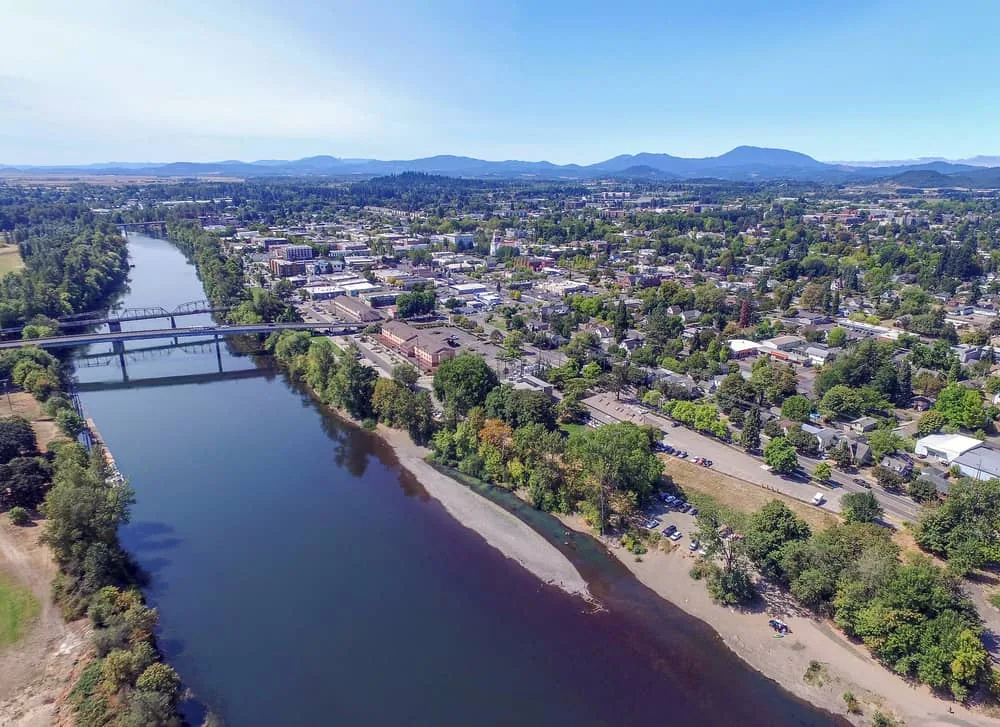
Retiring in Corvallis
Corvallis draws retirees for its balance of amenities, outdoor access, and cost. Here’s what to weigh.
🌤 Climate
Corvallis gets 159 sunny days a year, with dry, warm summers that make outdoor living genuinely comfortable from late May through September. Winters are gray and drizzly rather than brutally cold — temperatures rarely drop below freezing for extended stretches — but the overcast from November through March runs longer than retirees from sunnier climates typically expect.
🍴 Lifestyle
Oregon State University's public programming calendar means there's a consistent stream of lectures, performances, and cultural events that go well beyond what a city of 61,247 would typically sustain on its own. The Corvallis Art Center, Avery Park along the Marys River, and the Corvallis Farmers' Market anchor a walkable, engaged civic life. The fare-free Corvallis Transit System makes it possible to get around without driving most days.
🏚 55+ Communities
Stoneybrook Village is the established 55+ community within Corvallis city limits. For more detail on healthcare access and retirement-specific housing options in the area, the full picture is on the retiring in Corvallis page.
✈ Getting Around
The compact 14-square-mile layout and Gold-level cycling infrastructure mean that on-foot access and biking are genuinely practical options for most daily errands. Drivers will find OR-99W and US-20 the main arteries for trips outside the city. The nearest major airport is Eugene Airport (EUG), about 35 miles south — a straightforward drive for most travel needs.
🏛 Oregon Taxes for Retirees — What to Know
- Social Security is not taxed — Oregon does not tax Social Security or Railroad Retirement benefits. Any amount included in your federal adjusted gross income is subtracted back out on the Oregon return.
- But other retirement income IS taxed — This is the trade-off that surprises people moving from Washington or Texas. Pension distributions and 401(k)/IRA withdrawals are taxed as ordinary income at Oregon’s regular rates — there is no blanket retirement-income exclusion.
- Graduated income tax — Oregon has four brackets — 4.75%, 6.75%, 8.75% and 9.9%. The 4.75% rate covers the first $10,000 of taxable income for a single filer ($20,000 filing jointly); the 8.75% rate starts at $125,000 ($250,000 jointly); and the top 9.9% rate applies above $250,000 ($500,000 jointly).
- No sales tax — Oregon levies no general sales tax.
- Property taxes, with senior deferral — Oregon’s Senior and Disabled Property Tax Deferral lets qualifying homeowners have the state pay their county property taxes, with a lien recorded against the home. The 2026 household income limit is $70,000, and deferred balances accrue 6% simple interest — it defers the bill rather than forgiving it.
- Estate tax — the one to plan for — Oregon has its own estate tax with a $1 million filing threshold — far below the federal exemption, and NOT indexed for inflation, so it reaches more estates every year in real terms. Retirement accounts and a long-held home count toward the taxable estate, so estates that feel modest can cross the line without the owner expecting it.
- No inheritance tax — Oregon has no separate inheritance tax and no gift tax.
Tax laws change frequently and individual situations vary. This is general information, not tax advice — always consult a qualified Oregon tax professional or CPA for personalized retirement tax planning.
Weekends & Local Favorites in Corvallis
Saturday morning in Corvallis tends to organize itself around the Corvallis Farmers' Market, which runs through the warm months next to Riverfront Commemorative Park in the heart of downtown. The combination of the river, the park, and the market creates the kind of civic gathering point most cities pay consultants to manufacture — here it formed organically around the geography.
The Outdoors, Close In
Bald Hill Natural Area sits just west of the city, with trails that climb into the oak savanna and give views back across the valley — it's the kind of place longtime residents treat as their backyard. The McDonald-Dunn Research Forest, managed by Oregon State, covers tens of thousands of acres of working forest land adjoining the city and is open for hiking, mountain biking, and trail running. Avery Park, along the Marys River in the south part of the city, anchors outdoor recreation closer to home.
Marys Peak, about 25 miles west, is the highest point in the Coast Range and a genuine destination hike — the summit sits above treeline and delivers panoramic views of the Cascades on clear days. Getting there is a straightforward drive west, and it's the kind of outing that becomes a seasonal ritual for people who live here.
Where to Eat and Drink
Block 15 Brewing Downtown Pub is the reference point for local craft beer — it's been part of the downtown scene long enough that out-of-towners ask for it by name before they've even arrived. Sky High Brewing & Pub and Squirrels Tavern round out the local bar and pub options with distinct personalities. For a meal, Khalo Naser Syrian Cuisine & Lounge brings a level of cooking that surprises people expecting a narrow college-town food scene, and TakoVino fills the casual end with a following that extends well beyond the OSU crowd.
Coffee and the Campus Orbit
Coffee Culture Kings, Bodhi Cafe, Imagine Coffee Co., Interzone, and Futura Coffee Roasters are the independent cafés that define the local coffee scene — each with its own character and corner of the city's daily social life. Interzone in particular has a long history as a study spot and community gathering place that predates the current wave of remote-work café culture by decades.
Culture and Civic Life
A restored historic building in the downtown core anchors the visual arts scene at the Corvallis Art Center, with rotating exhibitions and programming throughout the year. The Benton County Courthouse and the wider downtown core give the city a sense of civic gravity that newer Oregon cities often lack. OSU's own calendar of lectures, performances, and public events fills the gaps and then some — the university's reach into community programming is one of the underrated benefits of living adjacent to a major research institution.
Local favorites in Corvallis
Restaurants
- Block 15 Brewing Downtown Pub
- Khalo Naser Syrian Cuisine & Lounge
- TacoVino
- Sky High Brewing & Pub
- Squirrels Tavern
Outdoors
- Marys Peak
- McDonald-Dunn Research Forest
- Riverfront Commemorative Park
- Bald Hill Natural Area
- Avery Park
Coffee
- Coffee Culture Kings
- Bodhi Cafe / Corvallis
- Imagine Coffee Co.
- Interzone
- Futura Coffee Roasters -- Downtown Corvallis
Farmers Markets
- Corvallis Farmers' Market
Top Things Locals Say About Corvallis
The best intel about a city comes from the people who actually live there. Here’s what Corvallis residents say when newcomers ask the questions everyone’s thinking.
“I knew it was a college town, but I didn't understand how much that meant until I actually lived here. The city's calendar is basically OSU's calendar — and that turns out to be a feature, not a bug. There's always something going on, and the bike commute I was skeptical about became the part of my day I look forward to most.”
— Recent Corvallis home buyer
“What's the most surprising thing about living in Corvallis?”
How small it feels once you're actually in it — in the best way. You can bike from the OSU campus to Riverfront Commemorative Park to Bald Hill Natural Area without ever feeling like you've left a coherent neighborhood. Most people who move here from Portland spend the first few months waiting for the city to feel bigger, and then they stop waiting and just enjoy it.
“What do locals love most about Corvallis?”
The combination of the outdoor access and the university culture is hard to replicate. You can hike McDonald-Dunn Research Forest on a weekday morning and catch a lecture or a live performance that evening. The Corvallis Farmers' Market runs through the warm months and functions as the town square in a way that formal civic spaces rarely do. And the cycling infrastructure is genuinely exceptional — it changes how you move through the city.
“What should newcomers to Corvallis know?”
OR-99W heading north toward Salem moves slower than you'd expect during morning and afternoon rush periods — it's a two-lane state highway for most of its length and gives up little margin when traffic builds. Also: August is the one month when the city's compact feel tips into congestion, as OSU students return and the rental market turns over all at once. Plan any major house projects or moves around that window.
“How much do you need a car in Corvallis?”
For daily life inside the city, many residents genuinely manage without one — or use a car only a few times a week. The bike network and fare-free transit handle most errands, commutes, and social trips within city limits. The calculus changes the moment you need to leave: a bigger shopping trip, the airport, or a drive to Portland all require a car. Most households own one; some OSU-connected households get by without.
Cities Near Corvallis
Other communities near Corvallis worth a look — each with its own character and price point.
| City | Distance | Best For | Vibe | Median Rent | Median Buy |
|---|---|---|---|---|---|
| Albany | 11 mi | Value buyers & Amtrak access | Working-class, growing, historic downtown | $1,744 | $439,047 |
| Philomath | 8 mi | Families wanting small-town feel | Quiet, rural edge, tight-knit | $1,876 | $529,921 |
| Lebanon | 18 mi | Budget-conscious buyers | Affordable, industrial heritage, rural | $1,565 | $397,559 |
More Helpful Guides for Corvallis
Going deeper on Corvallis? Our blog series covers everything from first-time buying to retiring here — explore the guides below.
Local Expert Takeaway: Corvallis rewards buyers who understand what it actually is: a compact, highly educated job center organized around Oregon State University, with infrastructure investments — cycling, transit, parks — that are genuinely exceptional for a city this size. The housing cost-to-income gap is real and shouldn't be glossed over, but the quality of daily life, the stability of institutional employers, and the access to outdoor recreation from Bald Hill to Marys Peak make it one of the more defensible long-term bets in the Willamette Valley.
Quick Takeaways & FAQs
✅ Corvallis holds Gold-level Bicycle Friendly Community status — one of only 34 cities nationwide — and 11% of residents actually commute by bike.
⚠️ The typical home price of $565,289 (July 2026) sits well above what the $65,012 median household income can carry, so most buyers here are dual-income or arriving with equity.
📍 The Corvallis Transit System runs fare-free, and OR-20 east to Albany connects residents to Amtrak's Coast Starlight and Cascades lines — practical regional rail without a car trip to Portland.
What is the typical home price in Corvallis, Oregon?
Is Corvallis a good place to live without a car?
How are the schools in Corvallis?
How far is Corvallis from Portland?
What is the crime rate in Corvallis, Oregon?
Helpful Links for Moving to Corvallis
Moving to Oregon?
Tell us what you need help with and we'll connect you with local resources.
