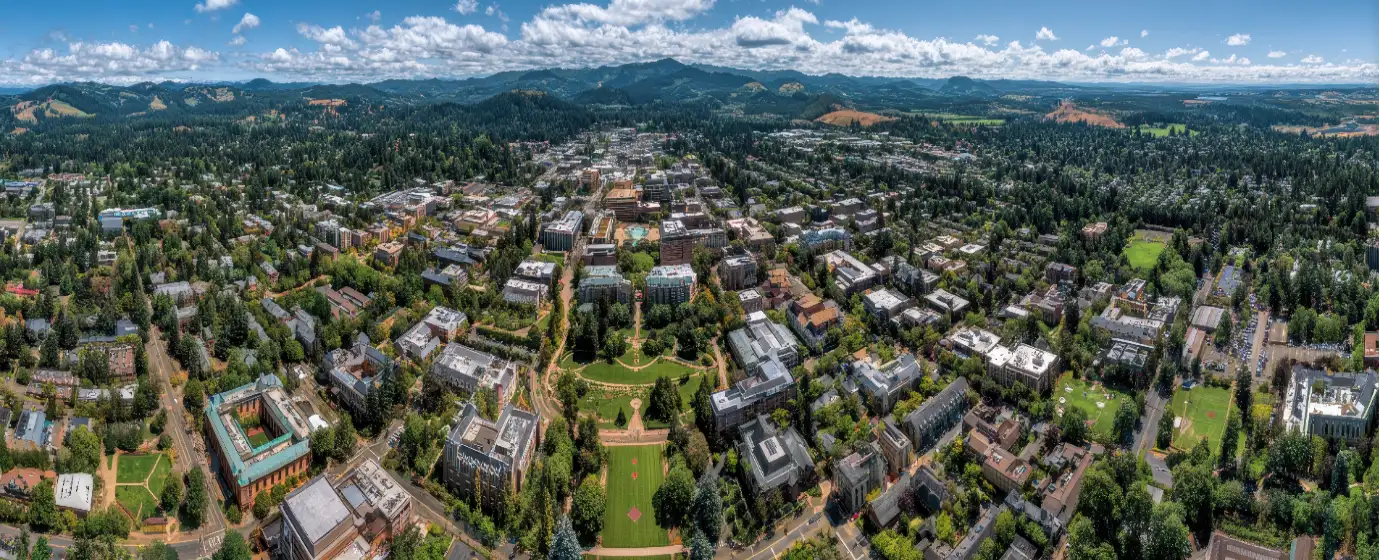
Most people who move to Corvallis from somewhere else say a version of the same thing after a few months: the city feels calmer than the numbers suggested it would. That gap between perception and lived experience comes down to one structural fact — Oregon State University. A campus of that scale, pulling students, event-goers, and visitors into a 61,247-person city, inflates raw crime totals in ways that look alarming on a chart and matter far less on a residential street in Northwest Corvallis or Timberhill.
The honest read is this: Corvallis has a violent crime rate of 2 per 1,000 residents, which sits well below both the Oregon state average of 3.3 per 1,000 and the national average of 3.7 per 1,000. A property crime rate of 37.1 per 1,000 residents is where the city's college-town reality shows up most clearly — it runs above the state figure of 24.5 per 1,000 and the national figure of 18.4 per 1,000. Understanding why that gap exists, and where it is concentrated geographically, is the whole game when you are evaluating this city's neighborhoods.
The comparison figures above come from federal crime reporting tables for 2024. The sections below focus on what a raw comparison table cannot tell you: where risk is actually distributed across Corvallis, what drives the property crime headline, and what the police department and community are doing about it. For neighborhood character and how safety considerations interact with the housing market, see the best neighborhoods in Corvallis page.
Whether you are considering a move or narrowing down which part of the city to focus on, the sections below break down Corvallis's crime picture by geography, explain the OSU effect on the numbers, and lay out what community-level safety infrastructure actually looks like on the ground.

The Violent Crime Picture: Lower Than It Looks
Corvallis recorded 113 violent incidents in 2024 across the entire city. For a city of 61,247 residents that includes a major research university, a busy downtown corridor, and several large parks drawing regional visitors, that count reflects a genuinely low violent crime environment — not a statistical artifact.
Corvallis has a violent crime rate of 2 per 1,000 residents, and that is the figure that matters most for anyone deciding where to live. It sits well below the Oregon state violent crime rate of 3.3 per 1,000 and nearly half the national average of 3.7 per 1,000. Most mid-sized Oregon cities cannot say that.
The geographic distribution inside Corvallis is where this gets actionable. Northwest Corvallis and the Timberhill area consistently rank as the lowest-activity zones for violent incidents. The eastern side of the city, closer to commercial corridors and the edges of downtown, sees the highest concentration. That northwest-to-east gradient is real, data-supported, and worth mapping onto the neighborhoods you are actually considering before you make an offer.
What the Trend Line Shows
The 2024 overall crime rate fell about 8% compared to 2023. Over the previous five years, the longer-term pattern shows property crime trending downward while violent crime edged modestly upward from a very low base. The Corvallis Police Department has expanded its patrol capacity over that same period, with patrol presence noticeably more consistent in the downtown and campus-adjacent corridors where the data shows elevated activity.
That staffing growth matters at the neighborhood level. More officers on the ground means faster response and more proactive patrol coverage in the areas where the data shows elevated activity. It is not a dramatic shift, but for a city this size it is a meaningful one.
Property Crime: The OSU Effect Explained
A property crime rate of 37.1 per 1,000 residents is the number that will stop you mid-scroll when you first look up Corvallis. It sits noticeably above the state property crime rate of 24.5 per 1,000 and substantially above the national figure of 18.4 per 1,000. It deserves a real explanation rather than a reassuring wave.
Larceny-theft is the engine behind it. Roughly 79% of all reported incidents in Corvallis are larceny-theft — items taken from vehicles, bags lifted in coffee shops, merchandise walked out of stores. In a college town where tens of thousands of students move through a compact urban core on foot and by bike every day, the volume of opportunity for low-level theft is structurally higher than in a city of the same population without a major university.
The Bike Theft Reality
Bike theft is the specific category locals talk about most, and for good reason. The area around the Oregon State University campus and the downtown corridor sees the highest concentration. OSU's campus safety office and the Corvallis Police Department jointly use Project 529, a national bike registration and recovery platform, specifically because the problem is persistent enough to warrant a coordinated response. If you are moving to Corvallis and you own a bike worth keeping, registration and a quality lock are not optional.
Foot Traffic and Raw Counts
The total crime volume across the city in 2024 was 1,544 property incidents. The downtown and campus corridor account for a disproportionate share of that total — the foot-traffic density in those zones creates concentrated opportunity for the larceny-theft that dominates the citywide count. The western and northwestern parts of the city, by contrast, see a small fraction of that activity.
Heat maps and crime-density tools — CrimeGrade.org is a useful one for looking up a specific address — flag downtown and campus-adjacent corridors as higher-activity areas, but crime analysts consistently note that elevated counts in high-traffic zones do not translate one-to-one into elevated risk for residents of the surrounding neighborhoods. The same dynamic plays out at every large university campus in the country.
What Clery Act reporting confirms is that on-campus crime at OSU runs at a notably low rate relative to peer institutions — the campus itself is not a significant driver of residential burglary in the surrounding blocks, which runs counter to what many people moving to a college town would assume.

Neighborhood-by-Neighborhood Safety Gradient
Corvallis does not have a uniform safety profile, and buying without understanding the internal geography is one of the more common mistakes relocating residents make. The northwest-to-east gradient is real, data-supported, and worth mapping onto the neighborhoods you are actually considering.
Lowest Activity: Northwest Corvallis and Timberhill
Northwest Corvallis and the adjacent Timberhill area are where the city's safety picture is most favorable by every measure. Multiple data sources place the northwest quadrant as the lowest-activity part of the city for both violent and property crime. These neighborhoods sit farther from the downtown core and the OSU campus footprint, with more residential density and fewer of the commercial foot-traffic generators that concentrate larceny-theft incidents.
West Hills and Willamette Landing
The West Hills sit above the city geographically, with limited through-traffic by design. Willamette Landing, along the Willamette River corridor, is similarly residential in character. Neither area draws the commercial density that feeds the property crime numbers downtown, and both register in the lower activity bands on crime-density tools.
Downtown Corvallis and Campus-Adjacent Areas
Downtown Corvallis and the blocks immediately surrounding the OSU campus carry the highest crime counts in the city. This is where the foot-traffic inflation is most pronounced. If you are considering a home in College Hill — which runs above the city median on home prices — understand that proximity to campus brings some of that elevated property crime environment with it, particularly around vehicle and bike theft. The best neighborhoods guide covers the College Hill trade-offs in more detail.
South Corvallis and Avery-Helm
South Corvallis and the Avery-Helm area sit in the middle of the city's safety spectrum. They are not the high-activity downtown core, but they also do not share the quiet residential profile of the northwest. Avery Park anchors the Avery-Helm neighborhood and draws regional visitors, which adds some foot traffic to an otherwise residential corridor.
The practical takeaway: if minimizing property crime exposure is a priority, the northwest quadrant gives you the city's best profile. If you want to be within walking distance of downtown or the university, price that trade-off honestly — the lifestyle access is real, and so is the elevated property crime environment that comes with it.
Looking to buy in Corvallis? Estimate your payment.
Enter your numbers to see an estimated monthly mortgage payment.
Estimate only. Excludes HOA fees and mortgage insurance. The interest rate above is a starting point, not a quoted rate — replace it with your own to see real numbers. Insurance is a flat placeholder, not a Corvallis quote.
Community Safety Infrastructure: What Corvallis Has Built
One of the less-discussed parts of the Corvallis safety picture is how organized the community-level response is. This is not a city that simply accepts its property crime numbers as inevitable.
Corvallis Police Department Programs
The Corvallis Police Department publishes quarterly crime reports — through the third quarter of 2025 as of mid-2026 — giving residents a current, granular view of what is happening in their specific part of the city. That level of transparency is not universal among Oregon cities of this size, and it matters when you are trying to distinguish between a neighborhood's trend and its raw count.
The Neighborhood Watch program goes beyond the typical sign-and-forget model. Registered groups receive home-security training, a quarterly crime-prevention newsletter, and direct burglary alerts from the department when incidents occur in their area. That last piece — timely, specific alerts — is the part residents consistently cite as useful.
Volunteer Auxiliary
The Corvallis Police Volunteer Auxiliary coordinates Neighborhood Watch, Business Watch, National Night Out, and a community Speakers Bureau. Volunteers monitor a dedicated Crime Prevention phone line and recover abandoned bicycles — a small but telling signal about where the department focuses its energy. In a city where bike theft is the dominant community complaint, a volunteer program built around bicycle recovery says something about institutional priorities.
What Nextdoor Tells You
Local discussion forums are an imperfect but useful signal of what residents actually experience. On Nextdoor, Corvallis residents describe the city as safe overall. The recurring concerns are not violent crime — they are scams targeting older residents, package theft, and property nuisances. That is a meaningfully different threat environment than what the raw property crime rate implies, and it shapes what practical precautions actually make sense in most Corvallis neighborhoods.
What This Means If You Are Moving to Corvallis
The honest summary: Corvallis is a safe city to live in by the measure that matters most to most people. Corvallis has a violent crime rate of 2 per 1,000 residents, well below state and national averages. Corvallis also has a property crime rate of 37.1 per 1,000 residents, and that elevation is real — but its causes are specific and concentrated, which means it is largely avoidable depending on where in the city you land and what habits you bring with you.
The Six-Month Reality
People who move here from lower-density Oregon cities sometimes find the property crime numbers jarring when they first look them up. After six months of actually living here, most describe the day-to-day experience as noticeably calmer than those numbers suggested. The gap is almost entirely explained by the OSU campus and downtown foot traffic inflating counts that don't touch residential life in the northwest or west side in any meaningful way.
What does catch people off guard: the specificity of bike theft. If you move here with a quality bike and park it unlocked outside a coffee shop near campus, you will lose it. Locals know this and plan accordingly — a solid U-lock, registration on Project 529, and covered or indoor storage when possible. Treat bike security the way you would treat car security in a city with a high vehicle break-in rate.
How to Research Safety Before Choosing a Neighborhood
Before you decide on a specific neighborhood, pull the CPD quarterly reports for the areas you are considering — they are publicly available on the city's website and broken down by geography. Cross-reference with CrimeGrade.org's heat maps to see whether a neighborhood you are evaluating falls in the northwest's lower-activity band or in the central city's higher-count zone. Then check whether an active Neighborhood Watch group exists for that block — that is often the most useful ground-level signal of a community that is paying attention.
For the full neighborhood-by-neighborhood character breakdown and how safety intersects with schools and housing, the best neighborhoods in Corvallis page is the right next stop. For how Corvallis home prices compare to neighboring Albany and what the cost of living actually looks like, see the cost of living page.

Local Expert Takeaway: Corvallis reads as a high-property-crime city on paper and a calm residential city in practice — and the gap is almost entirely Oregon State University's doing. The larceny-theft counts that inflate the citywide rate are concentrated in the campus and downtown corridor; the west and northwest neighborhoods register some of the lowest crime activity in the Willamette Valley. The practical advice locals give: register your bike on Project 529 the week you arrive, sign up for CPD's Neighborhood Watch alerts for your block, and check the quarterly crime reports before you finalize which neighborhood you want to be in. The violent crime picture is genuinely favorable by Oregon and national standards, and that is what matters most for day-to-day life.
Quick Takeaways & FAQs
✅ Corvallis has a violent crime rate of 2 per 1,000 residents — well below both the Oregon state average and the national average, making it one of the safer mid-sized cities in the Willamette Valley.
⚠️ A property crime rate of 37.1 per 1,000 residents runs above state and national benchmarks, driven almost entirely by larceny-theft concentrated around the OSU campus and downtown corridor — not spread evenly across residential neighborhoods.
📍 Bike theft is the crime locals talk about most: both OSU's campus safety office and the Corvallis Police Department use Project 529 for registration and recovery, and locking up properly near campus is treated as non-negotiable by longtime residents.
Is Corvallis, Oregon a safe place to live?
Which neighborhoods in Corvallis have the lowest crime?
Why is Corvallis property crime so high if it feels safe?
How bad is bike theft in Corvallis?
How does OSU's campus affect crime in surrounding neighborhoods?
Moving to Oregon?
Tell us what you need help with and we'll connect you with local resources.
