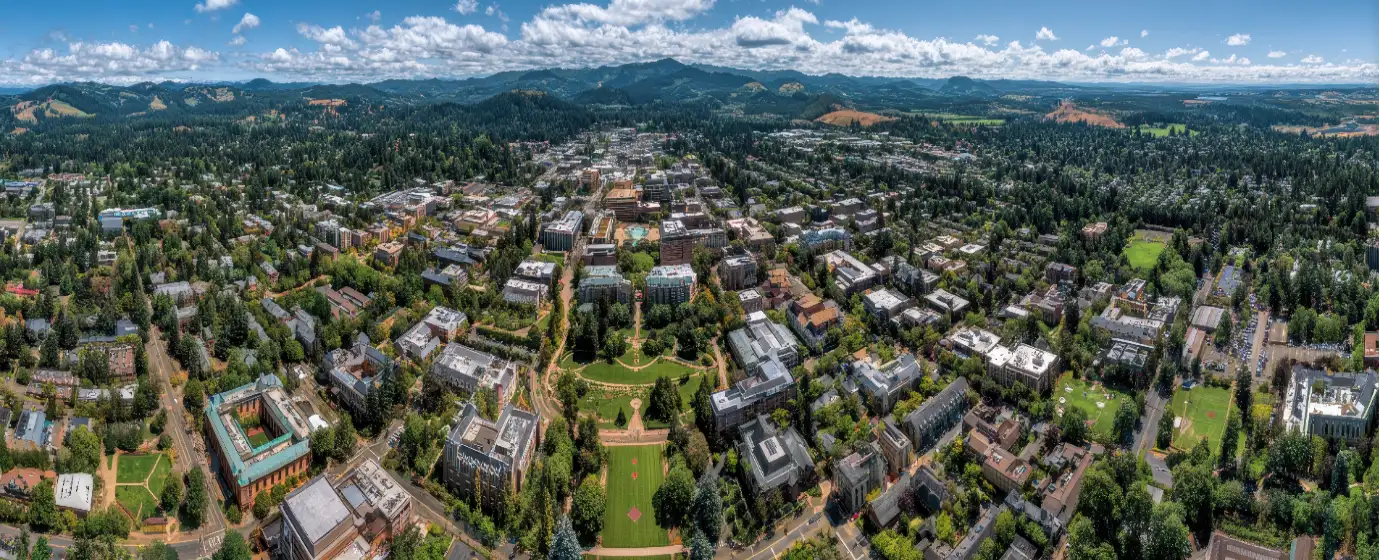
Everyone who moves to Corvallis from California says the same thing in month two: they expected a smaller version of what they left, and instead found something genuinely different. Corvallis sits in the Willamette Valley in Benton County, about 85 miles south of Portland, anchored by Oregon State University and ringed by Coast Range foothills. US-20 connects it west to the Oregon Coast and east toward the Cascades; OR-99W runs it north toward the Portland metro. It is a city of 61,247 people that functions as both a university town and a working regional hub — which means the energy here is different from the sprawling California suburb you may have left behind.
Oregon State University shapes nearly everything about Corvallis — the employment base, the cultural calendar, the rental market, and the reason the school district holds a B+ rating, according to Niche. Good Samaritan Regional Medical Center and HP round out the major employers alongside the university and the Corvallis School District. The people moving here are a specific mix: academics and researchers, remote workers pricing themselves out of the Bay Area, families drawn by the school district and the outdoor access, and retirees who want a genuine small-city feel without the rural isolation. What they all discover is that Corvallis is not cheap by Oregon standards — it is in fact among the most rent-burdened communities in the state — but measured against where most of them came from, the numbers still make sense.
The headline comparison that brings Californians here is home prices. Corvallis's typical home value stood at $565,289 as of July 2026 (Zillow Home Value Index). For context on the gap, California's statewide typical home value sits at $773,735 (Zillow Home Value Index) — and that statewide figure includes Central Valley markets that pull the number down significantly. In the metro areas most Californians are actually leaving, the gap is far wider. The tradeoff in Corvallis is that incomes are also lower, and the rental market is genuinely stretched: roughly 59% of households here rent rather than own, which puts upward pressure on the cost of living in ways that don't always show up in the headline price comparisons.
This guide covers the five things that matter most to Californians making this move: the full tax picture (which is more complicated than the headline suggests), how housing costs actually compare, what daily life looks like, what the neighborhoods offer, and the honest friction points nobody mentions until you've already signed the lease. Whether you're visiting for a weekend or have already accepted the offer, the sections below give you the on-the-ground picture.

The Tax Picture: What Oregon Gives and What It Takes Back
The sales tax situation is the first thing Californians notice, and it is genuinely as good as advertised. Oregon collects no general sales tax at any level of government — no state, county, or city levy, and no local jurisdiction may add one. California's statewide base sales tax rate of 7.25% is already the highest in the country; with local additions, most California households are effectively paying 8–10% on taxable purchases. For a household spending $50,000 a year on taxable goods, that translates to $4,000–$5,000 a year in California sales tax. In Oregon, that bill is zero.
Buy a $40,000 vehicle in California and you owe more than $3,000 in sales tax at the register. Buy the same vehicle in Corvallis and you pay nothing. The savings compound quickly across furniture, appliances, and major purchases — which matters most in the first year of a move, when you're furnishing a new home.
The Income Tax Surprise
Here is where it gets counterintuitive, and where Californians who did a quick Google search get the wrong impression. California's top state income tax rate of 13.3% applies only to the highest earners — income above roughly $1 million for single filers. Oregon's top rate is 9.9%, which looks like a win. But Oregon's brackets compress far faster, reaching near the maximum rate for anyone earning well into six figures.
The income-tax savings favor high earners; many middle-income households pay about the same or more in Oregon than they did in California. That is the counter-intuitive truth for most researchers, tech workers, and educators who make up Corvallis's working population. Oregon does offer a partial offset: filers can subtract a portion of their federal income taxes paid from Oregon taxable income. This benefit phases out completely for joint filers with federal adjusted gross income of $290,000 or more, so higher earners don't see it.
If you're a remote worker employed by a California company, you pay Oregon income tax where you live — not California's — which can be a meaningful change in either direction depending on your income level. Run the numbers for your specific situation before assuming the move saves money on taxes.
Property Tax: A Genuine Win
Corvallis's effective property tax rate is 0.95%. California's effective property tax rate of 0.71% is lower on paper — but California's rate applies to an assessed value that is reset at purchase and often dramatically higher than Oregon's. On a comparable home, the real-dollar tax bill in Corvallis tends to land close to what you were paying in California, sometimes lower. Oregon also offers a property tax deferral program for seniors and disabled homeowners who meet income thresholds, allowing eligible owners to defer taxes until the property is sold. See the full breakdown on the cost of living page.
| Tax Category | Corvallis / Oregon | California |
|---|---|---|
| State sales tax | $0 — no sales tax at any level | 7.25% statewide base rate, plus local additions |
| Top state income tax rate | 9.9% (brackets compress fast; near-max rate reached well into six figures) | 13.3% top rate applies only to the highest earners |
| Effective property tax rate | 0.95% | 0.71% (applied to purchase-price assessed value) |
| Local income tax | None | None statewide (some local payroll taxes in select cities) |
| Federal tax deduction offset | Partial subtraction available (phases out at $290K AGI for joint filers) | Not available |
| Vehicle purchase tax | $0 | 7.25%+ of purchase price |
The net tax picture is not a slam dunk in either direction. Californians with high incomes and high spending will often come out ahead in Oregon, especially once the sales tax savings compound. Middle-income earners should run the actual numbers before assuming the move saves money.
Housing: The Real Comparison and the Local Catch
Corvallis's typical home value stood at $565,289 as of July 2026 (Zillow Home Value Index). California's statewide typical home value of $773,735 is the honest comparison point — and even that figure includes inland markets that most Bay Area or Southern California transplants never considered buying in. The gap between Corvallis and the California market most Californians are actually leaving is wider than the statewide numbers suggest.
What that gap means in practice: a Corvallis home at the typical price point often means a three-bedroom on a real lot, with a garage, within a few miles of both the university campus and the riverfront trail system. That home would represent a substantial step up in physical space from what the same money bought in most California metros.
The Affordability Catch Californians Don't Expect
Here is the honest friction: Corvallis carries some of the steepest rent-burden pressures of any city in Oregon. The reason is structural — Oregon State University drives intense rental demand, and roughly 59% of households here rent rather than own. That competition keeps rents high relative to local incomes.
The median household income in Corvallis is $65,012, which falls well short of what's needed to comfortably carry the typical home here. For renters, the typical 2BR rent runs $1,590–$1,940 per month, and the city's own affordability data puts the income needed to afford a 3-bedroom apartment at $92,080. If you're arriving from California with California equity and a California salary, that math works in your favor. If you're arriving without equity and planning to earn local wages, the numbers are harder.
What Different Neighborhoods Offer Buyers
The geographic logic of Corvallis runs on two axes: proximity to Oregon State University and elevation. College Hill — listed on the National Register of Historic Places since 2002, with more than 250 homes built between 1916 and 1935 — sits above the city median, closer to the university core, and draws buyers who want walkable tree-lined streets and historic character. West Hills and Timberhill offer newer construction, views, and quiet, but require a car for most daily errands. Northwest Corvallis is the family-oriented growth corridor with newer subdivisions and easier access to schools. South Corvallis, including Willamette Landing — a larger neighborhood with two pools, a fitness center, pickleball courts, and a maintained park — gives buyers more square footage for the investment. For a deeper look at neighborhoods, see the neighborhoods page.
Californians arriving with equity from a home sale often find they can buy in Corvallis without stretching, and sometimes with room to spare. The move from renter to owner is where the city genuinely rewards people who make it.
Daily Life: What Actually Changes When You Move Here
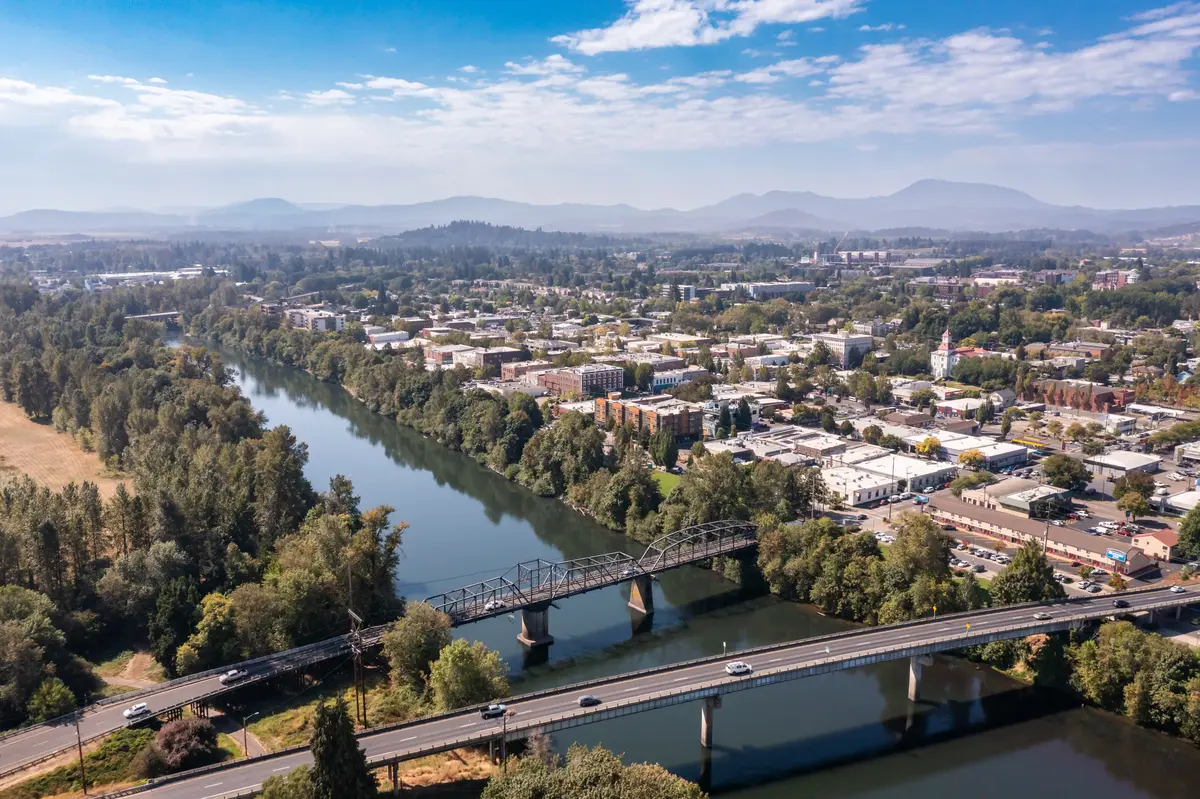
The shift that catches most California transplants off guard isn't the weather or the taxes — it's the pace. Corvallis moves slower, and that is not a complaint. Downtown is genuinely walkable; the Oregon State University campus anchors the eastern core and bleeds naturally into the commercial streets around it. The Corvallis Farmers' Market draws a serious crowd of residents who actually shop there, not just browse. Bike infrastructure is thorough enough that car-light living is practical for a significant portion of errands, which partially offsets transportation costs for people coming from California's car-dependent commute culture.
The Weather Reality
Corvallis averages 159 sunny days a year. If you're arriving from San Diego or the Bay Area's sunnier pockets, that number requires adjustment. The winters are mild by Oregon standards — rarely freezing, rarely snowing — but the grey cloud cover from November through March is persistent and pervasive. Californians almost universally underestimate this in month one and understand it viscerally by month four. The payoff is summer: warm, dry, and genuinely beautiful, with the Coast Range accessible on US-20 and the Cascades reachable to the east.
Getting Around and Getting Out
Corvallis is not an airport city. Eugene Airport sits about 35 miles south and serves most domestic connections adequately for a small city. The drive to Portland on OR-99W takes about 90 minutes — a realistic commute anchor for anyone with regular obligations in the metro. That drive is pleasant in the summer and genuinely difficult in December if weather hits the valley, so factor it in if you're planning to commute semi-regularly.
Health insurance premiums run noticeably below what most Californians were paying, though the honest trade-off is that specialist care and more complex procedures will mean driving to a larger city — that's true of most Oregon cities outside Portland.
What Californians Miss (and What They Don't)
A serious shopping run means driving out of town. Anything beyond what a mid-size grocery store and a handful of local shops carry will require planning — either a trip to Albany or a delivery order. What people stop missing faster than expected: the traffic, the density, and the commute. What they keep missing: year-round sunshine, ocean proximity without a mountain pass, and ethnic food diversity at the level California delivers it. Corvallis has independent food worth knowing, but the range is not what you had before.
Looking to buy in Corvallis? Estimate your payment.
Enter your numbers to see an estimated monthly mortgage payment.
Estimate only. Excludes HOA fees and mortgage insurance. The interest rate above is a starting point, not a quoted rate — replace it with your own to see real numbers. Insurance is a flat placeholder, not a Corvallis quote.
Weekends and Local Favorites
Oregon State University's campus is the city's most distinctive public space — wide, tree-lined, and genuinely integrated into the surrounding neighborhoods rather than walled off from them. The Riverfront Commemorative Park and its trail system along the Willamette give Corvallis a natural gathering point that cities twice its size would envy. Avery Park, on the south end of the city, draws families on warm afternoons with a rose garden and mature Douglas fir canopy. Bald Hill Natural Area is where the serious trail runners go — the climb rewards you with views across the valley that reorient your sense of where you are. Marys Peak, the highest point in the Coast Range, is about an hour's drive west and earns a visit in any season. The McDonald-Dunn Research Forest, managed by Oregon State, sits directly adjacent to the city and offers hundreds of miles of trail access that most residents still haven't fully explored.
The food and coffee scene is genuine for a city of this size. Block 15 Brewing Downtown Pub has earned its reputation over years, not just because it's local — the beer program is serious. Sky High Brewing & Pub draws a regular crowd that skews more neighborhood than campus. For something outside the brew pub genre, Khalo Naser Syrian Cuisine & Lounge is a specific kind of find in a city this size, and TacoVino earns repeat visits. Squirrels Tavern is the kind of place where people end up staying longer than they planned.
On the coffee side: Futura Coffee Roasters — Downtown Corvallis roasts at a level that would stand up in any California city. Interzone is the neighborhood anchor that's been part of Corvallis longer than most students have been alive. Coffee Culture Kings, Bodhi Cafe, and Imagine Coffee Co. each bring something different — Bodhi in particular draws the morning crowd that likes their coffee with a quieter room. The Corvallis Farmers' Market runs through the warm months and is worth building into the Saturday routine for produce, local goods, and the general sense of what Corvallis looks like when it's at its best.
The Honest Trade-offs: What California Transplants Should Know Before They Commit
Corvallis rewards people who do the honest math before arriving. The home price gap relative to California is real and meaningful — especially for buyers converting California equity into a Corvallis purchase. But the city has genuine affordability constraints of its own, driven by the university's rental pressure and local incomes that sit well below what most California transplants are accustomed to earning. The Corvallis School District's 5,858 students enrolled in 2025-26 are served by a district that holds a B+ rating, according to Niche — solid by Oregon standards and a genuine draw for families, but not without the boundary quirks and capacity pressures that any growing district carries. See the full school picture on the schools page.
The Six-Month Reality Check
What surprises most California transplants by month six isn't anything on the tax comparison table. It's the combination of grey winters and limited retail variety. People who came for the outdoor access and the university town culture stay. People who came primarily for the price — without really wanting a smaller, slower, rainier city — often don't. That's not a criticism of Corvallis; it's a fair characterization of what the city is and isn't.
The remote work picture is worth naming directly. If you're bringing a California salary to Corvallis, you're in one of the best positions a mover can be in: California income, Oregon prices, zero sales tax on everything you buy. Remote workers employed by California-based companies pay Oregon income tax where they live, not California taxes — a meaningful shift for anyone who was paying California's rates. That population makes up a real share of recent arrivals, and for high earners especially, the move tends to calculate well.
What You Would Not Do
If you're drawn to Corvallis primarily because it seems like a cheaper version of a big city, recalibrate before you arrive. It is a university town with a strong research culture, genuine outdoor access, and a food scene that punches above its population. It is not a smaller Portland, and residents who wanted that dynamic have generally drifted north. The people who thrive here came looking for exactly what Corvallis actually is — and they found that the crime picture, the safety profile, and the community texture matched what the numbers suggested.
For buyers comparing nearby options: Albany and Lebanon both sit noticeably lower than Corvallis on home prices, and Philomath comes in somewhat lower. Those cities offer a different trade-off — more affordability, less walkability and amenity density, a different community composition. Whether that trade-off works depends entirely on what you came here for.

Local Expert Takeaway: Californians who move to Corvallis with equity and a portable income — remote work, academic, or tech — are the ones who feel the math click within six months. The sales tax elimination is immediate and real on every purchase. The home price gap relative to California's statewide typical is genuine. What bites people is the income tax surprise (Oregon's brackets hit hard well into the six-figure range, and the savings favor high earners more than middle-income households), the grey winters after February, and the discovery that Corvallis has real affordability pressures of its own, driven by Oregon State University's rental market. Go in with accurate expectations — 159 sunny days a year, a mid-size city pace, a serious outdoor and university culture — and this move tends to stick.
Quick Takeaways & FAQs
✅ Oregon's zero sales tax delivers an immediate and permanent savings over California's 7.25% base rate — especially on big-ticket purchases like vehicles and appliances in your first year.
⚠️ Oregon's income tax brackets compress faster than California's, meaning the income-tax savings favor high earners while many middle-income households pay about the same or more in state taxes — run the numbers for your specific income before assuming a win.
📍 Corvallis carries some of Oregon's steepest rent-burden pressures, driven by Oregon State University's rental demand — roughly 59% of households rent, which keeps rents elevated relative to local incomes and makes buyer competition real even at the city's price point.
Is Corvallis actually cheaper than California for homebuyers?
Do I still pay California income tax if I work remotely from Corvallis for a California company?
How significant is the sales tax difference when moving from California to Corvallis?
What are winters like in Corvallis compared to California?
How do Corvallis property taxes compare to California?
Moving to Oregon?
Tell us what you need help with and we'll connect you with local resources.
