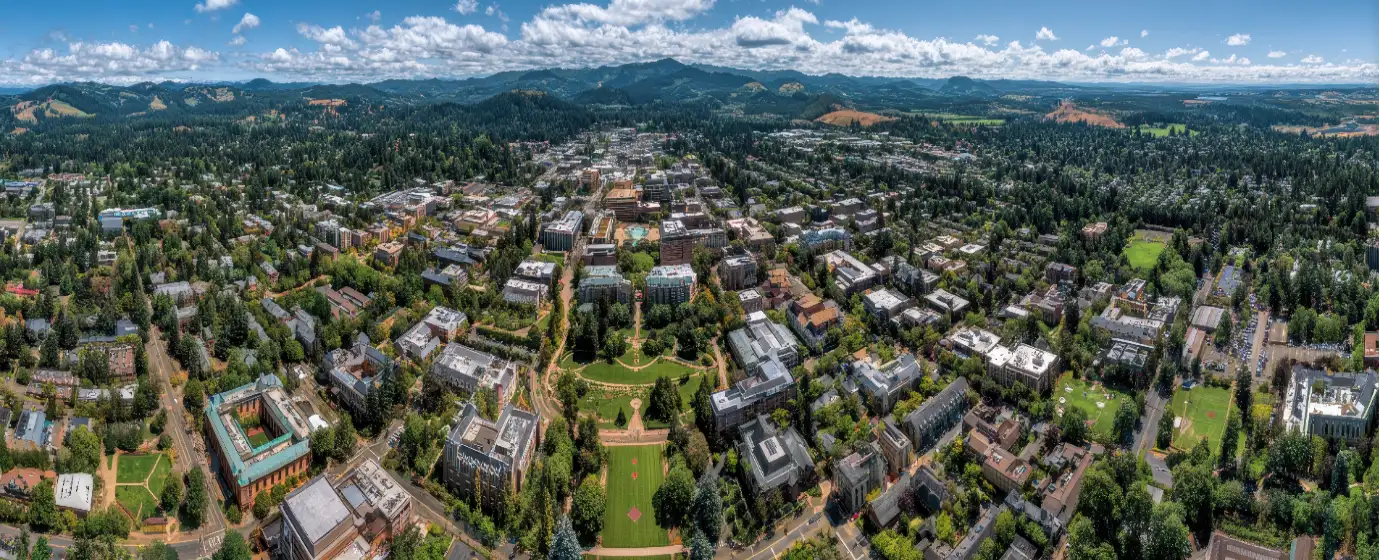
Most people who move to Corvallis arrive because of Oregon State University — or because someone who works there told them it was a good place to raise a family. Both are true, and the city of 61,247 delivers on that promise more consistently than most college towns its size. What nobody tells you upfront: Corvallis is physically small, and the differences between its neighborhoods are measured in atmosphere and school-boundary quirks rather than hour-long commutes from one end to the other. You can drive across the city in under fifteen minutes. That proximity is a gift, until you realize it makes the question of which neighborhood matter more, not less, because the gap between an easy daily life and an inconvenient one is often just a few blocks.
Oregon State University is the gravitational center of everything here — the city's largest employer, the driver of its rental market, and the reason the local economy stays relatively stable when the rest of Oregon's smaller cities stagnate. Good Samaritan Regional Medical Center anchors the healthcare sector, HP maintains a technology presence, and Benton County government rounds out the major employer base. The Corvallis School District 509J holds a B+ rating, according to Niche, and it is a genuinely high-performing district by Oregon standards — one of the main reasons families choose Corvallis over neighboring Albany even when Albany's prices are noticeably lower.
The typical home price in Corvallis sits at $565,289 (Zillow Home Value Index, July 2026), which puts it well above Albany but meaningfully below Portland's metro suburbs. The lifestyle offset is real: Bald Hill Natural Area, the McDonald-Dunn Research Forest, Marys Peak, and the Willamette riverfront trail system give residents more genuine outdoor access than most comparably priced Oregon cities. Corvallis also holds a well-earned reputation as one of the most bike-friendly cities in the state, with dedicated lanes throughout town and a commuter cycling culture that is embedded in daily life, not just a weekend amenity. The trade-off is weather: 159 sunny days a year, which is low even by western Oregon standards.
Whether you are buying your first home, relocating for an OSU position, or trying to figure out which side of town makes sense for your school-age kids, the sections below break down Corvallis's eight neighborhoods, compare them by buyer type, flag the most common purchasing mistakes, and map the best areas for renters.

The Corvallis Reality
The divide that shapes every buying decision in Corvallis is not east versus west or historic versus new — it is proximity to Oregon State University, and whether that proximity works for your life or against it. Neighborhoods close to campus, particularly College Hill and Downtown, carry a premium and a trade-off: walkability, historic character, and real energy, alongside student rental density, parking pressure, and more transient neighbors than you might expect in a city this size.
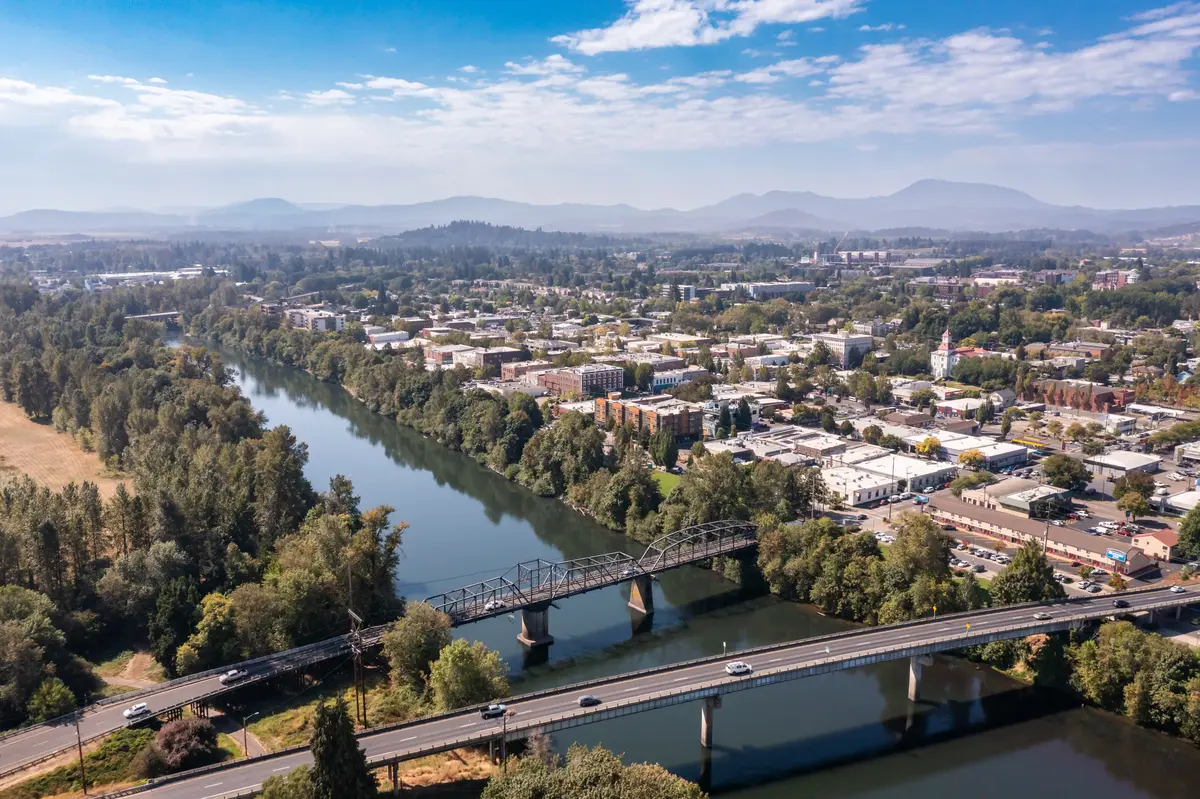
The second divide is the Willamette River itself. South Corvallis and Willamette Landing sit below OR-34 on the southern edge of the city, connected to downtown by a handful of crossings. That slight geographic separation makes those neighborhoods feel quieter and more self-contained — a genuine feature for some buyers, a frustration for others who find themselves driving north for most of their errands and appointments.
School boundaries in Corvallis are worth studying before you make an offer, not after. The district's elementary feeder zones do not always align with neighborhood names, and South Corvallis in particular has enough boundary variation across its blocks that two homes on the same street can feed into different schools. The district's overall rating is strong, but individual school assignments matter to parents with school-age children, and the city's compactness means a small geographic shift can change your child's school entirely. Check the district boundary map as part of your due diligence — see the full breakdown on the Corvallis schools page.
Neighborhoods at a Glance
| Neighborhood | Best For | Vibe |
|---|---|---|
| Northwest Corvallis | Families School Access | Quiet suburban streets with newer construction pockets and strong park access |
| Timberhill | Families Nature | Tree-lined and polished, backed by a natural area with White Oak prairie; requires a car for errands |
| South Corvallis | Families Value | Diverse, river-adjacent community with larger yards and a more international character |
| West Hills | Luxury Privacy Views | Spread-out and elevated, with a mix of rural character and upscale enclaves |
| College Hill | Walkable School Access | Historic and architecturally rich, steps from OSU; above the city median on price |
| Willamette Landing | Families Quiet | Master-planned riverside community with newer green-certified homes and a clubhouse |
| Avery-Helm | Walkable First-Time | Oldest residential district in the city, near downtown, with preserved 19th and early 20th century homes |
| Downtown Corvallis | Walkable Transit | The most on-foot-accessible part of the city; locally owned dining, the farmers market, and the riverfront |
Corvallis typical home price: $565,289 (Zillow ZHVI, July 2026). Typical rent: $1,731/mo (Zillow ZORI, July 2026). Neighborhood tiers on this page are relative to these figures.
Best Neighborhood by Buyer Type
| Buyer Type | Best Neighborhood | Why |
|---|---|---|
| First-Time Buyer | Avery-Helm | Near-downtown location with older single-family homes and a tight-knit neighborhood association that keeps the area stable. |
| Luxury Buyer | West Hills | The Grand Oaks pocket delivers elevated views, larger parcels, and a community clubhouse with amenities in a quieter setting removed from campus traffic. |
| Walkability Seeker | Downtown Corvallis | The Corvallis Farmers' Market, the Riverfront Commemorative Park, the Corvallis Art Center, and a dense ring of independent businesses are all reachable on foot. |
| Families with Kids | Northwest Corvallis | Consistent school-boundary access, Martin Luther King Jr. Park, trails connecting to major city parks, and a housing mix that suits growing households. |
| Commuters | South Corvallis | OR-34 and OR-99W both run through or near the area, giving commuters heading toward Albany or the valley corridor reasonable access without cutting through downtown congestion. |
| Large-Lot Buyers | West Hills | The spread-out, semi-rural character of the western edge means larger parcels and genuine breathing room that the more compact neighborhoods closer to campus cannot match. |
| Renters | Downtown Corvallis | The widest variety of apartment and townhouse inventory in the city, all within walking distance of OSU and the commercial core. |
Looking to buy in Corvallis? Estimate your payment.
Enter your numbers to see an estimated monthly mortgage payment.
Estimate only. Excludes HOA fees and mortgage insurance. The interest rate above is a starting point, not a quoted rate — replace it with your own to see real numbers. Insurance is a flat placeholder, not a Corvallis quote.
Most Popular Neighborhoods
Northwest Corvallis
This is where most families who have done their homework end up. The housing stock ranges from ranch-style homes and split-levels to newer construction with three-car garages in sub-pockets like Ponderosa Ridge, where trails connect directly to city parks. The trade-off is distance from downtown: you will be driving to most restaurants and cultural events, and the neighborhood has no commercial core of its own.
Best for: Families with school-age children, professionals who want a quiet suburban environment within the city limits.
Timberhill
Timberhill's defining asset is its immediate edge against the Timberhill Natural Area — a White Oak prairie and grassland preserve adjacent to Chip Ross Park — which means actual trail access from residential streets rather than a drive to a trailhead. The neighborhood is well-maintained and has attracted families and professionals for decades, but daily errands require a car without exception, as there is no walkable retail nearby.
Best for: Families and nature-oriented buyers who want quiet streets and trail access without leaving the city.
South Corvallis
South Corvallis is more diverse and more complicated than its neighbors to the north. Larger yard sizes, Willamette Park river access, and proximity to the Corvallis Farmers' Market give it genuine appeal, and the international community shaped by OSU's graduate population adds real texture. School-boundary research is non-negotiable before buying here — enough variation exists across the neighborhood's blocks that the due-diligence step is not optional.
Best for: Buyers who value yard size, river proximity, and neighborhood diversity over walkable streets.
West Hills
West Hills is the part of Corvallis where the city starts to feel like the rural Willamette Valley it sits inside. The neighborhood is spread out, bounded to the south by US-20, and includes several distinct sub-communities — including the upscale Grand Oaks pocket, which was completed around 2006 and includes a clubhouse with a pool, hot tub, and fitness rooms. Elevation gains across the area deliver views, but that spread-out character also means longer drives for everything.
Best for: Buyers seeking privacy, elevated views, and larger parcels, including the upscale buyer who wants amenities without high-density neighbors.
College Hill
College Hill sits just west of the OSU campus and is one of the most architecturally significant neighborhoods in Oregon: the College Hill West Historic District was listed on the National Register of Historic Places in 2002, with over 250 homes built primarily between 1915 and 1945. Prices here run above the city median, and OSU's footprint means the neighborhood includes a mix of faculty households, longtime residents, and student rentals side by side. That mix brings energy and walkability — and it also brings the noise and density that come with living near a major research university.
Best for: OSU faculty, buyers who value historic architecture and on-foot access to campus and downtown, and buyers who can accept the trade-offs of a university-adjacent neighborhood.
Willamette Landing
Willamette Landing is the newest-feeling neighborhood on this list: a master-planned, green-certified community developed by Legend Homes on the Willamette River's southern bank, with a clubhouse that includes two pools, a fitness center, pickleball courts, walking paths, and a basketball court. It draws retirees and families who want newer construction and built-in amenities in a quieter setting, though its position at the southern end of the city means you are driving north for most of Corvallis's cultural and dining life.
Best for: Buyers who want newer construction with community amenities and a quieter pace, including active retirees and families who prefer a planned environment.
Avery-Helm
Corvallis's first officially designated historic district takes its name from Joseph C. Avery, who filed a land claim at the confluence of the Willamette and Marys Rivers in 1845 — the literal founding ground of the city. The district covers fourteen blocks of residential development dating from 1870 to 1949, and preservation advocates successfully down-zoned portions of it to protect that scale. Its near-downtown location and walkable streets make it genuinely convenient, but the historic building stock means older systems, maintenance realities, and renovation costs that buyers coming from newer construction should price in carefully.
Best for: Buyers drawn to historic character and near-downtown walkability who understand the maintenance obligations that come with pre-1950 homes.
Downtown Corvallis
Downtown is the most on-foot-accessible part of the city by a significant margin, with the Riverfront Commemorative Park, the Benton County Courthouse, and the Corvallis Art Center all within the neighborhood, alongside independent dining, coffee, and the weekly Corvallis Farmers' Market. Housing ranges from apartments and townhouses to older single-family homes on quieter residential blocks just off the commercial streets. The proximity to OSU makes this the highest-demand rental zone in the city, which cuts two ways: strong rental investment potential, and more student-rental density than some owner-occupants want next door.
Best for: Buyers and renters who prioritize on-foot access above all else, and investors looking for rental demand tied to a stable university tenant base.
Common Mistakes Buyers Make in Corvallis
Assuming Every Neighborhood Feeds the Same Schools
Corvallis is compact enough that buyers routinely assume the district's strong overall rating applies uniformly to every address. It does not. South Corvallis in particular has enough boundary variation that two homes within a few blocks of each other can land in different elementary schools. Check the boundary map before you write an offer — not after your earnest money is on the table.
Underestimating the University's Effect on Daily Life
The neighborhoods closest to OSU — College Hill and Downtown — shift dramatically during the academic year. Parking pressure, noise levels, and the character of nearby rentals all change when a large student population returns each fall. Buyers who visit in July and fall in love with the quiet often find the reality different by October. If that energy appeals to you, great — but visit during the school year before you commit.
Choosing Square Footage Over Location
Because Corvallis is small, it is tempting to stretch toward a larger home in the more spread-out parts of the city — West Hills, the outer edges of Northwest Corvallis — and assume the convenience difference is minimal. It is not. Without a car, those neighborhoods are not functional for daily life. Buyers who move from walkable urban environments and expect the same on-foot access in the outer neighborhoods consistently underestimate how car-dependent even a small Oregon city can be once you step away from the downtown core.
Ignoring the OR-34 Crossing Patterns in South Corvallis
The southern neighborhoods — South Corvallis and Willamette Landing — sit below OR-34, and while the drive to downtown Corvallis is short in distance, the crossing patterns during peak hours and around OSU event days add friction that buyers do not anticipate. If your employer, your kids' school, or your daily errands are on the north side of town, the commute rhythm from the southern neighborhoods is worth a week of dry runs at actual commute times before you buy.
Best Areas to Rent in Corvallis
| Area | Ideal For | Trade-off |
|---|---|---|
| Downtown Corvallis | OSU students, young professionals, anyone who wants on-foot access to dining and the riverfront | Highest competition for units; student-rental density means less quiet than other areas |
| College Hill | OSU faculty, graduate students, and anyone who wants historic character within walking distance of campus | Tight supply of family-sized rentals; parking is limited and competes with student demand |
| Northwest Corvallis | Families with school-age children who want stability and park access over urban density | Car required for most errands; fewer apartments means most rentals are single-family homes or smaller complexes |
| South Corvallis | Grad students, international families, and renters who want more space and yard access at a lower density | School boundaries need to be confirmed; OR-34 crossing adds commute friction during peak hours |
| Willamette Landing | Renters who want newer construction, community amenities, and a quieter pace near the river | Limited rental inventory in a primarily owner-occupied planned community; most errands require driving |
The city-wide typical rent shown on the cost of living page reflects a market shaped heavily by OSU's enrollment cycle — units turn over fast in spring and go quickly in late summer, so renters who wait until August to search in Corvallis consistently find the best options already gone. If you are relocating for the fall, begin your search no later than May.

Local Expert Takeaway: Corvallis rewards buyers who do their geographic homework. The city is small enough that no neighborhood feels remote — but the differences between them are real: College Hill gives you historic architecture and walkable proximity to OSU at a price above the city median; Northwest Corvallis gives you the school access and suburban quiet that families consistently chase; and Downtown delivers on-foot access to the Corvallis Farmers' Market, the Riverfront Commemorative Park, and the Corvallis Art Center without needing a car. The mistake most relocating buyers make is treating the city as uniform. It is not. Spend a weekday morning in your target neighborhood during the academic year, drive the actual route to work, and confirm your school boundary assignment before you make an offer — and you will land in the right part of town.
Quick Takeaways & FAQs
✅ Corvallis's bike infrastructure is among the best in Oregon — in some neighborhoods, bicycle commuting is genuinely more practical than driving for daily errands and campus trips.
⚠️ South Corvallis has real appeal — larger yards, river access, genuine diversity — but school boundary variation across its blocks makes pre-offer due diligence non-negotiable for families with kids.
📍 The Avery-Helm Historic District, covering fourteen blocks near downtown, is the oldest residential area in the city and takes its name from the man who filed Corvallis's original land claim in 1845 — an unusual piece of local history embedded in the neighborhood's official designation.
What is the most walkable neighborhood in Corvallis?
Which Corvallis neighborhood is best for families with school-age children?
Is College Hill a good place to buy a home, or is it too close to OSU?
How does Willamette Landing compare to other Corvallis neighborhoods for someone wanting newer construction?
What should I know about renting in Corvallis before I start searching?
Moving to Oregon?
Tell us what you need help with and we'll connect you with local resources.
