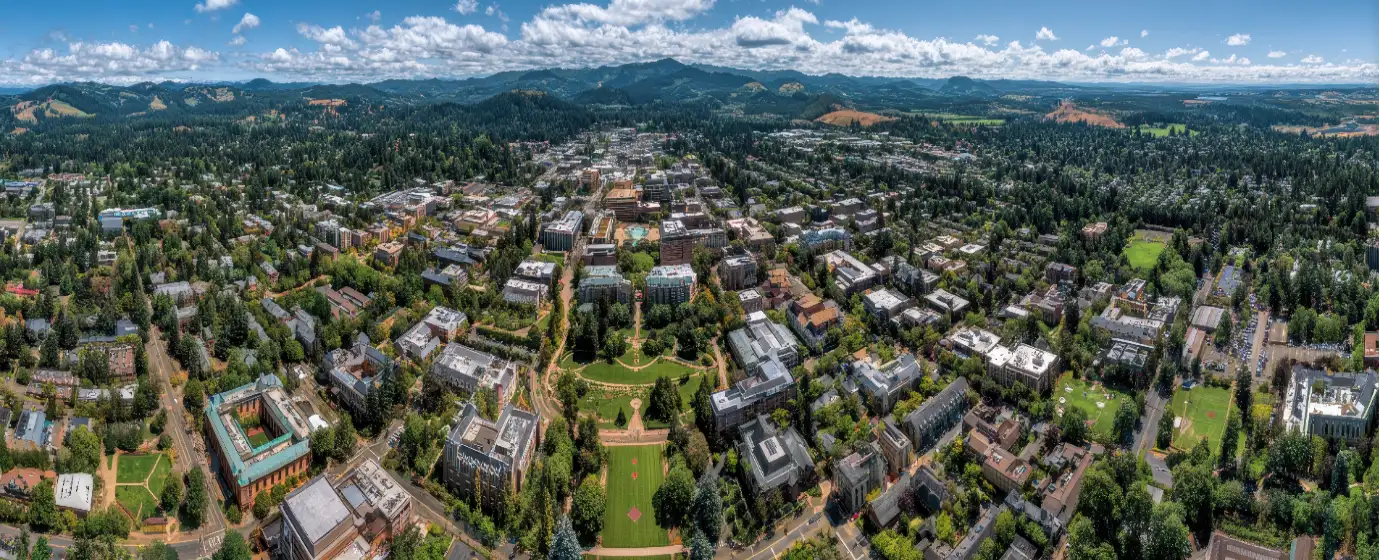
Parents who move to Corvallis from larger metro areas often arrive expecting a trade-off: a smaller city means a smaller school system, and smaller usually means fewer options. What they find instead is a district that consistently outperforms much of the state on academic measures, two high schools that rank among Oregon's strongest by independent measures, and a youth sports culture built around a college town that takes athletics seriously. The Oregon State University campus doesn't just define the economy here — it shapes the community's expectations around academics and organized activity in ways that ripple all the way down to elementary school.
Corvallis School District 509J serves a city of 61,247 people and 5,858 students enrolled in 2025-26 across 13 schools, including two comprehensive high schools, a K–8 school, multiple elementaries, a charter school, and alternative programs. The district holds a B+ rating, according to Niche, and ranks better than 93.6% of Oregon districts on SchoolDigger's statewide index. Oregon State University, Good Samaritan Regional Medical Center, HP, and Benton County government anchor the local economy — which means a disproportionate share of district families include researchers, engineers, and medical professionals. That demographic reality shows up in both the district's academic culture and the intensity of its parent involvement.
On the cost-of-living side, Corvallis sits noticeably below Portland-area prices while delivering a school system that competes with the suburbs families are often leaving. The city's typical home price was $565,289 as of July 2026 — see the full breakdown on the cost of living page. Day-to-day life here leans heavily on outdoor access: Bald Hill Natural Area, Avery Park, and the McDonald-Dunn Research Forest give kids genuine room to move, and the Willamette Valley climate means 159 sunny days a year alongside a gray, rainy stretch from November through March that parents with active kids learn to work around. Whether you're weighing enrollment options, trying to understand the youth sports landscape, or figuring out whether this district is a fit for your family's specific needs, the sections below cover District 509J's overall profile, its standout schools, academic performance, youth sports programming, and an honest look at who this system works best for — and who it doesn't.

Corvallis School District 509J: The Big Picture
Corvallis School District 509J is a mid-size district by Oregon standards — 5,858 students enrolled in 2025-26, spread across a PK–12 range that includes two comprehensive high schools on opposite ends of town, a K–8 school, a handful of elementaries, a charter school, and alternative programming. It is not a large suburban district with dozens of schools and specialty magnets at every grade level. What it is, consistently, is one of the stronger-performing districts in the state relative to its size.
The district holds a B+ rating, according to Niche, and SchoolDigger places it ahead of more than 93% of Oregon districts statewide. Those rankings align with what classroom data shows: on 2024-25 state assessments, 42.7% of students reached math proficiency and 54.7% reached reading proficiency — measurably above Oregon's state averages of 33% and 44% respectively. Oregon's statewide proficiency numbers are not strong by national standards, which means outperforming them is worth something but not everything. Still, the gap here is real and consistent across years.
Every teacher in the district is licensed — a baseline worth naming because it is not universal across all Oregon districts. Classes run at a size that families from private or small charter school settings will notice; the district is mid-size enough that specialty magnets don't exist at every grade level, and that's a realistic expectation to set before you arrive.
About 29.9% of district students qualify for the federal free and reduced-price meal program — a demographic profile that is meaningfully more economically diverse than the stereotypically homogenous college-town district. The Oregon State University connection creates a highly educated parent base at one end of the income spectrum; the city's service economy and recent growth create a broader mix than outsiders often expect.
What Closed — and Why It Matters
Two schools closed as of June 2026: Letitia Carson Elementary and Cheldelin Middle School. This is relevant context for families evaluating boundary assignments, especially those looking at specific neighborhoods. If a real estate listing mentions proximity to either of those schools, the assignment has changed. Confirm your current boundary directly with the district before making enrollment decisions based on address alone.
Three Standout Schools Worth Knowing
Franklin K-8 School
Franklin K-8 is the district's most recognized elementary-level performer. SchoolDigger awarded it a top rating among Oregon elementary schools in the 2024-25 school year, placing it among the state's highest-ranked. It consistently outperforms both district and state averages across math, reading, and science — making it one of the clearer cases where a specific school's performance diverges meaningfully from the district average.
For families focused on elementary academics, Franklin K-8 is the school that tends to come up first in parent conversations. The K–8 structure also means your child stays in one building through eighth grade, which matters logistically and for community continuity. Boundary assignment determines whether your address feeds into Franklin, so verify early.
Best for: Families prioritizing elementary and middle school academic performance who land in Franklin's boundary.
Crescent Valley High School
Crescent Valley consistently ranks among Oregon's strongest high schools by independent measures. It offers Advanced Placement coursework across multiple subjects and has an established college-prep orientation. On 11th-grade state assessments, it outperforms both district and state averages.
The school draws students from the western and northern parts of the city, including neighborhoods like Northwest Corvallis and Timberhill. Its college-prep culture is well established, which reflects both the school's programming and the parent community it serves. Students have access to a range of competitive athletics programs across multiple sports.
Best for: College-bound students who want AP access and a competitive academic environment within a mid-size high school.
Corvallis High School
Corvallis High School also ranks among Oregon's top-rated public high schools by independent measures and offers AP coursework across multiple subject areas. It draws students from the southern and eastern portions of the city and fields competitive athletics programs across multiple sports.
Having two high schools that both earn strong independent ratings is not something most cities of 61,247 can claim — and it is a genuine, verifiable characteristic of what the district delivers. The practical reality is that your address determines which one your child attends. Both schools are strong; the choice between them is usually geographic, not qualitative.
Best for: Families in South Corvallis, College Hill, and the eastern neighborhoods who want a rigorous public high school without navigating a transfer process.

Academic Performance: What the Numbers Mean in Context
On 2024-25 state assessments, 42.7% of students reached math proficiency and 54.7% reached reading proficiency. Set those numbers against Oregon's statewide figures — 33% math, 44% reading — and the gap is consistent and meaningful. Set them against top suburban districts in the Portland metro, and the gap narrows. Corvallis 509J performs well for a standalone mid-size district; it is not the highest-performing district in Oregon.
The context that shapes those numbers: Oregon's statewide proficiency benchmarks shifted in 2022-23 when the state adopted new, more rigorous standards. Every Oregon district saw raw proficiency numbers drop that year, and most haven't fully recovered. Corvallis's scores above state average should be read within that post-reset environment, not compared to pre-2022 figures from other sources.
The University Effect
Oregon State University's presence creates an unusual parent demographic for a city this size. A significant portion of district families include faculty, graduate students, and research staff — people for whom academic rigor is a professional priority, not just a preference. That parent engagement tends to drive school culture, PTA involvement, and supplemental enrichment in ways that standard district metrics don't capture.
It also creates an expectation gap. Families moving from high-performing suburban districts in California, Washington, or the Portland metro sometimes find the district's raw proficiency numbers lower than what they left. The university community context softens that gap in practice, but it's worth setting realistic expectations before the first parent-teacher conference.
Class Size and Licensed Staff
Every teacher in the district is licensed — a baseline that matters in a state where emergency licensing and out-of-field assignments exist at some districts. Classes run larger than what families from private or small charter settings typically expect, which is worth knowing if that's the environment your child is coming from. The trade-off is a public school that delivers genuine academic rigor without the tuition.
Looking to buy in Corvallis? Estimate your payment.
Enter your numbers to see an estimated monthly mortgage payment.
Estimate only. Excludes HOA fees and mortgage insurance. The interest rate above is a starting point, not a quoted rate — replace it with your own to see real numbers. Insurance is a flat placeholder, not a Corvallis quote.
Youth Sports and Kids Activities in Corvallis
Corvallis punches above its weight for youth sports programming given its population. The combination of the city's Parks and Recreation Department, the local recreational soccer region, the Boys & Girls Club of Corvallis, and the broader college-town culture creates more structured options than most comparably sized Oregon cities outside the Portland metro.
Soccer: The Deepest Program in Town
The local recreational soccer region — AYSO Region 149 — is the dominant recreational soccer provider, running divisions for ages 4 through 18 across fall outdoor, spring outdoor, indoor, and futsal winter seasons. The region has operated in Benton County for more than four decades. For families where a child wants more than recreational play, the region also runs a competitive select track. Soccer is the sport with the most pathway options in Corvallis — from first-time preschool players through high school-age athletes who want structured competitive development.
Basketball: The Boys & Girls Club Network
Youth basketball in Corvallis runs through the Boys & Girls Club of Corvallis (BGCC), which administers leagues via Valley League Sports — a regional framework that pulls teams from Philomath, Alsea, and surrounding communities. The league covers grades 1 through 12, with boys, girls, and co-ed divisions spanning recreational to competitive tracks. One aspect of the BGCC structure that distinguishes it from many private club programs: the organization provides substantial financial assistance, making cost a genuine non-barrier for most families who want to participate.
Parks & Rec: The Broadest Entry Point
The City of Corvallis Parks and Recreation Department runs youth sports leagues for ages 3 through 17, making it the widest-aperture entry point for younger or less experienced kids. The department also partners with the local Ultimate Frisbee club to offer Ultimate programs at the middle school, high school, and adult levels — an option that's genuinely rare for a city this size and reflects the college-town atmosphere that tends to keep non-traditional sports alive here.
What's Thinner — and the Tournament Travel Reality
Soccer and basketball have the deepest programming in Corvallis. Lacrosse and golf exist through Parks & Rec, but with noticeably less depth than the two major team sports. Families with kids serious about those sports, or about any competitive club track in general, need to factor in travel: most tournament weekends require one to two hours of driving, with Salem and Eugene serving as the nearest mid-size tournament markets. This is the honest trade-off of a mid-size city in the Willamette Valley — the programming is genuinely good at the recreational and developmental levels, but the competitive club ecosystem doesn't exist locally in the way it does in the Portland suburbs.
High School Athletics
Both Crescent Valley and Corvallis High School field competitive athletics programs across a full range of sports sanctioned by the Oregon School Activities Association. The Corvallis Knights, the collegiate summer baseball team that plays near the Oregon State University campus, have won 10 West Coast League championships and claimed a 2026 division title. That team gives baseball-oriented families a high-visibility local model, and the proximity to an active college athletics department means kids here grow up watching high-level sport more readily than in cities without a Division I anchor. Fall Friday nights during football season have a genuine small-city energy — the kind where you see the same families from the school pickup line filling the stands together.
Who This District Is — and Isn't — the Right Fit For
Corvallis School District 509J is a strong public school system. It is not the right fit for every family, and being honest about that matters more than a blanket endorsement.
This District Works Well For
- Families who value strong academic performance relative to peer Oregon districts, with both high schools earning strong independent ratings and elementary-level standouts like Franklin K-8.
- Parents who want AP access at the high school level without paying private school tuition.
- Families where kids are serious about soccer or basketball — the recreational soccer region and BGCC infrastructure give those sports real developmental depth.
- Households who prioritize teacher quality: 100% licensed staff is not a given at every Oregon district, and it matters here.
- Families comfortable with a mid-size district that delivers rigorous academics without the specialty magnet infrastructure of a large suburban system.
Where This District Tends to Disappoint
- Families relocating from top-tier suburban districts in California, Washington, or the Portland metro who expect raw proficiency scores in the 70th percentile and above. Corvallis beats Oregon averages; it does not beat the best suburban districts in the Pacific Northwest.
- Parents whose child is deeply invested in a competitive club sport outside of soccer or basketball. The club infrastructure for lacrosse, swimming, gymnastics, or hockey requires regular out-of-town travel that many families don't anticipate.
- Families who need or want school choice within the district: boundary assignments are real, the district is not large enough to run specialty magnet programs at scale, and transfer processes exist but aren't frictionless.
- Families where a middle school-aged child has a specific set of expectations — the closure of Cheldelin Middle School as of June 2026 has reorganized the middle grade landscape in ways worth investigating before you buy based on a specific address.
None of these are disqualifying for most families. But moving here from a district where those things existed and discovering they don't is exactly the kind of six-month surprise that feels avoidable in hindsight. See the full neighborhood guide for how boundary geography intersects with where families tend to settle.
Practical Enrollment Details for Incoming Families
Corvallis School District 509J uses address-based boundary assignments for most schools. Your neighborhood determines your home school, and while inter-district transfers are possible, they are not guaranteed and depend on capacity at the receiving school. Verifying your specific address against current boundaries — directly with the district's enrollment office — is the most important step before buying in a specific neighborhood with a particular school in mind.
The Boundary-Purchase Connection
The two recent school closures (Letitia Carson Elementary and Cheldelin Middle School, both as of June 2026) mean some boundary maps are newer than online real estate listings reflect. A listing that mentions a specific school as the "assigned school" may be citing pre-closure information. This is the detail that most relocating families miss — and it's worth a direct phone call to the district, not just a search on a real estate portal.
For families drawn to Franklin K-8 specifically, the school's boundary covers portions of the city that don't include every neighborhood. Northwest Corvallis and West Hills offer proximity to Crescent Valley High School's feeder pattern; South Corvallis and College Hill neighborhoods — College Hill runs above the city-wide typical home price, as noted on the cost of living page — tend to feed toward Corvallis High School. None of those assignments are absolute without checking current boundary maps.
Charter and Alternative Options
The district includes a charter school and alternative programs within its 13-school structure. These exist as genuine options, not just statistical footnotes. Families whose kids do better in non-traditional settings should ask the district specifically about these pathways rather than assuming the only choices are the two high schools and their feeder elementaries.
What the District Won't Tell You Automatically
The district's academic culture is strongly shaped by Oregon State University's presence — but that culture is not uniformly distributed across all schools and all neighborhoods. The parent engagement that drives Franklin K-8's performance, for instance, reflects its specific catchment area. Exploring where specific programs are housed, what enrichment exists at individual schools, and how recently staff assignments have shifted gives a more accurate picture than district-level averages alone. An in-person visit, timed before a move rather than after, is worth more than any ranking.

Local Expert Takeaway: Corvallis School District 509J delivers something genuinely rare for a city of 61,247: two high schools that earn strong independent ratings among Oregon's best, a standout K-8 performer in Franklin, and a youth sports infrastructure — anchored by the local recreational soccer region and the Boys & Girls Club's Valley League — that gives kids real developmental options. The honest catch is that this isn't a sprawling suburban district with specialty magnets and a deep competitive club ecosystem for every sport. Families whose kids are serious about something other than soccer or basketball will be driving to Eugene or Salem for tournament weekends. Verify your address against current school boundaries before you close — the 2026 school closures reshuffled assignments in ways that older real estate listings won't reflect.
Quick Takeaways & FAQs
✅ Corvallis School District 509J holds a B+ rating from Niche and ranks ahead of more than 93% of Oregon districts, with both high schools earning strong independent ratings among the state's best.
⚠️ Youth sports programming is strong for soccer and basketball, but families with kids in competitive club sports outside those two will face regular one-to-two-hour drives to Salem or Eugene for tournament play.
📍 Two district schools closed in June 2026 — Letitia Carson Elementary and Cheldelin Middle School — so always verify current boundary assignments directly with the district before buying based on a specific school.
What rating does Corvallis School District 509J have?
How many students are enrolled in Corvallis School District 509J?
Which high school will my child attend in Corvallis?
What youth sports options are available for kids in Corvallis?
Is Corvallis School District a good fit for families relocating from California or the Portland suburbs?
Moving to Oregon?
Tell us what you need help with and we'll connect you with local resources.
