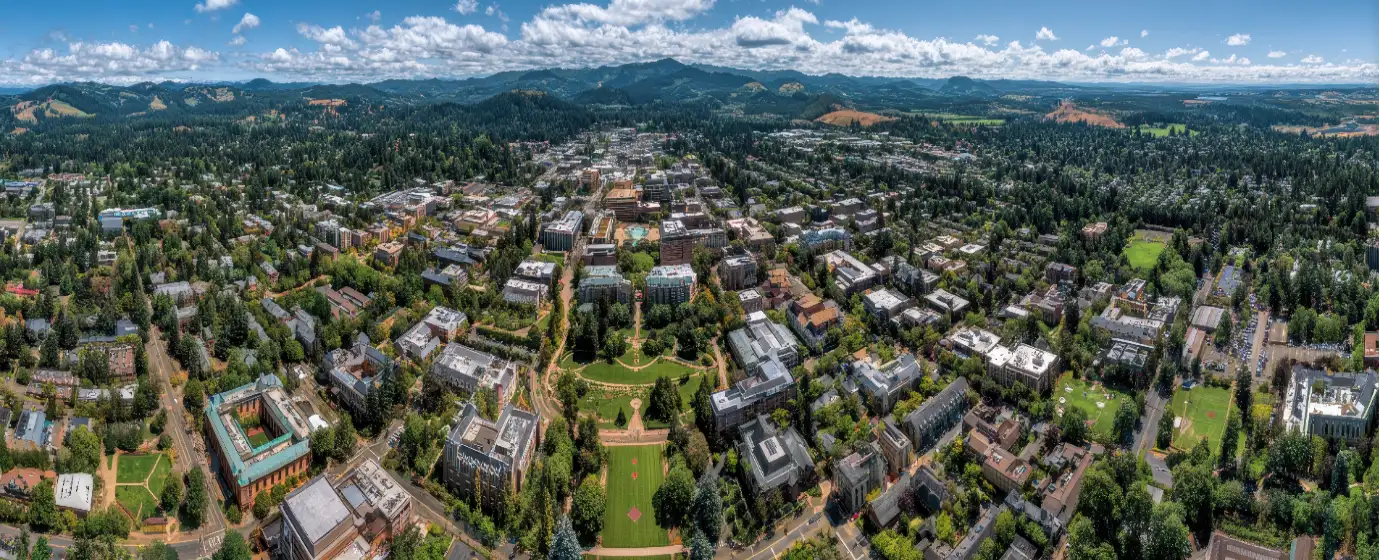
Most people who move to Corvallis after retirement say the same thing a few months in: they expected a college town and got a genuinely livable city. Oregon State University sets the cultural tone — lectures, concerts, sporting events, a walkable campus that bleeds into downtown — but the day-to-day reality is a small city of 61,247 that functions well for people who are done commuting and ready to actually use where they live. It sits in the heart of the Willamette Valley, roughly equidistant between Portland and Eugene, with access via US-20 and OR-99W to the coast to the west and the Cascades to the east.
The honest case for Corvallis in retirement rests on three things: a full-service regional hospital inside city limits, an active and educated population that sustains far more cultural programming than a city this size typically would, and a cost of living that — while not cheap by rural Oregon standards — is still noticeably below the Portland metro. The case against it is shorter but real: Oregon taxes pension and retirement account distributions at rates that run up to 9.9%, the valley gets 159 sunny days a year, and the housing stock skews toward large single-family homes rather than the single-level, low-maintenance options that make downsizing genuinely easy.
Daily life here is shaped heavily by the river, the university, and the hills that rise to the west. Riverfront Commemorative Park and Avery Park are the gathering spots. The Corvallis Farmers' Market draws a crowd through the warm months. For a retiree who wants intellectual engagement, access to trails and green space, and a hospital they can trust, Corvallis is a serious contender. For someone on a fixed income who needs Oregon's tax structure to be gentle on retirement distributions, the numbers deserve a careful look before committing.
Whether you are weighing a move or comparing Corvallis against Albany, Philomath, or another Willamette Valley option, the sections below break down healthcare access, the retiree budget, walkability, senior communities, and how this city stacks up against nearby alternatives.

Why Retirees Are Choosing Corvallis
Corvallis fits a particular kind of retiree very well: someone who wants a university-town energy without Portland's scale, easy access to quality healthcare, and enough natural beauty to fill a weekend without driving an hour. The Oregon State University presence means the city punches well above its weight on lectures, arts performances, continuing education programs, and a general culture of intellectual curiosity that makes it easy to stay engaged.
The typical home price of $565,289 (July 2026) places Corvallis in a middle tier for the Willamette Valley — not the entry-level price of Lebanon or Albany, but well below the Portland suburbs. Buyers who are selling a larger home elsewhere and arriving with equity often find they can right-size into Corvallis without stretching. For more on how that compares across the valley, see the cost of living page.
Who should look elsewhere? Retirees who draw most of their income from pensions, IRAs, or 401(k) distributions will find Oregon's income tax structure genuinely unfavorable — that income is taxed at the same rates as wages. If sunshine matters to your quality of life, 159 sunny days a year is the honest figure for the valley: the gray stretch from October through April is long, and newcomers from California or the Southwest consistently name it as the adjustment they underestimated.
Healthcare & Medical Access in Corvallis
For most retirees, the single most important practical question about a city is what happens when something goes seriously wrong medically. Corvallis has a genuinely strong answer: Good Samaritan Regional Medical Center is inside city limits — not a short drive away, not in the next county — and it is one of only five Level II trauma centers in the state of Oregon.
That designation matters beyond emergencies. A Level II trauma center maintains around-the-clock surgical capability, a broad specialty roster, and the staffing depth that smaller community hospitals cannot sustain. Good Samaritan is a 188-bed teaching hospital, affiliated with Western University of Health Sciences, and Joint Commission accredited. It is the largest hospital in Benton, Lincoln, and Linn counties — a regional anchor, not a community hospital that stabilizes and transfers.
Specialty Depth
The specialty coverage at Good Samaritan is notably broad for a city of this size. Comprehensive cancer care, a full cardiology and cardiovascular surgery program, neurosurgery, orthopedic and spine surgery, and inpatient mental health services are all on-site. Healthgrades has recognized the hospital with a Pulmonary Care Excellence Award in the past two years. That depth means fewer situations where Corvallis residents need to travel to Portland or Eugene for care that larger regional hospitals provide routinely.
The Honest Distance Reality
For highly subspecialized procedures — organ transplant programs, certain cancer clinical trials, complex pediatric care — OHSU in Portland remains the regional reference point, and that is about 90 minutes away by car. Most retirees who have lived here for any length of time describe Good Samaritan as genuinely sufficient for the full range of conditions that come up in their sixties and seventies, and they travel to Portland only for specific subspecialty situations. That is a different calculus than living in a small town served only by a critical access hospital.

The Retiree Budget in Corvallis
Oregon's tax treatment of retirement income has a bright spot and a real sting, and retirees planning a move here should understand both before making decisions. The bright spot: Oregon fully exempts Social Security and Railroad Retirement benefits from state income tax — even the portion that is taxed federally is subtracted entirely from Oregon taxable income. If Social Security is your primary income source, Oregon treats you well.
The sting is pension and investment-account distributions. Oregon taxes those at the same graduated rates as wages — from 4.75% up to 9.9%. There is no special retiree carve-out for pension income, and the top rate applies to incomes that many retirees with solid savings will reach. A retiree drawing primarily from a 401(k) or IRA should model that liability carefully. Oregon also has its own estate tax with a $1 million exemption — well below the federal threshold — which can affect estates that would owe nothing at the federal level.
On the property tax side, Oregon homeowners age 62 or older may qualify to defer county property taxes until they sell, provided household income doesn't exceed $60,000 annually. The state pays the taxes and records a lien at 6% simple interest, repaid on sale or death. That program offers meaningful cash-flow relief for retirees who are house-rich but income-constrained. The effective property tax rate in Corvallis is approximately 0.95% — moderate by Oregon standards and well below what most California and East Coast retirees are used to paying.
Day-to-day costs on a fixed income are manageable here. The Corvallis Farmers' Market brings local produce at competitive prices through the growing season. Oregon has no sales tax, which adds up meaningfully over a year of grocery and household purchases. The Corvallis Transit System runs about 13 bus lines, which can reduce or eliminate one-car costs for retirees who live in or near the core neighborhoods. For the full picture on groceries, utilities, and transportation costs, see the cost of living page.
Looking to buy in Corvallis? Estimate your payment.
Enter your numbers to see an estimated monthly mortgage payment.
Estimate only. Excludes HOA fees and mortgage insurance. The interest rate above is a starting point, not a quoted rate — replace it with your own to see real numbers. Insurance is a flat placeholder, not a Corvallis quote.
Walkability, Community & Staying Active in Corvallis
The honest answer on walkability is: it depends sharply on where you live. Downtown and the core neighborhoods — College Hill, Downtown Corvallis, and the areas immediately adjacent — are genuinely walkable for daily errands. The outer, auto-oriented neighborhoods require a car for nearly everything. If you are choosing specifically to be near the river, the library, and the farmers market, you can genuinely run most daily errands on foot or by bike.
Topography matters for retirees. The flat areas along the Willamette River and through downtown are genuinely accessible on foot or by bike at any age. The West Hills rise steeply, and while they are stunning for the views and for anyone who can handle the grade, they are not realistic for daily errands without a car. The city has invested in an Active Travel Corridor network and a formal Walking Map that marks pedestrian-only paths connecting parks, streets, and schools — a useful tool for finding the flattest and most connected routes.
Senior-Specific Community
Corvallis punches above its weight for senior programming. The Corvallis Community Center and the Aging & Disability Resource Center connect older adults with social, recreational, and informational services. These are not nominal organizations — they are active connectors that help retirees find volunteer opportunities, fitness programs, and peer networks.
The most distinctive community event is the Oregon Senior Games, an Olympic-style multi-sport competition for adults 50 and older held annually in Corvallis. It draws competitors from across the region in events ranging from pickleball and tennis to swimming, disc golf, track and field, and bowling. Whether you compete or just attend, it signals something concrete about the culture of active aging this city has chosen to cultivate.
Avery Park, Riverfront Commemorative Park, and the trails into Bald Hill Natural Area and the McDonald-Dunn Research Forest give retirees genuine outdoor variety at every fitness level — flat river walks, moderate forest trails, and longer routes into the hills for those who want them. Oregon State University opens its campus events, speaker series, and athletic facilities to the broader community in ways that smaller university towns often don't.
Right-Sizing: Downsizing in Corvallis
The biggest practical challenge for retirees downsizing into Corvallis is inventory, not price. The housing stock here skews toward the mid-century and older single-family homes that define most of the Willamette Valley — many of them two-story, on larger lots, with stairs that eventually become a problem. Single-level homes exist throughout the city, but they compete with families and younger buyers, and they tend to move quickly when they appear.
Condos and patio homes offer a realistic path to low-maintenance living, particularly in and around downtown and the areas near the university. These properties attract retirees precisely because they eliminate yard work and exterior maintenance while keeping residents within walking distance of the farmers market, the river path, and the city's restaurant and coffee scene. They tend to run above the city-wide typical home price, reflecting their location premium.
The 55+ Option
Stoneybrook Village is Corvallis's dedicated 55+ independent-living community. It offers full-kitchen apartments alongside on-site dining, housekeeping, transportation, and an activities calendar that includes exercise classes and social events. Its location near downtown is a genuine advantage for residents who want walkable access to shops and parks without managing a house and yard.
The senior living landscape is about to expand: a Bonaventure Senior Living community, with independent living, resort-style amenities, restaurant-style dining, and a bistro, was scheduled for a late 2027 opening in Corvallis. That will add meaningful capacity and a different product type to a market that currently has limited options at the higher end of the independent-living spectrum.
Retirees who need assisted living or memory care will find some options in Corvallis, but the depth of that market is thinner than in Portland or Eugene. Many families plan ahead by choosing independent living early, with an understanding of where they would go if needs increase. For neighborhood-level context on where single-level homes and condos tend to cluster, see the neighborhoods page.
Corvallis vs Nearby Retirement Destinations
| City | Cost vs Corvallis | Primary Hospital | Walkability | Senior Living Depth | Overall Retirement Fit |
|---|---|---|---|---|---|
| Corvallis | Anchor | Good Samaritan Regional Medical Center — Level II trauma, full specialty roster, inside city limits | Strong in the core; car-dependent in outer neighborhoods | Stoneybrook Village; Bonaventure opening late 2027; thin assisted-living supply | Best for active, engaged retirees who value healthcare access and university culture |
| Albany | Noticeably lower | Regional hospital with solid general coverage; complex cases transfer to Corvallis or Portland | Modest; a walkable historic downtown but most of the city requires a car | Multiple senior living facilities; more assisted-living options than Corvallis | Strong value play for budget-conscious retirees; less cultural programming than Corvallis |
| Philomath | Somewhat lower | Relies on Good Samaritan in nearby Corvallis; no hospital of its own | Limited; a small-town walkable center, but very car-dependent overall | Very thin; most residents look to Corvallis for senior services | Appeals to retirees who want a quieter, smaller-town feel with easy access to Corvallis amenities |
| Lebanon | Noticeably lower | Critical access hospital locally; Samaritan Albany General serves the area for more complex needs | Low; a car is essential for nearly everything | A handful of senior care facilities; limited independent-living options | Best for retirees prioritizing affordability over amenities or healthcare depth |
| Eugene | Comparable to slightly pricier | PeaceHealth Sacred Heart — a major regional medical center with broader subspecialty depth | Stronger citywide average; robust transit system and a walkable downtown core | Significantly deeper market across independent, assisted, and memory care | Better fit for retirees who want metro-level healthcare options and a larger city's amenities |
| Salem | Comparable | Salem Health — a large regional system; broader specialty capacity than Good Samaritan | Mixed; a walkable downtown but suburban sprawl dominates much of the city | One of the deepest senior living markets in the Willamette Valley | Strong option for retirees who want more senior living choices and a larger urban infrastructure |
Albany and Lebanon make the strongest case on pure affordability — both come in noticeably below Corvallis on home prices — but neither can match Corvallis's on-the-ground healthcare access or the cultural density that Oregon State University makes possible. Eugene edges out Corvallis on subspecialty healthcare depth and senior living inventory, and its transit system is more robust for car-free living; the tradeoff is a larger, noisier city that some retirees find less personally scaled. Philomath is genuinely appealing for retirees who want a quieter setting and are comfortable making the short drive to Corvallis for medical care, farmers markets, and most services. For retirees who are primarily Social Security-funded, live modestly, and want intellectual community without Portland's scale or price, Corvallis remains the most complete package in its size tier in the Willamette Valley.

Local Expert Takeaway: The retiree who does best in Corvallis is someone who came in clear-eyed: they know Oregon will tax their IRA distributions, they chose a neighborhood in or near the downtown core so the Corvallis Transit System and the river path are genuinely useful, and they made sure Good Samaritan's specialty depth covers what their health history actually requires. The people who end up frustrated are the ones who expected the tax picture to be more favorable than it is, or who bought in an outer neighborhood and now find that a car is necessary for everything. Pick your block as carefully as you pick your state tax strategy, and Corvallis tends to deliver.
Quick Takeaways & FAQs
✅ Good Samaritan Regional Medical Center — a Level II trauma center with on-site cardiovascular surgery, neurosurgery, and cancer care — is inside city limits, which is genuinely rare for a city of 61,247.
⚠️ Oregon exempts Social Security income entirely but taxes pension and 401(k) distributions at rates up to 9.9%, a real budget factor for retirees drawing primarily from retirement accounts.
📍 The Oregon Senior Games — an annual multi-sport competition for adults 50 and older — is hosted in Corvallis each year and draws competitors from across the region, which tells you something concrete about how seriously the city takes active aging.
Is Corvallis a good place to retire on Social Security alone?
What is the closest hospital to Corvallis, and how good is it?
Are there 55+ or active adult communities in Corvallis?
How does Oregon's tax structure affect retirees in Corvallis specifically?
Is Corvallis walkable enough for a retiree who wants to give up one car?
Moving to Oregon?
Tell us what you need help with and we'll connect you with local resources.
