
Most people who research Wilsonville before moving here expect a safe suburb. What surprises them is how concrete that expectation turns out to be. With a population of 27,341 and a layout built around master-planned neighborhoods, greenway connections, and a commercial corridor anchored to I-5, Wilsonville is the kind of city where safety shows up in both the data and in how residents describe daily life — not as an assumption, but as the feature they name first when asked what they value most about living here.
The city's economic base is white-collar and stable: Sysco, Rockwell Collins, and Siemens EDA are the anchor employers, and the West Linn-Wilsonville School District draws families who prioritize both education and community character. That profile tends to self-select for neighborhoods where people know their neighbors and care about what happens on their street. The median household income of $96,236 reflects that economic stability, and the community it supports is one where civic engagement runs high.
Day-to-day life here is quieter than you might expect from a city positioned about 25 minutes to Portland along I-5. The parks are genuinely used — Graham Oaks Nature Park draws walkers and cyclists through its oak savanna trails most mornings — and the newer residential areas in the southwest feel more like small-town Oregon than Portland exurb. That character is part of why the crime picture looks the way it does. Whether you're considering a move or just researching the area, the sections below break down Wilsonville's crime statistics, neighborhood-level safety geography, the city's policing approach, long-term trends, and what residents themselves say about feeling safe here.
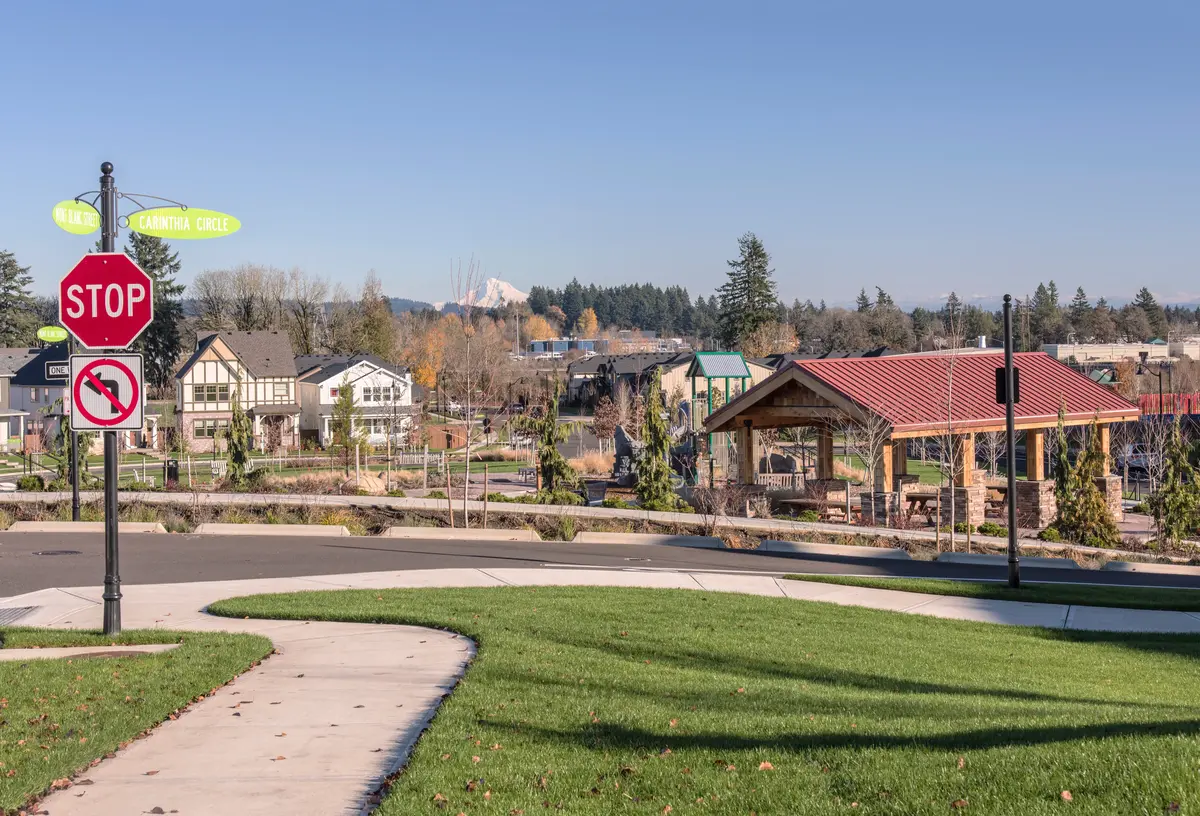
Wilsonville's Crime Rates vs. State and National Benchmarks
The Numbers in Context
Wilsonville carries a violent crime rate of 1.9 per 1,000 residents and a property crime rate of 15.4 per 1,000 residents, according to Bureau of Justice Statistics, Crime Known to Law Enforcement, 2024 (tables 2 and 3). Both figures sit meaningfully below the comparison points most relocating buyers want to know.
Oregon's state violent crime rate runs at 3.3 per 1,000. Nationally, it's 3.7 per 1,000. Wilsonville's figure is roughly half the national rate — not a rounding difference, but a meaningful gap that holds up across multiple reporting years.
The property crime picture is equally noteworthy. Oregon's state property crime rate is 24.5 per 1,000, and the national rate is 18.4 per 1,000. Wilsonville's 15.4 per 1,000 sits below both — an unusual position for any suburb with a busy commercial corridor, let alone one adjacent to an interstate with the volume I-5 carries through this stretch of Clackamas County.
What These Figures Actually Mean
Crime rates expressed per 1,000 residents can be hard to translate into felt experience. At Wilsonville's violent crime rate, the city is in materially different territory from the state average — and that gap has been holding, not narrowing. The property crime rate deserves a second look too: being below both the state and national averages, for a city with this much commercial traffic, is not something most Oregon suburbs can say.
The gap on violent crime is the more significant one for families evaluating neighborhoods. Property crime, while lower than both benchmarks, is not evenly distributed — the retail corridor in the north end sees the most incidents; the residential southwest sees far fewer. That geographic distinction matters more than the city-wide average when you're choosing where to put down roots.
Neighborhood Safety Geography: Where the Differences Are
The Southwest vs. the Northern Corridor
Wilsonville is not uniformly safe in every corner — no city of 27,341 is — and understanding its internal geography matters more than the city-wide average when you're choosing a neighborhood. The clearest divide runs between the southwestern residential areas and the more commercially active northern corridor near the I-5 interchange.
The southwest portion of the city, where master-planned developments like Villebois and the golf-course community of Charbonneau are concentrated, consistently shows per-capita crime risk meaningfully lower than the northern commercial strip. That reflects a real pattern: property crime in particular follows commercial density, and the northern end of Wilsonville — with its retail, logistics facilities, and highway-adjacent parcels — generates a disproportionate share of the city-wide property crime count.
By Neighborhood
Villebois is the most intentionally designed neighborhood in the city — a New Urbanist village with connected streets, a walkable village center, and the kind of foot-traffic-in-the-neighborhood feel that residents associate with feeling safe. Its relative newness and owner-occupancy rates keep it among the lower-crime areas in the city.
Charbonneau, built around the Charbonneau Golf Club in the city's southwest, is persistently described by its residents as peaceful. Nextdoor discussions for the neighborhood consistently surface the same three words: safe, quiet, friendly. Its geography — partially enclosed, with limited through-traffic — contributes to that character.
Canyon Creek and Frog Pond are newer residential subdivisions in the southern and southwestern sections. Their profile is similar to Villebois: family-oriented, owner-occupied, and well away from the commercial corridor activity that skews the property crime numbers.
Old Town and Town Center sit closer to the city's commercial heart. They carry more mixed-use character, which brings convenience but also slightly more exposure to the property crime patterns associated with commercial areas. Neither is unsafe by any reasonable measure — but buyers who want maximum distance from that dynamic tend to gravitate toward the southwestern neighborhoods.
Wilsonville Meadows and Hazelwood are more established, mid-city neighborhoods with a settled, residential feel. They're not as insulated as the southwest developments, but they're also not adjacent to the busiest commercial stretches.
For a fuller picture of how these neighborhoods compare on character, housing stock, and who tends to settle in each one, see the best neighborhoods in Wilsonville guide.
Best for: Buyers prioritizing the lowest crime exposure should look at Villebois, Charbonneau, Canyon Creek, and Frog Pond first.

How Wilsonville Polices Itself
A Contract Model With Community Policing Built In
Wilsonville doesn't run its own standalone police department. Instead, the city contracts with the Clackamas County Sheriff's Office — a common arrangement for Oregon cities of this size, and one that gives Wilsonville access to county-level resources while maintaining a dedicated local presence.
That local force includes patrol officers, traffic officers, detectives, a School Resource Officer, and an embedded Behavioral Health clinician. For a city of Wilsonville's population, the staffing configuration is on the more comprehensive end of what you see in comparable Oregon suburbs — and the embedded clinician is the detail that stands out most.
The Behavioral Health Co-Responder Model
The embedded Behavioral Health clinician works out of the police department, rides along with officers on calls involving mental health, and conducts follow-up visits and community outreach independently. The goal is to route mental-health-related incidents away from the criminal justice system where possible — a co-responder model that a growing number of Oregon cities have adopted, but one that is not universal at Wilsonville's population size.
The department also runs a Juvenile Diversion Program, which keeps lower-level youth incidents from entering the formal justice system, and the School Resource Officer creates a direct link between law enforcement and the West Linn-Wilsonville School District.
New Leadership in 2026
In January 2026, the city welcomed Jed Wilson as Chief of Police. Wilson came up through the Clackamas County Sheriff's Office and held community-policing roles — including school resource officer and crisis negotiator — before moving into leadership. His background aligns with the department's stated emphasis on community engagement rather than enforcement-first policing.
Looking to buy in Wilsonville? Estimate your payment.
Enter your numbers to see an estimated monthly mortgage payment.
Estimate only. Excludes HOA fees and mortgage insurance. The interest rate above is a starting point, not a quoted rate — replace it with your own to see real numbers. Insurance is a flat placeholder, not a Wilsonville quote.
Long-Term Crime Trends: The Direction of Travel
Fifteen Years of Decline
A single-year snapshot is useful context. A fifteen-year trend is the more meaningful signal for anyone deciding where to put down roots. Wilsonville's trend runs clearly in one direction: both violent crime and property crime have declined over a 15-year span, with data suggesting 2025 levels are lower than what the city recorded in 2013. That's not the trajectory of a city getting worse — it's the profile of a community that has grown in population while keeping crime in check.
That's worth holding alongside the regional picture. Portland's crime trends over the same period moved in the opposite direction for significant stretches, particularly post-2020. Wilsonville, sitting about 25 minutes to Portland along I-5, did not follow that pattern. Its suburban character, stable employment base, and consistent code enforcement appear to have insulated it from the pressures that hit the urban core.
What Newcomers Sometimes Don't Expect
Six months in, residents who moved from higher-crime metros sometimes say they had to recalibrate their baseline. The things that read as warning signs elsewhere — a car parked in an unusual spot, a stranger walking through the neighborhood — simply don't carry the same weight here. That recalibration is the kind of friction moment that's hard to anticipate until you're in it.
The one thing long-term residents flag is that property crime, while low, isn't zero — and it's not evenly distributed. Packages left on porches near commercial zones, car break-ins in retail parking areas, and occasional catalytic converter thefts (a statewide pattern, not unique to Wilsonville) make up the bulk of what gets reported. These aren't neighborhood-level safety concerns so much as urban-living realities that travel north from the metro. Keeping an eye on what you leave visible in your car is the most common practical advice you'll hear from neighbors who've been here a while.
The downward trend also shows up in how residents talk about the city over time. In the 2026 National Community Survey — benchmarked against more than 500 U.S. cities — nine in ten Wilsonville residents rated safety as good or excellent, making it the city's single highest-scoring category.
What Residents Say — and What to Look Into Before Choosing a Neighborhood
The Resident Verdict
Numbers tell part of the story. The 2026 National Community Survey fills in the rest. Nine in ten Wilsonville residents gave safety a good or excellent rating — the top category in the entire survey. Overall quality of life scored good or excellent from 80% of respondents. And 86% of residents said they would recommend living in Wilsonville to someone who asked, while more than 80% planned to stay for the next five years.
When the city asked residents what they valued most about Wilsonville, three things surfaced consistently: parks, safety, and well-designed neighborhoods. That combination — outdoor access, low crime, and intentional planning — is the city's strongest selling point, and residents who have been here long enough to see the city grow tend to emphasize all three.
What to Look Into Before Choosing a Neighborhood
The city-wide numbers are encouraging, but neighborhood selection still matters. If low property crime exposure is a priority for your household, the southwestern neighborhoods — Villebois, Charbonneau, Frog Pond, Canyon Creek — are where to focus your research. The northern end of the city, closer to the commercial and logistics activity near the I-5 corridor, carries a different risk profile, even if it's still well below the state average.
It's also worth spending time on Nextdoor or attending a neighborhood association meeting if you're seriously considering a specific area. Wilsonville's residents are notably engaged — the community survey had high participation rates, which suggests a city where people are paying attention to what's happening around them. That civic engagement is itself a safety indicator, and it's one the statistics don't capture directly. Tools like CrimeGrade or AreaVibes can also help you look up address-level context before making a decision.
For anyone comparing Wilsonville to nearby Tualatin, Sherwood, or Canby, the safety profile is genuinely competitive — Wilsonville holds its own against any of them. The fuller neighborhood-by-neighborhood breakdown, including character, housing types, and who each area suits best, lives on the best neighborhoods page.

Local Expert Takeaway: Wilsonville's crime numbers are genuinely good — not 'good for the Portland metro' but good by any standard, sitting below both state and national averages on violent and property crime. The real insight for anyone choosing a neighborhood here is geography: the southwestern areas around Villebois and Charbonneau carry meaningfully lower property crime exposure than the commercial corridor near the interstate. Long-term residents who've watched the city grow tend to say safety is what's stayed constant through all of it — and the 2026 community survey, where nine in ten residents rated safety as good or excellent, backs that up with something more than anecdote.
Quick Takeaways & FAQs
✅ Wilsonville has a violent crime rate of 1.9 per 1,000 residents — roughly half the national average and one of the stronger safety profiles in the Portland metro for a city of its size.
⚠️ Property crime, while below state and national averages, is not evenly distributed — the commercial corridor near I-5 generates a disproportionate share, so neighborhood location within the city still matters.
📍 Nine in ten Wilsonville residents rated safety as 'good' or 'excellent' in the 2026 National Community Survey, making it the city's highest-scoring category out of more than 500 comparison cities.
Is Wilsonville, Oregon a safe place to live?
Which neighborhoods in Wilsonville have the lowest crime rates?
How does Wilsonville's crime rate compare to the rest of Oregon?
Does Wilsonville have its own police department?
Is crime in Wilsonville getting better or worse over time?
Moving to Oregon?
Tell us what you need help with and we'll connect you with local resources.
