
What Is Living in Sherwood, Oregon Like?
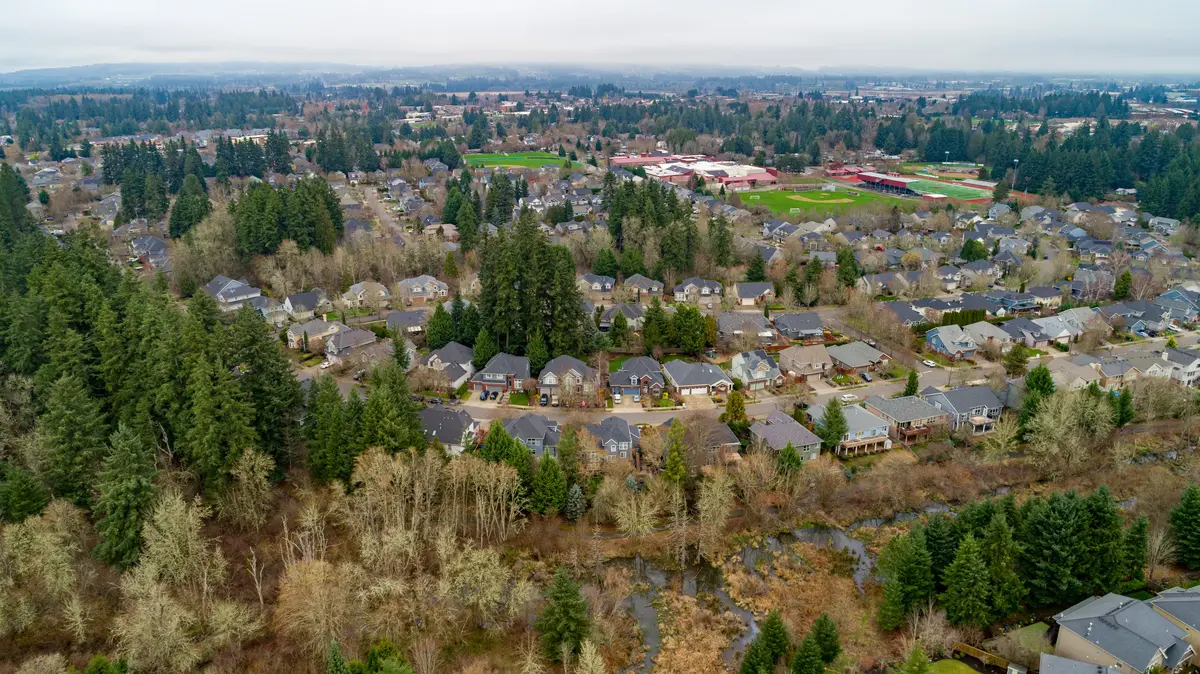
You've probably been priced out of Lake Oswego, maybe you've looked at Beaverton and found it too crowded, and someone on a Portland relocation forum mentioned Sherwood. The city sits about 17 miles southwest of Portland in the Tualatin Valley — technically in Washington County's southeast corner — and it surprises people in two ways. First, the setting: rolling vineyard hills, the Tualatin River floodplain, and a genuine historic Old Town with brick-paved streets. Second, the income: with a median household income of $109,966, this is not a scrappy starter suburb. It draws established professionals and families who want a quieter address without feeling like they've left the metro orbit entirely. OR-99W is the commercial spine, and keeping your car will not be optional — but the highway corridor stays where it belongs, well clear of the residential streets.
Sherwood School District 88J holds an A rating, according to Niche, and with 4,771 students enrolled in 2025-26 it stays small enough that parents actually know the principals by name. That rating is the single most common reason families with school-age children put Sherwood near the top of their list. On the employment side, the district and the city government are the largest in-town employers — Sherwood itself is not an industrial city. What it is, however, is well-positioned next to Tualatin's semiconductor and healthcare corridor, and Greater Portland Inc. places Sherwood squarely within the Silicon Forest footprint that draws advanced manufacturing to the southwest metro. The Bowmen of Sherwood High School, who opened a new campus building in 2021, give the community the kind of Friday-night football culture that still means something in a city this size.
The typical home price sits at $629,598 (Zillow Home Value Index, July 2026), which lands noticeably below Portland's close-in neighborhoods and well below Lake Oswego, but above what you'd pay in Newberg or McMinnville for comparable square footage. The city's effective property tax rate of approximately 0.84% is among the lower figures in the metro. Outdoors, the Tualatin River National Wildlife Refuge gives residents a federally protected floodplain with nearly 200 bird species essentially at the city's edge — that's an asset most suburbs can't claim. The trade-off is 142 sunny days a year, which is Oregon's reality and not a Sherwood-specific quirk, but worth internalizing before you commit.
Whether you're weighing Sherwood against nearby Tualatin or considering the commute from this far southwest of Portland, the sections below break down Sherwood's neighborhoods, housing market, commute reality, local employers, schools, and what day-to-day life here actually looks like.
Sherwood at a Glance
Looking to buy in Sherwood? Estimate your payment.
Enter your numbers to see an estimated monthly mortgage payment.
Estimate only. Excludes HOA fees and mortgage insurance. The interest rate above is a starting point, not a quoted rate — replace it with your own to see real numbers. Insurance is a flat placeholder, not a Sherwood quote.
Why Are People Moving to Sherwood?
The short version: Sherwood offers Portland-area access at a price point that still makes financial sense for a family earning well above the state median. The longer version involves a school district that consistently earns strong marks, a crime picture that runs well below state and national averages — a violent crime rate of 1.3 per 1,000 residents and a property crime rate of 14.7 per 1,000 residents, both meaningfully below state and national benchmarks — and a physical setting that doesn't feel like the back half of a strip mall. Those three things together are rare enough in the Portland metro that Sherwood fills up fast when comparable listings hit the market.
Who Actually Chooses Sherwood
Parents with school-age children are the most consistent demographic. The district's reputation travels, and families relocating from California or from higher-cost metro cores tend to land here specifically because Sherwood's schools check out under scrutiny. For a deeper look at what the Sherwood School District looks like on the ground, that page covers the individual buildings and the boundary quirks worth knowing.
Remote workers are a growing second group. Sherwood's residential neighborhoods are genuinely quiet, homes offer more square footage per dollar than anything closer to the city, and the commute — when you do need to go in — runs about 30 minutes to Portland on a good day. That flexibility makes the highway corridor dependence feel more manageable when it only matters two or three days a week.
The Silicon Forest Connection
Greater Portland Inc. places Sherwood inside the Silicon Forest footprint, meaning the southwest industrial corridor — semiconductor fabrication, advanced manufacturing, logistics — draws workers who live in Sherwood and commute to campuses in Tualatin and the broader Washington County corridor. Many residents work at semiconductor and manufacturing campuses just a few miles north without thinking of their daily drive as a long one. The employers are nearby even if they're not technically in-city.
Sherwood is also starting to attract buyers who simply ran out of options in the closer-in southwest suburbs. As the Sherwood West expansion — a 1,291-acre area approved to enter the Urban Growth Boundary in 2024 — moves through comprehensive planning, the city is likely to add between 3,100 and 5,600 new homes over the next decade. Buyers who purchase now are ahead of that supply wave, which cuts both ways: less competition immediately, more neighborhood change ahead.
What People Don't Expect
Six months in, most newcomers from larger cities are surprised by how intact the community fabric feels. Old Town Sherwood is not a facade — people actually shop, eat, and spend weekend mornings there. The Sherwood Center for the Arts hosts year-round programming, and the bi-annual Art Walks draw residents who've lived here for decades alongside people who moved in last spring. It's the kind of civic engagement that looks manufactured in newer suburbs and somehow isn't here.
What Daily Life Feels Like in Sherwood
The Highway Corridor Reality
OR-99W is how Sherwood connects to everything — groceries, big-box retail, regional services. The city's commercial layout keeps that activity concentrated along the highway corridor, which means it doesn't bleed into residential streets the way it does in some suburbs. Residents note this as a genuine quality-of-life feature: you can live two blocks off the commercial spine and feel like you're in a quiet neighborhood, not a strip-mall city.
That design works until the corridor itself bogs down. The stretch between Sherwood and Tigard handles significant through-traffic, and peak-hour backups are a real part of daily life. Most errands need a car, and planning around the corridor's rhythm — timing grocery runs for mid-morning rather than 5:30 p.m. — is something locals learn in the first few weeks.
Old Town as the Social Center
Old Town Sherwood's brick-paved streets make for a genuinely pleasant few blocks of independent businesses, boutiques, and casual dining. Stella Olsen Memorial Park sits directly adjacent, with a wooded creek setting and an outdoor amphitheater — it's where residents end up on a warm Saturday afternoon without much planning. Cannery Square anchors the historic district as a gathering point. The whole area is small enough to walk in twenty minutes and dense enough to feel like it has a pulse.
The Sherwood Center for the Arts adds something that most cities this size don't have: a legitimate arts venue with theater, music, dance, and rotating visual exhibitions. It's the reason Sherwood doesn't feel like a pure bedroom community. Parents bring kids to performances; longtime residents volunteer there. That combination ages well.
Weather, Seasons, and Outdoor Life
Sherwood gets 142 sunny days a year — enough that summers feel genuinely warm and outdoor life comes alive from June through September. The shoulder months are green but gray, and newcomers from the Sunbelt take a full winter to recalibrate. The upside is that the Tualatin River floodplain stays spectacular year-round: the Tualatin River National Wildlife Refuge turns up new bird species on nearly every visit, and the Cedar Creek Trail and Snyder Park give residents accessible green space without requiring a drive.
The wine country proximity is not just a marketing line. Sherwood sits at what Travel Oregon calls the closest wine country to Portland, and weekend trips into the Tualatin Valley and Chehalem Mountain appellation are a genuinely common habit among residents. It gives the city a flavor — literally and socially — that most suburbs at this price point don't have.
A Friction Moment Worth Knowing
The thing that surprises people who move out of Sherwood, when they do, is rarely the commute or the schools — it's the grocery situation. For anything beyond standard supermarket stock, the drive out of town is real. A serious specialty-food run or a big-box shopping trip means heading north. Longtime residents have either made peace with this or built a solid online-ordering habit. Coming in with that expectation set correctly makes the transition much smoother than discovering it the hard way in month two.
The Sherwood Housing Market Right Now
The typical home price in Sherwood sits at $629,598 (Zillow Home Value Index, July 2026). That figure puts Sherwood noticeably below the closer-in Portland suburbs — Lake Oswego in particular — while sitting above the smaller Willamette Valley towns to the south. For a full breakdown of how that price compares against rent costs, property taxes, and the overall cost of living in Sherwood, the cost of living page covers those figures in detail.
What the Inventory Looks Like
Most of Sherwood's housing stock is single-family homes built from the 1990s onward, with a meaningful cluster of newer construction in the western neighborhoods. The city grew fast in the late 1990s and again in the mid-2000s, so a typical listing is a two-story home with a two-car garage on a standard suburban lot. Old Town and the older core neighborhoods offer smaller, older homes — some with genuine character, some that need meaningful updating.
Townhomes and smaller attached units exist but represent a smaller share of the market than in denser suburbs like Beaverton or Hillsboro. If a detached single-family home is the goal, Sherwood delivers it consistently across most price points. The Sherwood West expansion, when it moves through planning, will eventually add new-construction options — but that is a years-out conversation, not a current inventory story.
Rent and the Rental Market
The typical two-bedroom rent runs $2,350–$2,860, with the city-wide typical rent sitting at $2,555 per month. Sherwood's rental inventory is limited compared to the ownership market — this is predominantly a homeowner city — which keeps rents firm and available units scarce. Families renting while they search to buy often find they need to move quickly when something opens up. For neighborhood-level character and how different parts of the city feel from a renter's or buyer's perspective, the neighborhoods page is the place to start.
Buyer Types This Market Suits
| Buyer Type | Why Sherwood Works | What to Watch |
|---|---|---|
| Families | A-rated school district, quiet residential streets, strong community feel | Commute timing on the highway corridor is a daily variable |
| School-focused buyers | District holds an A rating; high school campus built in 2021 | Enrollment boundary lines matter — verify before writing an offer |
| Remote workers | More square footage per dollar, genuine quiet, flexible Portland access | Must be comfortable with car-dependent daily logistics |
| Value seekers from closer-in Portland | Noticeably lower price point than Lake Oswego or SW Portland | Specialty retail and services require driving out of town |
| Move-up first-timers | Entry-level single-family homes available below the city median | Limited rental inventory makes the bridge period competitive |
| Outdoor-lifestyle buyers | Tualatin River refuge, Cedar Creek Trail, wine country proximity | 142 sunny days a year — gray winters require adjustment |
Sherwood Neighborhoods
Sherwood has several distinct areas — each with its own character and appeal. Here’s a breakdown to help you narrow down where to focus your home search.
🏡 Woodhaven
An established residential neighborhood with mature trees and a mix of 1990s and 2000s single-family homes, Woodhaven is a natural fit for families who want quiet streets and proximity to Woodhaven Park without being far from the highway corridor's services.
🏠 Old Town Sherwood
The historic core of the city, with older homes, brick-paved streets, and Stella Olsen Memorial Park just steps away — Old Town suits buyers who want walkable access to Sherwood's dining, arts scene, and community events.
🌳 Edy Ridge
A well-established residential area with larger lots and a slightly elevated feel, Edy Ridge draws families and established buyers who want more space and a quieter setting while staying close to the city's core.
🏘 Sherwood West
The newer growth edge of the city, Sherwood West features more recent construction and will eventually connect to the major Sherwood West urban expansion — a good fit for buyers who want newer homes and don't mind being on the city's developing frontier.
🏔 Heron Ridge
A quieter residential pocket with a neighborhood feel, Heron Ridge suits families and remote workers who want a settled, low-traffic address with easy access to the rest of the city.
🌆 Parrett Mountain
Sitting above the city on the western edge, Parrett Mountain offers a more rural and elevated setting with views across the Tualatin Valley — it draws buyers who want space, privacy, and a connection to the agricultural landscape that surrounds Sherwood.
Pros & Cons of Living in Sherwood
The Pros
- Top-rated Sherwood School District with an A-rated overall grade
- Historic, walkable Old Town with local shops and restaurants
- One of the safer, family-friendly suburbs in the Portland metro
- Close proximity to Willamette Valley wine country
The Cons
- Higher-than-average home prices for the Portland suburbs
- Limited rental inventory drives up rents
- Commute into downtown Portland can be lengthy given distance and highway congestion on 99W/I-5
Getting Around & Commuting in Sherwood
The OR-99W Spine
OR-99W is both Sherwood's commercial backbone and its primary connection to the rest of the metro. North toward Tigard and Portland, south toward Newberg and wine country — virtually everything leaves on this road. That concentration is by design, and it works well right up until peak hours, when the corridor between Sherwood and Tigard thickens into a genuine crawl.
The drive to Portland is about 30 minutes under normal conditions, but "normal" has a narrow window on weekday mornings. Experienced commuters know to leave before 7:15 a.m. or after 8:30 a.m. — the window in between adds twenty minutes to an otherwise straightforward drive. Southbound afternoon returns follow a similar pattern. This is the single most important daily-life variable for anyone considering Sherwood and working in Portland proper.
Transit Options
TriMet Line 94 runs between Sherwood and the Tigard Transit Center, where riders connect to the MAX light rail network toward Portland. The connection is real and usable, but it still requires a transfer, and the overall trip time to downtown Portland by transit is meaningfully longer than driving. For car-free commuting to work consistently, it requires the kind of schedule flexibility and downtown destination that not every Sherwood resident has.
Sherwood is a car-dependent city, and most daily life turns on that reality. Anyone relocating from a transit-rich metro who has built their lifestyle around not owning a car will need to recalibrate expectations before committing to this address.
Employment Geography
The largest in-city employers are the Sherwood School District and the City of Sherwood itself. For most private-sector workers, the job is elsewhere in the metro. The Tualatin corridor — just a few miles north — concentrates semiconductor manufacturing, logistics, and healthcare employment, and many Sherwood residents commute there rather than into Portland proper. That shorter hop significantly changes the commute math: Tualatin is a quick shot up the highway, not a 30-minute slog.
For those working in the broader Washington County tech and semiconductor corridor — the Silicon Forest that stretches from Beaverton to Tualatin — Sherwood often makes more geographic sense than living in Portland itself. The drive runs southwest against the heaviest commute traffic, not northeast into it.
Airport Access
Portland International Airport sits roughly 28 miles from Sherwood. The drive is straightforward and runs well outside the corridor's peak-hour crunch, using routes that bypass downtown Portland. For frequent flyers, Sherwood is not a punishing airport commute — it's a consistent 40 to 45 minutes that doesn't depend on rush-hour timing the way a closer-in city sometimes does.
The Sherwood West Factor
The approved Sherwood West expansion area — 1,291 acres added to the Urban Growth Boundary in 2024 — envisions roughly 4,500 new jobs alongside 3,100 to 5,600 new homes. When that development eventually matures through the multi-year planning process, it could shift Sherwood's employment profile meaningfully, reducing the outbound commute dependency that currently defines daily life here. That is a long-range view, but it's a real part of Sherwood's trajectory.
Schools in Sherwood
Families relocating to Sherwood have public, private, and higher-education options nearby. Here’s a quick overview.
🎓 School District
Sherwood School District 88J serves K–12 students across Sherwood and the surrounding area. Rated A (source: Niche.com).
🏆 Graduation Rate
The 4-year high-school graduation rate here is approximately 96.7%.
📚 Higher Education
Oregon’s public universities — the University of Oregon, Oregon State University, and Portland State University — offer four-year degrees statewide, with a network of 17 community colleges providing two-year and workforce programs.
🌐 Online Learning
Oregon State University Ecampus and Portland State University Online offer fully accredited online degrees for remote learners across the state.
Safety in Sherwood
A quick look at how Sherwood compares on the numbers that matter most when weighing a neighborhood or a move.
🛡 Violent Crime
Approximately 1.3 per 1,000 residents.
🔒 Property Crime
Approximately 14.7 per 1,000 residents.
Compared to the most recent national figures from the Bureau of Justice Statistics (2024), Sherwood’s violent crime is below the national average (about 3.7 per 1,000), and property crime is below the national average (about 18.4 per 1,000).
Against Oregon as a whole, Sherwood’s violent crime is roughly a third of the state average, and property crime is roughly half the state average (Bureau of Justice Statistics, Crime Known to Law Enforcement, 2024 (tables 2 and 3)).
Crime rates can vary a lot within a single city, so the citywide numbers above are only a starting point. Some neighborhoods in Sherwood run well below these averages, while others run higher — the kind of block-by-block detail that matters most when you’re actually choosing where to live. The full guide below breaks it down neighborhood by neighborhood.
Working in Sherwood
Sherwood’s largest employers span several industries — here are some of the anchors of the local job market.
🎓 Sherwood School District
Education
🏛 City of Sherwood
Municipal government
💻 Lam Research
Semiconductor manufacturing, located in Tualatin
🏥 Legacy Meridian Park Medical Center
Healthcare, located in Tualatin
Parks & Recreation in Sherwood
Some of the outdoor spaces that shape everyday life in Sherwood.
🌱 Tualatin River National Wildlife Refuge
🌱 Stella Olsen Memorial Park
Sherwood residents don’t have to go far for green space — spots like Tualatin River National Wildlife Refuge and Stella Olsen Memorial Park are part of everyday life here, whether that’s a morning walk, a weekend hike, or just somewhere to unwind outside. The full guide below covers more of what Sherwood has to offer for parks and outdoor recreation.
Retiring in Sherwood
Sherwood draws retirees for its balance of amenities, outdoor access, and cost. Here’s what to weigh.
🌤 Climate
Sherwood averages 142 sunny days a year, with warm, dry summers from June through September and a long, mild, gray rainy season from October through May. Snow is rare and typically light. Retirees from the Midwest or Northeast often find the winters damp but manageable, while those from the Southwest take a full season to recalibrate.
🍴 Lifestyle
Old Town Sherwood provides a walkable core with independent dining, the Sherwood Center for the Arts, and Stella Olsen Memorial Park — all within a few blocks. The Tualatin River National Wildlife Refuge is nearby for low-impact outdoor activity, and the Tualatin Valley wine country is a short drive for those who enjoy the region's culinary and winery scene.
🏚 55+ Communities
Retirees who choose Sherwood typically buy into the general residential market — often prioritizing single-level homes in established neighborhoods like Woodhaven or Heron Ridge. For those open to a broader search, the Washington County corridor offers additional senior-living choices within a reasonable drive.
✈ Getting Around
Most daily errands require a car, and OR-99W is the city's main connector. Portland International Airport is roughly 28 miles away — a consistent drive that avoids the worst of the peak-hour crunch. TriMet Line 94 bus service connects to the broader metro via Tigard for those who prefer transit options for occasional trips into Portland.
🏛 Oregon Taxes for Retirees — What to Know
- Social Security is not taxed — Oregon does not tax Social Security or Railroad Retirement benefits. Any amount included in your federal adjusted gross income is subtracted back out on the Oregon return.
- But other retirement income IS taxed — This is the trade-off that surprises people moving from Washington or Texas. Pension distributions and 401(k)/IRA withdrawals are taxed as ordinary income at Oregon’s regular rates — there is no blanket retirement-income exclusion.
- Graduated income tax — Oregon has four brackets — 4.75%, 6.75%, 8.75% and 9.9%. The 4.75% rate covers the first $10,000 of taxable income for a single filer ($20,000 filing jointly); the 8.75% rate starts at $125,000 ($250,000 jointly); and the top 9.9% rate applies above $250,000 ($500,000 jointly).
- No sales tax — Oregon levies no general sales tax.
- Property taxes, with senior deferral — Oregon’s Senior and Disabled Property Tax Deferral lets qualifying homeowners have the state pay their county property taxes, with a lien recorded against the home. The 2026 household income limit is $70,000, and deferred balances accrue 6% simple interest — it defers the bill rather than forgiving it.
- Estate tax — the one to plan for — Oregon has its own estate tax with a $1 million filing threshold — far below the federal exemption, and NOT indexed for inflation, so it reaches more estates every year in real terms. Retirement accounts and a long-held home count toward the taxable estate, so estates that feel modest can cross the line without the owner expecting it.
- No inheritance tax — Oregon has no separate inheritance tax and no gift tax.
Tax laws change frequently and individual situations vary. This is general information, not tax advice — always consult a qualified Oregon tax professional or CPA for personalized retirement tax planning.
Weekends & Local Favorites in Sherwood
Old Town and the Outdoors
Most Sherwood weekends start somewhere in or near Old Town. The historic district's brick-paved blocks hold a mix of independent boutiques, antique shops, and casual restaurants, with Stella Olsen Memorial Park right next door — the wooded creek setting and outdoor amphitheater make it a natural gathering place for families on a Saturday morning. Cannery Square anchors the district as the spot where people tend to linger after lunch before wandering the shops.
The Tualatin River National Wildlife Refuge is Sherwood's most distinctive outdoor asset, and residents use it hard. Nearly 200 species of birds, over 50 mammal species, and trails through the floodplain make it genuinely worth a visit any time of year — not just for birders. The annual Tualatin River Bird Festival in May is the event that draws the most out-of-town visitors and is a good marker for when the refuge is at its most spectacular. Cedar Creek Trail and Woodhaven Park offer closer-to-home green space without requiring a drive, and Snyder Park fills a similar role on the west side of the city.
Dining and Coffee Worth Knowing
For dining, Fat Milo's and Clancy's each bring something distinct to the Sherwood scene — Fat Milo's leans casual and crowd-friendly, Clancy's runs more neighborhood-pub energy. Tree's Restaurant and Catering has been a local institution long enough to have regulars who've been coming for decades. Sawatdee Thai Cuisine and Sabye round out a small but solid roster of independent options that keep residents from feeling like they need to drive to Tigard for a good meal.
On the coffee side, Symposium Coffee is the local anchor — the kind of independent shop that doubles as a work-from-home office and a weekend meeting spot. Ziggi's Coffee gives the drive-through crowd a solid alternative. Neither is a chain placeholder; both feel like they belong to the city rather than being dropped into it.
Wine Country on the Doorstep
Sherwood's wine country access is not incidental. Travel Oregon describes it as the gateway to the closest wine country to Portland, and the Tualatin Valley and Chehalem Mountain growing regions put a full afternoon of winery visits within a short drive. For residents who moved here from California wine regions, this is sometimes the detail that tips the decision. Weekend winery runs are a genuinely common local habit, not a special-occasion trip.
Arts and Culture
The Sherwood Center for the Arts hosts a year-round calendar of visual art, theater, music, and dance — including bi-annual Art Walks that animate the Old Town corridor. For a city of 20,500, the programming depth is notable. It's the kind of institution that makes Sherwood feel more like a small city with a real cultural identity than a suburb waiting for Portland to supply it.
Local favorites in Sherwood
Restaurants
- Fat Milo's
- Clancy's
- Tree's Restaurant and Catering
- Sawatdee Thai Cuisine
- Sabye
Outdoors
- Tualatin River National Wildlife Refuge
- Stella Olsen Memorial Park
- Woodhaven Park
- Cedar Creek Trail
- Snyder Park
Coffee
- Symposium Coffee
- Ziggi's Coffee
Top Things Locals Say About Sherwood
The best intel about a city comes from the people who actually live there. Here’s what Sherwood residents say when newcomers ask the questions everyone’s thinking.
“I knew the commute would be on OR-99W, but I didn't fully understand what that meant until I tried to leave at 7:45 on a Tuesday. That road is the whole equation. Once I started leaving earlier, it stopped being a problem — but you have to actually adjust, not just plan to.”
— Recent Sherwood home buyer
“What's the most surprising thing about living in Sherwood?”
How much Old Town actually delivers. Before we moved here, I assumed it was the kind of 'historic downtown' that exists mostly for photos on the city website. It's not — there are real restaurants, a functioning arts center, and Stella Olsen Park right there. On a good weekend afternoon it's genuinely the place people end up, not just a detour. That part caught me off guard in the best way.
“What do locals love most about Sherwood?”
The combination of the wildlife refuge and wine country in the same zip code is something that sounds like marketing copy until you actually live here. The Tualatin River refuge is a ten-minute drive and turns up something different on every visit. The Chehalem Mountain wineries are a weekend afternoon, not a road trip. Both of those things together, at a price point that isn't Lake Oswego — that's what keeps people here.
“What should newcomers to Sherwood know?”
Learn the highway corridor's timing before you build your schedule around it. The stretch between Sherwood and Tigard can be completely clear at 6:45 a.m. and a parking lot by 7:30. Most people who've been here a while have quietly adjusted their whole day around that window. Also: for specialty groceries or anything beyond a standard supermarket run, plan a dedicated trip — the in-city options cover the basics well, but a serious food shopping trip means heading out of town.
“How much do you need a car in Sherwood?”
A car is essential for most daily life here. Groceries, school runs, most recreation, and anything in Portland or Tualatin means driving. The TriMet Line 94 bus connects to Tigard and then MAX toward Portland, which works if your schedule is flexible and your destination is near a MAX stop — but it's a two-leg trip, not a direct connection. The downtown core of Old Town is walkable once you're in it, and Cedar Creek Trail and nearby parks are accessible on foot from some neighborhoods. Everything else needs wheels.
Cities Near Sherwood
Other communities near Sherwood worth a look — each with its own character and price point.
| City | Distance | Best For | Vibe | Median Rent | Median Buy |
|---|---|---|---|---|---|
| Tigard | 8 mi | Commuters, MAX access, urban amenities | Busier, more urban, transit-connected | $1,850 | $607,011 |
| Tualatin | 5 mi | Tech workers, families, newer homes | Planned, polished, suburban | $1,890 | $635,314 |
| Newberg | 10 mi | Wine country lifestyle, lower price point | Small-town, rural-edge, slower pace | $2,159 | $535,028 |
More Helpful Guides for Sherwood
Going deeper on Sherwood? Our blog series covers everything from first-time buying to retiring here — explore the guides below.
Local Expert Takeaway: Sherwood's strongest card is consistency: a school district that holds an A rating, a violent crime rate of 1.3 per 1,000 residents, and a housing market that still has room under Portland's close-in pricing. The catch is OR-99W — the drive to Portland is about 30 minutes when the timing is right, and noticeably longer when it isn't. Buyers who work in Tualatin's semiconductor corridor or remotely find the trade-off easy to make. Those commuting daily into central Portland feel it more acutely. Drive the corridor at 7:30 a.m. on a Tuesday before you write an offer — that single experience tells you more about whether Sherwood works for your life than any spreadsheet will.
Quick Takeaways & FAQs
✅ Sherwood School District 88J holds an A rating from Niche, making it one of the stronger public school districts in the Portland metro at this price point.
⚠️ OR-99W is the city's only practical connector to Portland and the broader metro, and peak-hour backups between Sherwood and Tigard are a real, daily variable — not a rare inconvenience.
📍 Sherwood sits at the gateway to the Tualatin Valley wine country, making it the only Portland suburb where a winery afternoon is a routine weekend option rather than a road trip.
Is Sherwood, Oregon a good place to raise a family?
How far is Sherwood, Oregon from Portland?
What is the cost of living like in Sherwood, Oregon?
What are the best neighborhoods in Sherwood, Oregon?
Does Sherwood have good public transit?
Helpful Links for Moving to Sherwood
Moving to Oregon?
Tell us what you need help with and we'll connect you with local resources.
