
If you are looking at Sherwood from the outside, you might assume it splits the difference between suburban affordability and Portland Metro convenience — and in some ways it does. But the price reality surprises nearly every first-timer who runs the numbers. The typical home in Sherwood sits at $629,598 (Zillow Home Value Index, July 2026), which is not entry-level by any measure, and the median household income here falls short of what it takes to carry that price by roughly $61,000. That gap is the central planning challenge for anyone buying their first home here without existing equity to roll in.
Sherwood is a city of 20,500, and its growth has been almost entirely through master-planned development. That means newer construction, more HOA-governed communities, and a housing stock that tends to hold up well — but it also means fewer of the smaller, older homes that give first-timers a toehold in other Oregon suburbs. Neighboring Newberg sits noticeably lower on the price scale if you are hunting for the absolute cheapest entry point in the region. Tigard and Tualatin run about the same as Sherwood, so switching neighborhoods between those cities rarely solves the budget problem on its own.
What draws buyers to commit here anyway is real: about 30 minutes to Portland on OR-99W, the Sherwood School District 88J — which holds an A rating, according to Niche — and a community feel that does not exist in more anonymous suburbs. The annual Robin Hood Festival in Old Town Sherwood, the trails along the Tualatin River National Wildlife Refuge, and the walkable character of the historic district are things residents actually talk about in year two. Understanding all of this — what the budget buys, how the process works, and where first-timers go wrong — is what this guide is for.
The sections below walk through what your money realistically gets you in Sherwood, the step-by-step homebuying process as it works locally, a budget snapshot table for planning purposes, and the specific mistakes that cost first-time buyers deals in this market.

The Sherwood First-Time Buyer Reality
The typical home in Sherwood is priced at $629,598 as of July 2026, which means most first-timers are entering a market where a minimum down payment still requires tens of thousands of dollars in cash before closing costs are even counted. Oregon's statewide median down payment on a single-family purchase was $65,341 in 2024 — more than double the national median. Sherwood prices sit above the statewide typical, so that figure is a reasonable floor for budgeting purposes, not a ceiling.
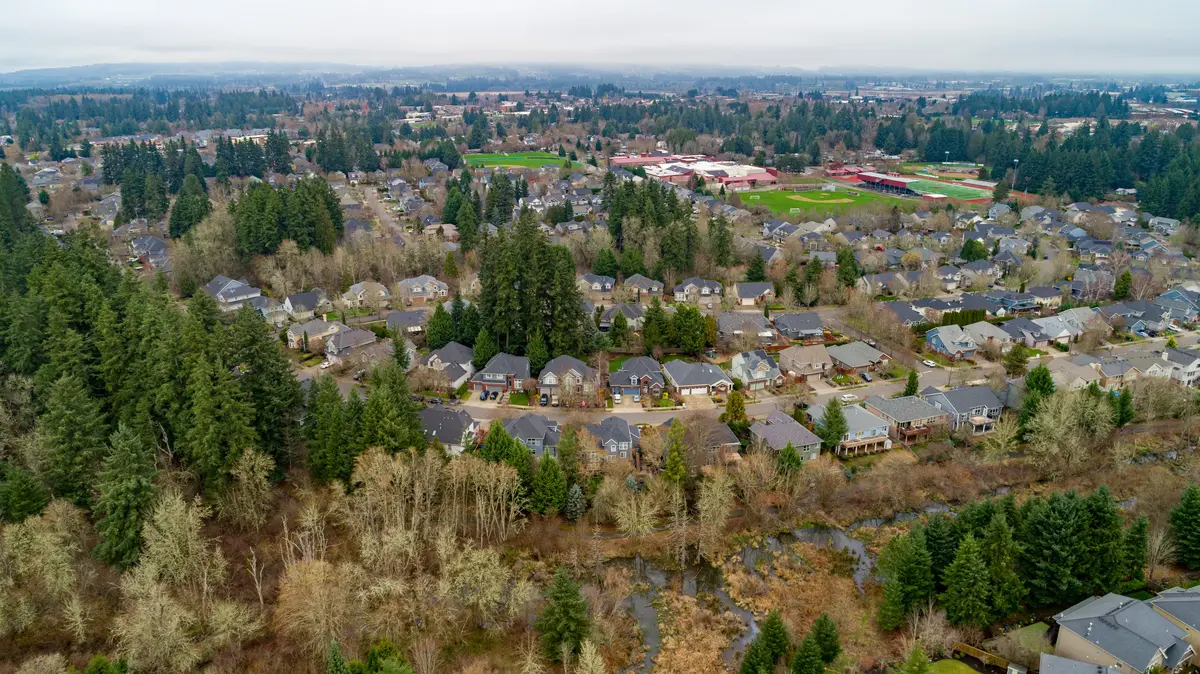
What that price gets you is largely newer, HOA-governed construction in planned neighborhoods like Woodhaven, Sherwood West, or Gleneagle Village. The older, smaller homes in Old Town Sherwood and the more established parts of Edy Ridge occasionally offer lower entry points into the city — see the full neighborhood breakdown on the best neighborhoods page — but they are less frequently available and move quickly when listed. The practical reality is that first-timers in Sherwood are competing for a limited pool of homes at the lower end of the city's range, and that pool is not large.
One thing that works in buyers' favor here: Sherwood's newer housing stock means fewer deferred-maintenance surprises. HOA dues are a recurring monthly cost to budget for, and design rules in many communities affect everything from fence color to accessory structures — review those covenants carefully before making an offer. Oregon also defines "first-time homebuyer" more generously than most people expect: if you have not owned a principal residence in the last three years, you qualify, even if you owned a home before that. That matters for state savings programs and certain loan products.
The Homebuying Process in Sherwood, Step by Step
Step 1: Get Pre-Approved Before You Tour Anything
In the Portland Metro market, sellers routinely decline to consider offers that arrive without a pre-approval letter — not a pre-qualification estimate, but a full pre-approval based on verified income, assets, credit history, and debt. Getting pre-qualified tells you roughly what a lender might lend; getting pre-approved tells you what they will actually lend, and shows a seller you are a vetted buyer who will not fall through at underwriting.
Pre-approval requires pay stubs, W-2s, two years of tax returns, bank and asset statements, debt information, and a government-issued ID. Give yourself time to gather these before you start touring homes. Pre-approval letters are typically valid for 30 to 90 days, so time your application close to when you plan to actively make offers — letting it expire mid-search and having to re-pull forces unnecessary credit inquiries.
Step 2: Shop With a Realistic Scope
Work with an agent who knows the difference between Sherwood's planned subdivisions and its older core — those two categories of home come with fundamentally different due diligence requirements. HOA documents, CC&Rs, and any pending assessments must be reviewed before you remove contingencies, not after.
Step 3: Make a Competitive Offer
Your agent will advise on offer structure based on how quickly the specific property has moved and what comparables support. In Sherwood, well-priced homes at the lower end of the city's range tend not to sit. Include an inspection contingency — waiving it entirely to be competitive is a risk most first-timers are not equipped to absorb financially.
Step 4: Inspection, Radon, and the Sewer Line
Oregon buyers commonly add radon testing and a sewer scope to the standard structural inspection — especially relevant in Sherwood's established neighborhoods where older lateral lines can have tree-root intrusion. Do not skip these to save time. Problems found here are negotiable before closing; after closing, they are yours entirely.
Escrow in Oregon is handled by a neutral title company or attorney who manages funds and paperwork through to closing. You will receive a closing disclosure at least three business days before your closing date — read it line by line and flag anything that has shifted from your loan estimate.
Step 5: Close and Plan for the First Year
First-timers consistently underestimate the cash needed in the first twelve months after closing — beyond the down payment and closing costs, budget for moving costs, any deferred maintenance you inherit, and HOA setup fees if applicable. Oregon does not have a state income tax on mortgage interest deductions the same way federal taxes do, but property tax planning and homeowner's insurance deserve a real conversation with your lender before closing day.

How Much Home Can You Afford in Sherwood
The table below shows approximate cash requirements for several realistic entry points in Sherwood, based on minimum down payment percentages and the Oregon closing cost range of 2% to 5% of the purchase price. These are estimates — actual figures depend on your lender, loan program, credit profile, and the specific property. The interactive mortgage calculator below this section builds out the monthly payment picture once you enter your own numbers.
| Scenario | Purchase Price | Down Payment | Est. Closing Costs (2–5%) | Est. Cash Needed at Table |
|---|---|---|---|---|
| FHA (3.5%) — lower entry | $490,000 | $17,150 (3.5%) | $9,800–$24,500 | ~$27,000–$41,650 |
| Conventional (3%) — lower entry | $490,000 | $14,700 (3%) | $9,800–$24,500 | ~$24,500–$39,200 |
| FHA (3.5%) — near city median | $630,000 | $22,050 (3.5%) | $12,600–$31,500 | ~$34,650–$53,550 |
| Conventional (3%) — near city median | $630,000 | $18,900 (3%) | $12,600–$31,500 | ~$31,500–$50,400 |
| Conventional (5%) — mid-range | $630,000 | $31,500 (5%) | $12,600–$31,500 | ~$44,100–$63,000 |
| Conventional (10%) — stronger position | $630,000 | $63,000 (10%) | $12,600–$31,500 | ~$75,600–$94,500 |
Closing costs at the higher end of the 2–5% range are common when a loan requires discount points or when the property has a complex title history. Ask your lender for a loan estimate that breaks down every line item so nothing surprises you on closing day.
Oregon also offers a First-Time Home Buyer Savings Account that allows single filers to deduct up to $6,125 per year — or up to $12,245 for married couples filing jointly — in deposits or earnings from Oregon taxable income. Accounts must be opened by December 31, 2026, and funds must be used toward a qualifying home purchase within ten years. If you are twelve to thirty-six months from buying, this is worth opening now.
Looking to buy in Sherwood? Estimate your payment.
Enter your numbers to see an estimated monthly mortgage payment.
Estimate only. Excludes HOA fees and mortgage insurance. The interest rate above is a starting point, not a quoted rate — replace it with your own to see real numbers. Insurance is a flat placeholder, not a Sherwood quote.
Common First-Time Buyer Mistakes in Sherwood
Touring Homes Without a Pre-Approval Letter
This is the single most common way first-timers lose deals in the Portland Metro, and Sherwood is no exception. Falling in love with a home on a weekend tour, then scrambling to get pre-approved while another buyer — who walked in ready — gets the accepted offer is an entirely avoidable situation. Get pre-approved first, then tour.
Underestimating the Total Cash Required
First-timers often budget for the down payment and forget that closing costs in Oregon run 2% to 5% of the purchase price on top of it. On a $630,000 home, that is an additional $12,600 to $31,500 in cash due at closing — before moving expenses, before HOA setup fees, before any repairs or upgrades in the first year. The table in the previous section shows what that looks like at several price points; work through it honestly before you set your target price.
Waiving the Inspection Contingency Without Understanding What You Are Giving Up
In a competitive offer situation, buyers sometimes waive the inspection contingency to strengthen their offer. For a first-timer in a newer Sherwood subdivision, the risk may be more manageable than in an older home — but in either case, going in without any inspection at all leaves you holding every repair bill the seller might otherwise have negotiated. A better middle path: keep the right to inspect, but shorten the inspection period and commit not to request cosmetic repairs.
Ignoring HOA Documents Until After the Offer Is Accepted
Sherwood's master-planned neighborhoods — Woodhaven, Gleneagle Village, Middlebrook, and others — come with HOA covenants, conditions, and restrictions that govern far more than most first-timers expect. Monthly dues, parking rules, rental restrictions, and pending assessments for shared infrastructure are all buried in those documents. Oregon gives buyers a review period for HOA disclosures after an offer is accepted, but do not treat it as a formality. A pending special assessment on a newly purchased home can cost thousands and arrives whether you knew about it or not.
Letting the Pre-Approval Letter Expire Mid-Search
Pre-approval letters are valid for 30 to 90 days. Buyers who get pre-approved, then spend several months casually browsing, find themselves having to re-apply — which means another round of document gathering and another credit inquiry — right when they find a home they want to move quickly on. Time your pre-approval to your actual search window, and if your search runs long, renew it proactively rather than waiting until you are under pressure.
Local Expert Takeaway: Sherwood is not a market where first-timers can improvise their way to a closing. The $629,598 typical home price (July 2026) demands real cash planning — the down payment alone at minimum percentages is meaningful, and closing costs stack on top. The buyers who do well here get their pre-approval locked in before they set foot in a home, understand exactly what their HOA covenants allow before they remove contingencies, and budget for the first year of ownership rather than just the closing table. The inspections that Oregon buyers commonly add — radon and sewer scope alongside the standard structural — are genuinely worth the cost in a city where you are often buying into a neighborhood of identical lateral lines laid in the same decade.
Quick Takeaways & FAQs
✅ Oregon's generous first-time buyer definition — no principal residence ownership in the last three years — means more buyers qualify for state savings programs and certain loan products than expect to.
⚠️ The typical home price of $629,598 (July 2026) sits well above what the median household income can carry, making cash savings and budget discipline the real entry barrier for most first-timers.
📍 Sherwood's planned subdivisions are HOA-heavy — review the covenants, dues, and any pending special assessments as a contingency step, not an afterthought.
What credit score do I need to buy a home in Sherwood, Oregon?
How long does it take to buy a home in Sherwood from pre-approval to closing?
Are there HOAs in most Sherwood neighborhoods?
What is Oregon's First-Time Home Buyer Savings Account and is it worth opening?
Do I need a radon test when buying a home in Sherwood?
Moving to Oregon?
Tell us what you need help with and we'll connect you with local resources.
