
You've done the spreadsheet. Sherwood checks the boxes on paper — a school district that holds an A rating, according to Niche, a drive to Portland that clocks in at about 30 minutes, and home prices that look dramatically different from what you left behind. But spreadsheets don't tell you that Sherwood has grown by more than 73% since 2000 and is still in the middle of that growth, or that the rain hits differently than you expect in month two, or that the community's pull — the historic Old Town district, the trails along the Tualatin River, the Friday night energy — takes about a season to feel real. This is a city of roughly 20,500 people that genuinely functions as a small town while sitting squarely inside the Portland metro.
The economic backbone here is worth understanding before you arrive. The Sherwood School District and the City of Sherwood are the primary local employers, which is typical for a city this size. The larger regional employment story is semiconductor and tech manufacturing in the Washington County corridor — a significant draw for engineers and tech workers who settle in Sherwood and commute out. If that describes you, you are not the first Californian to make this calculation, and the commute patterns are well established.
Sherwood's typical home value sits at $629,598 as of July 2026 — a figure that reads as almost startling against California's statewide typical home value of $773,735 (Zillow Home Value Index), even before you account for how much farther below that statewide figure Bay Area or Southern California prices run in practice. Day-to-day, housing is where the savings are sharpest; groceries and utilities run closer to California levels than most transplants expect, and the bigger recurring adjustment is the complete absence of a sales tax, which registers most in the first few months of grocery shopping. The full cost-of-living picture is on the cost of living page.
Whether you are relocating for a semiconductor-industry role, trading California equity for a larger home, or simply prioritizing a quieter pace without giving up Portland access, the sections below break down what California transplants actually find in Sherwood — the tax picture, the housing reality, the daily life adjustments, and the honest trade-offs that the spreadsheet doesn't surface.
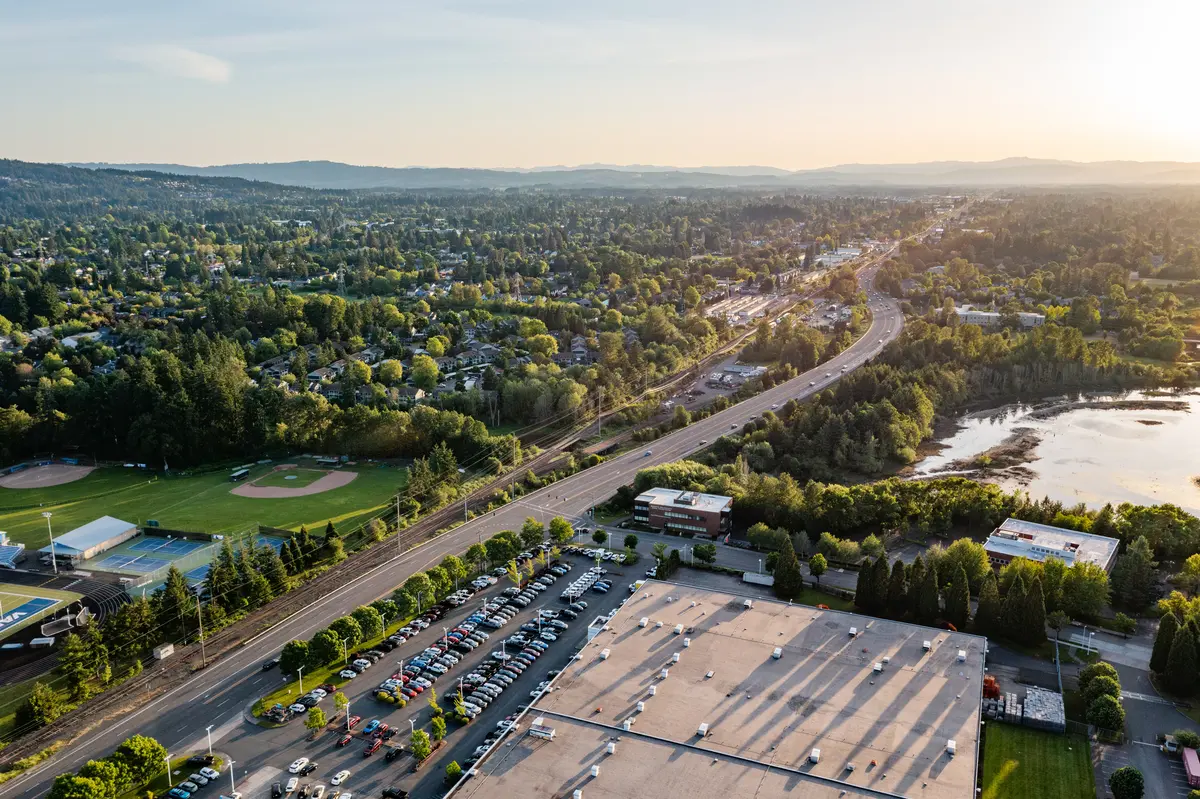
The Home Price Reality: What California Equity Buys Here
The comparison that brings most Californians to Sherwood is simple. California's statewide typical home value of $773,735 (Zillow Home Value Index) gets you into the lower end of the Sherwood market. Sherwood's own typical home value is $629,598 as of July 2026 — meaningfully below the California statewide figure, and a fraction of what the same equity represents in coastal California metros.
What that number actually buys is worth spelling out. At the Sherwood typical price point, you are looking at newer construction with four bedrooms, a two-car garage, and a yard that the California version of that budget would never produce. Entry-level options in older parts of the city can come in below the city-wide figure, while neighborhoods near Parrett Mountain and Heron Ridge run above it. The neighborhood landscape in more detail lives on the best neighborhoods page.
One honest note on affordability: Sherwood's median household income of $109,966 runs below the income required to comfortably carry the typical home here. That gap is real, and it matters for buyers who are not arriving with California equity to deploy as a substantial down payment. If you are coming with equity, you are in a fundamentally different position from a first-time buyer who has been saving locally.
What California Equity Changes
Buyers arriving with proceeds from a California sale often find they can eliminate a mortgage payment almost entirely, or buy significantly more house than they expected. That equity advantage is the single most common thing California transplants mention in their first year here — and it's real. The catch is that Sherwood's growth trajectory means prices have moved, and the city is not the sleeper deal it was a decade ago.
Nearby, Tigard and Tualatin price at about the same level as Sherwood. Newberg, a short drive to the southwest through wine country, comes in noticeably lower — which is worth knowing if your budget needs room.
Taxes: Where Oregon Wins, Where It Doesn't
The tax picture is more complicated than most Californians expect, and getting it wrong is one of the most common mistakes transplants make in the planning phase.
The Win That's Immediately Visible
Oregon has no sales tax — not at the state level, not locally. California's statewide base sales tax rate of 7.25% (California Department of Tax and Fee Administration) applies before local jurisdictions add their own levies on top. In Oregon, the price on the shelf is the price you pay. For everyday spending — groceries, clothing, home goods, restaurants — the absence registers immediately and compounds across years.
Income Tax: Read This Before You Celebrate
California's top state income tax rate of 13.3% (California Franchise Tax Board) is the highest in the nation, and it is the number most transplants cite when describing why Oregon felt like relief. Oregon's top rate is 9.9%, which is lower — but the income-tax savings favor high earners most clearly. Many middle-income households find they pay about the same or somewhat more in Oregon once effective rates are compared. The sales tax elimination can offset this for households with significant consumer spending, but the net picture depends on your specific income level, and a tax advisor is worth the conversation before you finalize your move.
Property Tax: A Genuine Advantage
Sherwood's effective property tax rate of 0.84% is higher than California's effective property tax rate of 0.71% (Tax Foundation) on paper. But California's Proposition 13 caps assessed value growth — and for longtime owners, effective rates can run far below 0.71% in practice while actual market values have compounded for decades. New buyers in California pay on current purchase price, just as they would in Oregon. For a first-time buyer or anyone who has recently purchased in California, the Sherwood rate is roughly comparable and sometimes better in total dollar terms given the lower purchase price.
Oregon does not tax Social Security benefits, and there is no inheritance tax — though Oregon does maintain an estate tax. For retirees or households with significant investment income, those details are worth a conversation with a tax advisor. The full tax breakdown, including income brackets, is on the cost of living page.
| Tax Category | California | Sherwood / Oregon | Net Direction |
|---|---|---|---|
| Sales tax | 7.25% statewide base (California Department of Tax and Fee Administration) | None | Oregon wins, clearly |
| Top income tax rate | 13.3% (California Franchise Tax Board) | 9.9% | Oregon wins for high earners; mixed for many households |
| Effective income tax (most earners) | Lower effective rate for many middle-income earners | Higher effective rate for many middle-income earners | Depends on income level |
| Property tax (effective rate) | 0.71% (Tax Foundation); Prop 13 benefits longtime owners | 0.84% | Roughly comparable; recent buyers often similar |
| Social Security tax | Taxed at state level | Not taxed | Oregon wins |
| Inheritance tax | None | None (estate tax exists) | Roughly equal |

Day-to-Day Cost Adjustments Californians Actually Notice
The headline savings when moving from California to Sherwood are real — but the distribution across spending categories is more textured than most transplants expect.
Housing: The Big Number
Housing is where the gap is sharpest, and it is the category that drives most California relocation decisions to Sherwood. Rent is proportionally lower as well — though this is a market with real demand and prices have moved with the city's growth. Renters arriving from coastal California will find the range familiar or better; those coming from inland California markets will find it closer.
Groceries and Utilities: Familiar Territory
Here is the adjustment most Californians don't anticipate: grocery and utility costs in Oregon run closer to California levels than most transplants expect. The savings versus California are modest in these categories — expect everyday prices to feel roughly comparable rather than dramatically lower. The sales tax elimination is where food spending actually improves, since restaurant and grocery bills carry no tax at all.
Winter heating costs are a genuine line item in Sherwood. The Pacific Northwest winter is wetter and grayer than most California transplants anticipate, and heating a larger house — which most transplants end up with — can offset some of those savings. The fact sheet puts Sherwood's typical monthly utilities at around $166, transportation at around $119, and groceries at around $387, which gives a concrete baseline for household budgeting.
Routine Care Costs
Health insurance premiums in Oregon tend to run noticeably below what most California residents were paying. The honest trade-off is access to specialist care — Sherwood is a smaller city, and complex or specialized treatment generally means driving farther than you would from a dense California metro.
The Seasonal Surprise
Sherwood averages 142 sunny days a year. For Californians who have absorbed the Pacific Northwest's reputation without the reality, the November-through-February stretch is a genuine adjustment. People who move here underestimating the gray sky count are the ones most likely to reconsider the move by spring of year one — and that is worth factoring into your quality-of-life calculation before you sign anything.
Looking to buy in Sherwood? Estimate your payment.
Enter your numbers to see an estimated monthly mortgage payment.
Estimate only. Excludes HOA fees and mortgage insurance. The interest rate above is a starting point, not a quoted rate — replace it with your own to see real numbers. Insurance is a flat placeholder, not a Sherwood quote.
What Californians Find Here — and What They Miss
Six months in, most California transplants to Sherwood report the same cluster of surprises — some positive, some not.
What Lands Well
The school district is the one that comes up first. Sherwood School District 88J holds an A rating, according to Niche, and with 4,771 students enrolled in 2025-26, it is a district small enough that families quickly know the principals and coaches by name. On 2024-25 state assessments, 53.9% of students reached math proficiency and 64% reached reading proficiency — figures the district publishes and is willing to own. For families leaving California districts with larger class sizes and more diffuse accountability, the scale difference registers quickly.
Old Town Sherwood is the second thing that surprises people. The historic district along Railroad Avenue has a concentrated walkable character — a farmers market rhythm through the warm months, the Sherwood Center for the Arts anchoring civic life, Cannery Square adding retail and gathering space — that feels genuinely local in a way newer suburban development doesn't.
The outdoor access also lands differently than expected. The Tualatin River National Wildlife Refuge is not a California transplant's idea of dramatic scenery — it is quiet, riparian, and deeply specific to this part of the Willamette Valley. Cedar Creek Trail and Stella Olsen Memorial Park give the city a walking infrastructure that makes the smaller square footage of many lots feel less constraining than it sounds.
What's Harder to Find
Sherwood is not a city that rewards those who want to walk everywhere or skip a car entirely. OR-99W is the spine of commercial life, and most errands require driving. The restaurant and dining scene is real, but it is not the density that California coastal cities produce. A serious dining night or a specialty shopping trip often means heading toward Tigard or Tualatin.
The Sherwood West Urban Growth Boundary expansion — approximately 1,291 acres approved by Metro in December 2024 under Ordinance 24-1520 — is still under appeal as of mid-2026, with a final determination from the Land Conservation and Development Commission pending. If it moves forward, it represents a significant addition of new homes, parks, and employment areas west of the current city edge. What that means for pricing and neighborhood character in the Sherwood West area is genuinely uncertain, which is different from most California markets where the direction of growth is more settled.
Weekends and Local Favorites
Sherwood's day-off geography centers on a few places that California transplants tend to adopt quickly and then wonder how they lived without.
Ziggi's Coffee is where the morning starts for a lot of the newer arrivals, and Symposium Coffee draws the crowd that wants something more deliberate with their espresso. Both give the city a genuine independent coffee culture rather than a chain-dependent one.
For food, the range is wider than the city's size suggests. Fat Milo's handles the casual end with something close to a neighborhood-restaurant feel. Clancy's is the kind of place that fills up without any particular occasion. Tree's Restaurant and Catering anchors the more established dining side, and Sawatdee Thai Cuisine and Sabye round out an Asian food presence that punches above the city's size.
On weekends, the Tualatin River National Wildlife Refuge pulls in the crowd that came from California specifically because they wanted to trade traffic noise for a different sound. The refuge's trail network runs through river bottomland and wetland habitat that is nothing like what most Californians picture when they think Oregon — no mountains, no dramatic elevation — just quiet, specific, and increasingly hard to find this close to a metro. Woodhaven Park and Snyder Park handle the closer-to-home version of outdoor time.
The Sherwood Center for the Arts schedules programming through the year and gives the city a cultural anchor that surprises people who assumed they were trading arts access for square footage. Old Town Sherwood and the adjacent Cannery Square are where the community actually gathers — the farmers market in the warm months, the general pull of a walkable few blocks in a city that otherwise requires a car.
Portland is about 30 minutes away, and most Sherwood residents use that access selectively — concerts, a specific museum, a restaurant that is worth the drive. The city's own texture is enough for most weekends, which is the thing California transplants tend to report as the most pleasant surprise of all.
Local Expert Takeaway: Sherwood is not the obvious choice for Californians who expect a dramatic cost savings across every category. Groceries and utilities feel familiar rather than dramatically cheaper, income tax may surprise you, and OR-99W requires a car for most of daily life. The genuine wins are in housing — where California equity goes significantly farther — the complete absence of sales tax, and a school district and community scale that is hard to find this close to a major metro. Families who arrive knowing what they are optimizing for tend to stay. Those who arrive expecting California weather and California dining density, just cheaper, are the ones who reconsider by year two.
Quick Takeaways & FAQs
✅ Sherwood's typical home value of $629,598 (July 2026) runs well below California's statewide figure, and California equity often eliminates or dramatically reduces a mortgage here.
⚠️ Oregon has no sales tax, but the income-tax savings favor high earners most clearly — many middle-income households find they pay about the same or more, so model your specific situation before assuming a windfall.
📍 Sherwood averages 142 sunny days a year: the Pacific Northwest winter is the adjustment most California transplants underestimate, and it is worth factoring into your quality-of-life calculation before you move.
Is Sherwood, Oregon actually cheaper than California to live in?
Do Californians pay less income tax in Oregon?
What is the property tax rate in Sherwood compared to California?
What do California transplants find hardest to adjust to in Sherwood?
Is Sherwood a good fit for California tech workers relocating to Oregon?
Moving to Oregon?
Tell us what you need help with and we'll connect you with local resources.
