
You've probably done the math on Portland and decided it's more city than you need. Maybe a colleague mentioned Sherwood, or you drove OR-99W through the Tualatin Valley and noticed how quickly the congestion fell away. Sherwood sits at roughly 20,500 people — large enough to have genuine amenities, small enough that you can actually recognize faces at the Saturday market. The question for anyone considering retirement here isn't whether Sherwood is pleasant — it clearly is — it's whether the trade-offs fit a fixed income, an aging body, and a life you want to live without a car for every single errand.
The economic backbone of the city is its school district and municipal government, which keeps the community stable and family-oriented — something retirees tend to appreciate more than they expect. The Tualatin River National Wildlife Refuge sits at the city's edge, giving retirees a genuine natural draw rather than a manufactured amenity. Sherwood is about 30 minutes to Portland, close enough that the Oregon Symphony, the Rose Quarter, and Portland's medical specialists are a realistic option without daily exposure to Portland's congestion.
Costs run meaningfully below Portland proper, and the cost-of-living picture reflects a suburban Oregon city that has held its value without spiraling. The typical home price stood at $629,598 as of July 2026 — real money, but noticeably lower than close-in Portland neighborhoods. Oregon's tax treatment of retirees has genuine advantages, particularly around Social Security, though pension and IRA income carry a sting that this guide covers in detail.
Whether you're seriously researching a move or just at the early-comparison stage, the sections below cover Sherwood's healthcare access, the retiree budget in real terms, what daily life without a car looks like, downsizing options, and an honest side-by-side with the other towns in this part of the Tualatin Valley that retirees most often weigh against it.
Why Retirees Are Choosing Sherwood
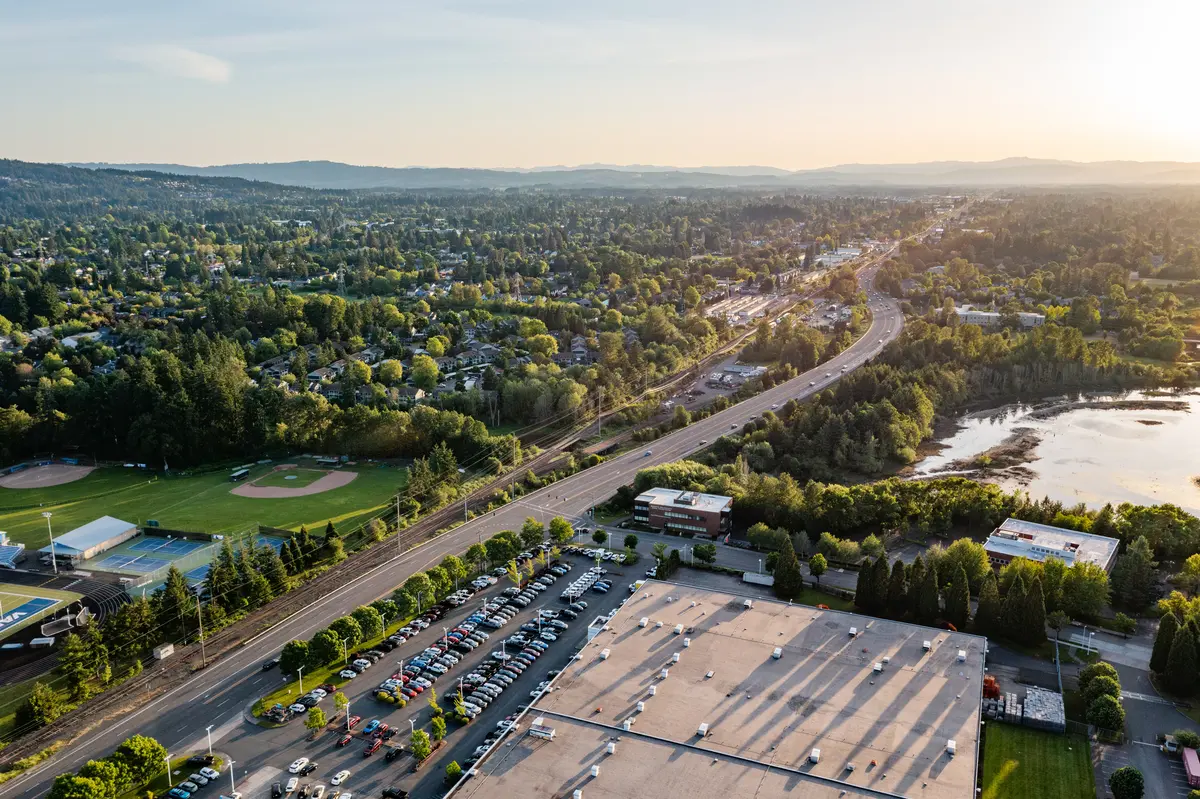
Sherwood fits a specific kind of retiree well: someone who wants a genuine community feel, reasonable proximity to Portland-level healthcare and culture, and a quieter pace — without relocating to a truly rural setting. The city of 20,500 has a small-town identity that isn't performed. The Old Town Sherwood historic district, the Saturday market at Cannery Square, the free concerts at Stella Olsen Memorial Park — these are things residents actually show up for, not just features on a relocation brochure.
The typical home price of $629,598 (July 2026) puts Sherwood within reach for retirees selling equity out of higher-cost markets — particularly California or the close-in Portland suburbs — though it's not a budget destination by Oregon standards. Retirees coming from Beaverton or Tigard will find prices roughly comparable. If you need to carry a mortgage into retirement, the monthly payment math on a home at this price point is worth running carefully — the cost-of-living page walks through the full picture.
The honest caveat: Sherwood is a car-dependent city, and that matters more at 72 than it did at 52. Most errands require a vehicle, and the transit infrastructure is limited. Retirees who are comfortable owning a car indefinitely — and who value space, a yard, and a real neighborhood over urban walkability — tend to settle here happily. Those who are already thinking about the day they stop driving should look seriously at Tigard's TriMet-connected corridors or closer-in Portland neighborhoods before committing.
Healthcare & Medical Access in Sherwood
The closest hospital is Legacy Meridian Park Medical Center in Tualatin, about 6 miles from Sherwood. That distance is meaningful to name honestly: on a clear afternoon it's a 10-to-15-minute drive, but it is not a walkable or transit-accessible option. For most routine emergencies, 6 miles is manageable. For time-sensitive events like a stroke or a cardiac episode, every minute matters, and retirees should factor that proximity into their planning.
Legacy Meridian Park carries genuine depth for a community hospital of its size — 150 licensed beds, with a specialty roster that covers cardiology, orthopedics, neurology, a total joint and spine center, a breast health center, and emergency services. That's the full scope of what most retirees actually need. The hospital has earned U.S. News recognition in areas that map directly onto retiree health concerns: hip fracture, hip replacement, spinal fusion, prostate cancer surgery, and stroke care. Those aren't generic categories — they are the procedures that define whether a hospital is genuinely equipped for an aging population.
For advanced oncology, complex cardiac interventions, or subspecialty neurology beyond Meridian Park's scope, the next tier is Oregon Health & Science University in Portland and the broader network of Legacy and Providence flagship hospitals in the city — all reachable in roughly 30 minutes under normal traffic conditions. That commute is realistic for scheduled specialist visits, though less reassuring for an urgent situation. Retirees with complex or actively managed chronic conditions should think carefully about whether a suburban community hospital as their primary facility is the right structural choice, or whether living closer to the Portland medical core makes more sense for their situation.
One practical asset that often goes unnoticed by people evaluating Sherwood: the Marjorie Stewart Senior Community Center, operated by the city, includes the Pearl Room — a free mental health support program offering depression treatment and counseling to older adults through in-person and telehealth formats. That's an unusual, city-funded benefit that speaks to how seriously Sherwood treats its older residents. The senior center also runs a city shuttle on select weekdays to help residents who have reduced driving access get to appointments and errands.

The Retiree Budget in Sherwood
Oregon's tax treatment of retirees is genuinely split, and Sherwood residents live under all of it. The good news first: Oregon does not tax Social Security or Railroad Retirement benefits at the state level, with no income limit on that exemption. If Social Security is your primary income source, the state leaves it entirely alone.
The harder news is that pensions, IRA withdrawals, and 401(k) distributions face Oregon's regular graduated income-tax rates — starting at 4.75% and climbing to 9.9% at higher income levels. That top rate is among the steepest in the country. A retiree drawing $80,000 or more per year from tax-deferred accounts will feel Oregon's income tax as a meaningful budget line, not a rounding error. This is the trade-off that sends some retirees to Washington State — where there is no income tax — even if they love the Oregon landscape.
On property taxes, Sherwood's effective rate is approximately 0.84%, which sits below the national average and is a genuine positive for fixed-income budgeting. Oregon also runs a property-tax deferral program for homeowners aged 62 and older who meet household income requirements — the state pays the county directly each year, with the deferred amount recovered later from the home's equity. For retirees who are asset-rich but cash-flow-constrained, that program can meaningfully reduce monthly pressure. There is no statewide sales tax, which adds up quietly across every grocery run and hardware store visit.
Daily costs in Sherwood reflect a suburban Oregon city: not cheap, not alarming. Groceries, gas, and services run close to Portland-metro averages. A serious shopping run means driving to larger retail clusters nearby, and anything specialized typically means ordering online. For retirees with a paid-off home and a modest draw on tax-deferred accounts, the budget works. For those still carrying a mortgage, the full math — taxes, insurance, ongoing maintenance on a Pacific Northwest home — warrants a careful look at the cost-of-living page before committing.
Looking to buy in Sherwood? Estimate your payment.
Enter your numbers to see an estimated monthly mortgage payment.
Estimate only. Excludes HOA fees and mortgage insurance. The interest rate above is a starting point, not a quoted rate — replace it with your own to see real numbers. Insurance is a flat placeholder, not a Sherwood quote.
Walkability, Community & Staying Active in Sherwood
Sherwood is car-dependent — most errands mean a drive, and the city's layout reflects decades of suburban development that prioritized residential space over pedestrian infrastructure. The neighborhoods closest to Old Town Sherwood offer the most on-foot access, but even there the street connectivity doesn't rival what you'd find in a grid-based urban neighborhood. If you're imagining a retirement where you walk to a café or the pharmacy most mornings, Sherwood will disappoint. If you're imagining a retirement where you drive five minutes to a trail, park, or small-town center and then walk from there, it delivers.
The Marjorie Stewart Senior Community Center is one of Sherwood's most underrated retirement assets. The city operates it with a genuine program: fitness offerings, social activities, a mental health support program through the Pearl Room, a monthly veterans-benefits session, and a senior shuttle that runs on select weekdays for residents who need transportation support. For retirees who are used to a senior center being a building with a bulletin board, Sherwood's version is more substantive than that.
Community life here gathers around a handful of recurring anchors. Cannery Square in Old Town Sherwood hosts the Saturday Market through the warm months — farmers, bakers, artists, live music — and the same square anchors the annual holiday parade and tree-lighting. Stella Olsen Memorial Park runs a summer outdoor concert series and an outdoor movie series. These aren't niche events; they draw broadly across age groups, which is exactly what retirees who want to stay socially integrated — not just sequestered in an age-restricted bubble — tend to look for. The Cedar Creek Trail and the Tualatin River National Wildlife Refuge give retirees who want a low-impact natural walking habit a genuinely beautiful setting to build it around.
The honest friction moment: Sherwood gets 142 sunny days a year. The rest are overcast, drizzly, or rainy — classic Willamette Valley. Retirees who have never wintered in the Pacific Northwest consistently underestimate how much the gray presses in by February. Building an active indoor social life through the senior center, arts programming at the Sherwood Center for the Arts, or volunteer commitments is what separates retirees who love it here from those who quietly start looking at Arizona by March.
Right-Sizing: Downsizing in Sherwood
Sherwood has no established 55+ ownership communities — that's an honest starting point, because it shapes the downsizing search significantly. Retirees who specifically want an age-restricted community with HOA-managed maintenance, amenity clusters, and neighbors in the same life stage will need to look at neighboring cities, some of which have more established senior-living infrastructure.
What Sherwood does offer is assisted living and memory care for those further along the aging continuum. Merrill Gardens at Sherwood provides independent living, assisted living, and memory care. The Ackerly at Sherwood offers assisted living and memory care. These are genuine options for retirees who need or anticipate needing care support — but they are not age-restricted ownership communities, and they should not be confused with the patio-home or condominium 55+ developments that many downsizers are searching for.
For retirees who own a home and want to downsize within Sherwood, the realistic search is for single-level homes — ranches, patio homes, and compact newer construction — in a market where the supply is genuinely limited. The neighborhoods around Edy Ridge and Sherwood West have newer construction that tends toward single-level or primary-on-main layouts, but Sherwood is predominantly a city of two-story family homes. Finding a well-maintained single-level home with no-step entry, an attached garage, and a manageable yard requires patience and a broker who knows which micro-pockets of inventory to watch. The broader neighborhood picture is covered on the neighborhoods page.
One practical consideration many downsizers miss: Sherwood's lot sizes are generous by suburban standards, which means even a smaller home often comes with more yard than a retiree wants to maintain. Factor landscape maintenance into the true cost of ownership here, particularly in a climate where grass and moss grow enthusiastically for eight months of the year.
Sherwood vs Nearby Retirement Destinations
| City | Cost vs Sherwood | Primary Hospital | Walkability | Senior Living Depth | Overall Retirement Fit |
|---|---|---|---|---|---|
| Sherwood | — | Legacy Meridian Park (Tualatin, ~6 mi) | Car-dependent; best near Old Town | Assisted living / memory care; no 55+ communities | Strong community feel; limited walkability and 55+ options |
| A compact neighboring city to the south | Noticeably lower | Legacy Meridian Park (~4 mi) | Car-dependent but compact | Established 55+ and senior-focused housing stock | Best for retirees specifically seeking age-restricted community life |
| Tigard | About the same | Legacy Meridian Park (~5 mi); Providence nearby | Better near Washington Square; TriMet access | Mixed; some senior communities and retirement facilities | Better transit access; more retail and dining density |
| Tualatin | About the same | Legacy Meridian Park (on-site or adjacent) | Car-dependent; some walkable retail pockets | Several assisted living and senior facilities | Closest to hospital; good for medically focused retirees |
| Newberg | Noticeably lower | Providence Newberg Medical Center (local) | Car-dependent; compact downtown walkable | Some 55+ and senior living options | Wine country setting; lower entry cost; smaller retail base |
| Wilsonville | About the same | Legacy Meridian Park (~10 mi) | Car-dependent; regional bus service available | More established 55+ community options than Sherwood | Good for retirees wanting newer construction and light regional transit |
Among these options, the compact neighboring city to the south is the most direct answer for retirees who want the suburban Oregon lifestyle with the security of age-restricted housing — it's smaller, more affordable, and its housing stock was largely built with older adults in mind. Tualatin gives you the shortest drive to Legacy Meridian Park and a slightly more active retail and restaurant scene. Newberg is the value play for retirees who don't need proximity to Portland and find the Chehalem Valley wine country appealing on its own terms.
Sherwood's advantage over all of them is community identity: the Old Town district, the senior center's programming depth, the arts infrastructure at the Sherwood Center for the Arts, and the consistency of community events across the year give retirees a social fabric that a newer master-planned suburb often lacks. For retirees who will drive indefinitely and want to feel genuinely embedded in a city rather than sequestered in a retirement zone, Sherwood is a stronger fit than its lack of 55+ communities might initially suggest.
Local Expert Takeaway: Sherwood works best for retirees who are mobile, community-oriented, and realistic about Oregon's income-tax bite on retirement accounts. The Marjorie Stewart Senior Community Center is a legitimate civic asset — not just a room with a coffee maker — and the Pearl Room's free mental health support is something most Oregon cities don't offer at all. Legacy Meridian Park in Tualatin is close enough for routine care and has real orthopedic and stroke depth, but retirees with complex conditions will be driving to Portland for subspecialty care. The Saturday Market at Cannery Square, the concerts at Stella Olsen Park, and the Tualatin River trails give daily life a quality that spreadsheets don't capture — but if the day ever comes when driving isn't an option, Sherwood will present a real challenge.
Quick Takeaways & FAQs
✅ The Marjorie Stewart Senior Community Center offers fitness, mental health support through the Pearl Room, and a city-operated shuttle — an unusually substantive city-run senior program for a city of 20,500.
⚠️ Sherwood has no 55+ ownership communities, and most errands here need a car — retirees who anticipate giving up the keys should weigh Tigard or closer-in Portland neighborhoods instead.
📍 Oregon exempts Social Security from state income tax entirely, but pension and IRA withdrawals face rates up to 9.9% — one of the steepest retirement-income tax environments in the country.
Is Sherwood, Oregon a good place to retire?
What is the closest hospital to Sherwood, Oregon?
Does Oregon tax Social Security income?
Are there 55+ or active adult communities in Sherwood, Oregon?
What is Sherwood's property tax rate, and are there any senior tax breaks in Oregon?
Moving to Oregon?
Tell us what you need help with and we'll connect you with local resources.
