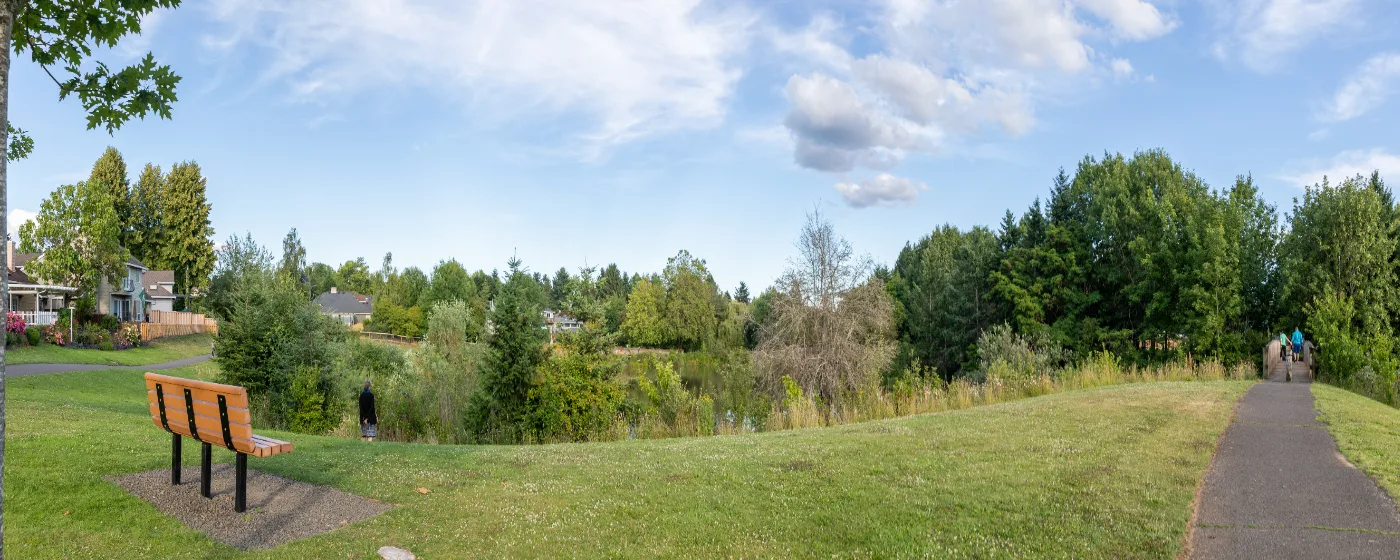
What Is Living in Tigard, Oregon Like?
If you're choosing between Tigard and one of its Portland-area neighbors, the decision usually comes down to one real trade-off: you get meaningfully more space and a lower price point than Lake Oswego or the inner westside — without sacrificing much in terms of access. Tigard sits at the convergence of I-5, OR-217, and OR-99W, which makes it one of the best-positioned suburbs in the metro for commuters who need to move in multiple directions on any given week. With a population of 57,301, it ranks as the 11th-largest incorporated city in Oregon, and it carries that weight — not a sleepy bedroom community, but a fully functioning city with its own employers, arts institutions, transit hub, and parks network.
The economic backbone here is a mix of public-sector stability and private retail. The Tigard-Tualatin School District is one of the largest employers in the city, and the municipal government itself is a significant institutional presence. Costco Wholesale anchors the retail corridor, and a large share of residents commute to Nike's campus in neighboring Beaverton. The median household income of $108,823 reflects a professional workforce, many of whom work in Portland's tech, healthcare, and financial sectors and value Tigard's location as a practical midpoint. Families with kids account for a meaningful slice of the population — the district serves 11,041 students enrolled in 2025-26 — but the city draws renters, downsizers, and remote workers too.
Tigard home prices sit noticeably below Lake Oswego and meaningfully below the inner Portland neighborhoods that many buyers are priced out of — for the full breakdown with current figures, see the cost of living page. What you actually get for that price depends heavily on which part of Tigard you're looking at — Bull Mountain delivers hilltop views and newer construction, while the older neighborhoods closer to OR-99W offer more modest footprints. Day-to-day life here leans on a car for most errands, but the Fanno Creek Trail — nearly 10 miles of paved path through wetlands and greenways — gives the city a recreational spine that surprises a lot of newcomers.
Whether you're being relocated here, moving out of a pricier Portland neighborhood, or just beginning your research, the sections below break down Tigard's neighborhoods, housing market, commute realities, local employers, and what weekends actually look like when you live here.
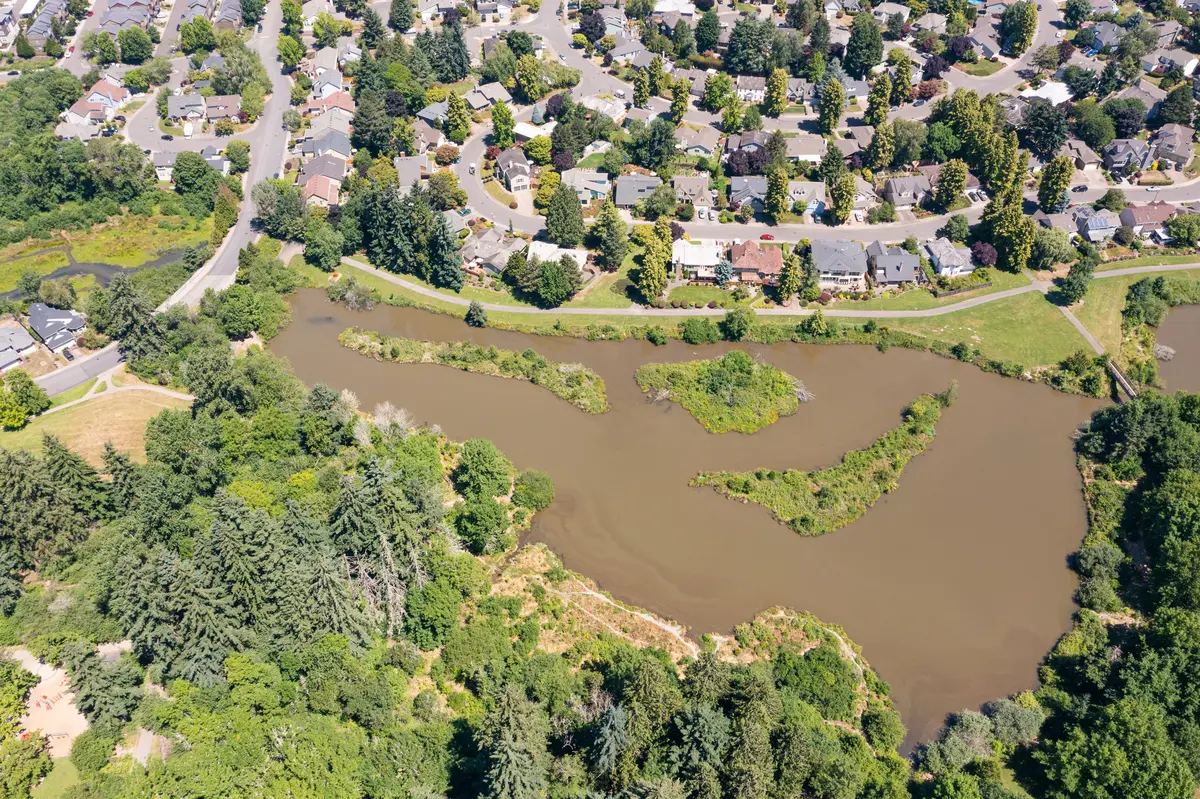
Tigard at a Glance
Looking to buy in Tigard? Estimate your payment.
Enter your numbers to see an estimated monthly mortgage payment.
Estimate only. Excludes HOA fees and mortgage insurance. The interest rate above is a starting point, not a quoted rate — replace it with your own to see real numbers. Insurance is a flat placeholder, not a Tigard quote.
Why Are People Moving to Tigard?
The case for Tigard is straightforward once you see it on a map. Three major routes — I-5, OR-217, and OR-99W — give residents the ability to reach Portland, Beaverton, and Tualatin without ever being locked into a single corridor. That geographic flexibility is rare in the metro, and it's one of the primary reasons families and remote-hybrid workers keep landing here when they're priced out of closer-in options.
The Employer Picture
Tigard's own job base is anchored by the Tigard-Tualatin School District, which is both the city's school system and one of its largest employers. The City of Tigard municipal government adds another layer of stable public-sector employment. Costco Wholesale operates a major location here and employs a significant local workforce. Beyond city limits, Nike's Beaverton campus draws a large number of Tigard residents — many people here run their lives around that commute.
A meaningful portion of the workforce also commutes into Portland's downtown core or the broader Beaverton-Hillsboro tech corridor anchored by Intel and its suppliers. For remote workers, Tigard's price point and trail access make it genuinely competitive with trendier options that cost considerably more.
A City in Motion
Tigard is not standing still. The city's Tigard HOME planning initiative — in active public engagement through 2026 — aims to bring shops and services closer to neighborhoods, simplify business zoning, and create safer walking connections citywide. The River Terrace area has had infrastructure for Phase 3 complete since early 2026, with new home construction on the way. Downtown Tigard and the Tigard Triangle are both inside Tax Increment Financing districts, with a Vertical Housing Development Zone offering partial property tax exemptions to spur mixed-use construction above street-level commercial space.
This is not a city that finished building itself. Buyers who want an established neighborhood can find one on Bull Mountain. Buyers who want to be in early on an area that's actively reshaping itself have options too.
Who Moves Here
| Buyer Type | Why Tigard Works | Best Fit |
|---|---|---|
| Portland commuters | about 20 minutes to Portland via I-5 or OR-217, with WES commuter rail as a backup | Commuter |
| Families with school-age children | Tigard-Tualatin School District holds a B+ rating, according to Niche; good parks network | Families School |
| Nike / Beaverton commuters | Quick access to Beaverton via OR-217 without Beaverton's price premium | Commuter Value |
| Remote workers | Strong trail access, walkable pockets, room to breathe at a lower price than inner Portland | Nature Value |
| First-time buyers | Entry-level options exist, especially in Southview; see the buying guide for financing details | First-Time |
| Downsizers and 55+ buyers | Summerfield is an established 55+ community with a walkable feel; see the retiring page | Quiet |
| Renters testing the market | A range of apartment and rental options; typical 2BR rent runs $1,700–$2,070 | Renter |
The city's median household income sits at $108,823, which reflects real purchasing power — but it's worth knowing that figure runs below the income needed to comfortably carry the typical home here at current prices.
What Daily Life Feels Like in Tigard
Tigard doesn't have one downtown that everyone orbits. It has several centers of gravity, and which one you use depends almost entirely on where you live within the city. That's both its strength and the thing that takes adjustment.
The Geographic Reality
Bull Mountain residents often drive down into the flatter commercial corridors along OR-99W for groceries and daily needs. Metzger and Summerlake households are close to Washington Square Mall, which handles the bulk of major retail for the western side of the city. Residents in the River Terrace area — still actively under construction — are in a newer, less-connected part of the city where a car is genuinely non-optional for most tasks right now.
Downtown Tigard and the Tigard Triangle are the areas the city is actively trying to transform into walkable, mixed-use environments. They're not there yet, but the zoning and financial incentives are in place, and the direction is clear.
Where People Actually Gather
Cook Park is the city's true community gathering point — a large riverside park at the south end of the city with Tualatin River frontage, trail connections at both ends via the Fanno Creek Trail, and the annual Festival of Balloons each June, which has been drawing crowds since 1984. The festival's pre-dawn balloon launches and Night Glow are the kind of thing that makes new residents feel like they've landed somewhere with actual civic identity.
The Fanno Creek Trail is the other constant. Nearly 10 miles of paved greenway thread through the city with dozens of neighborhood entry points — it functions less like a destination trail and more like a daily commuter and dog-walking route that happens to pass through wetlands and wildlife areas. The Tigard Public Library sits at a practical northern access point.
What Surprises People After Six Months
Most newcomers underestimate how much OR-99W functions as both the city's main commercial artery and one of its primary traffic bottlenecks. The strip mall density along that corridor is real, and rush-hour movement on OR-99W can feel disproportionate to what the road visually suggests it should handle. People who buy in areas that require OR-99W for daily errands — and don't factor that into their commute planning — tend to feel it within a few months. The Fanno Creek Trail, on the other hand, tends to exceed expectations: most people discover it after moving here rather than before.
The Seasonal Quirk
Tigard averages 145 sunny days a year. That number sharpens things for anyone coming from sunnier climates — it's not a rumor about Oregon rain, it's a real adjustment. The payoff is that spring and summer here are genuinely beautiful, and the trail system makes outdoor life accessible in a way that compressed summers elsewhere don't always allow. Most longtime residents develop a rhythm around the gray months rather than fighting them.
The school district, active OSAA athletics programs, and Friday night football at Tigard High School — home of the Tigers — give the city a community pulse that keeps weeknights from feeling anonymous, even in a metro suburb of this size.
The Tigard Housing Market Right Now
The typical home in Tigard is priced at $607,011 (Zillow Home Value Index, July 2026). That figure sits at a level where the city's own median household income falls short of what's needed to carry it comfortably at current rates — which is worth knowing before you build your budget. For a full breakdown of what that means month-to-month, the cost of living page has the detail.
What the Housing Stock Actually Looks Like
The median construction year for Tigard homes is 1988, which means the majority of the inventory is ranch-style and colonial construction from the late 1980s and 1990s — solid bones, often with dated kitchens and bathrooms, on established lots with mature landscaping. About 13.6% of homes were built in the 2010s, and the newest post-2020 construction represents a smaller 3.2% slice — concentrated primarily in River Terrace, where infrastructure for Phase 3 was completed in early 2026 with new homes on the way.
Roughly 61.7% of housing units are owner-occupied, which gives most established neighborhoods a stable, owner-invested feel. Renters are concentrated in the flatter, more commercial corridors and in apartment stock near the Tigard Transit Center and Washington Square area.
How the Neighborhoods Tier Out
The city's neighborhoods spread meaningfully around the typical home price. The Tigard Triangle runs above it, reflecting its investment in redevelopment and mixed-use potential. Summerlake (Scholls-Summerlake) and Downtown Tigard sit right at the city median. Southview comes in below it — making it one of the more accessible entry points in the city for buyers working closer to the floor of the market. For a fuller picture of which neighborhoods fit which budgets and lifestyles, the best neighborhoods page goes deeper.
The Rental Side
Typical 2BR rent in Tigard runs $1,700–$2,070, with the city-wide typical rent sitting at $1,850 per month (Zillow ZORI, July 2026). That range reflects meaningful variation between older apartment stock along OR-99W and newer units in mixed-use buildings closer to the transit center. Rentals move reasonably quickly in well-located pockets; the areas nearest to WES service and Washington Square tend to have the tightest availability.
The city is actively using Tax Increment Financing and a Vertical Housing Development Zone to incentivize new residential construction above commercial space — so the rental picture in Downtown Tigard and the Tigard Triangle is likely to shift as those projects come online.
Tigard Neighborhoods
Tigard has several distinct areas — each with its own character and appeal. Here’s a breakdown to help you narrow down where to focus your home search.
🏡 Bull Mountain
Bull Mountain sits on the elevated southwestern edge of the city with hilltop views and a mix of newer homes and established 1990s construction — it's where families who want breathing room and a quieter street feel tend to land, and Bull Mountain Park gives the area a natural anchor.
🏠 River Terrace
River Terrace is Tigard's active growth edge, with infrastructure for Phase 3 complete as of early 2026 and new home construction on the way — it appeals to buyers who want newer product and don't mind being in a neighborhood that's still finding its feet.
🌳 Metzger
Metzger is a flat, more established neighborhood that sits close to Washington Square Mall and OR-217 — practical for commuters and buyers who want walkable retail proximity over hilltop scenery, with housing stock that skews older and more modestly sized.
🏘 Summerlake (Scholls-Summerlake)
Summerlake is a comfortable, family-oriented neighborhood in the western part of Tigard with good park access and a neighborhood feel that tends to hold buyers long-term — it prices right at the city median and draws parents with school-age children who want established surroundings.
🏔 Summerfield
Summerfield is Tigard's signature 55+ community, anchored by a golf course and a resident culture that prizes connection and active living — it's where downsizers land when they want a real community identity, not just a quieter zip code.
🌆 Southview
Southview sits below the city median in price, making it one of the more accessible entry points into Tigard ownership — the housing stock is modest and the neighborhood is unpretentious, which suits first-time buyers and value-focused households who prioritize location over finish level.
Pros & Cons of Living in Tigard
The Pros
- Easy freeway access to Portland via I-5 and OR-217 with a shorter-than-average metro commute
- Extensive Fanno Creek Trail system and roughly 550 acres of parks
- Diverse housing stock from hillside Bull Mountain estates to newer River Terrace construction
- Strong regional retail anchor at Washington Square Mall
The Cons
- Property crime, especially vehicle break-ins near retail corridors and park-and-rides, runs well above the national average
- Home prices remain relatively high for the region despite recent softening
- Traffic on 99W and around Washington Square can be heavy during peak commute hours
Getting Around & Commuting in Tigard
Tigard is a two-car city for most households — Census data puts average car ownership at 2 vehicles per household, and the average commute runs 22.9 minutes. Most residents drive alone. That's the baseline, and it's worth accepting rather than hoping the transit will cover the gap.
The Road Network
Three routes define the city's access: I-5 runs along the eastern edge and provides the fastest path toward Portland or toward Tualatin and points south. OR-217 — the Beaverton-Tigard Freeway — is the primary connector to Beaverton and the tech corridor; it's a short freeway that carries a disproportionate volume during peak hours and backs up accordingly. OR-99W, also known as Pacific Highway West, is the commercial spine running through the middle of the city, and it is the route most residents love to hate — essential for daily errands, congested during commute windows, and slow through the signal-heavy commercial corridor.
The I-5/OR-217 interchange is a known pressure point. Buyers who choose homes that require navigating that interchange during rush hour — particularly those commuting south toward Tualatin or north toward the Barbur corridor into Portland — should test that drive at 7:30 a.m. before making an offer. The drive to Portland averages about 20 minutes under normal conditions, but that figure can stretch on heavy-traffic mornings.
The Transit Option
Tigard has genuine transit infrastructure, which is not something every suburb of this size can say. The WES Commuter Rail (Westside Express Service) links the Tigard Transit Center to Beaverton to the north and Wilsonville to the south, running on weekday peak schedules with frequent enough service that regular commuters rarely feel stranded — though it is not an all-day or weekend option, which limits its usefulness for anyone with irregular hours.
The Tigard Transit Center — a park-and-ride facility in downtown Tigard — also anchors multiple TriMet bus routes, including lines serving the Washington Square corridor and connections toward Lake Oswego and Portland. For riders who commute into the core on a predictable schedule, the combination of WES and TriMet bus can genuinely reduce car dependency for the work trip. For everything else — groceries, school pickup, weekend errands — a car is the practical answer.
Portland International Airport
Portland International Airport (PDX) sits approximately 20 miles from Tigard. Most residents drive or use a rideshare; the route is straightforward via I-5 north, and off-peak travel to PDX typically runs under 30 minutes. For frequent flyers, Tigard's airport access is one of its quieter advantages over Beaverton or Hillsboro.
Schools in Tigard
Families relocating to Tigard have public, private, and higher-education options nearby. Here’s a quick overview.
🎓 School District
Tigard-Tualatin School District 23J serves K–12 students across Tigard and the surrounding area. Rated B+ (source: Niche.com).
🏆 Graduation Rate
The 4-year high-school graduation rate here is approximately 86.7%.
📚 Higher Education
Oregon’s public universities — the University of Oregon, Oregon State University, and Portland State University — offer four-year degrees statewide, with a network of 17 community colleges providing two-year and workforce programs.
🌐 Online Learning
Oregon State University Ecampus and Portland State University Online offer fully accredited online degrees for remote learners across the state.
Safety in Tigard
A quick look at how Tigard compares on the numbers that matter most when weighing a neighborhood or a move.
🛡 Violent Crime
Approximately 3.1 per 1,000 residents.
🔒 Property Crime
Approximately 33.3 per 1,000 residents.
Compared to the most recent national figures from the Bureau of Justice Statistics (2024), Tigard’s violent crime is below the national average (about 3.7 per 1,000), and property crime is above the national average (about 18.4 per 1,000).
Against Oregon as a whole, Tigard’s violent crime is about the same as the state average, and property crime is somewhat above the state average (Bureau of Justice Statistics, Crime Known to Law Enforcement, 2024 (tables 2 and 3)).
Crime rates can vary a lot within a single city, so the citywide numbers above are only a starting point. Some neighborhoods in Tigard run well below these averages, while others run higher — the kind of block-by-block detail that matters most when you’re actually choosing where to live. The full guide below breaks it down neighborhood by neighborhood.
Working in Tigard
Tigard’s largest employers span several industries — here are some of the anchors of the local job market.
🎓 Tigard-Tualatin School District
Education
🏛 City of Tigard
Municipal government
🛒 Costco Wholesale
Retail
💼 Nike
Athletic apparel, located in Beaverton
Parks & Recreation in Tigard
Some of the outdoor spaces that shape everyday life in Tigard.
🌱 Cook Park
🌱 Fanno Creek Trail
Tigard residents don’t have to go far for green space — spots like Cook Park and Fanno Creek Trail are part of everyday life here, whether that’s a morning walk, a weekend hike, or just somewhere to unwind outside. The full guide below covers more of what Tigard has to offer for parks and outdoor recreation.

Retiring in Tigard
Tigard draws retirees for its balance of amenities, outdoor access, and cost. Here’s what to weigh.
🌤 Climate
Tigard averages 145 sunny days a year — the gray months from November through February are real, and retirees from sunnier climates typically need a season or two to settle into the rhythm. Spring and summer here are genuinely mild and pleasant, with warm days that rarely push into uncomfortable heat. The rain is manageable once you stop waiting for it to stop.
🍴 Lifestyle
The Broadway Rose Theatre Company anchors the performing arts scene and draws audiences from across the westside with a professional regional calendar. Cook Park and the Fanno Creek Trail give retirees a parks network that rewards both leisurely walks and more active pursuits. A weekly farmers market and Washington Square's full retail offering mean that day-to-day needs are well within reach.
🏚 55+ Communities
Summerfield is Tigard's established 55+ community, offering an active-adult lifestyle with a golf course and a strong sense of neighborhood identity that longtime residents describe as one of the more connected communities in the city. It draws downsizers who want a quieter pace without giving up proximity to Portland and the westside's amenities.
✈ Getting Around
Most retirees here drive, and the road network — I-5, OR-217, and OR-99W — makes regional access straightforward outside of peak commute windows. Portland International Airport (PDX) is approximately 20 miles away, a practical asset for anyone with family out of state. The WES commuter rail and TriMet bus connections at the Tigard Transit Center offer car-free options for trips into Beaverton or toward the core, though a personal vehicle remains the practical anchor for daily life.
🏛 Oregon Taxes for Retirees — What to Know
- Social Security is not taxed — Oregon does not tax Social Security or Railroad Retirement benefits. Any amount included in your federal adjusted gross income is subtracted back out on the Oregon return.
- But other retirement income IS taxed — This is the trade-off that surprises people moving from Washington or Texas. Pension distributions and 401(k)/IRA withdrawals are taxed as ordinary income at Oregon’s regular rates — there is no blanket retirement-income exclusion.
- Graduated income tax — Oregon has four brackets — 4.75%, 6.75%, 8.75% and 9.9%. The 4.75% rate covers the first $10,000 of taxable income for a single filer ($20,000 filing jointly); the 8.75% rate starts at $125,000 ($250,000 jointly); and the top 9.9% rate applies above $250,000 ($500,000 jointly).
- No sales tax — Oregon levies no general sales tax.
- Property taxes, with senior deferral — Oregon’s Senior and Disabled Property Tax Deferral lets qualifying homeowners have the state pay their county property taxes, with a lien recorded against the home. The 2026 household income limit is $70,000, and deferred balances accrue 6% simple interest — it defers the bill rather than forgiving it.
- Estate tax — the one to plan for — Oregon has its own estate tax with a $1 million filing threshold — far below the federal exemption, and NOT indexed for inflation, so it reaches more estates every year in real terms. Retirement accounts and a long-held home count toward the taxable estate, so estates that feel modest can cross the line without the owner expecting it.
- No inheritance tax — Oregon has no separate inheritance tax and no gift tax.
Tax laws change frequently and individual situations vary. This is general information, not tax advice — always consult a qualified Oregon tax professional or CPA for personalized retirement tax planning.
Weekends & Local Favorites in Tigard
Tigard's weekend rhythm is shaped more by its parks and trail network than by its restaurant scene — though the dining options have real depth once you know where to look.
Outdoors First
Cook Park is the anchor. This riverside park connects to the Fanno Creek Trail at both ends, offers Tualatin River access including a boat ramp for small watercraft, and functions as the city's largest gathering space. The annual Festival of Balloons fills Cook Park each June with pre-dawn launches, a Night Glow, and live music — a nonprofit community event that has been running since 1984 and draws crowds from across the region.
The Fanno Creek Trail is where the everyday outdoor life happens. Nearly 10 miles of paved path run through the city with wetlands, wildlife areas, and neighborhood access points throughout. Bull Mountain Park offers a different feel — hilltop open space with views and trail connections for those who prefer elevation over the creek-side flat. Dirksen Nature Park is a quieter option for families who want wildlife habitat without the crowds.
Food and Coffee
Banning's Restaurant & Pie House is a Tigard institution — a full-service diner known for its pies, the kind of place that gets mentioned in the same breath as the Festival of Balloons when longtime residents describe what makes the city feel like itself. Thirsty Lion offers a livelier atmosphere with a broad menu and a bar program. Margarita Factory Tigard handles Mexican fare and a solid margarita list. Fogo de Chão Brazilian Steakhouse brings the full churrasco experience to the city. Tigard Taphouse rounds out the casual end of the dining scene with local beer and a neighborhood feel.
On the coffee side, Symposium Coffee is well-regarded for its craft approach. Well & Good Cafe - Tigard, Lugano Cafe & Catering, Primo Espresso, and Vault 13 Espresso each have their own character and following — Tigard is not a city that depends on a single coffee shop to carry the whole scene.
Culture and Markets
The Broadway Rose Theatre Company is the city's main performing arts anchor — a professional regional theater with a calendar that draws audiences from across the westside. The Tigard Farmers Market and The Bull Mountain Farmers Market give residents a weekly produce-and-local-goods circuit through the warmer months. The John Tigard House Museum offers a window into the city's 19th-century origins for anyone curious about how the place started. Washington Square Mall handles the big-box and chain retail needs that most suburban households still require, and its concentration of options means serious shopping rarely requires leaving the city.
Local favorites in Tigard
Restaurants
- Banning's Restaurant & Pie House
- Thirsty Lion
- Margarita Factory Tigard
- Fogo de Chão Brazilian Steakhouse
- Tigard Taphouse
Outdoors
- Cook Park
- Fanno Creek Trail
- Bull Mountain Park
- Dirksen Nature Park
- Tualatin River access
Coffee
- Symposium Coffee
- Well & Good Cafe - Tigard
- Lugano Cafe & Catering
- Primo Espresso
- Vault 13 Espresso
Farmers Markets
- The Bull Mountain Farmers Market
- Tigard Farmers Market Parking
Top Things Locals Say About Tigard
The best intel about a city comes from the people who actually live there. Here’s what Tigard residents say when newcomers ask the questions everyone’s thinking.
“I knew the commute would be fine on paper — but I didn't realize OR-99W would be the thing I thought about every single morning. The trail access more than made up for it, honestly. I found a Fanno Creek entry point two blocks from my house within the first week and it changed the whole picture.”
— Recent Tigard home buyer
“What's the most surprising thing about living in Tigard?”
How different Bull Mountain feels from everything else. You move up there expecting a suburb and you get hilltop views, quieter streets, and a neighborhood that genuinely has its own character. Then you drive down to OR-99W for groceries and it snaps you back into strip-mall reality pretty fast. The Fanno Creek Trail is the other surprise — most people don't know it exists until they're already here.
“What do locals love most about Tigard?”
The Festival of Balloons at Cook Park every June is the thing everyone mentions. Pre-dawn launches, the Night Glow, the whole energy of it — it's the kind of event that makes a suburban city feel like it has actual civic pride. Beyond that, the trail system. Sixteen miles of paved paths and nearly 550 acres of parks means you can get outside without planning a trip.
“What should newcomers to Tigard know?”
Test your actual commute route at rush hour before you buy — specifically if it involves OR-99W or the spot where I-5 and OR-217 meet. Both slow down more than new residents expect. Also: the WES commuter rail is real and useful if your schedule is regular, but it only runs on weekday peak schedules, so don't count on it for anything outside a predictable nine-to-five pattern. And get on the Tigard Farmers Market email list early in spring.
“How much do you need a car in Tigard?”
For most things, a car is non-negotiable. The average household here owns two, and that's not an accident. Groceries, school pickup, weekend errands — nearly all of it requires driving. The exception is the Fanno Creek Trail, which you can reach on foot from a lot of neighborhoods and which connects you to a genuinely useful greenway without starting an engine. The WES rail covers the commute to Beaverton and Wilsonville on weekdays, and TriMet buses connect through the Tigard Transit Center — but for daily life beyond the commute, plan to drive.
Cities Near Tigard
Other communities near Tigard worth a look — each with its own character and price point.
| City | Distance | Best For | Vibe | Median Rent | Median Buy |
|---|---|---|---|---|---|
| King City | 3 mi | 55+ buyers, quiet living | Small-scale, retirement-focused, peaceful | $1,600 | $475,000 |
| Beaverton | 4 mi | Tech commuters, diverse amenities | Busy, diverse, well-connected | $1,880 | $527,947 |
| Tualatin | 5 mi | Families, newer construction | Suburban, lake-anchored, growing | $1,890 | $635,314 |
More Helpful Guides for Tigard
Going deeper on Tigard? Our blog series covers everything from first-time buying to retiring here — explore the guides below.
Local Expert Takeaway: Tigard rewards buyers who do their geographic homework before they look at listings. Bull Mountain and River Terrace feel like a different city from the Metzger and OR-99W corridor — not just in price but in how daily life works. The Fanno Creek Trail is the thread that ties the city together, and proximity to a trailhead will matter more to your quality of life here than almost any other feature on a listing sheet. Don't buy anywhere that requires OR-99W for daily errands without driving that route at 8 a.m. on a Tuesday first.
Quick Takeaways & FAQs
✅ Three major routes — I-5, OR-217, and OR-99W — make Tigard one of the most commuter-flexible suburbs in the Portland Metro, with about 20 minutes to Portland under typical conditions.
⚠️ OR-99W is a genuine traffic chokepoint through the commercial core, and buyers who don't test that drive at rush hour before committing often wish they had.
📍 The annual Festival of Balloons at Cook Park each June — with pre-dawn launches and a Night Glow — has been a community anchor since 1984 and is the kind of local tradition that makes the city feel like more than a suburb.
What is the typical home price in Tigard, Oregon?
How are the schools in Tigard?
Is Tigard a good place for commuters?
What are the best neighborhoods in Tigard?
What is Tigard, Oregon known for?
Helpful Links for Moving to Tigard
Moving to Oregon?
Tell us what you need help with and we'll connect you with local resources.
