Most people who ask "is Tigard safe?" are really asking two different questions: how dangerous is it to live here, and what does that property crime number actually mean? The city of 57,301 carries a violent crime rate of 3.1 per 1,000 residents — below both the Oregon state average and the national figure. A property crime rate of 33.3 per 1,000 residents is higher than both benchmarks, and that number deserves an honest explanation rather than a dismissal.
The short answer is that Tigard's property crime rate is shaped almost entirely by its commercial geography. Washington Square Mall and the OR-99W commercial corridor generate a disproportionate share of reported incidents — vehicle break-ins in retail parking lots, larceny in shopping centers, and organized retail theft in the kinds of big-box corridors that Tigard has in abundance. When those incidents get averaged across the entire residential population, the per-capita number climbs fast. The residential neighborhoods where most families actually live look considerably quieter when you pull the map apart.
The city's police department is one of the more institutionally serious in the Portland Metro. It holds accreditation through the Northwest Accreditation Alliance — a rigorous, multi-year process — and runs what it describes as the only Commercial Crimes Unit of its kind in Oregon, funded through business license fees and focused specifically on the organized retail theft and fraud that inflate the citywide property crime count. Voters renewed the Police Services Levy in 2024 with 78% support, which is not a number you see in cities where residents have lost confidence in their department.
Whether you are weighing Tigard against Beaverton, Tualatin, or a neighborhood inside Portland, the sections below break down what the crime figures mean in practice, which parts of the city generate most of the incidents, where the quieter residential pockets sit, and what the police department is actually doing about the commercial crime problem that drives the headline number.

How Tigard's Crime Rates Compare
The numbers bear stating plainly before anything else. Tigard carries a violent crime rate of 3.1 per 1,000 residents — below Oregon's state rate of 3.3 per 1,000 and meaningfully below the national rate of 3.7 per 1,000. On the metric that most directly affects personal safety, Tigard comes in favorably against both benchmarks.
The property crime picture is different. A property crime rate of 33.3 per 1,000 residents sits above Oregon's state figure of 24.5 per 1,000 and well above the national rate of 18.4 per 1,000. That gap is real and worth understanding — but understanding it requires knowing what drives it.
The engine-rendered comparison table below this section gives you the side-by-side figures at a glance. What the table cannot show is the geographic concentration behind them: the commercial corridor running through central Tigard generates the overwhelming majority of property crime incidents, while the residential neighborhoods on the hillside west side of the city see very few. That is not a neighborhood-character difference. It is a land-use difference.
One data point worth anchoring the violent crime conversation: Tigard recorded zero murders in 2024, per FBI Uniform Crime Report data. For a city of this size in a major metro, that is a meaningful signal about the character of violent crime here — and about where the genuine risk actually concentrates.
Where the Crime Actually Happens: The Commercial Corridor Effect
The single most important thing to understand about Tigard's crime statistics is that property crime in this city is not evenly distributed — and the residential neighborhoods where most people live bear very little resemblance to the citywide average.
The OR-99W and Washington Square Corridor
OR-99W — the commercial spine running through central Tigard — carries a disproportionate share of vehicle break-ins, retail theft, and larceny. Washington Square Mall and its surrounding retail cluster generate incident volumes that are structural to that land use, not a reflection of the surrounding community. Park-and-ride lots, retail parking structures, and high-turnover commercial zones are where the numbers accumulate.
The commercial corridor sees the most incidents in the city by a substantial margin. The Tigard Triangle, the commercial district wedged between I-5, OR-217, and OR-99W, sits in this higher-activity zone by geography. Buyers drawn to that area for its transit access and walkable potential should understand it sits in the commercial corridor rather than the quieter residential west side.
The Residential West: Bull Mountain, River Terrace, and Summerlake
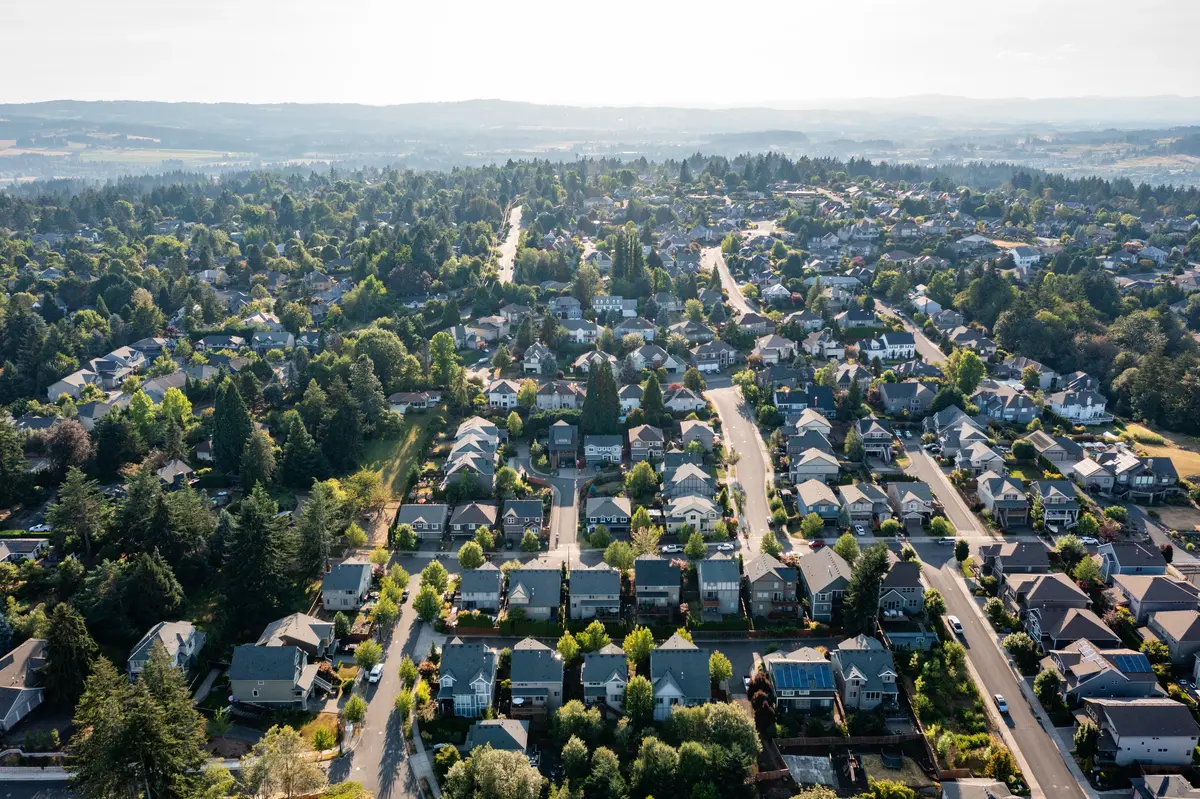
Pull the map westward and the picture changes substantially. Bull Mountain and River Terrace are elevated, hillside neighborhoods built almost entirely of lower-density single-family homes with attached garages and limited through-traffic. Those physical characteristics directly correlate with lower property crime rates — there are fewer targets of opportunity, fewer pedestrian-scale retail environments, and higher owner-occupancy rates that bring active neighborhood investment.
The subdivisions near Scholls Ferry Road benefit from the same pattern: higher owner-occupancy, active neighborhood associations, and strong proximity to parks like Bull Mountain Park and Dirksen Nature Park. Residents in these areas describe day-to-day life as genuinely quiet in a way the citywide property crime figure does not suggest.
Summerlake (Scholls-Summerlake) and Southview share similar characteristics — established residential fabric, little commercial intrusion, and the kind of block-level familiarity that tends to function as informal crime prevention. The residential southwest sees few incidents compared to the commercial center. The full neighborhood breakdown covers what each area looks and feels like in more detail.
The Tigard Police Department: Structure, Funding, and Accountability
A police department's accreditation status is one of the more durable indicators of institutional quality — and Tigard's department has held accreditation through the Northwest Accreditation Alliance since 2019, subsequently earning reaccreditation by meeting 106 standards of excellence grounded in national best practices. That is a voluntary, rigorous process, and most departments in cities of this size do not pursue it.
The Commercial Crimes Unit
Tigard's Commercial Crimes Unit is the piece of the department most directly relevant to the property crime conversation. By the department's own account — and corroborated by national recognition — it is the only unit of its kind in Oregon and possibly on the entire West Coast. It is funded through business license fees rather than general tax revenue, staffed by detectives who handle organized retail theft, embezzlement, burglary, and fraud cases that regularly cross state lines and take months to build. The CCU is the city's direct institutional response to the commercial corridor crime that inflates the headline number.
Levy Support and Use-of-Force Transparency
In 2024, Tigard voters renewed the Police Services Levy by a 78% margin — sustaining funding for additional patrol officers, a school resource officer, and crisis intervention and de-escalation training. A levy renewal at that margin, in the current political environment around policing, reflects a community that feels substantively supported by its department.
The department's 2024 transparency data shows officers handled an extensive call volume across the city, with force used in only 0.12% of all interactions. For a city operating in the Portland Metro orbit, that restraint figure reflects a department with meaningful training investment behind it.
Community Engagement
The Tigard Police run a free, multi-week Community Academy open to all residents, covering patrol operations, investigations, commercial crimes, and more. The program is designed to build genuine familiarity between officers and the community rather than function as a PR exercise. The crime-prevention program also supports Neighborhood Watch formation across the city's residential areas — something the Bull Mountain and Summerlake neighborhoods have taken advantage of at above-average rates.
Looking to buy in Tigard? Estimate your payment.
Enter your numbers to see an estimated monthly mortgage payment.
Estimate only. Excludes HOA fees and mortgage insurance. The interest rate above is a starting point, not a quoted rate — replace it with your own to see real numbers. Insurance is a flat placeholder, not a Tigard quote.
Neighborhood-by-Neighborhood Safety Picture
No neighborhood in Tigard posts the kind of violent crime concentration that would put residents on alert. The differences between areas are almost entirely about property crime exposure, and that exposure tracks closely with proximity to commercial land use.
Bull Mountain and River Terrace
These are the hillside neighborhoods that consistently log the lowest incident rates in the city. Elevated terrain, cul-de-sac street networks, attached garages, and limited retail intrusion all work in residents' favor. If minimizing property crime exposure is your primary safety concern, these are the areas that deliver it most reliably. See how they compare on other dimensions — housing stock, community feel, and access — on the neighborhoods page.
Summerlake (Scholls-Summerlake) and Southview
Both areas benefit from established, owner-occupied residential fabric and active neighborhood associations. Summerlake in particular has the kind of park access — the Fanno Creek Trail corridor runs through this part of the city — that brings consistent foot traffic and informal community presence. Neither area borders the OR-99W commercial strip in a way that bleeds incident volume into the residential blocks.
Metzger and Downtown Tigard
Metzger sits in the northern part of the city closer to the Washington County urban boundary, with a more mixed residential and commercial character. Downtown Tigard is undergoing its own evolution — the commercial density is thinner than a true downtown, which in safety terms means lower foot-traffic incidents, but also less of the activated street life that functions as passive deterrence. Neither area is a concern for violent crime; property crime exposure is modestly higher than the hillside west simply by proximity to the OR-99W corridor.
Tigard Triangle
The Triangle's commercial and transit-oriented character places it squarely in the higher-incident zone. Buyers drawn there for transit access to Portland should factor that in. It is an area in transition, and the safety picture may shift as development density changes the street-level environment.
Summerfield
Summerfield is Tigard's established 55+ community and operates with the kind of close-knit neighborhood association structure that correlates with low incident rates. It sits away from the OR-99W corridor and functions more like the quiet west-side residential areas than the commercial-adjacent center of the city.
What Residents Actually Notice — and What to Check Before You Decide
People who move to Tigard from denser parts of the Portland Metro often describe the same six-month realization: the city felt less safe on paper than it turned out to feel on the ground. The property crime rate is the number that unsettles relocating buyers, and then they move in and discover that their specific block — particularly if it is in Bull Mountain, River Terrace, or Summerlake — looks nothing like the headline figure suggested.
The Parking Lot Problem
What residents do notice, fairly consistently, is vehicle break-ins in retail parking areas. Washington Square Mall's parking structure has a reputation that locals know well. If you park there — or in the transit center lots along OR-99W — leaving anything visible in your car is genuinely inadvisable. This is the everyday friction that the property crime number reflects. It is real, it is annoying, and it is almost entirely confined to those commercial environments.
What to Actually Research Before Choosing an Area
The most useful thing you can do before settling on a neighborhood is to look at the Tigard Police Department's crime map, which is publicly accessible and updated regularly. Zoom into the specific streets around any home you are seriously considering. The difference between a block in River Terrace and a block adjacent to OR-99W is stark and immediately visible on that map — do not make the decision based on the citywide average alone.
Tools like NeighborhoodScout and CrimeGrade can also help you compare specific addresses when you are narrowing down a short list. Neighborhood Watch participation is worth asking about too: Bull Mountain and Summerlake have active programs with strong block-captain networks, and an active association is a reliable proxy for a community paying attention to its own environment.
A Seasonal Note
Retail theft activity around Washington Square tends to spike in the pre-holiday retail season. That is not a Tigard-specific problem — it reflects the commercial density — but locals know to be more deliberate about parking and vehicle security from late October onward. It is the kind of thing nobody tells you about until you have lived through your first December here.
For a fuller picture of what daily life here looks like beyond safety, the living in Tigard overview covers commute patterns, who moves here, and the community texture that shapes day-to-day experience.
Local Expert Takeaway: Tigard carries a violent crime rate of 3.1 per 1,000 residents — genuinely below the Oregon state average — and the city recorded zero murders in 2024. A property crime rate of 33.3 per 1,000 residents is real but heavily concentrated in the OR-99W commercial corridor and around Washington Square Mall, not in the residential neighborhoods where most families live. Bull Mountain and River Terrace consistently log the city's lowest incident rates, and the Tigard Police Department's accreditation, levy support, and nationally recognized Commercial Crimes Unit all point to an institution that takes the commercial crime problem seriously. Before settling on a specific street, pull the city's crime map: the difference between the quiet hillside west and the commercial corridor is visible immediately, and it matters far more than the citywide average.
Quick Takeaways & FAQs
✅ Tigard carries a violent crime rate of 3.1 per 1,000 residents — below both the Oregon state average and the national figure — and the city recorded zero murders in 2024.
⚠️ A property crime rate of 33.3 per 1,000 residents is above state and national averages, driven heavily by retail theft and vehicle break-ins concentrated along the OR-99W corridor and Washington Square Mall rather than in residential neighborhoods.
📍 The Tigard Police Department's Commercial Crimes Unit is described as the only one of its kind in Oregon, funded through business license fees and focused specifically on the organized retail theft that inflates the citywide property crime count.
Is Tigard a safe place to live?
Which Tigard neighborhoods have the lowest crime rates?
Why is Tigard's property crime rate so high compared to the state average?
How is the Tigard Police Department rated?
Is the area around Washington Square Mall safe to live near?
Moving to Oregon?
Tell us what you need help with and we'll connect you with local resources.
