What Is Living in West Linn, Oregon Like?
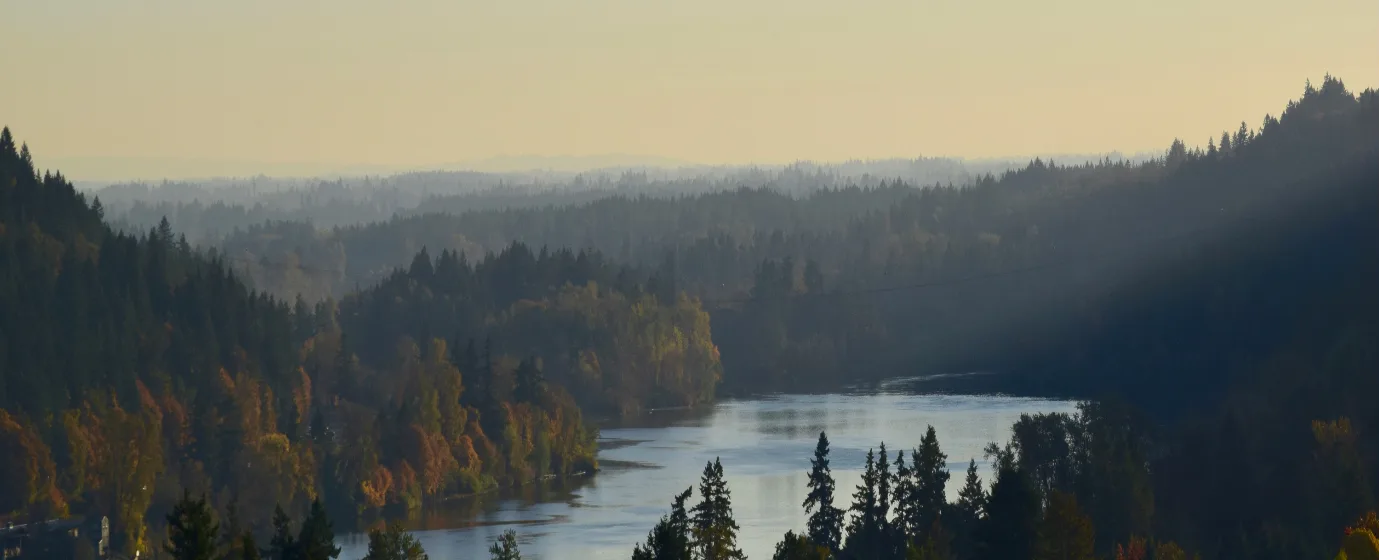
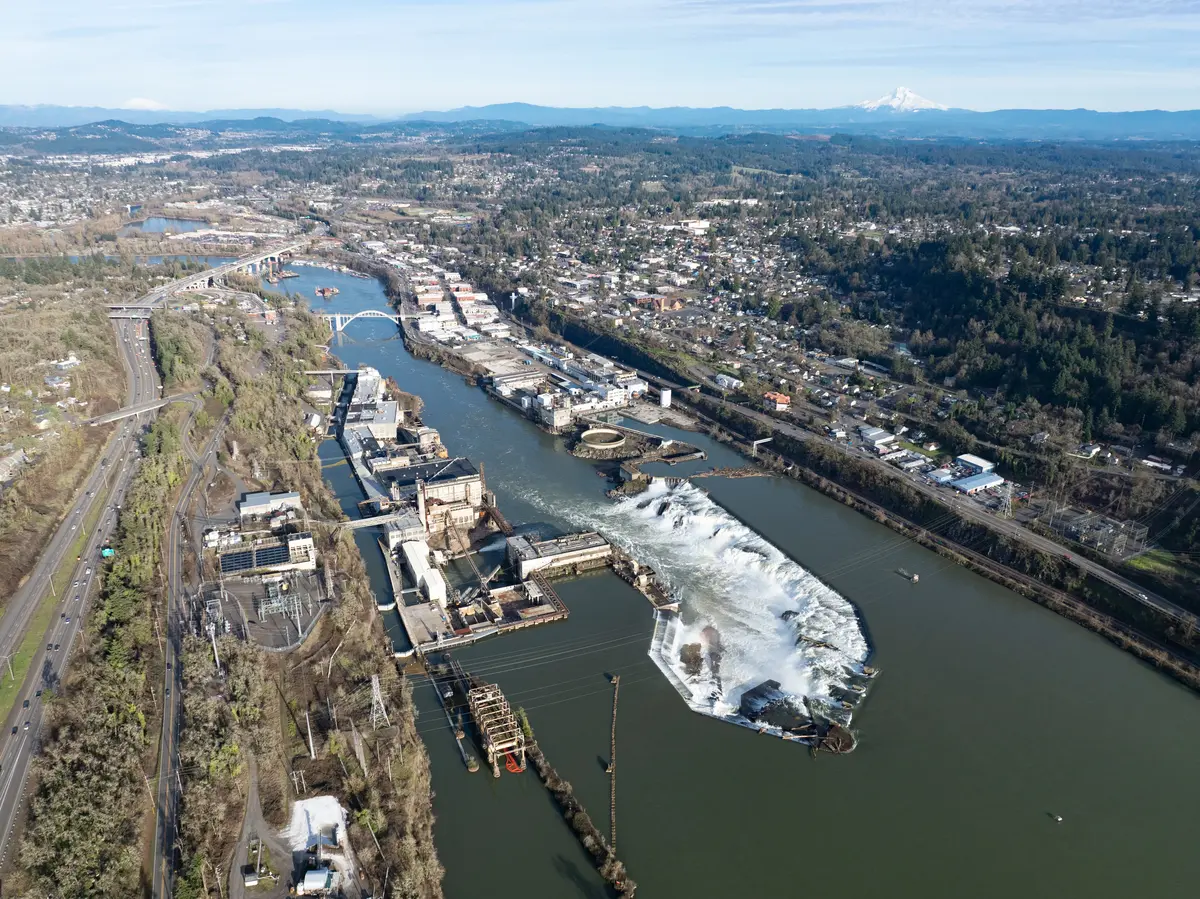
Most people who move to West Linn say they came for the schools. What keeps them — and what surprises them — is something harder to quantify: the sensation of living inside a forested hillside city that somehow sits about 25 minutes to Portland. West Linn occupies the west bank of the Willamette River about 13 miles south of downtown Portland, wedged between I-205 and OR-43, with residential neighborhoods literally stacked on ridges above two rivers. It is not a flat grid suburb. Streets curve into ravines, homes sit above the tree canopy, and Willamette Falls — the second-largest waterfall by volume in the United States — drops 40 feet across a 1,500-foot basalt ledge right at the edge of town.
The economic profile here is distinctly professional. The median household income of $146,507 reflects a resident base concentrated in law, medicine, finance, and technology — most of whom commute north to Portland or northwest into the Lake Oswego and Washington County tech corridor rather than working locally. The West Linn-Wilsonville School District, which holds an A rating according to Niche, is the single most cited reason families choose this city over nearby alternatives, and school boundaries drive purchase decisions as much as street addresses do. With 8,617 students enrolled in 2025-26, the district is large enough to offer genuine depth in academics, arts, and athletics while staying small enough that individual schools maintain a community feel.
The typical home price of $779,602 (July 2026, Zillow Home Value Index) places West Linn noticeably above most Portland-area suburbs, though still below Lake Oswego's upper tier. Typical two-bedroom rents run $2,190–$2,660 per month. Oregon's lack of a state sales tax and West Linn's effective property tax rate of approximately 0.98% soften the sticker shock somewhat — see the full cost of living breakdown for the complete picture. Day-to-day life leans heavily on car ownership given the hilly terrain and limited flat commercial density, but Mary S. Young State Park's 136 forested acres, the Camassia Natural Area's rare camas meadows, and a genuine historic main street in the Willamette district give the city a quality-of-life dividend that most comparably priced suburbs don't offer.
Whether you're seriously considering a move or just starting your research, the sections below break down West Linn's neighborhoods, the housing market, daily commute realities, local employers, and what living here actually feels like on a Tuesday morning and a Saturday afternoon.
West Linn at a Glance
Looking to buy in West Linn? Estimate your payment.
Enter your numbers to see an estimated monthly mortgage payment.
Estimate only. Excludes HOA fees and mortgage insurance. The interest rate above is a starting point, not a quoted rate — replace it with your own to see real numbers. Insurance is a flat placeholder, not a West Linn quote.
Why Are People Moving to West Linn?
The case for West Linn is easy to make: a top-rated school district, a dramatic river-and-ridge setting, and a population of 27,601 that keeps the city genuinely small without feeling isolated from Portland. The case against it is shorter but worth reading before you make an offer — the commute is real, the hills make walking for errands impractical, and the price of entry is high.
The School District Pull
The West Linn-Wilsonville School District — which holds an A rating according to Niche — is the dominant driver of demand in this market. Families with school-age children move here specifically to access it, and those boundaries shape where people buy with unusual precision. On 2024-25 state assessments, 49.3% of students reached math proficiency and 59.8% reached reading proficiency. West Linn High School's alumni include NBA player Payton Pritchard and Pulitzer Prize-winning photographer David Hume Kennerly, which gives you some sense of the range the district produces. For more on the full district picture, see the West Linn schools guide.
The Setting Is Not Incidental
West Linn's terrain is topographically dramatic for a suburb. Neighborhoods sit on ridges above the Willamette and Tualatin rivers, with forested ravines between them. That geography is part of what people are paying for — and it's also what makes the city feel different from Tualatin or Oregon City even though they're minutes away.
Willamette Falls anchors the southern edge of the city's identity. Sea lions gather at its base during salmon runs. The Willamette Falls Locks — closed since 2011 — sit on the West Linn side of the river, and a community group was actively working to reopen them as of August 2026.
Who Actually Moves Here
The typical West Linn buyer is a dual-income professional household — lawyers, physicians, tech workers, finance professionals — relocating from Portland proper or from a higher-cost California market where West Linn's price point looks reasonable by comparison. Parents with elementary-age children make up a substantial share of first-time buyers here. Some retirees buy into the general residential market, often targeting single-level homes on quieter ridges, since the city has no dedicated 55+ communities. For a deeper look at what retirement looks like here, see the West Linn retiring guide.
What the Safety Picture Looks Like
West Linn carries a violent crime rate of 0.6 per 1,000 residents and a property crime rate of 7.8 per 1,000 residents — well below Oregon state figures and national averages. For the full safety breakdown, see the West Linn safety guide.
What Daily Life Feels Like in West Linn
Six months after moving here, a lot of newcomers say the same thing: they underestimated how much they'd rely on their car. The hills are beautiful. They are also non-negotiable. You will drive to get coffee, drive to get groceries, drive to the park, and drive to the trailhead — even if the trailhead is technically close.
The Willamette District vs. the Rest of the City
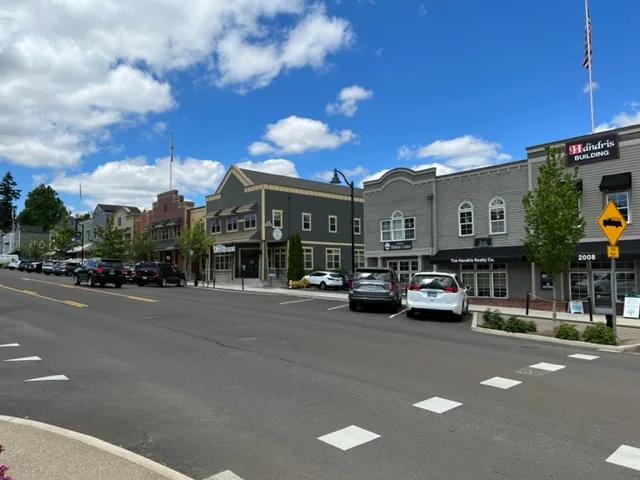
The Historic Willamette Main Street is the closest thing West Linn has to a walkable neighborhood center. It's a small commercial strip with real local character — independent shops, a farmers market in the warmer months, and a low-key pace that feels nothing like a Portland commercial corridor. The surrounding Willamette neighborhood sits below the city median price-wise, which makes it one of the more accessible entry points. The rest of the city — Robinwood, Rosemont Summit, Skyline Ridge, Hidden Springs — is almost entirely residential, with amenities requiring a drive.
Outdoors as Infrastructure
Mary S. Young State Park functions as the city's communal backyard. Its more than five miles of hiking and biking trails, dog off-leash area, sports fields, and a floating pedestrian bridge to Cedar Island (accessible spring through fall) mean that on any warm weekend, this is where West Linn families actually go. The Camassia Natural Area — a 22.5-acre Nature Conservancy preserve featuring camas meadows and basalt scabland shaped by ancient glacial flood geology — draws serious crowds on spring weekends when the wildflowers peak. Cedaroak Boat Ramp Park and Willamette Park at Bernert Landing give river access that most suburbs can't match. See the full parks and recreation guide for trail details.
The Weather Reality
West Linn gets 144 sunny days a year — which is the honest Oregon number, not the aspirational Pacific Northwest marketing figure. The winters are grey, wet, and long. This doesn't surprise people who've spent time in Portland, but it does catch some California transplants off guard in their first January. The upside is that when spring arrives, the camas at Camassia blooms, the trails at Mary S. Young dry out, and the city earns every dollar of its reputation.
Where Families Gather
Beyond the parks, the Willamette district functions as a low-key social hub — a handful of independent spots clustered within walking distance of each other, which is rare enough in this city to matter. Friday nights during football season, the stands at West Linn High School fill with the kind of crowd that makes the city feel like a genuine community rather than a collection of residential ridges.
The West Linn Housing Market Right Now
The typical home price in West Linn sits at $779,602 (July 2026, Zillow Home Value Index). That figure is not evenly distributed across the city — some areas run noticeably above it, others come in below — but the city-wide median is a meaningful anchor. For neighborhood-level context and a deeper look at what different areas cost relative to that figure, see the West Linn neighborhoods guide.
What the Price Reflects
West Linn's price point is carried by two things: the school district and the setting. Remove either and you'd be pricing closer to Oregon City, which sits just across the river. The effective property tax rate of approximately 0.98% — applied to assessed value, which in Oregon can diverge from market value under Measure 50 — adds to carrying costs but remains below many comparable suburban markets nationally.
The typical city-wide rent of $2,376 per month (Zillow ZORI, July 2026) — with two-bedroom units running roughly $2,190 to $2,660 — reflects that this is not a renter-heavy market. Most rentals are single-family homes or smaller attached units; the city has no large apartment complexes in the way that Tualatin or Oregon City do. For the full cost-of-living breakdown including utilities, groceries, and taxes, see the West Linn cost of living guide.
Market Character
Well-priced homes in desirable school boundaries don't sit long. The inventory tends to be thin because turnover is low — people who buy here with school-age children often stay a decade or more, which keeps supply constrained. Buyers moving from California often find West Linn's prices striking a reasonable balance, while buyers coming from other parts of the Portland metro can find the jump significant. The median household income of $146,507 shapes who can realistically compete.
Incremental infill continues — subdivision proposals on Rosemont Road and Parker Road, middle housing development, and mixed-use proposals in the pipeline reflect a city that is slowly adding density without dramatically altering its residential character.
West Linn Neighborhoods
West Linn has several distinct areas — each with its own character and appeal. Here’s a breakdown to help you narrow down where to focus your home search.
🏡 Willamette (Historic Willamette District)
The most walkable corner of West Linn, with the historic main street, the Wednesdays In Willamette Summer Street Market, and a concentrated cluster of local dining and coffee within a few blocks. It's a genuine neighborhood center in a city that otherwise disperses across ridgelines, and it sits below the city-wide median price — making it one of the more accessible entry points into West Linn.
🏠 Bolton
A quieter residential area that comes in below the city median, Bolton suits families looking for more house per dollar without sacrificing school district access. The neighborhood has a low-key, established feel with mature trees and modest lot sizes that contrast with the grander ridgeline estates elsewhere in the city.
🌳 Robinwood
A mid-city neighborhood with a mix of ranch-style and two-story homes on established streets, Robinwood has a settled, family-oriented character and sits in a central location that gives reasonable access to both I-205 and OR-43. It tends to attract parents with school-age children who want practical proximity to West Linn High School.
🏘 Hidden Springs
One of the city's more tucked-away residential pockets, Hidden Springs lives up to its name with forested lots and a sense of separation from the city's commercial activity. It suits buyers who prioritize privacy and tree canopy over walkability, and who are comfortable with the drive that comes with it.
🏔 Rosemont Summit
Sitting high on West Linn's eastern ridgeline, Rosemont Summit offers elevated views and spacious lots that draw buyers who want maximum separation from the flatlands. The commute to Portland is longer than from the Willamette district, and the drive down to daily errands is not trivial — this is a neighborhood for people who have consciously chosen the ridge over the convenience.
🌆 Sunset
Sunset is one of the city's more accessible neighborhoods price-wise, sitting below the city-wide median and offering a range of housing stock from mid-century ranches to newer construction. It's a practical choice for buyers entering the West Linn market for the first time who want school district access without reaching for the upper end of the city's price range.
Pros & Cons of Living in West Linn
The Pros
- Consistently ranked one of Oregon's safest cities
- Top-rated West Linn-Wilsonville schools
- Scenic Willamette River setting with abundant parks and trails
- Relatively short commute into downtown Portland
The Cons
- High home prices and limited new construction due to geographic constraints
- Car-dependent with few transit options beyond bus lines
- Property taxes among the highest in Oregon
Getting Around & Commuting in West Linn
West Linn is a commuter city. Its residents leave for work — to Portland, to Lake Oswego, to the Washington County tech corridor — and return. Understanding how that flow works before you choose a neighborhood is one of the most important things a relocating buyer can do here.
The Two Routes Out
I-205 is the freeway option, running north to Portland and east to Oregon City. OR-43 runs north along the river through Lake Oswego toward southwest Portland — a scenic alternative that becomes a slow crawl during peak commute hours. Both routes have their advocates and their detractors, and which one you'll use depends heavily on where in the city you live. The drive is about 25 minutes to Portland under normal conditions; count on longer during morning rush hours, particularly on OR-43 through the Lake Oswego corridor.
The Neighborhood-Commute Connection
This is the detail most buyers underestimate. West Linn's ridgeline geography means that getting from your home to either main arterial can itself take five to ten minutes on winding residential streets. A house in Skyline Ridge or Rosemont Summit adds meaningful time to a commute that already looks tight on paper. Buyers who work in Portland and care about commute time should think carefully about which neighborhood they choose — the difference between Willamette and Rosemont Summit is not just scenery, it's twenty minutes a day. See the full neighborhoods guide for a geographic breakdown.
Transit
TriMet Route 35 connects West Linn to Portland, with stops connecting to MAX light rail at Rose Quarter Transit Center. Service runs on a schedule that works for Portland commuters willing to plan around it, but most West Linn residents drive — the hilly terrain and dispersed residential pattern make transit a supplement rather than a primary mode for most households.
Local Employment
The city's own employer base is modest. The West Linn-Wilsonville School District and the City of West Linn are the two largest local employers, supplemented by Clackamas County municipal positions. Beyond public-sector work, residents commute out. A significant share of the workforce works remotely or drives to Portland, Lake Oswego, or Washington County tech campuses. That remote-work reality is part of why West Linn's income profile is as high as it is — this is a city where household incomes are sustained by professional employment that doesn't need to be local.
Portland International Airport is approximately 20 miles from West Linn, a meaningful consideration for frequent business travelers who need reliable airport access.
Schools in West Linn
Families relocating to West Linn have public, private, and higher-education options nearby. Here’s a quick overview.
🎓 School District
West Linn-Wilsonville School District serves K–12 students across West Linn and the surrounding area. Rated A (source: Niche.com).
🏆 Graduation Rate
The 4-year high-school graduation rate here is approximately 97.5%.
📚 Higher Education
Oregon’s public universities — the University of Oregon, Oregon State University, and Portland State University — offer four-year degrees statewide, with a network of 17 community colleges providing two-year and workforce programs.
🌐 Online Learning
Oregon State University Ecampus and Portland State University Online offer fully accredited online degrees for remote learners across the state.
Safety in West Linn
A quick look at how West Linn compares on the numbers that matter most when weighing a neighborhood or a move.
🛡 Violent Crime
Approximately 0.6 per 1,000 residents.
🔒 Property Crime
Approximately 7.8 per 1,000 residents.
Compared to the most recent national figures from the Bureau of Justice Statistics (2024), West Linn’s violent crime is below the national average (about 3.7 per 1,000), and property crime is below the national average (about 18.4 per 1,000).
Against Oregon as a whole, West Linn’s violent crime is roughly a quarter of the state average, and property crime is roughly a third of the state average (Bureau of Justice Statistics, Crime Known to Law Enforcement, 2024 (tables 2 and 3)).
Crime rates can vary a lot within a single city, so the citywide numbers above are only a starting point. Some neighborhoods in West Linn run well below these averages, while others run higher — the kind of block-by-block detail that matters most when you’re actually choosing where to live. The full guide below breaks it down neighborhood by neighborhood.
Working in West Linn
West Linn’s largest employers span several industries — here are some of the anchors of the local job market.
🎓 West Linn-Wilsonville School District
Education
🏛 City of West Linn
Municipal government
🏛 Clackamas County
Municipal government
Parks & Recreation in West Linn
Some of the outdoor spaces that shape everyday life in West Linn.
🌱 Willamette Falls
🌱 Willamette Falls Locks
🌱 Mary S. Young State Park
West Linn residents don’t have to go far for green space — spots like Willamette Falls and Willamette Falls Locks are part of everyday life here, whether that’s a morning walk, a weekend hike, or just somewhere to unwind outside. The full guide below covers more of what West Linn has to offer for parks and outdoor recreation.
Retiring in West Linn
West Linn draws retirees for its balance of amenities, outdoor access, and cost. Here’s what to weigh.
🌤 Climate
West Linn averages 144 sunny days a year — the honest Oregon figure. Winters are mild by national standards but consistently wet and grey from November through March, which surprises retirees arriving from sunnier climates. Summers are warm, dry, and genuinely lovely, with comfortable temperatures and low humidity making outdoor time a daily habit from June through September.
🍴 Lifestyle
Daily life for retirees here centers on the outdoors — Mary S. Young State Park's forested trails and river access, the Camassia Natural Area's seasonal wildflower blooms, and the Willamette Falls viewpoint for something genuinely dramatic. The historic Willamette main street offers independent dining and coffee shops at a pace that suits retirement well. A serious shopping run means driving out of town, which is the honest compromise.
🏚 55+ Communities
West Linn has no dedicated 55+ or active-adult housing communities. Retirees here buy into the general residential market, often prioritizing single-level homes with manageable lots on quieter ridgeline streets. The West Linn retiring guide covers what that search typically looks like and what to expect from the city's housing stock.
✈ Getting Around
A car is essential for daily life in West Linn — the hilly terrain and dispersed residential layout make most errands a drive. Portland International Airport is approximately 20 miles away, a manageable trip for retirees with regular travel plans. OR-43 north toward Lake Oswego and Portland is the most direct route for most of the city's western neighborhoods.
🏛 Oregon Taxes for Retirees — What to Know
- Social Security is not taxed — Oregon does not tax Social Security or Railroad Retirement benefits. Any amount included in your federal adjusted gross income is subtracted back out on the Oregon return.
- But other retirement income IS taxed — This is the trade-off that surprises people moving from Washington or Texas. Pension distributions and 401(k)/IRA withdrawals are taxed as ordinary income at Oregon’s regular rates — there is no blanket retirement-income exclusion.
- Graduated income tax — Oregon has four brackets — 4.75%, 6.75%, 8.75% and 9.9%. The 4.75% rate covers the first $10,000 of taxable income for a single filer ($20,000 filing jointly); the 8.75% rate starts at $125,000 ($250,000 jointly); and the top 9.9% rate applies above $250,000 ($500,000 jointly).
- No sales tax — Oregon levies no general sales tax.
- Property taxes, with senior deferral — Oregon’s Senior and Disabled Property Tax Deferral lets qualifying homeowners have the state pay their county property taxes, with a lien recorded against the home. The 2026 household income limit is $70,000, and deferred balances accrue 6% simple interest — it defers the bill rather than forgiving it.
- Estate tax — the one to plan for — Oregon has its own estate tax with a $1 million filing threshold — far below the federal exemption, and NOT indexed for inflation, so it reaches more estates every year in real terms. Retirement accounts and a long-held home count toward the taxable estate, so estates that feel modest can cross the line without the owner expecting it.
- No inheritance tax — Oregon has no separate inheritance tax and no gift tax.
Tax laws change frequently and individual situations vary. This is general information, not tax advice — always consult a qualified Oregon tax professional or CPA for personalized retirement tax planning.
Weekends & Local Favorites in West Linn
West Linn is not a city with a dense restaurant row or a nightlife district. What it has instead is a small cluster of genuinely good local spots, two of the most distinctive natural areas in the Portland metro, and a waterfall most cities would build an entire tourism industry around.
The Local Dining Scene
The Willamette district is where most of the dining life concentrates. Lil' Cooperstown Bar & Grill draws a reliably local crowd — sports on, unpretentious, the kind of place where you run into neighbors. Linn City Pub fills a similar role with a slightly different energy. J. Willys Public House and Eatery covers the casual sit-down end, while Nineteen33 steps up the experience for something more deliberate. Willamette Garage rounds out the options with a distinct, laid-back character that regulars tend to be loyal to.
For coffee, Willamette Coffee House and Lark Café are the two independent anchors. Both are genuine neighborhood spots — not drive-through chains — and both function as the kind of place where people work remotely on weekday mornings and meet friends on weekends.
The Farmers Market
The Wednesdays In Willamette Summer Street Market runs through the warmer months along the historic main street and is one of those local institutions that shows up in nearly every conversation about what makes the neighborhood worth living in. It's small by Portland standards, which is exactly the point.
The Natural Anchors
Mary S. Young State Park is the city's most used outdoor space — over 136 acres of Willamette River frontage, forested trails, a dog off-leash area, and a floating pedestrian bridge to Cedar Island that only exists spring through fall. It's worth arriving early on weekends in good weather. Camassia Natural Area is worth putting on the calendar specifically for spring — the camas bloom on the basalt scabland is one of the genuinely unusual wildflower moments in the Pacific Northwest, and the geology shaped by ancient glacial flooding makes the place feel unlike any other preserve in Clackamas County.
The Willamette Falls viewpoint and the adjacent historic locks are a perennial reason to walk down to the river. The falls drop over 40 feet across a 1,500-foot basalt ledge — sea lions appear below during salmon runs — and a community group is working toward reopening the four interconnected Willamette Falls Locks on the West Linn side. Cedaroak Boat Ramp Park and Willamette Park (Bernert Landing) offer river access that most suburbs can't offer at all. For the full trails and parks picture, see the parks and recreation guide.
Local favorites in West Linn
Restaurants
- Lil' Cooperstown Bar & Grill
- Linn City Pub
- J. Willys Public House and Eatery
- Nineteen33
- Willamette Garage
Outdoors
- Mary S. Young State Park
- Camassia Natural Area
- Willamette Falls viewpoint
- Cedaroak Boat Ramp Park
- Willamette Park (Bernert Landing)
Coffee
- Willamette Coffee House
- Lark Café
Farmers Markets
- Wednesdays In Willamette Summer Street Market
Top Things Locals Say About West Linn
The best intel about a city comes from the people who actually live there. Here’s what West Linn residents say when newcomers ask the questions everyone’s thinking.
“I knew about the schools before we moved — everyone does. What I didn't expect was how much the hills change everything. Even getting to the grocery store feels like a decision. Once we found our rhythm with it, we loved the privacy and the trees. But that first year, I kept thinking I'd miscalculated the commute somehow, and I hadn't — the road just adds up.”
— Recent West Linn home buyer
“What's the most surprising thing about living in West Linn?”
How much the geography shapes your day. You picture a suburb near Portland and expect flat streets and easy errands. West Linn is ridges and ravines and winding roads — beautiful, but it means everything takes a little longer than the map suggests. The first time you try to walk to get coffee from a Rosemont address, you understand why almost everyone drives.
“What do locals love most about West Linn?”
The combination of things you can't find in one place anywhere else nearby: a legitimately top-rated school district, forested trails out the back door, a real historic main street in the Willamette district, and Willamette Falls sitting at the edge of town like it's no big deal. Most suburbs in the Portland metro offer one or two of those. West Linn offers all of them, which is why people who can afford to stay, do.
“What should newcomers to West Linn know?”
Pick your neighborhood with your commute in mind first, scenery second. OR-43 through Lake Oswego gets genuinely slow during morning rush hours, and if you're living on a ridge, add internal drive time before you even hit the main road. The Willamette district is the most practical base for someone who wants to occasionally leave the car at home. Also: spring at Camassia is not to be missed — go on a weekday if you can, because the spring wildflower weekends draw real crowds.
“How much do you need a car in West Linn?”
Almost entirely. The Willamette historic district has a walkable cluster of shops, cafés, and the summer street market that covers some daily-life needs on foot if you live right in that neighborhood. Everywhere else in the city, a car is a practical necessity — the hills, the distances between residential areas and commercial nodes, and the limited transit frequency mean that day-to-day life without one would be genuinely difficult for most residents. TriMet Route 35 connects to Portland, but it's a supplement for most people, not a primary way of getting around.
Cities Near West Linn
Other communities near West Linn worth a look — each with its own character and price point.
| City | Distance | Best For | Vibe | Median Rent | Median Buy |
|---|---|---|---|---|---|
| Lake Oswego | 4 mi | Upscale buyers wanting walkable amenities | Polished, walkable, higher-end | $2,209 | $889,944 |
| Oregon City | 3 mi | Value-focused buyers, first-time buyers | Historic, more affordable, hilly | $1,955 | $605,330 |
| Tualatin | 7 mi | Commuters, families, flat living | Practical, suburban, convenient | $1,890 | $635,314 |
More Helpful Guides for West Linn
Going deeper on West Linn? Our blog series covers everything from first-time buying to retiring here — explore the guides below.
Local Expert Takeaway: West Linn earns its price premium on two things: the West Linn-Wilsonville School District and the river-and-ridge setting. If neither of those matters to you, you will get more house for less money in Oregon City or Tualatin. If both matter, the calculus flips fast — there isn't another suburb in the Portland metro where you can hike five miles of forested Willamette River trail, walk to a genuine historic main street, and sit in a consistently top-rated school district simultaneously. The compromise is the commute: OR-43 through Lake Oswego and the I-205 interchange both clog predictably, and the hillside neighborhoods add internal drive time that doesn't show on any map. Choose your neighborhood with your morning commute in mind, not just the view from the backyard.
Quick Takeaways & FAQs
✅ The West Linn-Wilsonville School District holds an A rating from Niche and is consistently among Oregon's strongest — it's the primary reason most families choose this city over nearby alternatives at a similar price point.
⚠️ Most errands and nearly all commuting require a car; the hillside terrain and dispersed residential layout make on-foot access to daily needs impractical outside the Willamette historic district.
📍 Willamette Falls — the second-largest waterfall by volume in the United States — sits at the edge of town, and sea lions gather at its base during salmon runs each year.
What is the typical home price in West Linn, Oregon?
How are the schools in West Linn?
How long is the commute from West Linn to Portland?
Is West Linn a safe place to live?
What is there to do outdoors in West Linn?
Helpful Links for Moving to West Linn
Moving to Oregon?
Tell us what you need help with and we'll connect you with local resources.
