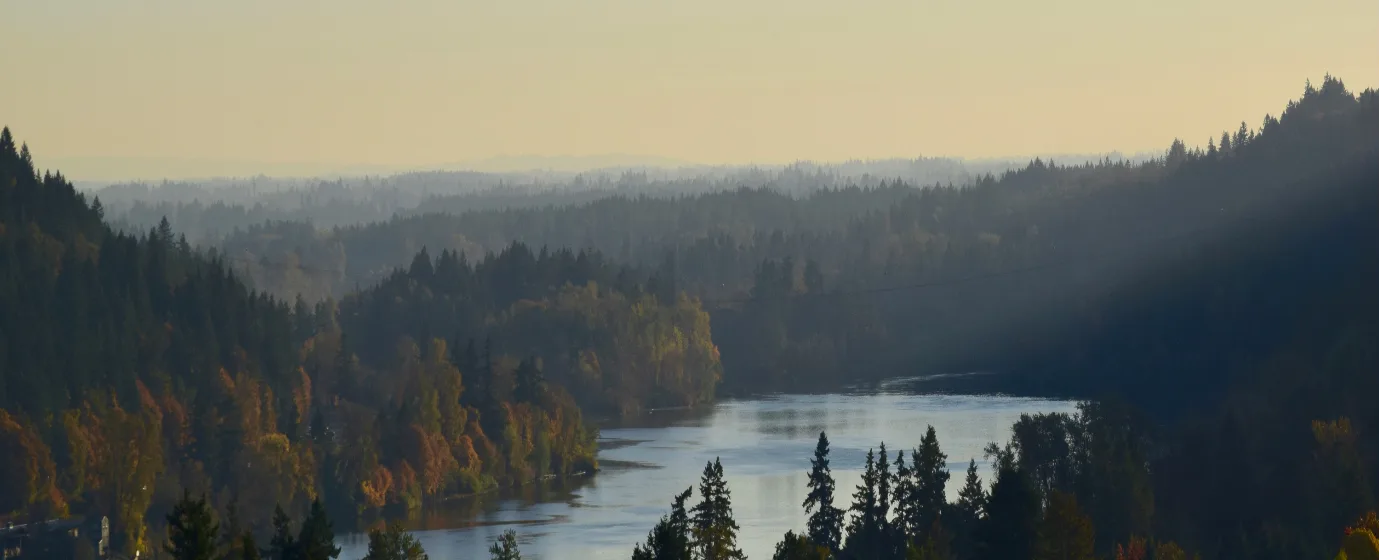
Most cities of 27,601 people have a park or two. West Linn has a forested river park larger than many urban neighborhoods, a Nature Conservancy preserve that hosts plant communities found nowhere else in the Portland metro, the largest waterfall by volume in the Pacific Northwest on its doorstep, and a riverfront gathering ground that anchors civic life through every season. For buyers deciding between West Linn and nearby Lake Oswego or Oregon City, the outdoor infrastructure here is genuinely one of the decisive factors — not because the parks are well-maintained (they are), but because they are irreplaceable by type.
The city sits in the Portland Metro, roughly 25 minutes to Portland along the Willamette River corridor, with OR-43 and I-205 threading through its edges. That geography — steep river bluffs, basalt plateaus, and two river confluences — is not incidental to the parks system. It is the parks system. The terrain that makes West Linn's neighborhoods hilly and its roads occasionally inconvenient is the same terrain that produces five miles of forested trail inside city limits, a volcanic plateau with wildflowers in April, and direct river access for paddlers year-round.
West Linn's typical home price stands at $779,602 (July 2026), and a meaningful part of what buyers are paying for is this landscape — access to it without a weekend drive. The cost of living page covers the full financial picture, but it's worth knowing upfront that the parks here are free, maintained by the city's Parks and Recreation department, and genuinely used by residents rather than existing as checkbox amenities.
Whether you're considering a move or just researching what daily outdoor life in West Linn looks like, the sections below break down the city's signature parks, its trail network, its water access and river recreation, and the seasonal events that pull the community together each year.
Mary S. Young Park: The Heart of the System
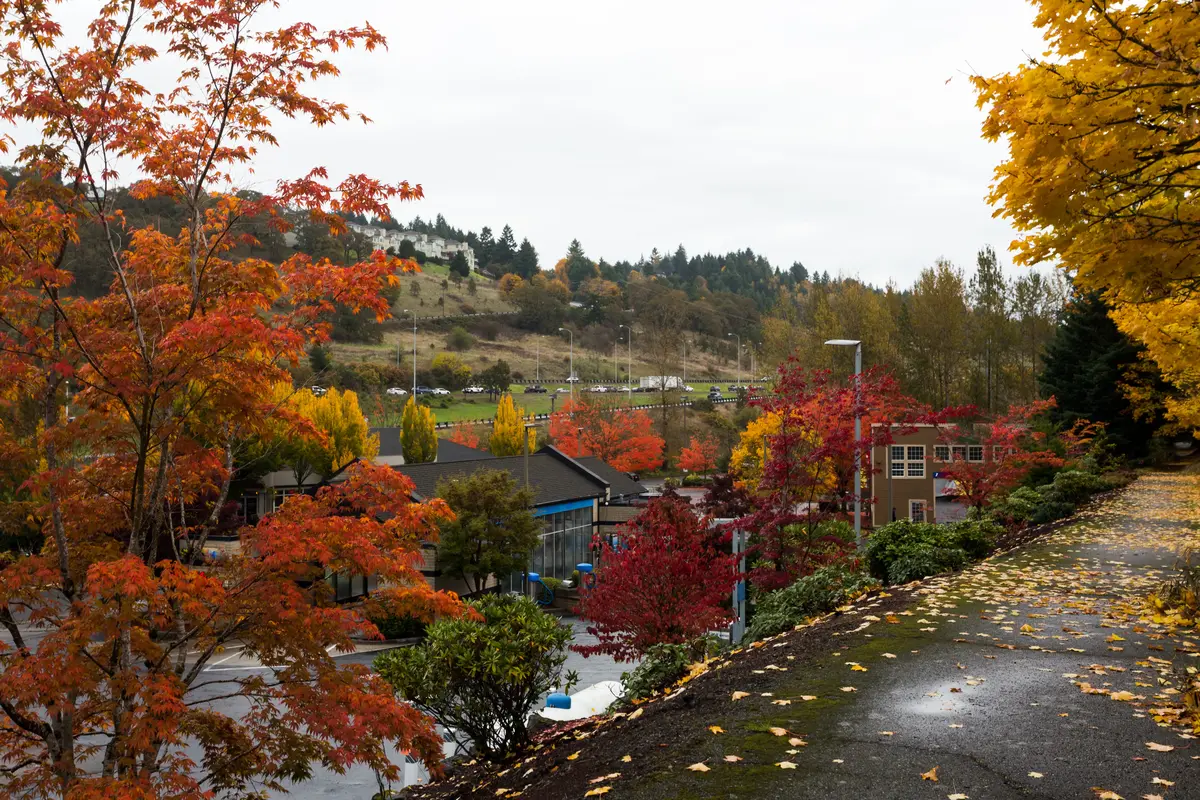
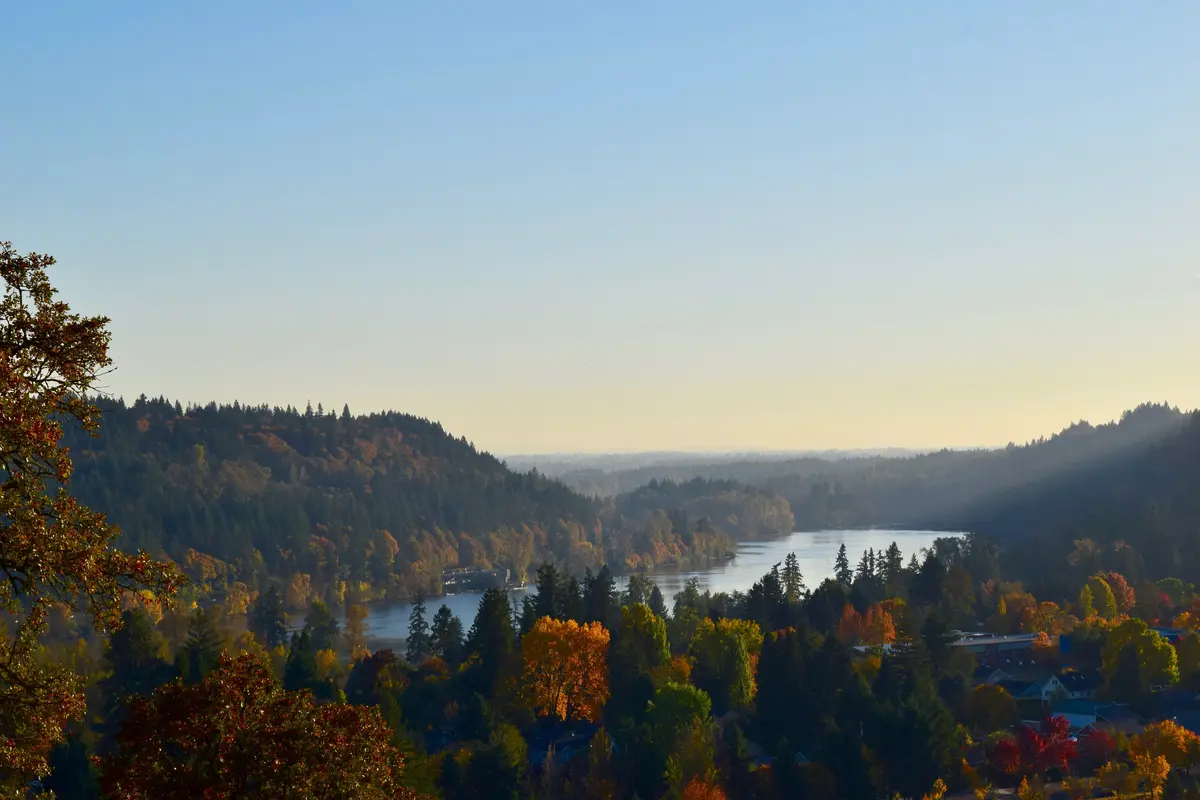
Mary S. Young Park is the kind of park that makes people stop renting and start buying. The 128-acre forested property runs along the Willamette River and was donated to the city in 1973 by Mary Scarborough Young, who attached one condition: it had to stay a natural area. The city has honored that in letter and spirit.
The trail network covers more than five miles, with about two miles accessible to wheelchair users — a rarity in a park this rugged. The canopy is old-growth Douglas fir and big-leaf maple, and it shows. Bald eagles nest in the tall firs near the river. Pileated woodpeckers work the older trees. The trail to the river bluff delivers Mount Hood on clear days, which in West Linn's 144 sunny days a year means you earn the view often enough to make it part of a regular routine.
Facilities are more varied than the forested setting suggests. There are two off-leash dog areas, sports fields, picnic tables, a reservable covered shelter, disc golf, fishing spots, and a small swimming beach on the Willamette. It is, genuinely, a full-day park — not a loop trail with a parking lot.
The Down to Earth Forest School
One of the more interesting details about Mary S. Young is that it hosts the Down to Earth Forest School, an outdoor environmental education program for children that operates within the park. It's the kind of use that would have pleased the original donor, and it explains why you'll see school-age kids in the park on weekday mornings even during the school year.
Cedar Island Access
Cedar Island, a 14-acre island in the Willamette, sits within reach of the park via a seasonal floating bridge. It's a genuinely unusual amenity — an island accessible on foot, seasonally — and it's the kind of thing West Linn residents mention when they're explaining the park to someone new.
The Haunted Trail
Each autumn, the park hosts a Haunted Trail in the weeks before Halloween. What started as a community event has grown into an elaborate seasonal production. New residents are sometimes surprised by the scale of it — this is not a few carved pumpkins on a path. It's become one of those West Linn traditions that people plan around.
Best for: Families Nature Dog owners
Camassia Natural Area: Something You Won't Find Anywhere Else in the Metro
Camassia Natural Area is easy to underestimate from the description: 22.5 acres, a 0.8-mile loop, 70 feet of elevation change. On paper it sounds like a short walk. In practice it is a volcanic basalt plateau sculpted by the Missoula Ice Age Floods, hosting rare plant species, oak woodlands, meadows, and wetland communities that don't exist anywhere else in the Portland metro.
The Nature Conservancy has managed the site since 1962 — making it one of the oldest TNC preserves in the region. That longevity shows in the quality of the restoration work: invasive Himalayan blackberry, Scotch broom, and English ivy have been systematically removed over decades; native white oak has been protected by girdling competing Douglas fir; and native wildflowers and grasses have been reseeded throughout.
The Spring Bloom
Spring is when Camassia earns its reputation. The wildflower bloom across the basalt meadows is spectacular in a way that photographs don't fully capture, partly because the geology — exposed rock, shallow soil, standing water in the depressions — creates an environment that looks nothing like a typical Pacific Northwest forest. Osprey nest on site. Anna's hummingbirds and Rufous hummingbirds both appear in the meadows.
Entry is free and no permit is required. Dogs, bikes, and horses are not permitted — the habitat is genuinely sensitive, and the restrictions are enforced. If you're moving here with a dog, Mary S. Young is your park; Camassia is where you go without the leash.
What Locals Know
People who've lived in West Linn for years tend to describe Camassia as something they don't take for granted — a place this ecologically significant being walkable from residential streets is unusual. First-time visitors sometimes arrive expecting something closer to a neighborhood greenspace and leave having reconsidered what a 22.5-acre preserve can hold.
Best for: Nature Wildflower season Quiet walks
Willamette Falls, the Locks, and River Access
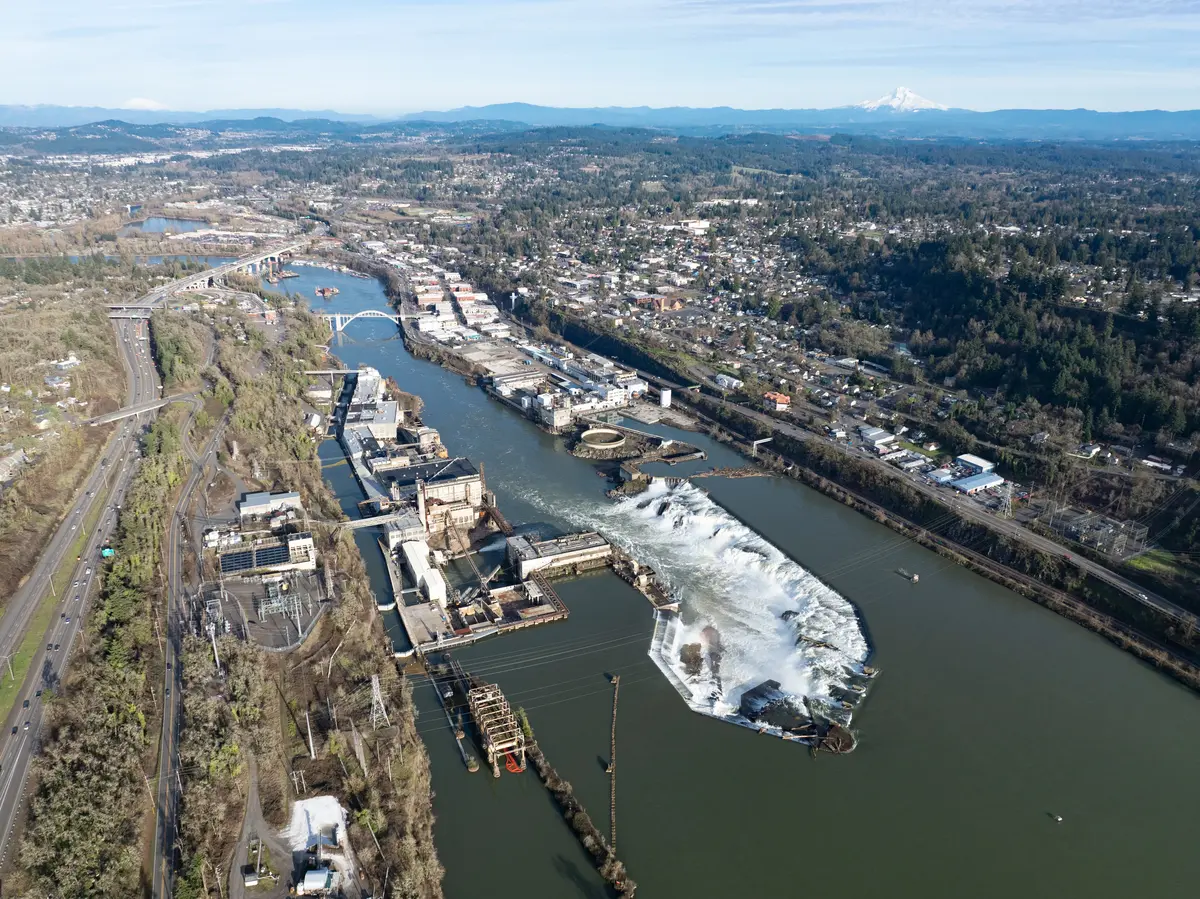
Willamette Falls sits on West Linn's eastern border and it is not a modest feature. The horseshoe-shaped basalt falls drop roughly 40 feet and stretch approximately 1,500 feet wide — the largest waterfall by volume in the Pacific Northwest and the 17th widest in the world. A free scenic overlook off I-205 frames the falls with Mount Hood on clear days.
Adjacent to the falls on the West Linn side are the Willamette Falls Locks, the oldest continuously operating multi-lift lock-and-canal system in the United States. The locks are a working piece of American infrastructure history, and they sit within the city's daily geography rather than at a destination that requires a special trip.
River Access for Paddlers
West Linn participates in the Willamette River Water Trail, a fully mapped paddling route running from Eugene to Portland. Two launch points serve the city: the Cedaroak Boat Ramp Park and Bernert Landing at Willamette Park. For residents who kayak or canoe, this means on-ramp access to a regional water trail without loading the car for an hour.
The river here is not a background amenity. It is where a meaningful portion of outdoor life happens — fishing, paddling, wildlife watching from the banks, and in summer, the swimming beach at Mary S. Young.
Willamette Park (Bernert Landing)
Willamette Park occupies 22.5 acres at the confluence of the Tualatin and Willamette Rivers. The facility list is longer than most city parks: two large picnic shelters, a stage, baseball and softball fields, grass and sand volleyball courts, horseshoe pits, a playground, a wading pool, and a boat ramp with a dock system. It's the park the city uses for its largest gatherings, and the infrastructure reflects that.
The West Linn Old Time Fair has been held at Willamette Park since the 1950s. It fills the riverfront every July — free to enter — with a community parade, water-ski shows, an antique and classic boat show, lumberjack competitions, live music, carnival rides, and a pancake breakfast. For residents who move here from larger cities, the scale and sincerity of this event tends to be the first real signal that West Linn has a community identity that predates them by decades.
Best for: Families Paddlers River access
Looking to buy in West Linn? Estimate your payment.
Enter your numbers to see an estimated monthly mortgage payment.
Estimate only. Excludes HOA fees and mortgage insurance. The interest rate above is a starting point, not a quoted rate — replace it with your own to see real numbers. Insurance is a flat placeholder, not a West Linn quote.
Weekends & Local Favorites: How West Linn Uses Its Parks
The honest answer to how West Linn residents spend their weekends outdoors is: in layers. Mary S. Young handles the trail run or the dog walk or the morning with kids. Camassia Natural Area gets one specific season of attention — spring — and then quiets down. The river access points at Cedaroak Boat Ramp Park and Willamette Park are the summer anchors for anyone who paddles or fishes. The Falls viewpoint is where you take people visiting from out of town.
A few things worth knowing before you move here:
- The rainy season affects all of it. West Linn gets 144 sunny days a year. The trails at Mary S. Young are hikeable year-round — the forest canopy manages the rain — but the Camassia plateau is muddy and the river access points are best in the dry half of the year. Residents who move here from drier climates sometimes underestimate this in month three.
- Mary S. Young fills on summer weekends. The off-leash dog areas and the swimming beach pull large crowds on warm Saturdays. If you want the trails without the parking lot chaos, weekday mornings are the local answer.
- The Old Time Fair is genuinely the city's biggest social event. It's not a niche fair for enthusiasts — it's where West Linn sees itself. Missing it in your first year means missing a real piece of how the community understands its own identity.
- Youth sports and kids activities in the parks system are part of a larger picture — the schools page covers that context in full.
The Dining and Coffee Scene Near the Parks
After a morning at Mary S. Young or a lap around Camassia, the Historic Willamette District is a natural landing point. Willamette Coffee House and Lark Café handle the coffee side. For a proper meal, Lil' Cooperstown Bar & Grill, Linn City Pub, J. Willys Public House and Eatery, Nineteen33, and Willamette Garage represent the range of the local dining scene — from casual pub food to something closer to a sit-down dinner. The Wednesdays In Willamette Summer Street Market runs through the warm months in the Historic District and is worth building a routine around.
What You Won't Find Here
West Linn doesn't have a large municipal recreation center with an indoor pool, nor a regional sports complex that draws tournament traffic. The parks system is weighted toward natural areas and river access rather than synthetic turf and organized leagues. For families with kids in competitive travel sports, that means some programming means driving to Oregon City or Lake Oswego. The tradeoff is a parks system that feels like a genuine landscape rather than a managed facility — and most residents who chose West Linn did so partly because that distinction mattered to them.
Best for: Nature lovers Families Walkable district access
Local Expert Takeaway: West Linn's parks aren't supplementary amenities — they're the central argument for living here. Mary S. Young's 128 acres of river-bluff forest, Camassia's botanically irreplaceable basalt plateau, and direct paddling access to the Willamette Water Trail are the kinds of outdoor resources most Portland-area cities gesture toward and West Linn actually has. The catch is that the system is weighted toward natural landscape rather than organized recreation facilities, and West Linn's 144 sunny days a year means you plan your outdoor life around the rain as much as the trails. Buyers who understand that going in treat it as a reasonable trade. Those who don't sometimes wish the city had more indoor options by February.
Quick Takeaways & FAQs
✅ Mary S. Young Park delivers more than five miles of forested river-bluff trails, two off-leash dog areas, a swimming beach, and direct access to Cedar Island — all within city limits.
⚠️ West Linn's parks system is built around natural areas and river access rather than recreation centers or indoor facilities, which matters if your family's activities skew toward organized indoor sports.
📍 Camassia Natural Area is a Nature Conservancy preserve that has been actively restored since 1962 and hosts plant communities found nowhere else in the Portland metro — the spring wildflower bloom is the event locals plan their April around.
Is Mary S. Young Park a state park or a city park?
Can I bring my dog to Camassia Natural Area?
Where can I launch a kayak or canoe in West Linn?
What is the West Linn Old Time Fair?
When is the best time of year to visit Camassia Natural Area?
Moving to Oregon?
Tell us what you need help with and we'll connect you with local resources.
