
Maybe you've been priced out of the Bay Area and someone mentioned Oregon. Maybe your company went remote and you started doing the math. Either way, West Linn keeps showing up on California transplants' shortlists — and not by accident. The city sits on the west bank of the Willamette River in Clackamas County, connected to Portland by I-205 and OR-43, and it reads immediately like somewhere people chose deliberately rather than landed by default. The hills are real, the tree cover is dense, and the scale — 27,601 residents — means you are not trading one version of urban sprawl for another.
The city's population skews toward dual-income households with school-age children, which is not a coincidence: the West Linn-Wilsonville School District holds an A rating, according to Niche, and that draws families from across the Portland metro. The district's 8,617 students enrolled in 2025-26 span a system with strong test-score results and active OSAA athletics programs. The local employer base is anchored by the school district itself, the City of West Linn, and Clackamas County — small-city infrastructure jobs that contribute to stability without generating the kind of tech-campus traffic that reshapes a place overnight. Many residents commute about 25 minutes to Portland for work, or work remotely from homes that actually have rooms for it.
On price, West Linn is not cheap by any American standard, and it is not cheap relative to California's statewide typical home value of $773,735 either — the typical home here came in at $779,602 as of July 2026, putting the two markets remarkably close on the headline number. But West Linn's number buys you a house in a city of 27,601 with genuine green space, strong schools, and no state sales tax, while groceries, utilities, and everyday services run noticeably below what Bay Area or Los Angeles residents have been paying. The comparison is not just about the sticker price on the home — it is about what the whole cost of being here looks like month to month.
Whether you are still researching or already have a house in mind, the sections below break down how West Linn's prices, taxes, and daily costs stack up against what you left behind in California, what surprises transplants in the first year, and what the city's neighborhoods, lifestyle, and community feel like from the inside.

Home Prices: The California Comparison That Actually Holds Up
The headline comparison is genuinely unusual. California's statewide typical home value of $773,735 and West Linn's typical home price of $779,602 as of July 2026 sit within a few thousand dollars of each other. That is not a rounding trick — it reflects the reality that West Linn is one of the more expensive cities in the Portland metro, and that Oregon's statewide median is pulled down by smaller inland cities that don't look anything like this one.
What the number buys is the real story. California's statewide figure includes the Central Valley, the Inland Empire, and hundreds of smaller cities. West Linn's figure is the city-wide typical — a 27,000-person community on a forested bluff above the Willamette, with a top-rated school district, a historic downtown along the river, and parks that start where the sidewalk ends.
What Entry-Level Looks Like Here
Entry-level buyers in West Linn are working with older construction in areas like Bolton and Sunset, where price tiers sit below the city median. The Historic Willamette District is another area where buyers can find their way in — it has its own neighborhood character worth understanding on its own terms, separate from the price conversation. These are the areas where a California buyer who sold a modest home has the most realistic path in.
Marylhurst tracks at the city median. Robinwood, Hidden Springs, Rosemont Summit, and Skyline Ridge — which includes the Barrington Heights and Tanner Basin area — have their own pricing dynamics, and California equity from a higher-cost market translates most directly into purchasing power in those neighborhoods. For a full breakdown of neighborhood character and geographic divides, the neighborhoods page goes deeper.
The Affordability Honest Truth
West Linn's median household income of $146,507 is genuinely high by national standards. It is not, however, high enough to comfortably carry the typical home here — the income needed to buy at the city median runs meaningfully above that figure. For buyers coming from California with substantial equity, that gap is bridgeable. For buyers arriving without California equity, West Linn is a stretch, and nearby Oregon City or Tualatin — both noticeably lower on typical home price — may be a more realistic starting point.
The for-sale market here does not reward hesitation. Well-priced homes in sought-after areas move quickly, and conditional offers without strong equity positions tend to lose to those that don't have them.
The Tax Picture: Where Oregon Wins and Where It Doesn't
Oregon's tax structure is the most consequential financial surprise for California transplants, and not always in the direction people expect. The wins are real. The catches are real too.
Sales Tax: The Win Is Real
Oregon has no general sales tax — not at the state level, not at the county level, not at the city level. California's statewide base sales tax rate of 7.25% is the highest in the country before local additions. For a household spending roughly $40,000 a year on taxable goods, switching from California's combined rate to Oregon's zero produces roughly $3,600 in annual savings. That figure compounds quietly over years of grocery runs, appliances, furniture, and car purchases.
Income Tax: More Complicated Than the Headline
California's top state income tax rate of 13.3% applies only to the highest earners — it is a rate most people never reach. Oregon's top rate of 9.9% looks better, but Oregon's brackets are compressed and steep. A six-figure income reaches near-maximum Oregon rates quickly, while California reserves its steepest tiers for seven-figure earners. For many middle-income households, effective Oregon income tax rates run higher than what they were paying in California.
Oregon does offer one meaningful offset: residents may subtract a portion of federal income taxes paid from their Oregon taxable income, directly reducing what Oregon actually taxes. This benefit phases out entirely for joint filers above $290,000 in federal adjusted gross income. Oregon also does not tax Social Security benefits at the state level — a factor worth noting for households approaching retirement.
Property Tax: Measure 50 Changes the Math
West Linn's effective property tax rate is 0.98%. California's effective property tax rate of 0.71% is lower — but California's Proposition 13 structure and Oregon's Measure 50 are closer cousins than most people realize. Under Measure 50, Oregon property taxes are calculated on assessed value, not current market value, and assessed value can grow no more than 3% per year regardless of what the market does. West Linn's assessed values have tracked at approximately 71% of average home market value in recent years. That gap means the tax bill on a $779,602 home is smaller than the 0.98% rate applied to market value would suggest.
One honest note: Clackamas County carries the highest median annual property tax paid of any county in Oregon. West Linn sits squarely inside it. The rate is manageable by California standards, but don't assume Oregon is universally cheaper on property taxes than where you came from — the full picture for taxes and cost of living depends heavily on your income bracket and how you spend.
| Tax Category | California | Oregon / West Linn | Practical Impact |
|---|---|---|---|
| Sales Tax | California's statewide base sales tax rate of 7.25% (plus local, avg ~8.99%) | 0% — no sales tax statewide | Real savings on everyday purchases |
| Top Income Tax Rate | California's top state income tax rate of 13.3% | 9.9% (Oregon top rate) | Lower ceiling, but brackets compress — middle earners often pay more in OR |
| Property Tax Rate | California's effective property tax rate of 0.71% | 0.98% (West Linn effective rate) | Higher rate, but Measure 50 caps assessed-value growth at 3%/year |
| Social Security Tax | Taxed at state level | Not taxed at state level | Meaningful for retirees and those approaching retirement |
| Federal Tax Deduction | Not deductible from state income | Partial deduction allowed (phases out above $290K AGI) | Modest offset for lower and middle earners |
| Local Sales Tax | Local additions allowed, vary by city | Prohibited statewide by law | No local layering on top of the zero rate |

What Daily Life Costs: Beyond the Headline Numbers
California transplants arrive expecting housing to be the only thing cheaper here. They are mostly right — but what surprises them is how much the rest of the cost picture normalizes. Groceries, utilities, and services in West Linn sit closer to national norms than to Bay Area or Los Angeles prices, which means the monthly breathing room is larger than the home price comparison alone suggests.
The Healthcare Trade-Off
Health insurance premiums run noticeably below what most California residents were paying, which adds to the monthly budget margin. The honest trade-off is that West Linn is a smaller city: routine care is accessible locally, but specialist appointments and advanced care may mean a drive into Portland or the broader metro. For most transplants this is a non-issue day to day, but it is worth building into your planning if anyone in your household has complex or ongoing care needs. The full picture on healthcare access is on the retiring page.
The Rent Picture for Arrivals
If you are renting while you shop for a home — a common move for California buyers who want to learn the city before committing — West Linn's typical rent runs noticeably below what comparable space costs in the Bay Area or Los Angeles neighborhoods most transplants are leaving behind. That gap matters when you are carrying two housing costs while searching.
What You Stop Paying For
Beyond the sales tax savings, California transplants often mention the things they stop budgeting for: the $18 cocktail, the parking garage, the restaurant markup that reflected a city running on tourist and tech dollars. West Linn's dining and service economy is priced for residents, not visitors, and that shifts the feel of everyday spending even when the line items look similar.
The broader cost-of-living picture for West Linn runs roughly 33% above the U.S. national average, with housing accounting for most of that premium. Take housing out of the equation and the city's cost structure lands much closer to national norms — a meaningful distinction for households coming from markets where even non-housing costs were elevated.
Looking to buy in West Linn? Estimate your payment.
Enter your numbers to see an estimated monthly mortgage payment.
Estimate only. Excludes HOA fees and mortgage insurance. The interest rate above is a starting point, not a quoted rate — replace it with your own to see real numbers. Insurance is a flat placeholder, not a West Linn quote.
What Californians Don't Expect: The Real Adjustments
Oregon earned the title of America's top moving destination for 2025 in the United Van Lines annual study, with 22% of all inbound movers coming from California. That volume means West Linn has seen enough California arrivals to develop a pretty clear picture of what catches people off guard.
The Weather Is Not What the Rain Total Suggests
Portland averages about 36 inches of rain annually — less than Houston, New York, or Miami. California transplants almost always say the total doesn't matter. What matters is the gray. The overcast stretch from November through March is sustained, low-intensity, and unbroken in a way that feels categorically different from a rainy week followed by sunshine. West Linn gets 144 sunny days a year. That is the real figure, and it is the number to sit with before you move, not the inches.
Most people adapt. Some don't. The ones who struggle most are those who moved for the lower cost of living and weren't prepared for a lifestyle that shifts indoors from Thanksgiving to spring.
The Scale Takes Getting Used To
West Linn is a city of 27,601. For buyers coming from the Bay Area, San Diego, or even a mid-sized California suburb, that scale is a genuine adjustment. There is no big-box retail cluster, no regional mall inside city limits. A serious shopping trip or a specialty errand means driving out of town. A lot of residents order online for anything the local shops don't carry. This is not a bug for most people who choose West Linn — the smaller footprint is part of the appeal — but it reads differently after six months than it did on a visit.
The Pipeline Into Portland
West Linn's commute to Portland runs about 25 minutes in normal conditions via I-205. That figure holds on a clear Tuesday morning. It does not hold on a rainy Friday afternoon when everyone is heading the same direction. California buyers who have survived the 101 or the 405 tend to find the commute manageable — but it is still a commute, and the city's position at the southern edge of the metro means Portland errands are a planned activity, not a spontaneous one.
What Brings People Here Stays True
The transplants who settle in most smoothly are the ones who came for the specific things West Linn actually has: trails through Mary S. Young State Park right from residential streets, the history of Willamette Falls and the ongoing restoration of the Willamette Falls Locks, the walkable stretch of Historic Willamette Main Street along the river, and a community that gathers at places like the Wednesdays In Willamette Summer Street Market through the warmer months. Those things are real. They are why people stay.
Weekends and Local Favorites: What West Linn Actually Feels Like
West Linn's social geography is built around the river and the hills rather than a downtown commercial corridor — which is a deliberate California comparison worth making. The Historic Willamette District along the river is the closest thing to a walkable village center, and it functions as one: small-scale, residential in feel, with a handful of restaurants and coffee spots where you recognize the same faces week to week.
Lark Café and Willamette Coffee House anchor the coffee end of the neighborhood. For food and drinks, Lil' Cooperstown Bar & Grill and Linn City Pub draw regulars, while J. Willys Public House and Eatery, Nineteen33, and Willamette Garage round out the options for a sit-down evening without driving somewhere else. The dining density here is nothing like what most California cities offer — but the quality-to-casualness ratio is high, and the neighborhood feel is something larger cities spend money trying to recreate.
The outdoor scene is where West Linn genuinely punches above its weight class. Mary S. Young State Park connects directly to residential streets and offers wooded trails above the river that feel nothing like a suburban greenway. Camassia Natural Area — a rare pocket of camas prairie and oak woodland — sits within city limits and draws visitors who've lived near it for years. Cedaroak Boat Ramp Park and Willamette Park at Bernert Landing give the community direct river access.
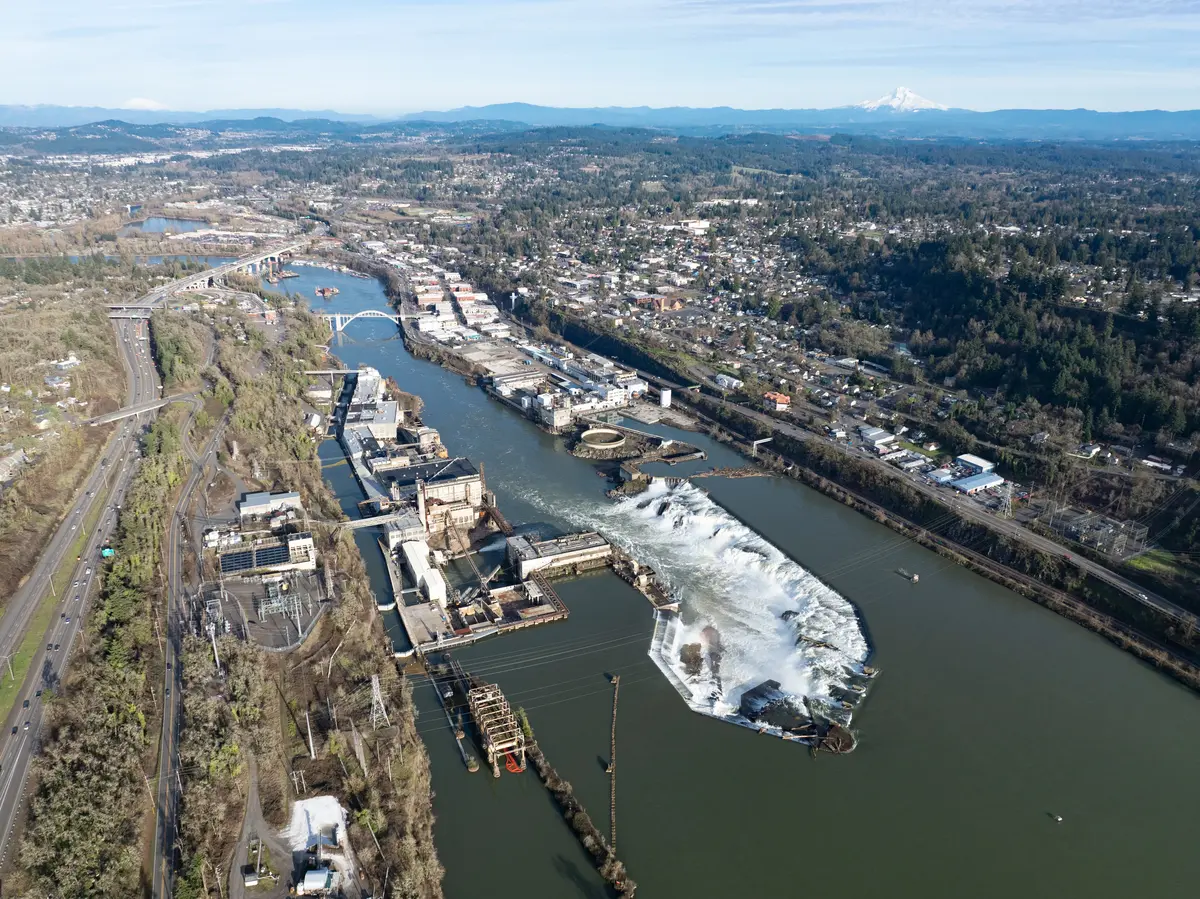
Willamette Falls itself, the 40-foot waterfall that defines the city's eastern edge, is the kind of landmark that takes a while to stop noticing. The Willamette Falls Locks alongside it — the oldest multi-chambered bypass canal and navigation lock system in America, opened in 1873 and closed since 2011 — are in an active, phased restoration. The U.S. Army Corps of Engineers has completed seismic upgrades, and the Willamette Falls Locks Authority is pursuing ownership transfer using previously allocated funds, though the Oregon Legislature ended its 2025 session without passing the $11.4 million needed to complete the project. The timeline remains in flux, but the corridor is genuinely being invested in, and the broader Willamette Falls waterfront is an active area of civic and economic renewal.
The texture of a West Linn weekend looks like this for most residents: a trail run before the kids are up, a coffee in the Willamette District, a farmers market stop in the warmer months, and a dinner out without getting in the car for more than five minutes. That is the rhythm the city sells, and it is the rhythm most of its residents are actually living.
Local Expert Takeaway: West Linn surprises California buyers in two directions at once: the home price is closer to what they left than they expected, and the day-to-day cost of living is lower than they feared. The tax math is genuinely nuanced — no sales tax is real money back every month, but Oregon's compressed income tax brackets bite earlier than California's do for six-figure earners. The buyers who do best here come in with California equity, a clear-eyed view of a 144-sunny-days-a-year winter, and a real preference for trails, river access, and a smaller-city rhythm over the density and services they are giving up.
Quick Takeaways & FAQs
✅ West Linn's school district holds an A rating from Niche, with 8,617 students enrolled in 2025-26 — one of the strongest draws for families relocating from California.
⚠️ Oregon's income tax brackets compress quickly and often produce higher effective rates for six-figure earners than California's structure does, despite the lower top rate of 9.9% versus 13.3%.
📍 The Willamette Falls Locks — the oldest multi-chambered navigation lock system in America — are in active, phased restoration alongside the waterfront that defines West Linn's eastern edge.
Is West Linn actually cheaper than California?
How does Oregon's income tax compare to California's for a six-figure earner?
What is the property tax situation in West Linn compared to California?
What do California transplants find hardest about living in West Linn?
Which West Linn neighborhoods are most realistic for California buyers without outsized equity?
Moving to Oregon?
Tell us what you need help with and we'll connect you with local resources.
